Sci-tech innovations have revolutionized China's energy storage in materials, facilities and scenarios, expected to provide tech support for the development of new electricity networks.
The innovations were in the spotlight at the 13th Energy Storage International Conference and Expo (ESIE), which was held from last Thursday to Saturday in Beijing.
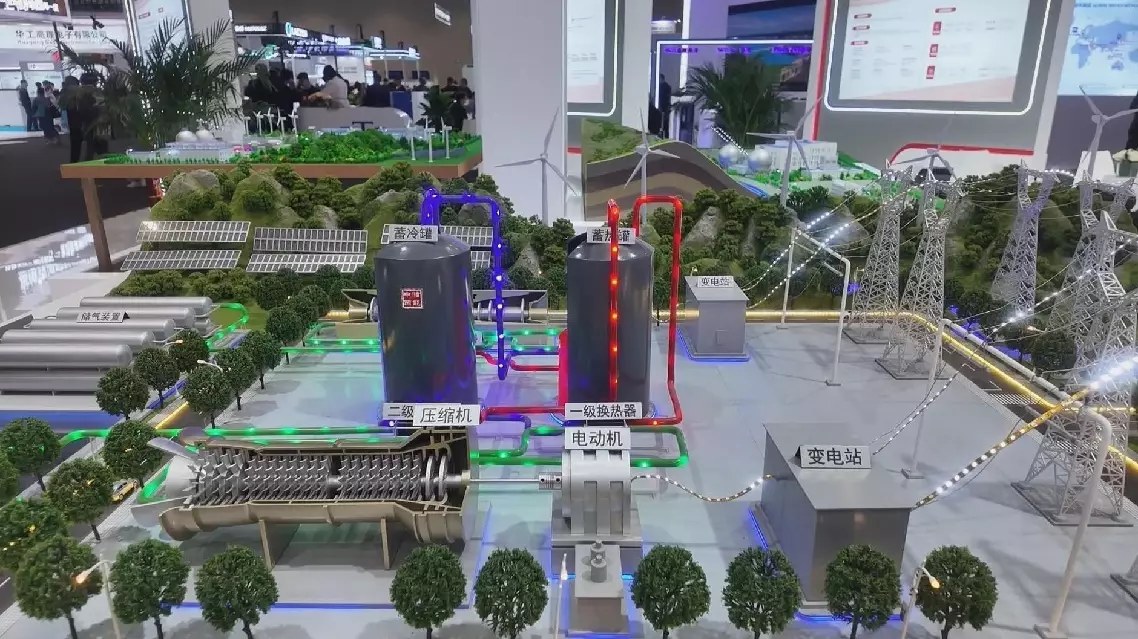
Among the exhibits were a type of energy storage cases, each boasting the world's largest individual storage capacity of eight megawatt hours, which could substantially reduce the operational costs for power stations. A compressed-air energy storage technology, featuring an energy transformation ratio of 70 percent, was also displayed at the event.
"This technology is characterized by its large scale, with a single unit being able to store more than 300 megawatts, and a capacity to store energy for 4 to 10 hours. Meanwhile, its service life is very long, 30 to 50 years," said Ji Lyu, president of Zhongchu Guoneng Technology Company that developed the technology.
The event also displayed China's first gigawatt-hour-level platform of new energy storage safety monitoring, which can inform technicians of the operational status at any time through accurate data collection information from more than 4.7 million observation points and second-level big data analysis based on 18 million algorithms.
"The accuracy rate of this algorithm is up to 97.6 percent. In case of abnormality of the equipment with some potential safety hazards, it can pre-warn the operation and maintenance personnel 15 minutes in advance to avoid accidents," said Chen Man, chief of the platform's research and development team and also deputy director of the Energy Storage Research Institute under China Southern Power Grid Energy Storage.
As the integration of artificial intelligence and energy storage industry has spawned more new application scenarios, a smart energy storage trading system shone at the event.
Equipped with built-in large AI trading model, it can forecast meteorological conditions and electricity prices, automatically generate trading strategies, and control strategy implementation.
Statistics show that China has seen a flourishing new energy storage industry, with the installed capacity up 126.5 percent year on year in 2024, and the cumulative installed capacity reaching 78.3 gigawatts.
In 2025, the newly installed capacity is expected to exceed 30 gigawatts, heralding a compound annual new installation growth of 100 percent during the 14th Five-Year Plan period (2021-2025), according to a whitepaper released at the 13th ESIE.
Now a full-fledged new energy storage industrial chain is taking shape in China, with electrochemical energy storage products like lithium batteries getting more affordable and efficient.
In 2024, China produced lithium batteries with a total capacity of 1,170 gigawatt hours, up 24 percent year on year and with the industrial value exceeding 1.2 trillion yuan.
"With a focus on enhanced safety, reliability, efficiency and service life, we will support the research and development of advanced energy storage technology and products, push for breakthroughs in solid state energy storage batteries and other fields, and advance the integration of new-generation information technology and new energy storage technology. We will encourage the application of new energy storage technology in the power sector, and promote the application of the wind-photovoltaic-storage model and the photovoltaic-storage-charging model," said Zhou Haiyan, an official from the Ministry of Industry and Information Technology.
Innovations revolutionize China's energy storage