CHEYENNE, Wyo.--(BUSINESS WIRE)--Apr 14, 2025--
Kraken, one of the longest standing and most secure cryptocurrency platforms, today announced the initial rollout of commission-free trading for over 11,000 U.S.-listed stocks and ETFs to clients in New Jersey, Connecticut, Wyoming, Oklahoma, Idaho, Iowa, Rhode Island, Kentucky, Alabama and the District of Columbia. A continuous, phased, national rollout to all eligible U.S. clients will follow.
This press release features multimedia. View the full release here: https://www.businesswire.com/news/home/20250414231716/en/
Kraken clients can now seamlessly manage stocks, crypto, cash and stablecoins, all in one place, on the Kraken mobile app, the Kraken Pro app or on Kraken Pro web.
Kraken also offers fractional trading on over half of listed assets, empowering clients to invest in the markets with greater flexibility. This allows traders to buy less than one full share of a high-priced stock, making partial ownership in a company more accessible.
The future of finance is advancing rapidly, as the integration of digital and traditional assets redefines investing. With this milestone, Kraken expands beyond crypto for the first time, allowing clients to easily buy stocks with U.S. dollars. This new ability to rotate between digital assets and stocks is powered by Kraken Securities LLC, a new FINRA-regulated division of the company.
“Crypto isn’t just evolving, it’s becoming the backbone for trading across asset classes, such as equities, commodities, and currencies. As demand for 24/7 global access grows, clients want a seamless, all-in-one trading experience.” said Arjun Sethi, Kraken’s Co-CEO. “Expanding into equities is a natural step for us, and paves the way for the tokenization of assets. The future of trading is borderless, always on, and built on crypto rails—and Kraken will continue to lead this shift.”
Kraken eventually plans to expand traditional securities trading to clients in the U.K., Europe, and Australia, while also introducing new features to enhance the trading experience.
For more information on Kraken’s U.S. stock and ETF investment offering, please visit our U.S. equities homepage.
About Kraken
Kraken is one of the world’s longest-standing and most secure crypto platforms. Our mission is to accelerate the global adoption of crypto, so that everyone can achieve financial freedom and inclusion. Globally, Kraken clients trade more than 300 digital assets and 6 different national currencies, including GBP, EUR, USD, CAD, CHF, and AUD.
Founded in 2011, Kraken was among the first to offer spot trading with margin, parachain auctions, staking, regulated derivatives and index services under one roof. With millions of individuals, traders and institutions around the world, Kraken offers professional 24/7/365 client support along with one of the fastest, most performant trading platforms available. Kraken has set the industry standard for transparency and client trust, and was the first crypto platform to conduct Proof of Reserves.
Kraken markets can be monitored and traded via the web or through the Kraken and Kraken Pro iOS and Android apps.
For more information about Kraken, please visit www.kraken.com.
Currently available in the U.S. only; may not be available in all states. Brokerage services are provided by Kraken Securities LLC, member FINRA/SIPC. Please view the firm’s profile, registration and background of our registered reps onhttps://brokercheck.finra.org/. Digital asset services offered by Payward Interactive, not a member of FINRA/ SIPC and not FDIC insured. This is not an offer, solicitation, inducement or advice to buy or sell securities, or open a brokerage account in any jurisdiction where Kraken Securities is not registered. All trading involves risk, including loss of your investments. View full disclosures at:Equities DisclosuresandCrypto Risk Disclosures.

Kraken Launches U.S.-Listed Stock & ETF Trading, Expanding Beyond Crypto
SEOUL, South Korea (AP) — North Korea likely planted the land mines that exploded and injured three South Korean soldiers at the country’s heavily-armed border last week, South Korea’s military said Monday, a finding that could further inflame tensions between the rivals.
The South’s Joint Chiefs of Staff announced the preliminary finding after inspecting the site with the U.S.-led United Nations Command.
Relations between the Koreas have deteriorated sharply in recent years amid North Korea’s accelerating nuclear weapons program and the collapse of U.S.-led diplomacy aimed at resolving the nuclear standoff.
Three South Korean military officers were injured in two consecutive explosions Sept. 21 near the military demarcation line (MDL) in the western section of the Demilitarized Zone (DMZ), a heavily fortified border buffer zone between the Koreas.
The explosions occurred during an operation to establish a patrol route through an area that had rarely been visited for decades, officials said. The route was intended to allow future inspections with the U.N. Command after South Korea detected “terrain changes” last year that may have resulted from North Korean mine-laying.
South Korean officials initially said the blasts appeared to have been caused by mines but did not attribute them to North Korea.
Kwon Dae-won, vice chairman of South Korea’s Joint Chiefs of Staff, said there was a “very high possibility” that North Korean mines caused the explosions, which occurred about 10 meters (11 yards) south from the military demarcation line.
He said there was no record of South Korean or allied forces laying mines in the densely vegetated area. Blast marks, debris and what appeared to be a third suspected North Korean mine at the scene also pointed to the North, he said.
If the final investigation reaches the same conclusion, Kwon said: “We will hold North Korea fully responsible for this. Our military will take appropriate and corresponding measures.” He did not elaborate.
North Korea has denied responsibility for numerous previous incidents blamed on it by Seoul and described the allegations as plots to stir anti-Pyongyang sentiment.
The latest incident came more than a decade after South Korea blamed the North for land mine explosions that maimed two South Korean soldiers and sharply raised tensions between the countries in August 2015.
The Joint Chiefs of Staff said forensic analysis detected TNT and unidentified brown substances on a bulletproof helmet, protective vests and rifles belonging to soldiers involved in the operation. The absence of metal fragments or shrapnel indicated that South Korean or allied mines did not cause the explosions, it said.
The blasts occurred after the battalion commander leading the 18-member team decided to end the mission and withdraw because the unit was too close to the demarcation line, the Joint Chiefs said.
The first explosion occurred as a soldier stepped forward while the team prepared to withdraw. A second followed shortly afterward as the commander and an intelligence officer approached the wounded soldier.
Some soldiers said they saw what appeared to be a third North Korean mine as they withdrew to a safe area, from which the troops were airlifted for treatment and medical examinations.
The DMZ, which is 248 kilometers (155 miles) long and 4 kilometers (2.5 miles) wide, is one of the world’s most heavily fortified borders. An estimated 2 million mines are buried in and around the zone, which is also guarded by barbed-wire fences, tank traps and combat troops on both sides.
The zone is a legacy of the 1950-53 Korean War, which ended with an armistice rather than a peace treaty.
In recent months, North Korea has added mines, anti-tank barriers and other front-line fortifications. The activity has fueled concern in South Korea about the growing presence of North Korean soldiers near the DMZ.
South Korea fired warning shots in April 2025 after a group of North Korean soldiers crossed the demarcation line in the eastern section of the DMZ. The soldiers retreated after South Korea broadcast audio warnings and fired the shots, and there was no exchange of fire.
In June 2024, North Korean troops crossed the border three times, prompting South Korea to fire warning shots.
North Korean mines have occasionally been carried into South Korea by swollen rivers, killing or injuring civilians.
After the 2015 mine explosions, the Koreas traded threats, staged weapons demonstrations and resumed border propaganda broadcasts. Days of talks eventually pulled them back from the brink. North Korea issued a vague expression of regret over the soldiers’ injuries without clearly accepting responsibility.
Last week's explosions came as South Korea’s liberal government sought to help revive diplomacy between Pyongyang and Washington as part of broader efforts to reduce tensions on the Korean Peninsula.
Since early 2024, North Korea has taken an increasingly hard-line stance toward South Korea, declaring its neighbor a permanent enemy and moving to abandon the concept of shared statehood in favor of a hostile “two-state” system.
North Korea has intensified tensions with a series of military displays this month, including short-range ballistic missile launches, live-fire missile and artillery exercises, and the commissioning of a new warship. Leader Kim Jong Un has continued to showcase his expanding nuclear program despite U.S. calls to revive diplomacy.
Last month, U.S. President Donald Trump scaled back a major military exercise with South Korea in an apparent effort to restart diplomacy with Kim, who views such drills as rehearsals for invasion.
North Korea has so far rebuffed Trump’s outreach. It says Washington must first abandon its “hostile policy” — a term Pyongyang mainly uses to describe U.S.-led sanctions and joint U.S.-South Korean military exercises — and drop denuclearization as a precondition for talks.
— AP writer Hyung-jin Kim contributed to this report.
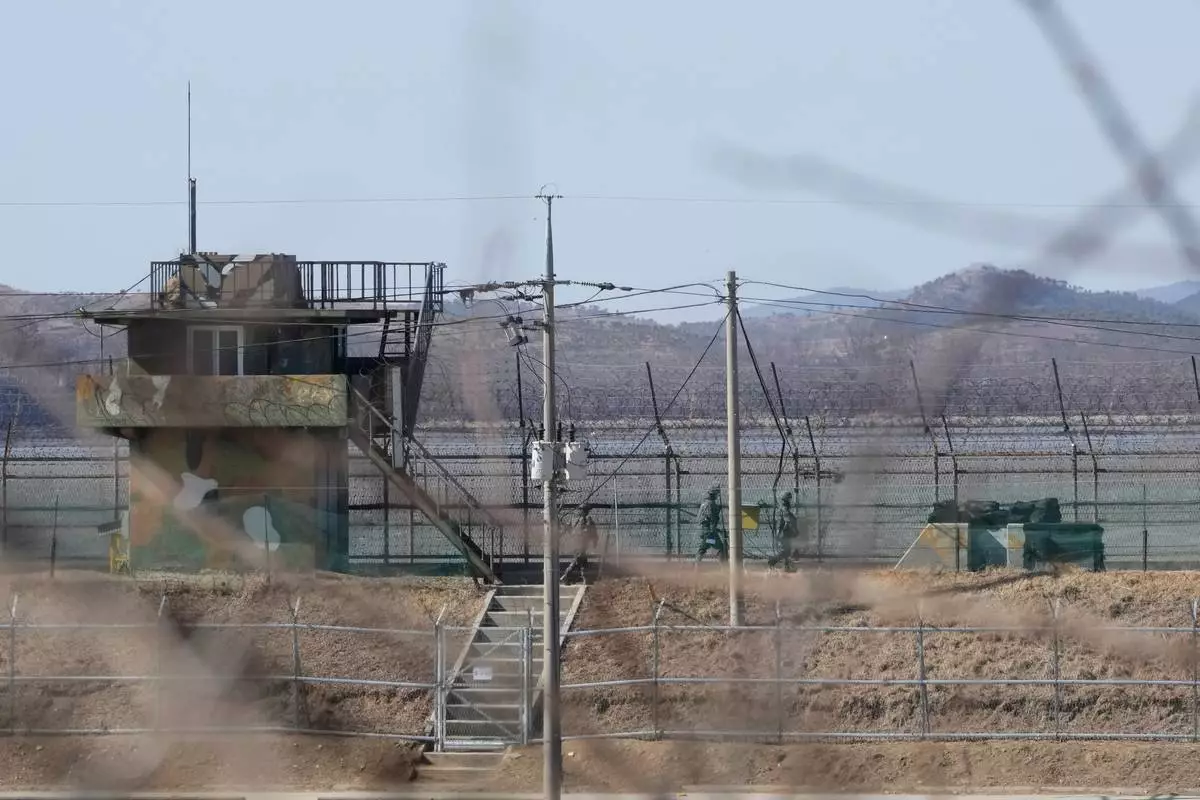
FILE - South Korean army soldiers patrol along the barbed-wire fence in Paju, South Korea, near the border with North Korea, on Feb. 18, 2025. (AP Photo/Ahn Young-joon, File)