Skip to Content Facebook Feature Image

Visa cancellations sow panic for international students, with more than 1,000 fearing deportation

News

Visa cancellations sow panic for international students, with more than 1,000 fearing deportation
News

News

Visa cancellations sow panic for international students, with more than 1,000 fearing deportation

2025-04-18 00:57 Last Updated At:01:11

WASHINGTON (AP) — At first, the bar association for immigration attorneys began receiving inquiries from a couple students a day. These were foreigners studying in the U.S., and they'd discovered in early April their legal status had been terminated with little notice. To their knowledge, none of the students had committed a deportable offense.

In recent days, the calls have begun flooding in. Hundreds of students have been calling to say they have lost legal status, seeking advice on what to do next.

“We thought it was going to be something that was unusual,” said Matthew Maiona, a Boston-based immigration attorney who is getting about six calls a day from panicked international students. “But it seems now like it’s coming pretty fast and furious.”

The speed and scope of the federal government's efforts to terminate the legal status of international students have stunned colleges across the country. Few corners of higher education have been untouched, as schools ranging from prestigious private universities, large public research institutions and tiny liberal arts colleges discover status terminations one after another among their students.

At least 1,024 students at 160 colleges, universities and university systems have had their visas revoked or their legal status terminated since late March, according to an Associated Press review of university statements, correspondence with school officials and court records. Advocacy groups collecting reports from colleges say hundreds more students could be caught up in the crackdown.

Around 1.1 million international students were in the United States last year — a source of essential revenue for tuition-driven colleges. International students are not eligible for federal financial aid, and their ability to pay tuition often factors into whether they will be admitted to American schools. Often, they pay full price.

Many of the students losing their legal status are from India and China, which together account for more than half the international students at American colleges. But the terminations have not been limited to those from any one part of the world, lawyers said.

Four students from two Michigan universities are suing Trump administration officials after their F-1 student status was terminated last week. Their attorney with the American Civil Liberties Union, Ramis Wadood, said the students never received a clear reason why.

“We don’t know, and that’s the scary part,” he said.

The students were informed of the status terminations by their universities via email, which came as a shock, Wadood said. The reason given was that there was a “criminal records check and/or that their visa was revoked,” Wadood said, but none of them were charged or convicted of crimes. Some had either speeding or parking tickets, but one didn’t have any, he said. Only one of the students had known their entry visa was revoked, Wadood said.

Last month, Secretary of State Marco Rubio said the State Department was revoking visas held by visitors who were acting counter to national interests, including some who protested Israel's war in Gaza and those who face criminal charges.

But many students say they don't fall under those categories. Students have filed lawsuits in several states, arguing they were denied due process.

In New Hampshire, a federal judge last week granted a temporary restraining order to restore the status of a Ph.D. student at Dartmouth College, Xiaotian Liu. On Tuesday, a federal judge in Wisconsin issued a similar order, ruling the government could not take steps to detain or revoke the visa of a University of Wisconsin-Madison gradate student.

Two graduate students at Montana State University, Bozeman, on Tuesday were granted a temporary restraining order by a federal judge in Montana, restoring their terminated legal status and shielding them from efforts to remove them from the U.S.

At many colleges, officials learned the legal immigration status of some international students had been terminated when staff checked a database managed by the Department of Homeland Security. In the past, college officials say, legal statuses typically were updated after colleges told the government the students were no longer studying at the school.

The system to track enrollment and movements of international students came under the control of Immigration and Customs Enforcement after 9/11, said Fanta Aw, CEO of NAFSA, an association of international educators. She said recent developments have left students fearful of how quickly they can be on the wrong side of enforcement.

“You don’t need more than a small number to create fear,” Aw said. “There’s no clarity of what are the reasons and how far the reach of this is.”

Her group says as many as 1,300 students have lost visas or had their status terminated, based on reports from colleges.

The Department of Homeland Security and State Department did not respond to messages seeking comment.

Foreigners who are subject to removal proceedings are usually sent a notice to appear in immigration court on a certain date, but lawyers say affected students have not received any notices, leaving them unsure of next steps to take.

Some schools have told students to leave the country to avoid the risk of being detained or deported. But some students have appealed the terminations and stayed in the United States while those are processed.

Still others caught in legal limbo aren't students at all. They had remained in the U.S. post-graduation on “optional practical training,” a one-year period — or up to three for science and technology graduates — that allows employment in the U.S. after completing an academic degree. During that time, a graduate works in their field and waits to receive their H-1B or other employment visas if they wish to keep working in the U.S.

Around 242,000 foreigners in the U.S. are employed through this “optional practical training.” About 500,000 are pursuing graduate degrees, and another 342,000 are undergraduate students.

Among the students who have filed lawsuits is a Georgia Tech Ph.D. student who is supposed to graduate on May 5, with a job offer to join the faculty. His attorney Charles Kuck said the student was likely targeted for termination because of an unpaid traffic fine from when the student lent his car to a friend. Ultimately, the violation was dismissed.

“We have case after case after case exactly like that, where there is no underlying crime,” said Kuck, who is representing 17 students in the federal lawsuit. He said his law firm has heard from hundreds of students.

“These are kids who now, under the Trump administration, realize their position is fragile,” he said. “They’ve preyed on a very vulnerable population. These kids aren’t hiding. They’re in school.”

Some international students have been adapting their daily routines.

A Ph.D. student from China at University of North Carolina at Chapel Hill said she has begun carrying around her passport and immigration paperwork at the advice of the university’s international student office. The student, who spoke on condition of anonymity for fear of being targeted by authorities, said she has been distressed to see the terminations even for students like her without criminal records.

Seminera reported from Raleigh, N.C., and Keller reported from Albuquerque, N.M.

The Associated Press’ education coverage receives financial support from multiple private foundations. AP is solely responsible for all content. Find AP’s standards for working with philanthropies, a list of supporters and funded coverage areas at AP.org.
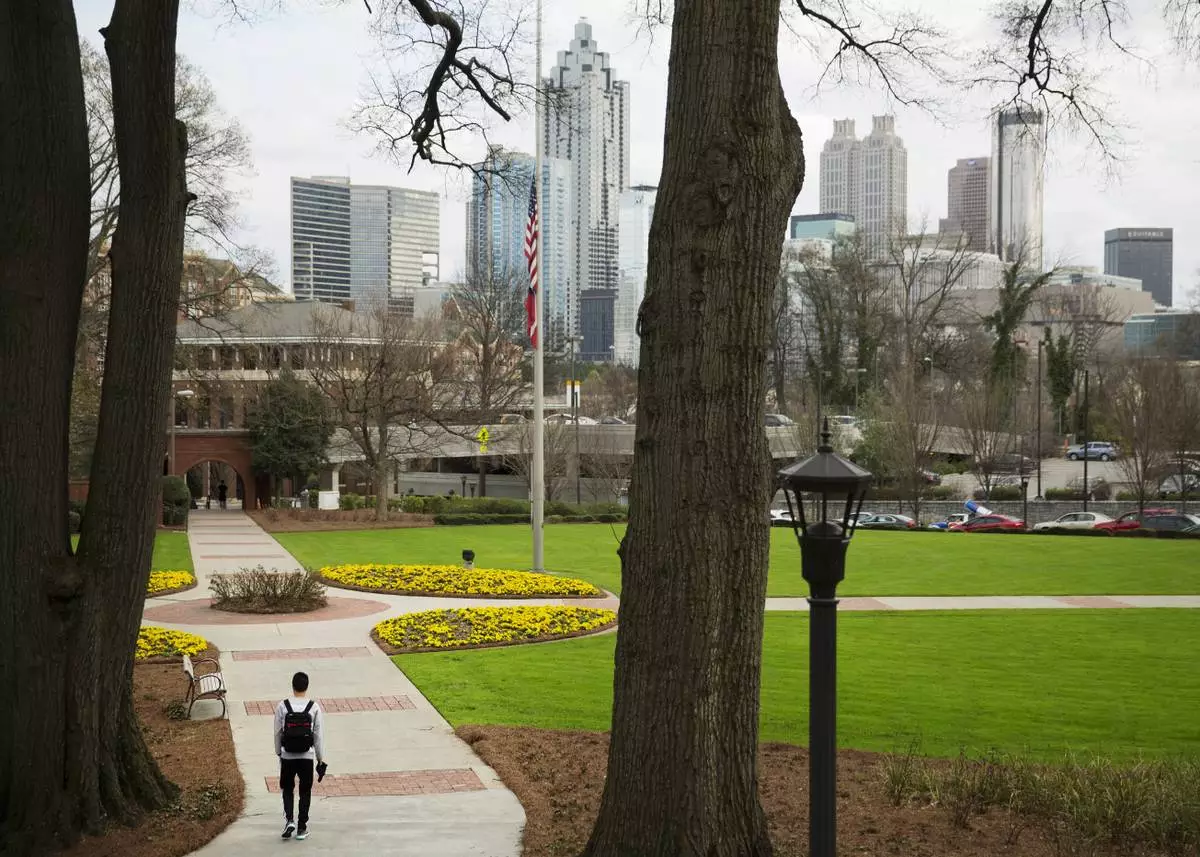
FILE - A person walks through the Georgia Tech campus with the downtown skyline in the background, March 11, 2016, in Atlanta. (AP Photo/David Goldman, File)
FILE - A person walks through the Georgia Tech campus with the downtown skyline in the background, March 11, 2016, in Atlanta. (AP Photo/David Goldman, File)
WASHINGTON (AP) — Becky Pepper-Jackson finished third in the discus throw in West Virginia last year though she was in just her first year of high school. Now a 15-year-old sophomore, Pepper-Jackson is aware that her upcoming season could be her last.

West Virginia has banned transgender girls like Pepper-Jackson from competing in girls and women's sports, and is among the more than two dozen states with similar laws. Though the West Virginia law has been blocked by lower courts, the outcome could be different at the conservative-dominated Supreme Court, which has allowed multiple restrictions on transgender people to be enforced in the past year.

The justices are hearing arguments Tuesday in two cases over whether the sports bans violate the Constitution or the landmark federal law known as Title IX that prohibits sex discrimination in education. The second case comes from Idaho, where college student Lindsay Hecox challenged that state's law.

Decisions are expected by early summer.

President Donald Trump's Republican administration has targeted transgender Americans from the first day of his second term, including ousting transgender people from the military and declaring that gender is immutable and determined at birth.

Pepper-Jackson has become the face of the nationwide battle over the participation of transgender girls in athletics that has played out at both the state and federal levels as Republicans have leveraged the issue as a fight for athletic fairness for women and girls.

“I think it’s something that needs to be done,” Pepper-Jackson said in an interview with The Associated Press that was conducted over Zoom. “It’s something I’m here to do because ... this is important to me. I know it’s important to other people. So, like, I’m here for it.”

She sat alongside her mother, Heather Jackson, on a sofa in their home just outside Bridgeport, a rural West Virginia community about 40 miles southwest of Morgantown, to talk about a legal fight that began when she was a middle schooler who finished near the back of the pack in cross-country races.

Pepper-Jackson has grown into a competitive discus and shot put thrower. In addition to the bronze medal in the discus, she finished eighth among shot putters.

She attributes her success to hard work, practicing at school and in her backyard, and lifting weights. Pepper-Jackson has been taking puberty-blocking medication and has publicly identified as a girl since she was in the third grade, though the Supreme Court's decision in June upholding state bans on gender-affirming medical treatment for minors has forced her to go out of state for care.

Her very improvement as an athlete has been cited as a reason she should not be allowed to compete against girls.

“There are immutable physical and biological characteristic differences between men and women that make men bigger, stronger, and faster than women. And if we allow biological males to play sports against biological females, those differences will erode the ability and the places for women in these sports which we have fought so hard for over the last 50 years,” West Virginia's attorney general, JB McCuskey, said in an AP interview. McCuskey said he is not aware of any other transgender athlete in the state who has competed or is trying to compete in girls or women’s sports.

Despite the small numbers of transgender athletes, the issue has taken on outsize importance. The NCAA and the U.S. Olympic and Paralympic Committees banned transgender women from women's sports after Trump signed an executive order aimed at barring their participation.

The public generally is supportive of the limits. An Associated Press-NORC Center for Public Affairs Research poll conducted in October 2025 found that about 6 in 10 U.S. adults “strongly” or “somewhat” favored requiring transgender children and teenagers to only compete on sports teams that match the sex they were assigned at birth, not the gender they identify with, while about 2 in 10 were “strongly” or “somewhat” opposed and about one-quarter did not have an opinion.

About 2.1 million adults, or 0.8%, and 724,000 people age 13 to 17, or 3.3%, identify as transgender in the U.S., according to the Williams Institute at the UCLA School of Law.

Those allied with the administration on the issue paint it in broader terms than just sports, pointing to state laws, Trump administration policies and court rulings against transgender people.

"I think there are cultural, political, legal headwinds all supporting this notion that it’s just a lie that a man can be a woman," said John Bursch, a lawyer with the conservative Christian law firm Alliance Defending Freedom that has led the legal campaign against transgender people. “And if we want a society that respects women and girls, then we need to come to terms with that truth. And the sooner that we do that, the better it will be for women everywhere, whether that be in high school sports teams, high school locker rooms and showers, abused women’s shelters, women’s prisons.”

But Heather Jackson offered different terms to describe the effort to keep her daughter off West Virginia's playing fields.

“Hatred. It’s nothing but hatred,” she said. "This community is the community du jour. We have a long history of isolating marginalized parts of the community.”

Pepper-Jackson has seen some of the uglier side of the debate on display, including when a competitor wore a T-shirt at the championship meet that said, “Men Don't Belong in Women's Sports.”

“I wish these people would educate themselves. Just so they would know that I’m just there to have a good time. That’s it. But it just, it hurts sometimes, like, it gets to me sometimes, but I try to brush it off,” she said.

One schoolmate, identified as A.C. in court papers, said Pepper-Jackson has herself used graphic language in sexually bullying her teammates.

Asked whether she said any of what is alleged, Pepper-Jackson said, “I did not. And the school ruled that there was no evidence to prove that it was true.”

The legal fight will turn on whether the Constitution's equal protection clause or the Title IX anti-discrimination law protects transgender people.

The court ruled in 2020 that workplace discrimination against transgender people is sex discrimination, but refused to extend the logic of that decision to the case over health care for transgender minors.

The court has been deluged by dueling legal briefs from Republican- and Democratic-led states, members of Congress, athletes, doctors, scientists and scholars.

The outcome also could influence separate legal efforts seeking to bar transgender athletes in states that have continued to allow them to compete.

If Pepper-Jackson is forced to stop competing, she said she will still be able to lift weights and continue playing trumpet in the school concert and jazz bands.

“It will hurt a lot, and I know it will, but that’s what I’ll have to do,” she said.

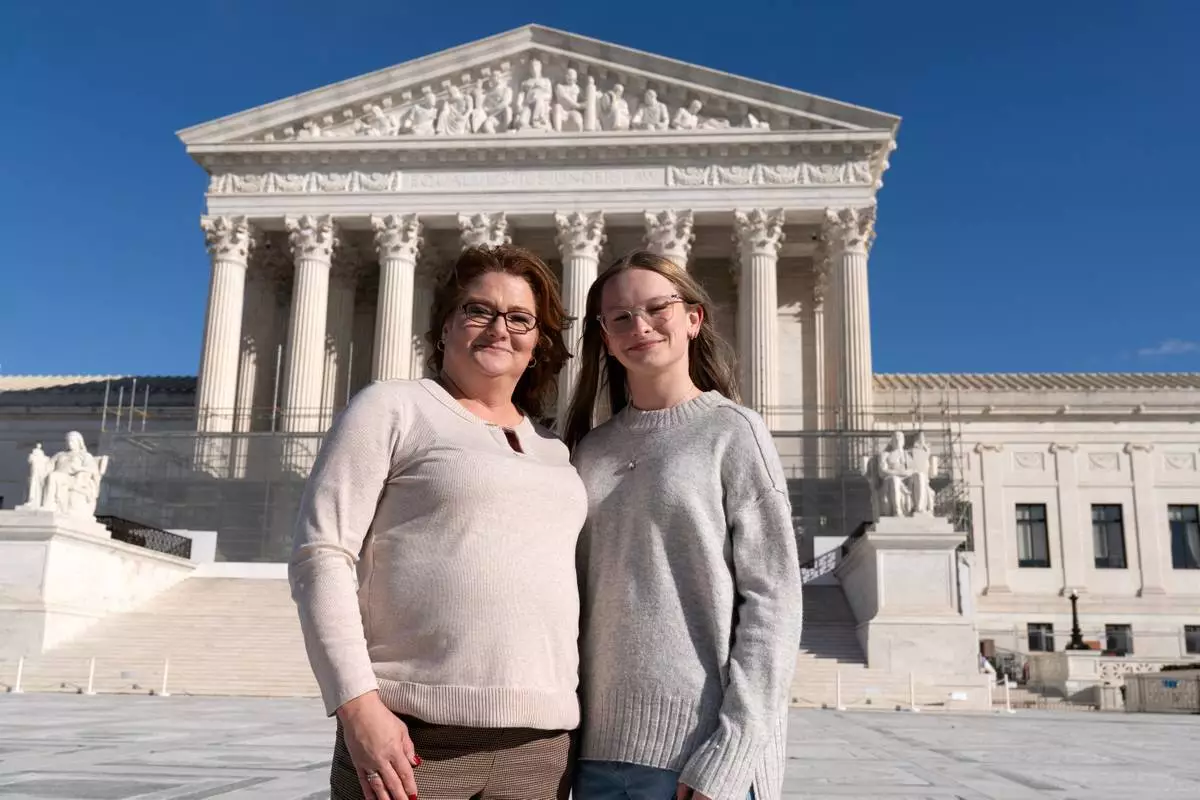
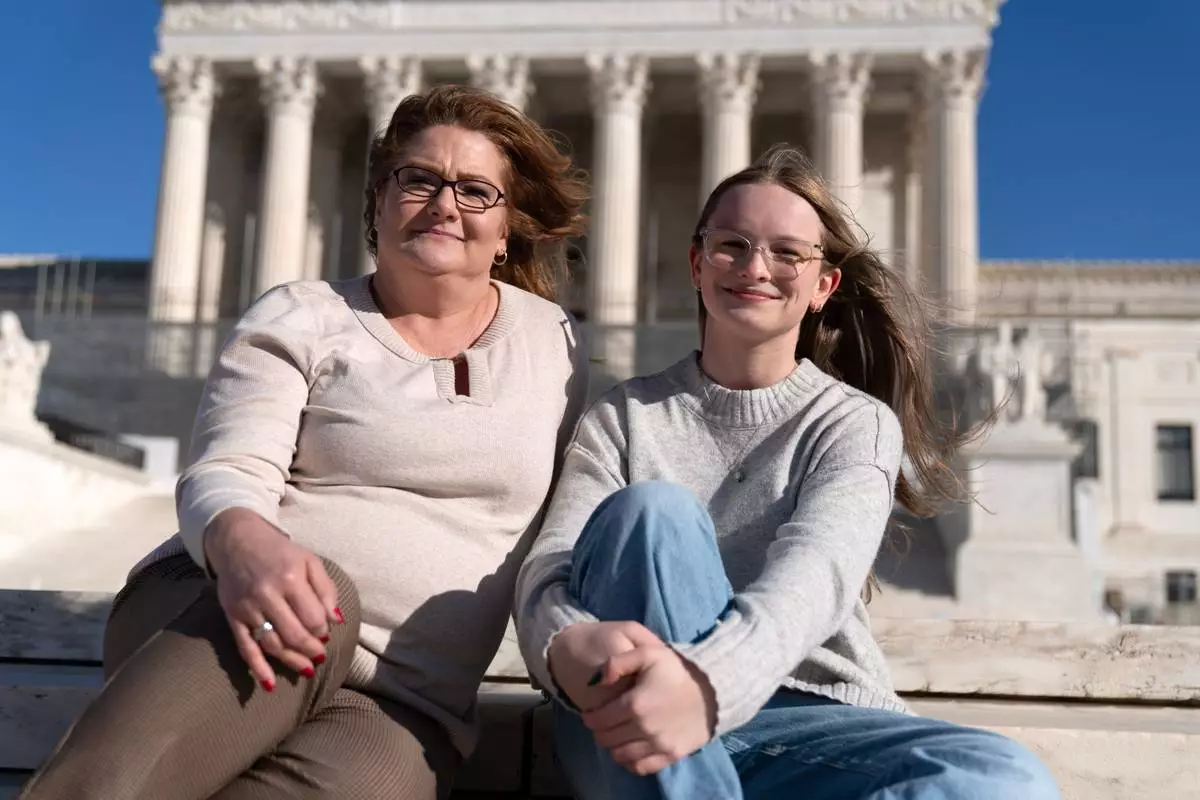
Heather Jackson, left, and Becky Pepper-Jackson pose for a photograph outside of the U.S. Supreme Court in Washington, Sunday, Jan. 11, 2026. (AP Photo/Jose Luis Magana)

Heather Jackson, left, and Becky Pepper-Jackson pose for a photograph outside of the U.S. Supreme Court in Washington, Sunday, Jan. 11, 2026. (AP Photo/Jose Luis Magana)

Heather Jackson, left, and Becky Pepper-Jackson pose for a photograph outside of the U.S. Supreme Court in Washington, Sunday, Jan. 11, 2026. (AP Photo/Jose Luis Magana)

Heather Jackson, left, and Becky Pepper-Jackson pose for a photograph outside of the U.S. Supreme Court in Washington, Sunday, Jan. 11, 2026. (AP Photo/Jose Luis Magana)

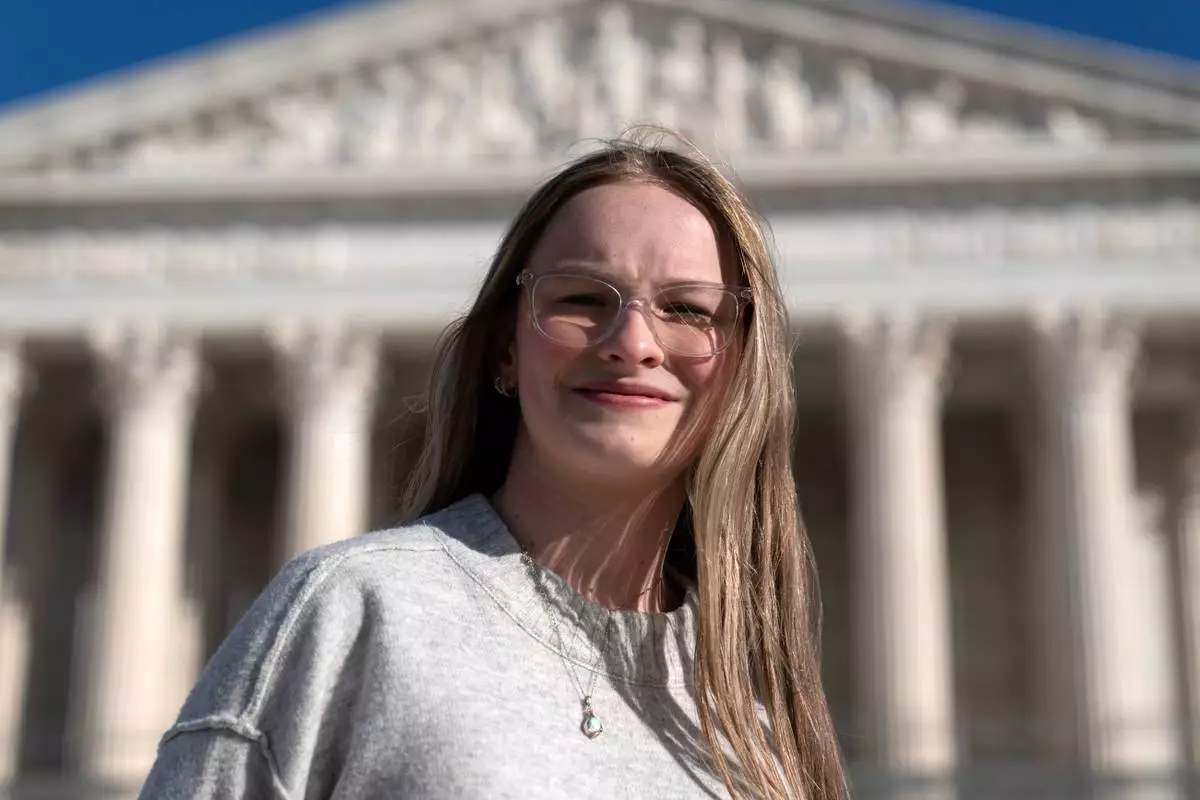
Becky Pepper-Jackson poses for a photograph outside of the U.S. Supreme Court in Washington, Sunday, Jan. 11, 2026. (AP Photo/Jose Luis Magana)

Becky Pepper-Jackson poses for a photograph outside of the U.S. Supreme Court in Washington, Sunday, Jan. 11, 2026. (AP Photo/Jose Luis Magana)

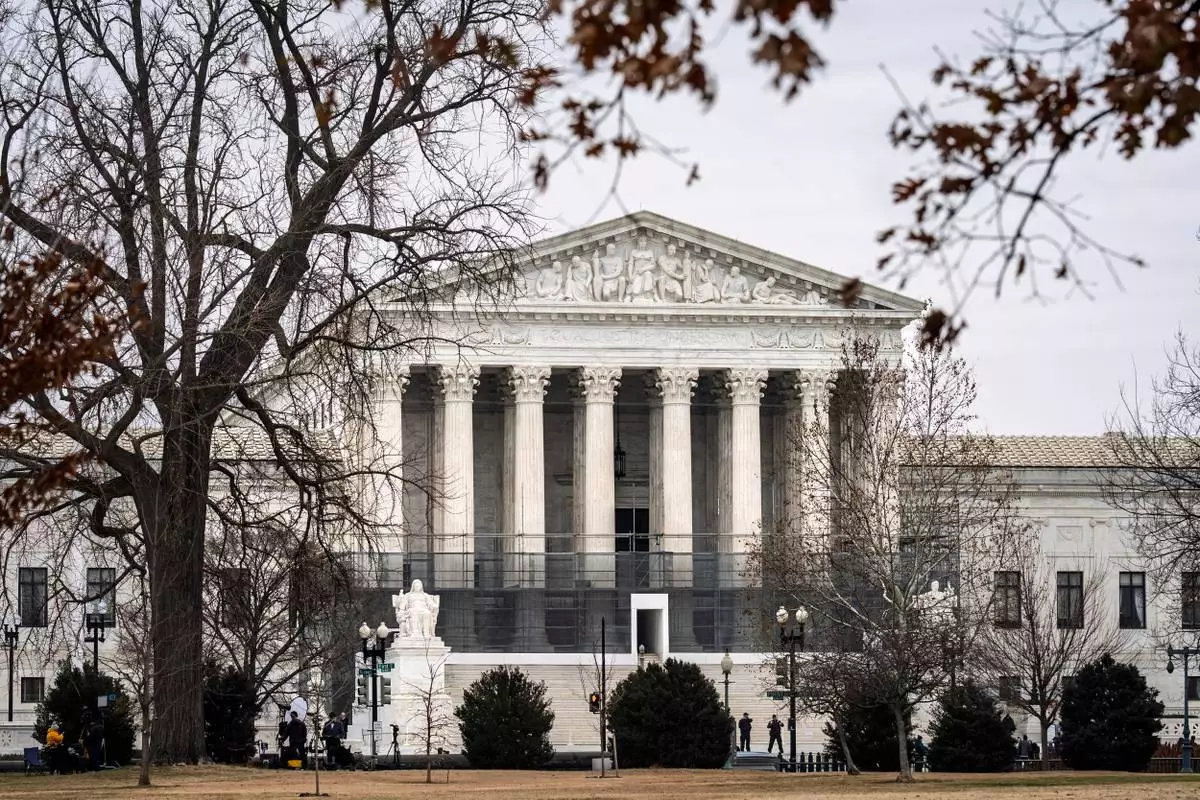
The Supreme Court stands is Washington, Friday, Jan. 9, 2026. (AP Photo/J. Scott Applewhite)

The Supreme Court stands is Washington, Friday, Jan. 9, 2026. (AP Photo/J. Scott Applewhite)

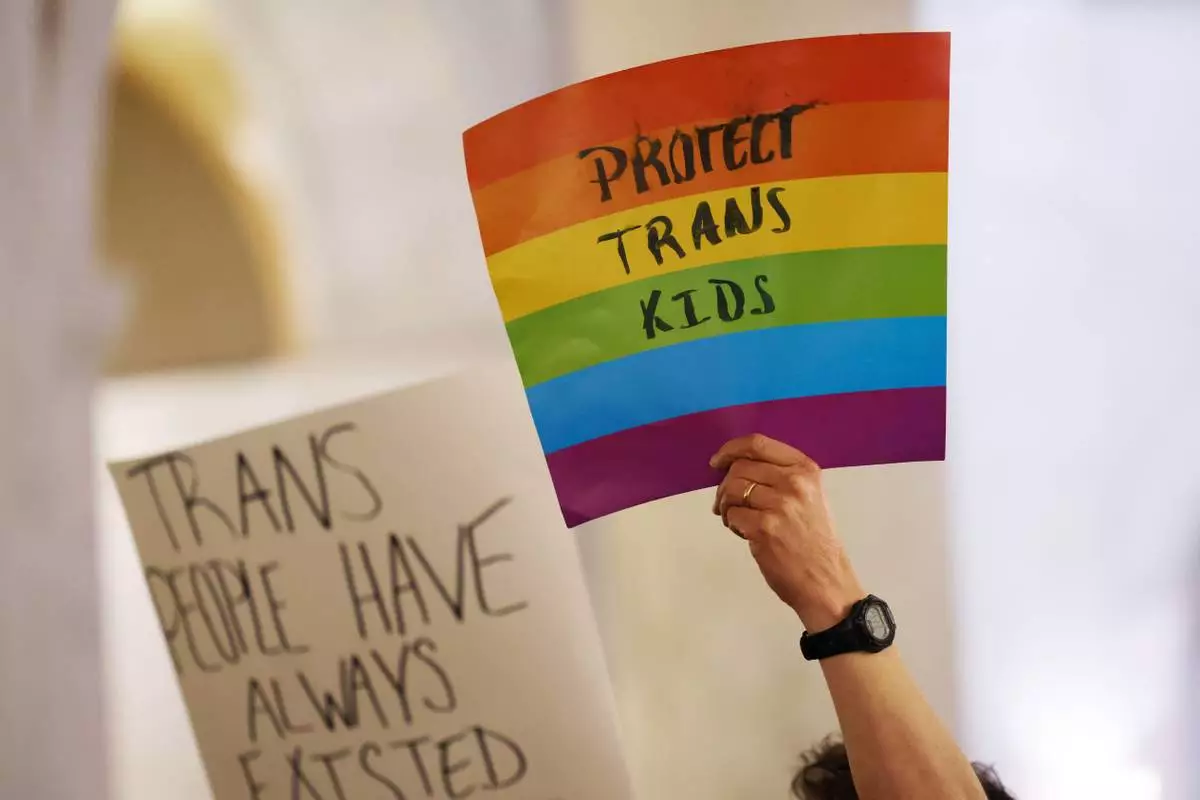
FILE - Protestors hold signs during a rally at the state capitol in Charleston, W.Va., on March 9, 2023. (AP Photo/Chris Jackson, file)

FILE - Protestors hold signs during a rally at the state capitol in Charleston, W.Va., on March 9, 2023. (AP Photo/Chris Jackson, file)

Recommended Articles