The U.S. Army Corps of Engineers has decided to fast-track permits for building a protective tunnel around an aging Enbridge oil pipeline that runs beneath a channel connecting two Great Lakes, stoking environmentalists' fears that the project will escape scrutiny, damage the sensitive region and perpetuate fossil fuel use.
The move comes after President Donald Trump issued an executive order in January declaring that the U.S. has become too dependent on foreign energy sources. The order mandates that federal agencies identify energy infrastructure projects for expedited emergency permitting from the U.S. Army Corps of Engineers and the Environmental Protection Agency.
The corps designated the tunnel project on Line 5 as an emergency under the order late Tuesday. The corps had initially planned to make a permitting decision early next year. Corps officials were vague during a conference call with reporters Wednesday morning about how quickly the process may move forward.
The Detroit District's regulatory chief, Shane McCoy, said that the timeline will be “truncated" but didn't elaborate beyond saying no steps would be skipped and the process will result in “a very legally defensible, very well-informed decision.”
Multiple groups lined up to criticize the fast-track decision Wednesday, including the Sierra Club, environmental law firm Earthjustice and the Great Lakes Business Network, a coalition of businesses that works to protect the Great Lakes with sustainable business practices.
“The only energy ‘emergency’ the American people face is Trump's efforts to disregard clean air and water safeguards in order to rush through dirty, dangerous fossil fuel projects,” said Mahyar Sorour, director of the Sierra Club's Beyond Fossil Fuels Policy.
Enbridge spokesperson Ryan Duffy said in a statement Wednesday that Line 5 is “critical energy infrastructure” and the tunnel project is designed to “make a safe pipeline safer.” He noted that Enbridge first began applying for permits five years ago.
The pipeline runs through northern Wisconsin into Michigan's upper and lower peninsulas before terminating in Sarnia, Ontario, in Canada. Enbridge has used the pipeline since 1953 to transport crude oil and natural gas liquids between Superior, Wisconsin, and Sarnia. It currently moves about 23 million gallons (87 million liters) a day, according to Enbridge. Part of the pipeline runs beneath the Straits of Mackinac, a channel that connects Lake Michigan and Lake Huron.
Company officials maintain the aging pipeline is structurally sound. But concerns about a potentially catastrophic spill in the straits that could contaminate Lake Michigan and Lake Huron have been mounting since 2017, when Enbridge officials revealed engineers had known about gaps in the pipeline's coating in the straits for three years. Fears of a spill escalated in 2018 after a boat anchor damaged the line. The company reached an agreement in 2018 with then-Michigan Gov. Rick Snyder's administration to encase the line in a protective tunnel.
Enbridge wants to replace the section of pipeline beneath the straits and encase the segment in a new, 3.6-mile (5.8-kilometer) tunnel bored beneath the lakebed, according to an Army Corps summary of the proposal. An initial cost estimate in 2018 put the project’s price tag at $500 million.
Environmental groups, tribal nations and Democrats have spent the last five years filing lawsuits to remove the line from the straits. A Michigan appellate court ruled in February that state permits for the tunnel were properly issued. Separate lawsuits from Attorney General Dana Nessel and Gov. Gretchen Whitmer seeking to void the easement that allows the pipeline to run beneath the straits are still pending in state and federal court.
The lawsuits notwithstanding, Enbridge needs only approval from the Army corps and the Michigan Department of Environment, Great Lakes and Energy before it can begin tunnel construction.
Seven Native American tribes consulting with the corps about the tunnel project's potential impacts on their treaty rights have ended any discussions beyond impact on historic properties after learning the project would be fast-tracked. Tribal leaders said in a March letter to the corps that the corps has failed to include the risk of a spill in its analysis and has disregarded the project's effects on climate change.
Katie Otanez, regulatory project manager for the corps' Detroit District, said Wednesday that the corps continues to consult with 20 other tribes. She did not elaborate.
Enbridge is embroiled in a separate legal battle over Line 5 in Wisconsin. About 12 miles (19 kilometers) of the line runs across the Bad River Band of Lake Superior Chippewa's reservation. The tribe sued in 2019 to force Enbridge to remove the line from the reservation, arguing it's prone to a spill and easements allowing the company to operate on the reservation expired in 2013. A federal judge in 2023 gave the company three years to get the pipeline off the reservation.
Enbridge has proposed a 41-mile (66-kilometer) reroute around the reservation. The tribe has filed a lawsuit seeking to void state construction permits for the project and joined several other groups in challenging the permits through the state Department of Natural Resources' contested case process.
This story has been updated to correct that the pipeline carries 87 million liters of crude oil and natural gas liquids daily.
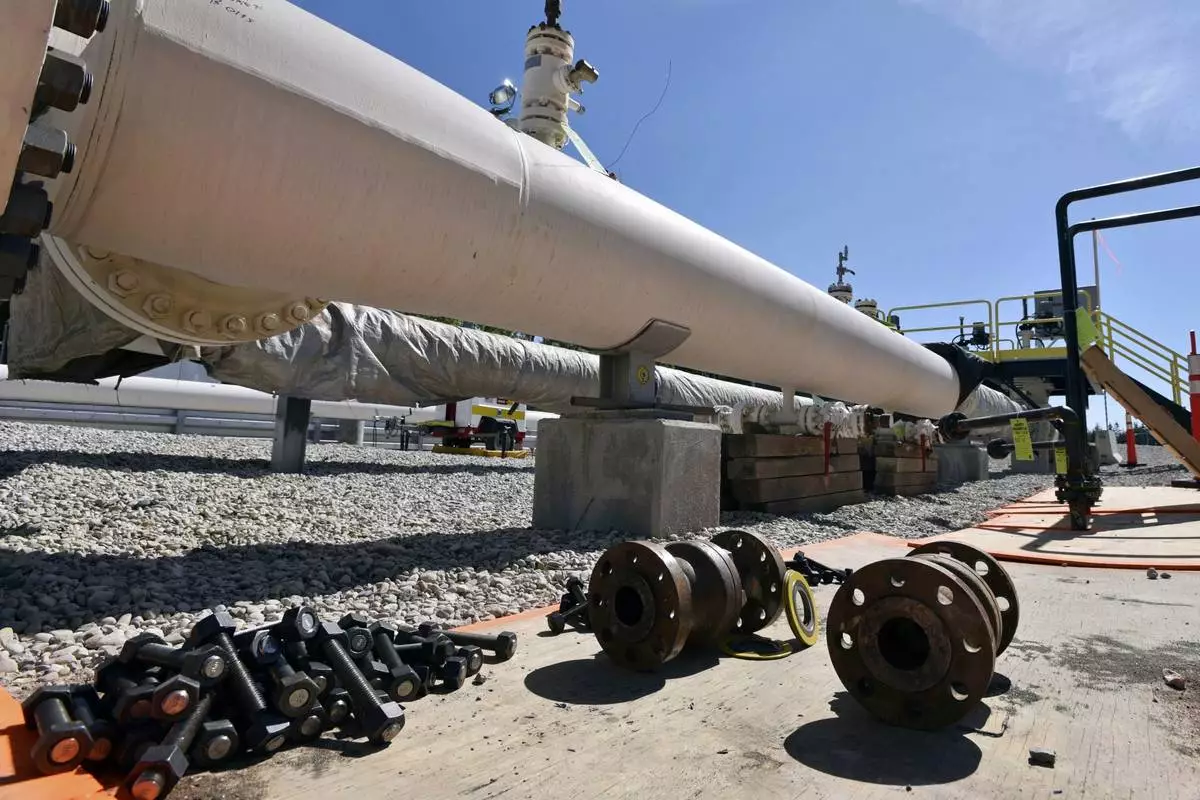
FILE - Nuts, bolts and fittings are shown near St. Ignace, Mich., ahead of work on the Line 5 pipeline, which runs beneath the Straits of Mackinac that connects Lake Michigan and Lake Huron, June 8, 2017. (Dale G Young/Detroit News via AP, File)
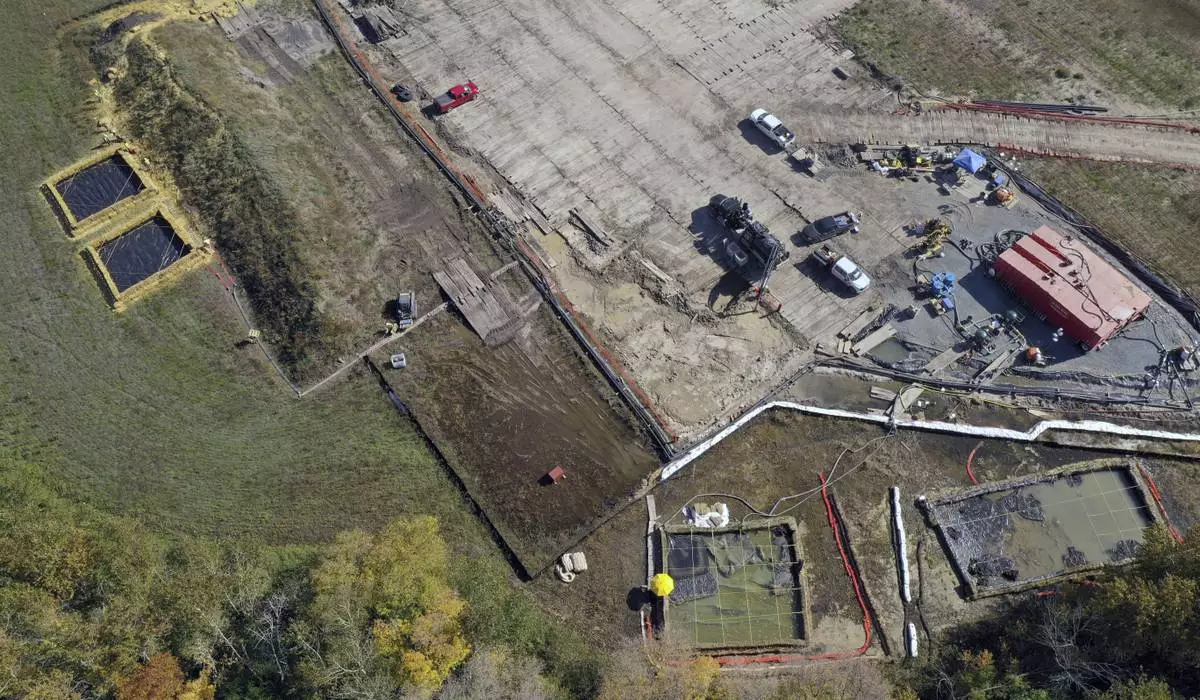
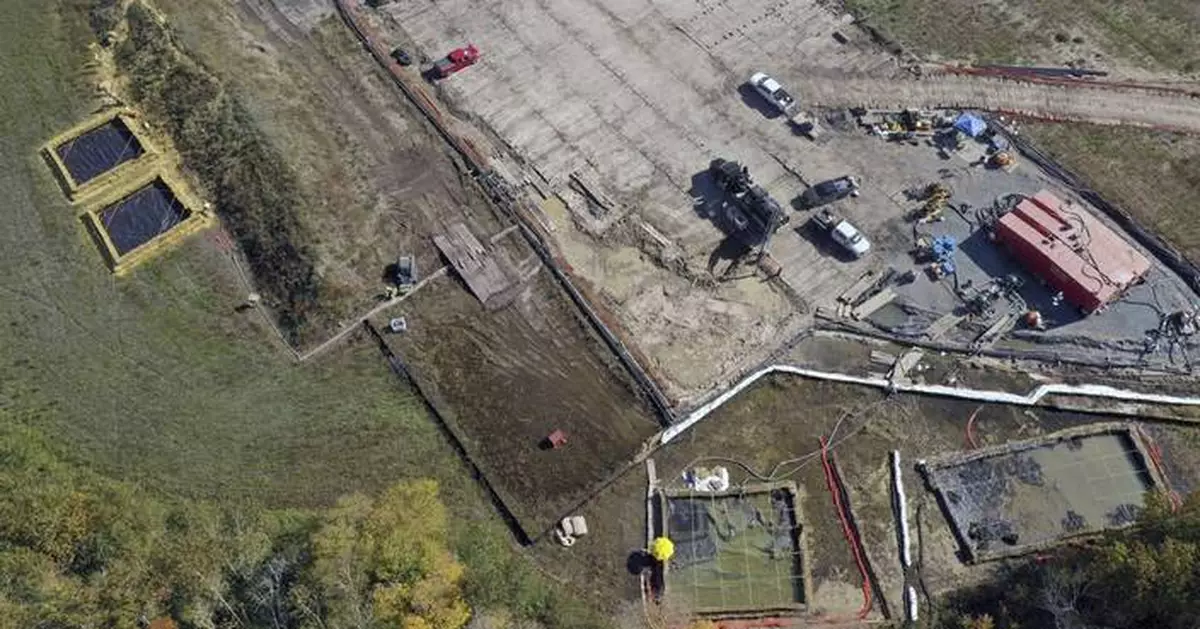
FILE - Crews prepare for remediation to temporarily reduce the confined aquifer pressure near Clearbrook, Minn., on Sept. 28, 2021. (Brian Peterson/Star Tribune via AP, file)
WASHINGTON (AP) — The Trump administration's criminal investigation of Federal Reserve Chair Jerome Powell appeared on Monday to be emboldening defenders of the U.S. central bank, who pushed back against President Donald Trump’s efforts to exert more control over the Fed.
The backlash reflected the overarching stakes in determining the balance of power within the federal government and the path of the U.S. economy at a time of uncertainty about inflation and a slowing job market. This has created a sense among some Republican lawmakers and leading economists that the Trump administration had overstepped the Fed's independence by sending subpoenas.
The criminal investigation — a first for a sitting Fed chair — sparked an unusually robust response from Powell and a full-throated defense from three former Fed chairs, a group of top economic officials and even Republican senators tasked with voting on Trump's eventual pick to replace Powell as Fed chair when his term expires in May.
White House press secretary Karoline Leavitt told reporters that Trump did not direct his Justice Department to investigate Powell, who has proven to be a foil for Trump by insisting on setting the Fed's benchmark interest rates based on the data instead of the president's wishes.
“One thing for sure, the president’s made it quite clear, is Jerome Powell is bad at his job,” Leavitt said. “As for whether or not Jerome Powell is a criminal, that’s an answer the Department of Justice is going to have to find out.”
The investigation demonstrates the lengths the Trump administration is willing to go to try to assert control over the Fed, an independent agency that the president believes should follow his claims that inflationary pressures have faded enough for drastic rate cuts to occur. Trump has repeatedly used investigations — which might or might not lead to an actual indictment — to attack his political rivals.
The risks go far beyond Washington infighting to whether people can find work or afford their groceries. If the Fed errs in setting rates, inflation could surge or job losses could mount. Trump maintains that an economic boom is occurring and rates should be cut to pump more money into the economy, while Powell has taken a more cautious approach in the wake of Trump's tariffs.
Several Republican senators have condemned the Department of Justice's subpoenas of the Fed, which Powell revealed Sunday and characterized as “pretexts” to pressure him to sharply cut interest rates. Powell also said the Justice Department has threatened criminal indictments over his June testimony to Congress about the cost and design elements of a $2.5 billion building renovation that includes the Fed's headquarters.
“After speaking with Chair Powell this morning, it’s clear the administration’s investigation is nothing more than an attempt at coercion,” said Sen. Lisa Murkowski, R-Alaska, on Monday.
Jeanine Pirro, U.S. attorney for the District of Columbia, said on social media that the Fed “ignored” her office’s outreach to discuss the renovation cost overruns, “necessitating the use of legal process — which is not a threat.”
“The word ‘indictment’ has come out of Mr. Powell’s mouth, no one else’s,” Pirro posted on X, although the subpoenas and the White House’s own statement about determining Powell's criminality would suggest the risk of an indictment.
A bipartisan group of former Fed chairs and top economists on Monday called the Trump administration's investigation “an unprecedented attempt to use prosecutorial attacks" to undermine the Fed's independence, stressing that central banks controlled by political leaders tend to produce higher inflation and lower growth.
“I think this is ham-handed, counter-productive, and going to set back the president’s cause,” said Jason Furman, an economist at Harvard and former top adviser to President Barack Obama. The investigation could also unify the Fed’s interest-rate setting committee in support of Powell, and means “the next Fed chair will be under more pressure to prove their independence.”
The subpoenas apply to Powell's statements before a congressional committee about the renovation of Fed buildings, including its marble-clad headquarters in Washington, D.C. They come at an unusual moment when Trump was teasing the likelihood of announcing his nominee this month to succeed Powell as the Fed chair and could possibly be self-defeating for the nomination process.
While Powell's term as chair ends in four months, he has a separate term as a Fed governor until January 2028, meaning that he could remain on the board. If Powell stays on the board, Trump could be blocked from appointing an outside candidate of his choice to be the chair.
Powell quickly found a growing number of defenders among Republicans in the Senate, who will have the choice of whether to confirm Trump's planned pick for Fed chair.
Sen. Thom Tillis, a North Carolina Republican and member of the Senate Banking panel, said late Sunday that he would oppose any of the Trump administration’s Fed nominees until the investigation is "resolved."
“If there were any remaining doubt whether advisers within the Trump Administration are actively pushing to end the independence of the Federal Reserve, there should now be none,” Tillis said.
Sen. Dave McCormick, R-Penn, said the Fed may have wasted public dollars with its renovation, but he said, “I do not think Chairman Powell is guilty of criminal activity.”
Senate Majority Leader John Thune offered a brief but stern response Monday about the tariffs as he arrived at the U.S. Capitol, suggesting that the administration needed “serious” evidence of wrongdoing to take such a significant step.
“I haven’t seen the case or whatever the allegations or charges are, but I would say they better, they better be real and they better be serious,” said Thune, a Republican representing South Dakota.
If Powell stays on the board after his term as chair ends, the Trump administration would be deprived of the chance to fill another seat that would give the administration a majority on the seven-member board. That majority could then enact significant reforms at the Fed and even block the appointment of presidents at the Fed's 12 regional banks.
“They could do a lot of reorganizing and reforms” without having to pass new legislation, said Mark Spindel, chief investment officer at Potomac River Capital and author of a book on Fed independence. “That seat is very valuable.”
Powell has declined at several press conferences to answer questions about his plans to stay or leave the board.
Scott Alvarez, former general counsel at the Fed, says the investigation is intended to intimidate Powell from staying on the board. The probe is occurring now “to say to Chair Powell, ’We’ll use every mechanism that the administration has to make your life miserable unless you leave the Board in May,'" Alvarez said.
Asked on Monday by reporters if Powell planned to remain a Fed governor, Kevin Hassett, director of the White House National Economic Council and a leading candidate to become Fed chair, said he was unaware of Powell’s plans.
“I’ve not talked to Jay about that,” Hassett said.
A bipartisan group of former Fed chairs and top economists said in their Monday letter that the administration’s legal actions and the possible loss of Fed independence could hurt the broader economy.
“This is how monetary policy is made in emerging markets with weak institutions, with highly negative consequences for inflation and the functioning of their economies more broadly,” the statement said.
The statement was signed by former Fed chairs Ben Bernanke, Janet Yellen, and Alan Greenspan, as well as former Treasury Secretaries Henry Paulson and Robert Rubin.
Still, Trump's pressure campaign had been building for some time, with him relentlessly criticizing and belittling Powell.
He even appeared to preview the shocking news of the subpoenas at a Dec. 29 news conference by saying he would bring a lawsuit against Powell over the renovation costs.
“He’s just a very incompetent man,” Trump said. “But we’re going to probably bring a lawsuit against him.”
__
AP writers Lisa Mascaro and Joey Cappelletti contributed to this report.
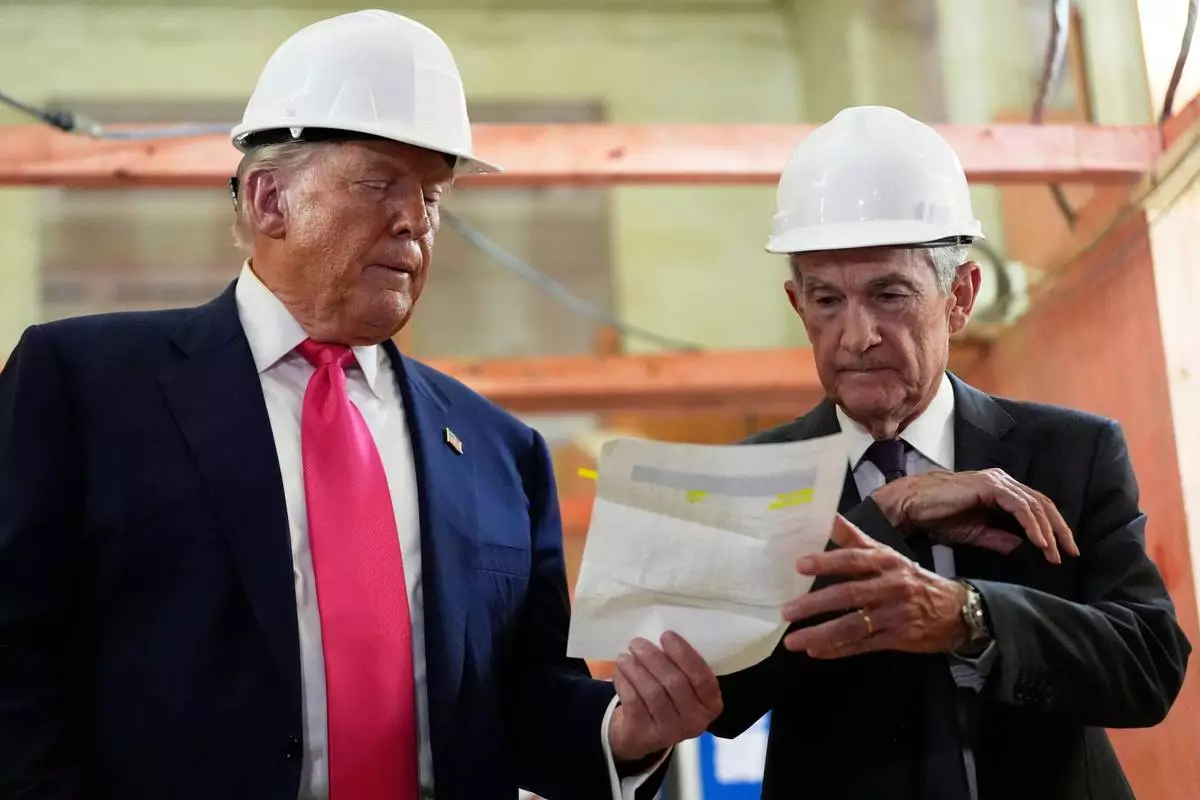
FILE - Federal Reserve Chairman Jerome Powell, right, and President Donald Trump look over a document of cost figures during a visit to the Federal Reserve, July 24, 2025, in Washington. (AP Photo/Julia Demaree Nikhinson, File)