Skip to Content Facebook Feature Image

Cambodia celebrates vibrant Khmer New Year with traditions, water festivities

China

China

China

Cambodia celebrates vibrant Khmer New Year with traditions, water festivities

2025-04-17 22:22 Last Updated At:04-18 00:37

Immersed in the joyous celebrations of the Khmer New Year, Cambodia celebrated its most significant festival this week, marked by family reunions, temple ceremonies, and exuberant water fights that symbolize washing away the past year's misfortunes.

The three-day festival, which began on Monday, coincides with the end of the harvest season and has brought to grand festivities to the entire nation as residents and visitors alike participate in time-honored traditions.

The festive period holds special significance this year as it witnesses a state visit by Chinese President Xi Jinping at the invite of King Norodom Sihamoni. The convergence highlights Cambodia's unique position where ancient traditions meet modern international connections.

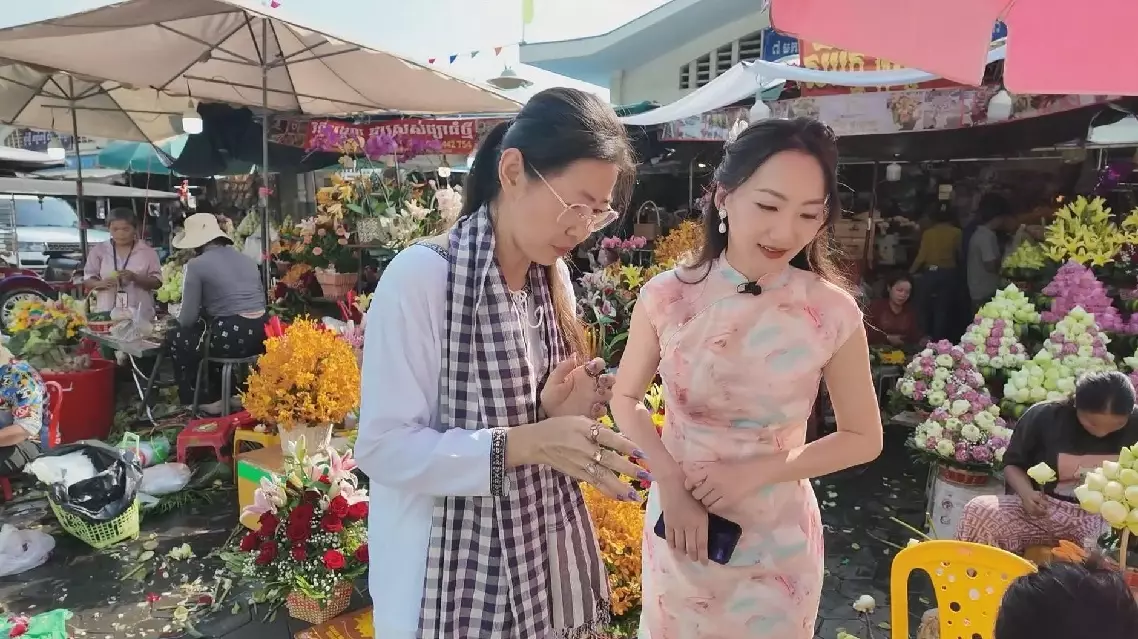
Phnom Penh's historic Central Market, established in 1937, has been buzzing with cross-cultural exchanges, as evidenced by many vendors fluent in Chinese.

Jewelry vendor Lek Mao Jr. has learned Chinese to serve the many shoppers visiting from China.

"So many Chinese customers come to shop, and I picked up Chinese from them," he said.

At the market, Chinese mobile payments like Alipay and WeChat Pay are accepted at some stalls.

During the holiday, the market is filled with locals and tourists eager to purchase lotus flowers, fruits and decorations for New Year rituals.

Engly Tuy, a local lifestyle podcaster, explained that Cambodians traditionally prepare offerings to welcome an angel who brings luck for the new year.

"We prepare the flowers, we prepare the food, especially the fruits to welcome the Angel and we wish for the New Year the Angel brings us luck. We also use the lotus flowers for the Buddha and also to welcome the angel. We also take these flowers to celebrate the Khmer New Year, but when the government or maybe the royal family hold ceremonies, they use those kinds of flowers (too)," she said.

As temperatures rise, many escape to the Mekong River for sunset boat tours.

"Some people don't plan to go to another province. They can come to the riverside, take a boat and enjoy the sunset," Tuy said.

But the festival's highlight remains the massive water fights that erupt across cities. Revelers armed with water guns and buckets drenched each other in streets transformed into liquid playgrounds, a tradition believed to cleanse sins and bad luck.

From market rituals to river cruises and watery battles, Khmer New Year embodies Cambodia's spirit of renewal and communal joy, a cultural phenomenon that, while uniquely Cambodian, resonates with spring festival traditions throughout Asia.
Cambodia celebrates vibrant Khmer New Year with traditions, water festivities
Cambodia celebrates vibrant Khmer New Year with traditions, water festivities
The Iranian government is focusing on public concerns and maintaining stable supplies of essential goods amid recent protests, Iranian President Masoud Pezeshkian said in a televised interview on Sunday.

In the city of Karaj, northwest of the capital Tehran, daily life has largely continued as normal. A video filmed by a local resident on Sunday shows food stores open and grocery shelves fully stocked.

"This is the block near my home, and there are some food stores here. Daily life continues here. Last night we did not see many protests in Karaj. Right now the city is very safe. This is a grocery store close to my home. All the food is available; nothing is in shortage. Here are noodles and different types of beans. Here are dairy products, cheese, and yogurt. I also checked other grocery stores and didn't see any shortages. Everything is available," said local resident Ali Reza.

Iranian officials have described recent disturbances as acts orchestrated by the "enemy," including some carried out by well-trained and armed "terrorists." The incidents have caused casualties among security personnel and civilians, as well as property damage.

The Secretary of Iran's Supreme National Security Council Ali Larijani has directed authorities to severely punish the "terrorists."

Meanwhile, Iran's police chief Ahmad-Reza Radan said on Sunday that the police had raised alert levels and arrested several leaders of the troublemakers during the operations on Saturday.

President Pezeshkian noted in the interview that the normal demands of the Iranian people are reasonable and justified, but they must realize that triggering riots and carrying out terrorist acts are the enemy's attempts to undermine the country. He urged the public to remain vigilant.

Also on Sunday, Iranian Parliament Speaker Mohammad Baqer Qalibaf warned that Tehran would regard U.S. and Israeli bases and facilities in the Middle East as "legitimate targets" if Washington takes military action against Iran. His remarks followed media reports saying U.S. President Donald Trump is "seriously considering authorizing a strike" against Iran.

Iranian state media reported that at least 109 members of Iran's security forces have been killed in clashes since the protests began 14 days ago. Meanwhile, human rights groups based outside the country said the number of protesters killed has exceeded 200, though the figure could not be independently verified.

The protests initially erupted over a sharp depreciation of the rial and sweeping subsidy reforms. Iranian authorities have blamed the unrest on foreign-linked agents and sanctions imposed by the United States.

Iranian president says government focusing on ensuring supplies amid protests

Iranian president says government focusing on ensuring supplies amid protests

Recommended Articles