China's industrial production posted strong growth in the first quarter of 2025, laying a solid foundation for achieving the annual economic goal, according to a Chinese official on Friday.
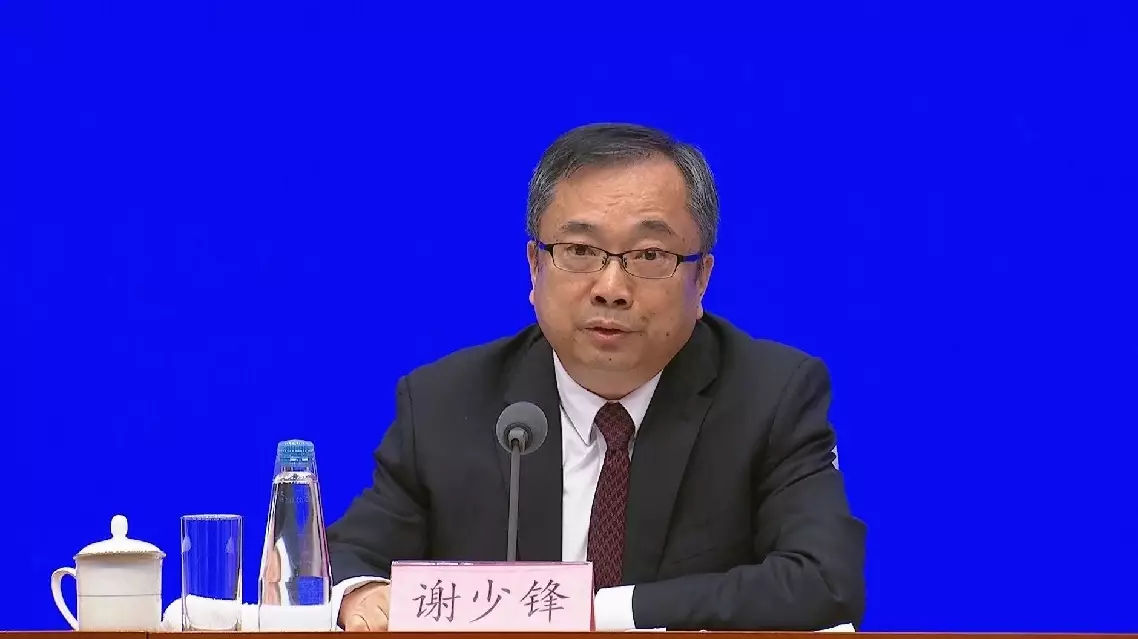
At a press conference in Beijing, Xie Shaofeng, chief engineer of China's Ministry of Industry and Information Technology, briefed the media on the overall performance of China's industrial production in the first three months.
"In the first quarter, the added value of industrial enterprises above designated size increased by 6.5 percent year on year. The equipment manufacturing industry developed well, with the electronics, automobile, electrical machinery and equipment sectors playing a prominent role in driving growth. During this period of time, the contribution rate of industry to macroeconomic growth reached 36.3 percent. Industrial private investment remained rising by double digit, along with boosted corporate expectations, improved efficiency and increasing number of industrial enterprises above designated size. China's manufacturing purchasing managers' index, aka PMI, has expanded for two consecutive months," said Xie.
Then he highlighted the efforts that the country has put into technological and industrial innovation, which has promoted the high-end, intelligent and green development, as well as strengthened endogenous driving forces for industrial transformation and upgrading.
For example, increasing deployment of autonomous AI large models in key industrial sectors, more breakthroughs in AI+ products, and wider usage of smart terminal products.
He also introduced the sound development of China's digital industry.
"Digital technologies represented by 5G and AI large models are developing rapidly. In the first two months, the business revenue of the digital industry increased by 8.2 percent year on year. The capacity of network infrastructure has been continuously enhancing. As of the end of March, a total of 4.395 million 5G base stations have been built and put into operation," Xie noted.
China's industrial production grows at faster pace in Q1
China's industrial production grows at faster pace in Q1
The people-to-people exchanges should be encouraged rather than limited as they can promote relations among countries, said an expert from the United States.
On April 10, 1971, the U.S. table tennis delegation visited China, breaking the ice for China-U.S. relations and is remembered as the Ping-Pong Diplomacy.
This year marks the 55th anniversary of the Ping-Pong Diplomacy.
Odd Arne Westad, a renowned historian and a global Cold War scholar at Yale University, said in a recent interview with the China Global Television Network (CGTN) that history shows sports and cultural links can steer state relations toward positive interaction.
"I'm glad that we are celebrating the anniversary of the Ping-Pong Diplomacy, because I think all kinds of exchanges, including sports exchanges and cultural exchanges among countries, are really important, particularly in the kind of setting that we are seeing today. And as you rightly said, the kind of sports links that gradually started to develop between the United States and China, then became a kind of conduit over onto much more significant positive changes in the relationship between the two countries. What I want to see today is much more interaction in terms of those people-to-people contacts between the United States and China," he said.
The scholar said such exchanges should develop naturally rather than be restricted.
"Instead, we are heading, it seems to me, in the opposite direction. There are far fewer American students in China now than was the case a decade ago. The number of Chinese students coming to the United States also seemed to be going down. At Yale, some of my very best students are Chinese. As an institution, we take enormous pride in the more than 100-year-old relationship that we have with China. I think it's very important for those kinds of links to continue, not just because they are good for the people involved, but much more importantly, as the Ping-Pong Diplomacy shows that they can influence the broader relationships, including even issues that have to do with high politics and strategy, if we let them develop naturally instead of trying to limit it," he said.
In April 1971, nine players from the U.S. Table Tennis team took a historic trip to China, becoming the first delegation of Americans to visit China in decades. Their trip helped lay the groundwork for the establishment of official diplomatic relations between China and the United States.
Later that year, then U.S. Secretary of State Henry Kissinger secretly visited Beijing in July, paving the way for a groundbreaking 1972 meeting in Beijing between then U.S President Richard Nixon and China's late Chairman Mao Zedong.
On Feb 28, 1972, as Nixon's visit to China drew to an end, the historic Shanghai Communique was issued, becoming the political foundation for normalizing China-U.S. relations.
The two countries officially established diplomatic relations in 1979.

US scholar stresses importance of people-to-people exchanges in promoting ties among countries