The death toll from Israel's Wednesday strikes on Lebanon had risen to 357, with 1,223 people injured, Lebanon's Health Ministry said on Friday.
In a statement, the Emergency Operations Center at the Ministry of Public Health said the figures remain preliminary, as rescue teams continue clearing rubble and recovering human remains.
It noted that the large number of unidentified body parts requires time for DNA testing to confirm victims' identities before a final toll can be determined.
The ministry added that the overall death toll from Israeli attacks since March 2, when Hezbollah launched rockets toward Israel, has climbed to 1,953, with 6,303 people injured.
The fragile two-week ceasefire between Iran and the United States came into force on Wednesday. On the same day, the Israel Defense Forces (IDF) said that it had launched the largest-scale strikes against Hezbollah in Lebanon since the beginning of the current round of conflict on Feb 28, when the United States and Israel launching joint military strikes against Iran.
Iranian media reported on Friday, quoting a senior Iranian security source, that the Israeli army had halted its attacks on Beirut, the capital of Lebanon, under the persistent demands and pressure from Iran.
According to the source, the visit of an Iranian delegation to Islamabad, capital of Pakistan, has been postponed multiple times.
Iran warned that if the Israeli military continues its attacks on Lebanon, it could lead to a total breakdown of the talks between Iran and the United States, the source said.
Under sustained pressure from Iran and the country's threats to withdraw from the talks, the United States has forced Israel to halt its attacks on Beirut, according to the source.
In the latest development, a high-level Iranian delegation led by Parliament Speaker Mohammad Baqer Qalibaf has arrived in Islamabad, capital of Pakistan to participate in the upcoming talks with the United States which are expected to take place on Saturday morning, Pakistan's foreign ministry said in a statement.
The delegation also includes Iranian Foreign Minister Seyed Abbas Araghchi.

Death toll from Israel's Wednesday strikes on Lebanon rises to 357
U.S. stocks ended mixed on Friday as investors digested hotter-than-expected inflation data amid ongoing geopolitical uncertainties.
The Dow Jones Industrial Average fell 0.56 percent to 47,916.57. The S and P 500 slipped 0.11 percent to 6,816.89. The Nasdaq Composite Index rose 0.35 percent to 22,902.89.
Seven of the 11 primary S and P 500 sectors closed lower. Consumer staples and health care led the declines, falling 1.43 percent and 1.33 percent, respectively. Technology and materials were the top performers, advancing 0.76 percent and 0.64 percent.
The U.S. consumer price index (CPI) jumped 3.3 percent in March from a year earlier, representing nearly a full percentage point increase from February's annual pace, according to the Bureau of Labor Statistics. The energy index surged 10.9 percent in March, propelled by a 21.2-percent jump in gasoline prices, which alone accounted for nearly three quarters of the monthly increase across all items.
The core CPI, which excludes volatile food and energy components to measure underlying inflation, increased more modestly, rising 0.2 percent for the month and 2.6 percent year over year.
White House Deputy Press Secretary Kush Desai stated that the economy "remains on a solid trajectory," while acknowledging that food and gas prices have risen. National Economic Council Director Kevin Hassett described the current situation as "a temporary energy disruption," adding that the economic effects of the Iran conflict are "a temporary distraction that will very, very quickly go away."
However, Kathy Bostjancic, chief economist at Nationwide, argued that even if a long-lasting deal to end the war is reached and the Strait of Hormuz is fully reopened, "it would take months for oil, gasoline, diesel and other commodity supplies to snap back to pre-war levels and thus for prices to settle back to pre-conflict levels."
Meanwhile, the University of Michigan's preliminary April consumer sentiment index fell sharply to a record low of 47.6, down from 53.3 in March and well below analysts' expectations of 52.0, reflecting growing public concern over the impact of the Iran war on household finances.
Shares of the "Magnificent Seven" technology giants were mostly lower on the day. Nvidia stood out as the strongest performer, rising 2.57 percent.
Investors are now turning their attention to the upcoming U.S.-Iran talks scheduled for this weekend.
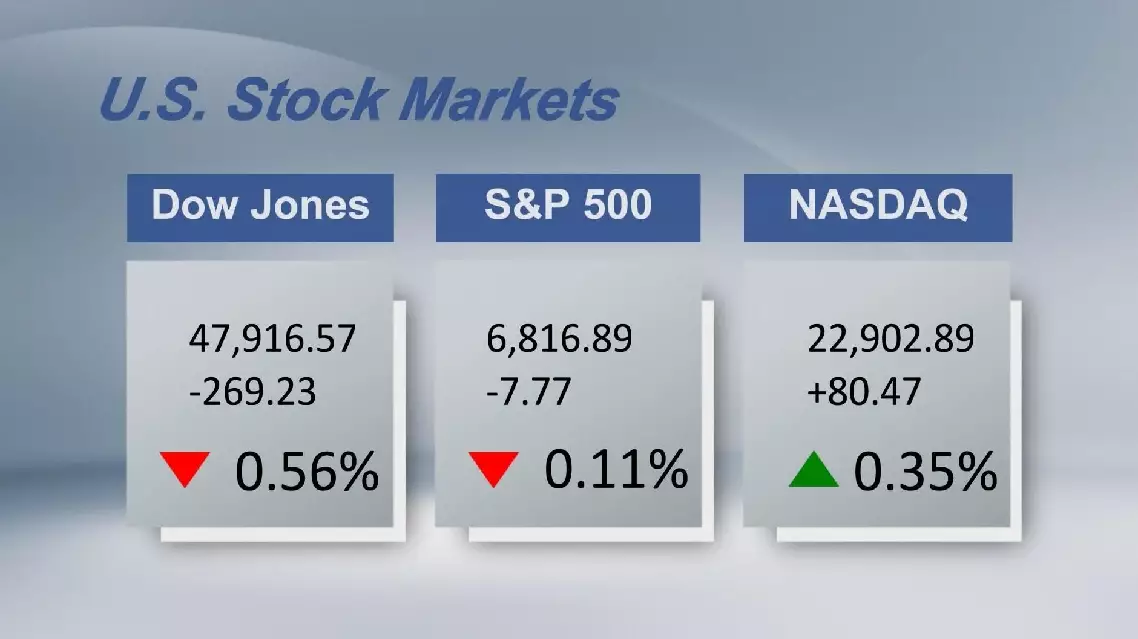
U.S. stocks close mixed after shocking inflation data