U.S. stocks ended mixed on Friday as investors digested hotter-than-expected inflation data amid ongoing geopolitical uncertainties.
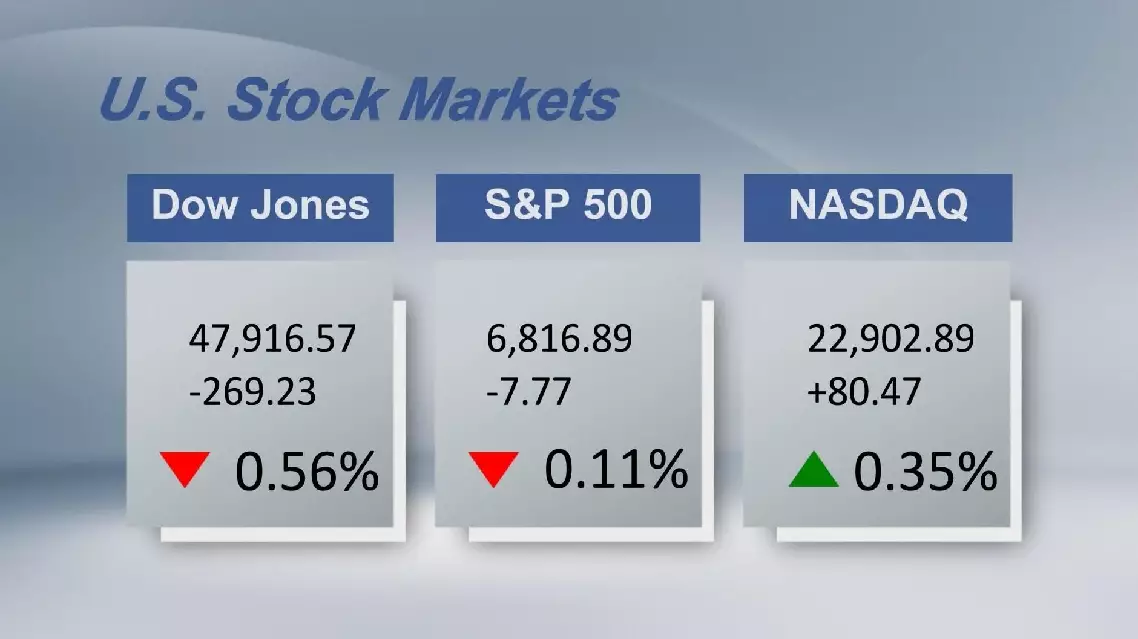
The Dow Jones Industrial Average fell 0.56 percent to 47,916.57. The S and P 500 slipped 0.11 percent to 6,816.89. The Nasdaq Composite Index rose 0.35 percent to 22,902.89.
Seven of the 11 primary S and P 500 sectors closed lower. Consumer staples and health care led the declines, falling 1.43 percent and 1.33 percent, respectively. Technology and materials were the top performers, advancing 0.76 percent and 0.64 percent.
The U.S. consumer price index (CPI) jumped 3.3 percent in March from a year earlier, representing nearly a full percentage point increase from February's annual pace, according to the Bureau of Labor Statistics. The energy index surged 10.9 percent in March, propelled by a 21.2-percent jump in gasoline prices, which alone accounted for nearly three quarters of the monthly increase across all items.
The core CPI, which excludes volatile food and energy components to measure underlying inflation, increased more modestly, rising 0.2 percent for the month and 2.6 percent year over year.
White House Deputy Press Secretary Kush Desai stated that the economy "remains on a solid trajectory," while acknowledging that food and gas prices have risen. National Economic Council Director Kevin Hassett described the current situation as "a temporary energy disruption," adding that the economic effects of the Iran conflict are "a temporary distraction that will very, very quickly go away."
However, Kathy Bostjancic, chief economist at Nationwide, argued that even if a long-lasting deal to end the war is reached and the Strait of Hormuz is fully reopened, "it would take months for oil, gasoline, diesel and other commodity supplies to snap back to pre-war levels and thus for prices to settle back to pre-conflict levels."
Meanwhile, the University of Michigan's preliminary April consumer sentiment index fell sharply to a record low of 47.6, down from 53.3 in March and well below analysts' expectations of 52.0, reflecting growing public concern over the impact of the Iran war on household finances.
Shares of the "Magnificent Seven" technology giants were mostly lower on the day. Nvidia stood out as the strongest performer, rising 2.57 percent.
Investors are now turning their attention to the upcoming U.S.-Iran talks scheduled for this weekend.
U.S. stocks close mixed after shocking inflation data
The people-to-people exchanges should be encouraged rather than limited as they can promote relations among countries, said an expert from the United States.
On April 10, 1971, the U.S. table tennis delegation visited China, breaking the ice for China-U.S. relations and is remembered as the Ping-Pong Diplomacy.
This year marks the 55th anniversary of the Ping-Pong Diplomacy.
Odd Arne Westad, a renowned historian and a global Cold War scholar at Yale University, said in a recent interview with the China Global Television Network (CGTN) that history shows sports and cultural links can steer state relations toward positive interaction.
"I'm glad that we are celebrating the anniversary of the Ping-Pong Diplomacy, because I think all kinds of exchanges, including sports exchanges and cultural exchanges among countries, are really important, particularly in the kind of setting that we are seeing today. And as you rightly said, the kind of sports links that gradually started to develop between the United States and China, then became a kind of conduit over onto much more significant positive changes in the relationship between the two countries. What I want to see today is much more interaction in terms of those people-to-people contacts between the United States and China," he said.
The scholar said such exchanges should develop naturally rather than be restricted.
"Instead, we are heading, it seems to me, in the opposite direction. There are far fewer American students in China now than was the case a decade ago. The number of Chinese students coming to the United States also seemed to be going down. At Yale, some of my very best students are Chinese. As an institution, we take enormous pride in the more than 100-year-old relationship that we have with China. I think it's very important for those kinds of links to continue, not just because they are good for the people involved, but much more importantly, as the Ping-Pong Diplomacy shows that they can influence the broader relationships, including even issues that have to do with high politics and strategy, if we let them develop naturally instead of trying to limit it," he said.
In April 1971, nine players from the U.S. Table Tennis team took a historic trip to China, becoming the first delegation of Americans to visit China in decades. Their trip helped lay the groundwork for the establishment of official diplomatic relations between China and the United States.
Later that year, then U.S. Secretary of State Henry Kissinger secretly visited Beijing in July, paving the way for a groundbreaking 1972 meeting in Beijing between then U.S President Richard Nixon and China's late Chairman Mao Zedong.
On Feb 28, 1972, as Nixon's visit to China drew to an end, the historic Shanghai Communique was issued, becoming the political foundation for normalizing China-U.S. relations.
The two countries officially established diplomatic relations in 1979.

US scholar stresses importance of people-to-people exchanges in promoting ties among countries