Skip to Content Facebook Feature Image

Standard Chartered CIO on negative impacts from US tariffs

China

China

China

Standard Chartered CIO on negative impacts from US tariffs

2025-04-18 22:27 Last Updated At:23:17

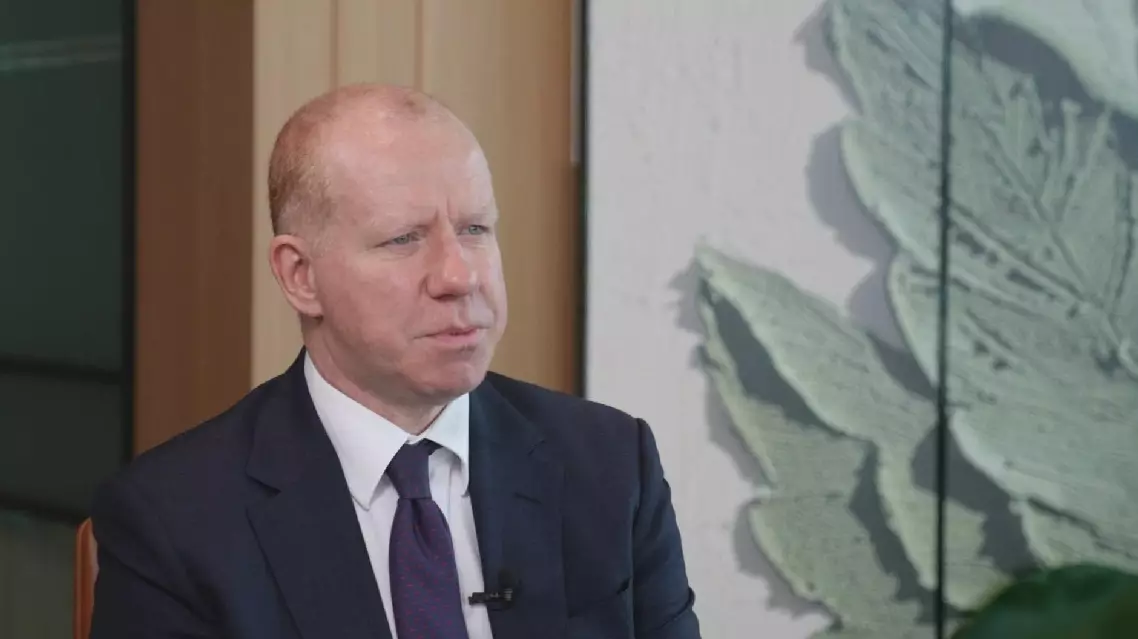
President Donald Trump's capricious tariffs have put the U.S. economy on a path toward weaker growth, higher unemployment and faster inflation, and cast shadow over market expectations and business sentiment, said Steve Brice, chief investment officer of Standard Chartered. 

The Trump administration's tariff policy runs counter to the Federal Reserve's dual mandate of full employment and low inflation, putting the central bank in uncharted waters, Brice said during an interview with China Global Television Network (CGTN), sharing his insights on how the tariffs could affect global economic growth and investment decisions. 

"So that (increasing tariffs) will hit GDP growth, so the current tariffs, the 10 percent tariffs probably take about half to one percent off GDP in the U.S. If they were to increase tariffs even more than obviously that (would have) greater impact and that would increase the risks of a recession. And that's what people are starting to price in just due to business uncertainty. We know that increasing tariffs is a tax on consumers as well. So, this is all sort of feeding into the weaker U.S. economic growth narrative. And on the other hand, we have the fact that they're inflationary. So we had obviously Fed Chairman (Jerome) Powell talking overnight and just sort of flagging that it's putting them in a very difficult situation, which is very clear right so they've got slower growth and rising inflation. That's the opposite direction of what their mandate is -- it's for full employment and low inflation," he said. 

The Standard Chartered CIO believes the lingering uncertainty has eroded business confidence and thwarted the international banking group's holding of U.S. equity portfolio.

"I think the challenge that the U.S. has now is that the level of uncertainty is so high. So, historically, you'd say, okay, we know that the rule of law is there. We know that what the fiscal policy is going to be like. We know what tariffs are going to be in the future. There was a conversation, so that's how we knew what was going to happen. We have a neutral allocation to U.S. equities within our global equity allocation that has been overweight for, actually, the vast majority of about 10 years, we've been overweight the U.S., so this is a significant change. So we've moved to a neutral allocation because we feel that, look, there's still huge strength in the U.S. economy, and obviously the tech sector is still very strong, but we just have less visibility about what the outlook is going to be," he said. 

So far, Trump has imposed 25 percent tariffs on aluminum and steel; 25 percent tariffs on goods from Mexico and Canada that don't comply with a free-trade agreement; a massive 145 percent duty on Chinese imports; a 25 percent tariff on cars, with separate tariffs on auto parts coming at a later date; and a 10 percent baseline tariff on all U.S. imports.
Standard Chartered CIO on negative impacts from US tariffs

Standard Chartered CIO on negative impacts from US tariffs
Institutional opening-up, a key topic at this year's two sessions and in the 15th Five-Year Plan, is fundamentally about establishing long-term effectiveness through systematic, nationwide efforts rather than fragmented, short-term actions, said a deputy to the 14th National People's Congress (NPC) on Friday in Beijing.

The "two sessions", a major event in China's political calendar, refer to the annual meetings of China's top legislature, the National People's Congress (NPC), and the top political advisory body, the National Committee of the Chinese People's Political Consultative Conference (CPPCC).

Peng Shou, also an academician of Chinese Academy of Engineering, explained that by developing comprehensive pilot frameworks in free trade zones like Shanghai and the Hainan Free Trade Port, China is transforming fragmented policies into cohesive systems, such as addressing processing VAT to boost high-tech industries; and exploring the expansion of models like negative lists and digital infrastructure to create a more transparent and predictable environment for global partners.

"I believe that a system is about long-term effectiveness, it's not a short-term move, and not fragmented. It's not about handling isolated cases, but about involving everyone, the whole society," said Peng.

China has built a series of comprehensive testing grounds for institutional openness.

With 22 free trade zones covering the entire country, a full-scale pilot framework has been established. Especially in free trade zones like Shanghai and the Hainan Free Trade Port, China has launched over 110 innovative, integrated pilot measures.

"Turning previous fragmented small policies into a systematic framework is key. For example, the issue of processing and value-added tax is well addressed. By incorporating processing technologies and adding value, it drives the development of high-tech industries," said Peng.

Such models could also be promoted in other regions.

Peng also said that the Hainan Free Trade Port's special customs operations can be used as a great example.

"We may apply this negative list model to some cities or development zones. Additionally, we can focus on digital infrastructure, using AI and digital technology as a foundation in cities like Beijing and Shanghai," he said.

At its core, institutional opening-up is not just about aligning with global standards; it's about creating a more open, transparent, and predictable environment that attracts global partners, according to Peng.

By embracing this new model, China is not only enhancing its position in the global market but also reshaping its own economic future, he added.

NPC deputy emphasizes long-term, systematic impact of institutional opening-up strategies

NPC deputy emphasizes long-term, systematic impact of institutional opening-up strategies

Recommended Articles