The world's first humanoid robot half-marathon was held in Beijing on Saturday.
For the first time ever, robots and humans shared the same route on separate tracks in a marathon event.
A total of 20 humanoid robots from teams across China took part in the competition.
The 21-km route featured different terrains including ramps instead of consisting of all flat stretches, posing challenge to the humanoids' mobility and flexibility .
To achieve better results, each team made adjustments on their robots for long-distance running. For example, some improved materials of robots' feet to make them more wear-resisting; while others changed the gait and pace of robots via algorithm in order to extend the battery life.
According to the organizer, the event was not only a sports competition, but also a test for humanoid robots' comprehensive abilities, such as reliability, durability and safety.
Eight refreshment stations for humanoid robots were also set up, allowing robots to have their battery changed.
In the end, "Tiangong Ultra" humanoid robot came out as the winner of the half-marathon with a speed of around eight kilometers per hour.

World's first humanoid robot half-marathon held in Beijing

World's first humanoid robot half-marathon held in Beijing
China's first 500-kV cross-border alternating-current power interconnection project entered service Monday, creating the highest voltage grid tie between the two countries and advancing Belt and Road energy cooperation.
The project raises two-way power transfer capacity between the two countries from 50,000 kW to 1.5 million kW, enabling the annual transmission of about 3 billion kWh of clean electricity, roughly 30 times the capacity of previous lines, according to China Southern Power Grid.
As the largest cross-border grid project and the highest-voltage power link between China and Laos, it connects southwest China's Yunnan Province with Oudomxay and Luang Namtha provinces in northern Laos.
Cross-border electricity trading began as the project entered operation. About 4.81 million kWh of power from clean energy bases in northern Laos was transmitted to Yunnan through the new line, marking a more regular and institutionalized phase of power connectivity between the two countries.
It is also the first time an overseas new energy project has participated in China's electricity market, the company said. The power involved in the transaction came from a large mountain photovoltaic project in Laos, one of the core supporting power sources for the interconnection line.
"This project is the cross-border power grid project with the highest voltage level between China and Laos. Leveraging the China-Laos power grid interconnection and the power markets in southern China, surplus hydropower from Laos can be transmitted to China during the rainy season, while China can supply supplemental power to northern Laos during the dry season. This project represents yet another landmark achievement between China and Laos in deepening power cooperation and jointly advancing the high-quality development of the Belt and Road Initiative," said Li Jingru, general manager of Electricite du Laos Transmission Company Limited (EDL-T), a joint venture of China Southern Power Grid and Lao state-run Electricite du Laos.
The solar project has an average annual power generation capacity of about 1.65 billion kWh. In 2026, it is expected to transmit about 1.1 billion kWh of solar power across the border, supporting energy complementarity between the two countries.
"In the future, efforts will be made to further promote normalized cross-border electricity trading, meet the trading needs such as electricity transmission from Laos to China's Yunnan, from China's Yunnan to Laos, and from Laos to China's Guangdong, and facilitate the optimal allocation of energy resources in the Lancang-Mekong region," said Li Minhong, marketing director of China Southern Power Grid.
Construction of the interconnection project began in late February last year. Spanning a total length of 177.5 km, the transmission line includes a 145-km Chinese section and a 32.5-km Lao section.
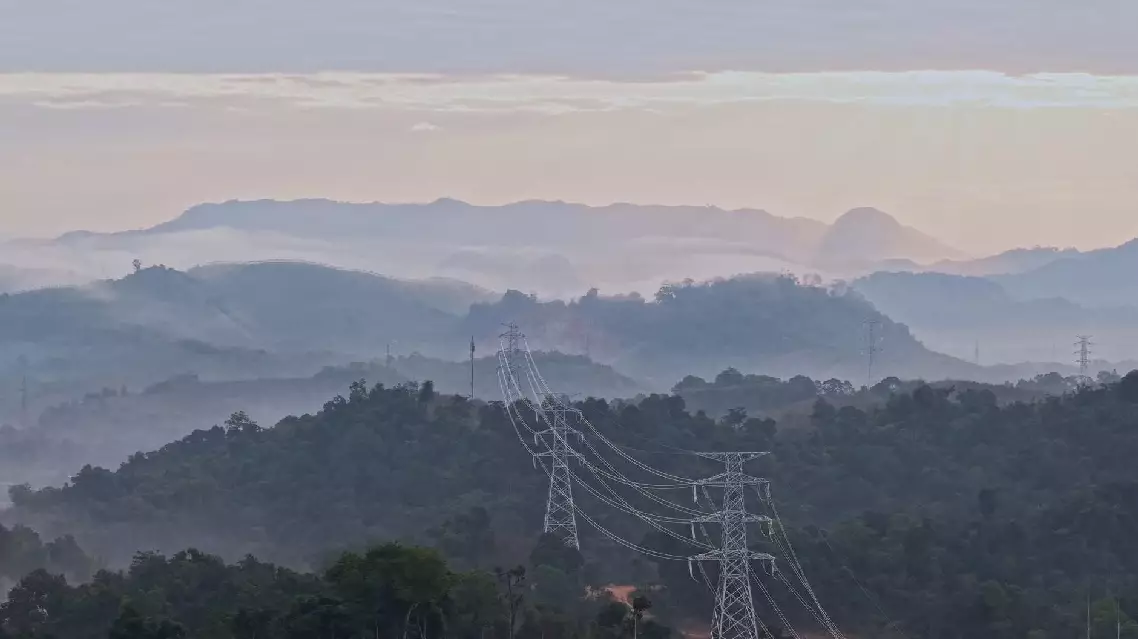
New China-Laos power link expands transfer capacity 30-fold, boosts electricity trading