RALEIGH, N.C. (AP) — The blueprint keeps bringing the Carolina Hurricanes to the Stanley Cup Playoffs. The only question is whether it will be enough to push them within reach of the Cup itself.
The Hurricanes open their seventh straight playoff run Sunday against the New Jersey Devils. That puts Carolina among only four teams with active playoff streaks of at least seven years, joining Toronto (nine), Colorado (eight) and Tampa Bay (eight).
Click to Gallery

Carolina Hurricanes' Sebastian Aho, center, celebrates his goal against the Toronto Maple Leafs with teammates Seth Jarvis (24) and Brent Burns (8) during the third period of an NHL hockey game in Raleigh, N.C., Sunday, April 13, 2025. (AP Photo/Karl DeBlaker)
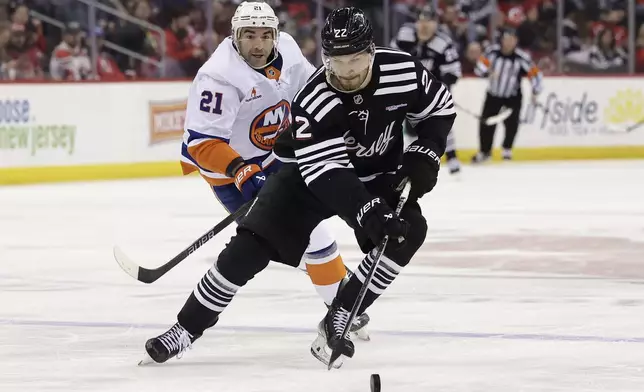
New Jersey Devils defenseman Brett Pesce (22) skates with the puck past New York Islanders center Kyle Palmieri in the third period of an NHL hockey game Sunday, April 13, 2025, in Newark, N.J. (AP Photo/Adam Hunger)
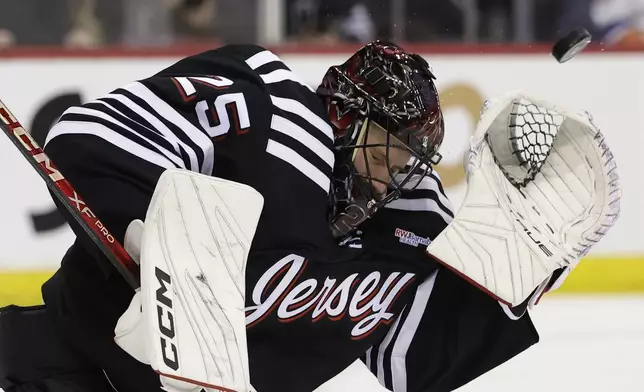
New Jersey Devils goaltender Jacob Markstrom makes a save in the third period of an NHL hockey game against the New York Islanders Sunday, April 13, 2025, in Newark, N.J. (AP Photo/Adam Hunger)
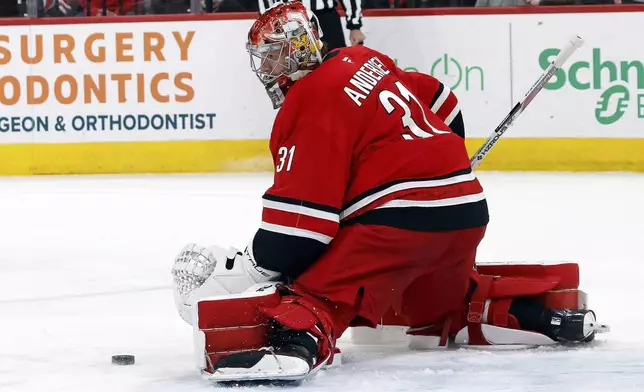
Carolina Hurricanes goaltender Frederik Andersen (31) blocks a shot from the Toronto Maple Leafs during the first period of an NHL hockey game in Raleigh, N.C., Sunday, April 13, 2025. (AP Photo/Karl DeBlaker)

New Jersey Devils head coach Sheldon Keefe directs his team in the third period of an NHL hockey game against the New York Islanders Sunday, April 13, 2025, in Newark, N.J. (AP Photo/Adam Hunger)
The Hurricanes, who hold the No. 2 playoff spot from the Metropolitan Division, have won at least one series each year in their current run and twice reached the Eastern Conference Final (2019 and 2023). The approach hasn’t changed much in Rod Brind’Amour’s coaching tenure: use an aggressive forecheck to control the puck and keep the pressure on in the offensive zone while minimizing the opportunities going the other way.
It routinely puts the Hurricanes in position to win, though pushing to the final round has proven elusive — particularly when it comes to generating goals and elite scoring chances in tight games.
“I think we play a pretty consistent game,” Brind’Amour said. “We’ve got good balance. We rely on all 20 guys. I don’t think there’s any one thing that we can say we hang our hat on. But I just think our game, when we’re on, just top to bottom when the penalty kill’s good, when our power play’s going good, it’s just a solid game and that’s kind of the way we approach it.
“We’re not relying on one thing, I guess is the way I look at it, because we’re just not built that way.”
The Devils, the Metro's No. 3 team, are in the playoffs for only the third time since 2012. The last trip ended with a five-game loss to the Hurricanes in the second round. New Jersey won’t have top center Jack Hughes, who had shoulder surgery in March and is out for the season.
“Since playing them just after Christmas, we had a pretty good sense that if we were going to make the playoffs, it would be in a situation like this where we’re playing Carolina," coach Sheldon Keefe said. “We’ve been having an eye toward them for a while.”
Games 1 and 2 are in Raleigh, North Carolina, with Game 2 set for Tuesday. The series then shifts to Newark, New Jersey, for Game 3 on Friday and Game 4 on April 27.
If necessary, Game 5 will take place in Raleigh on April 29, Game 6 will be May 2 in Newark and Game 7 on May 4 back in Raleigh.
Offensively minded defenseman Dougie Hamilton returned for New Jersey in the regular-season finale after he had been out since early March due to a lower-body injury.
Hamilton logged 23:42 of ice time in his return.
“It was great just to be back playing (and) get ready for playoffs,” said Hamilton, who missed 18 games.
Defenseman Jonas Siegenthaler has been out with a lower-body injury since early February. While Siegenthaler has been skating, Keefe said “it would be a surprise to me and our team” if he returned during this series.
Jacob Markstrom had a bounce-back first year in New Jersey, finishing 26-16-6 with a 2.50 goals-against average with four shutouts. He allowed three goals or fewer in six of his last seven starts, including a shutout.
The Hurricanes have leaned on veteran Frederik Andersen more in the playoffs in recent years, and Brind'Amour said Saturday that Carolina would “more than likely” go with Andersen (13-8-1, 2.50 goals-against average) in Game 1 over 25-year-old Pyotr Kochetkov (27-16-3, 2.60 GAA).
The Devils have a more balanced offense than in the postseason meeting of 2023.
Nico Hischier (career-high 35 goals and 34 assists), Jesper Bratt (21 goals and career-high and franchise-record 67 assists) and Timo Meier (26 goals, 27 assists) have all increased their production in Jack Hughes’ absence. New Jersey is third on the power play (28.2%) and their PK is second (82.7%) behind only Carolina.
Carolina has multiple veterans from its playoff streak, including center Sebastian Aho, captain Jordan Staal, forward Seth Jarvis and defenseman Jaccob Slavin. But there could be a late addition with the arrival of top defenseman prospect Alexander Nikishin from the KHL. It's unclear whether the 23-year-old viewed as a long-term piece will play much, if at all, in this series.
“We just wanted to get him over here and then I think we'll just progress as it goes,” Brind'Amour said Saturday of starting Nikishin's “learning curve.”
AP Hockey Writer Stephen Whyno in Washington and AP Sports Writer Vin A. Cherwoo in Newark, New Jersey, contributed to this report.
AP NHL: https://apnews.com/hub/nhl

Carolina Hurricanes' Sebastian Aho, center, celebrates his goal against the Toronto Maple Leafs with teammates Seth Jarvis (24) and Brent Burns (8) during the third period of an NHL hockey game in Raleigh, N.C., Sunday, April 13, 2025. (AP Photo/Karl DeBlaker)
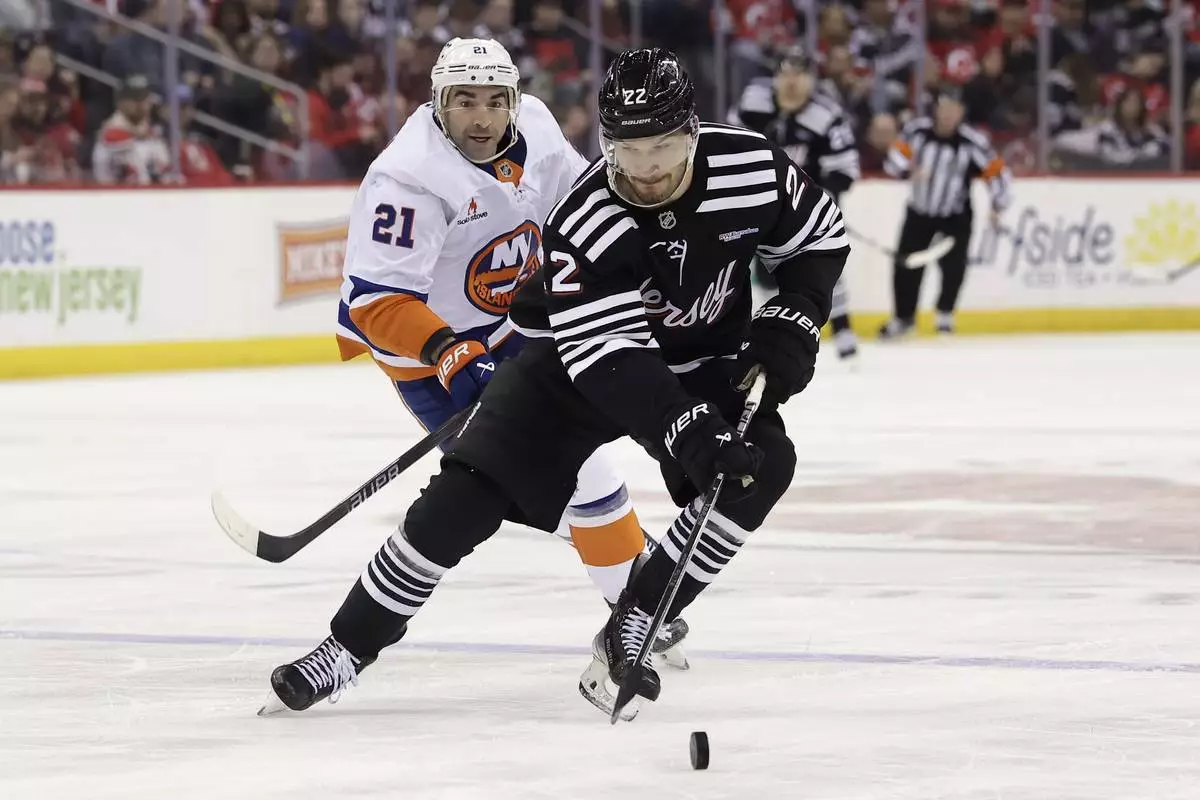
New Jersey Devils defenseman Brett Pesce (22) skates with the puck past New York Islanders center Kyle Palmieri in the third period of an NHL hockey game Sunday, April 13, 2025, in Newark, N.J. (AP Photo/Adam Hunger)
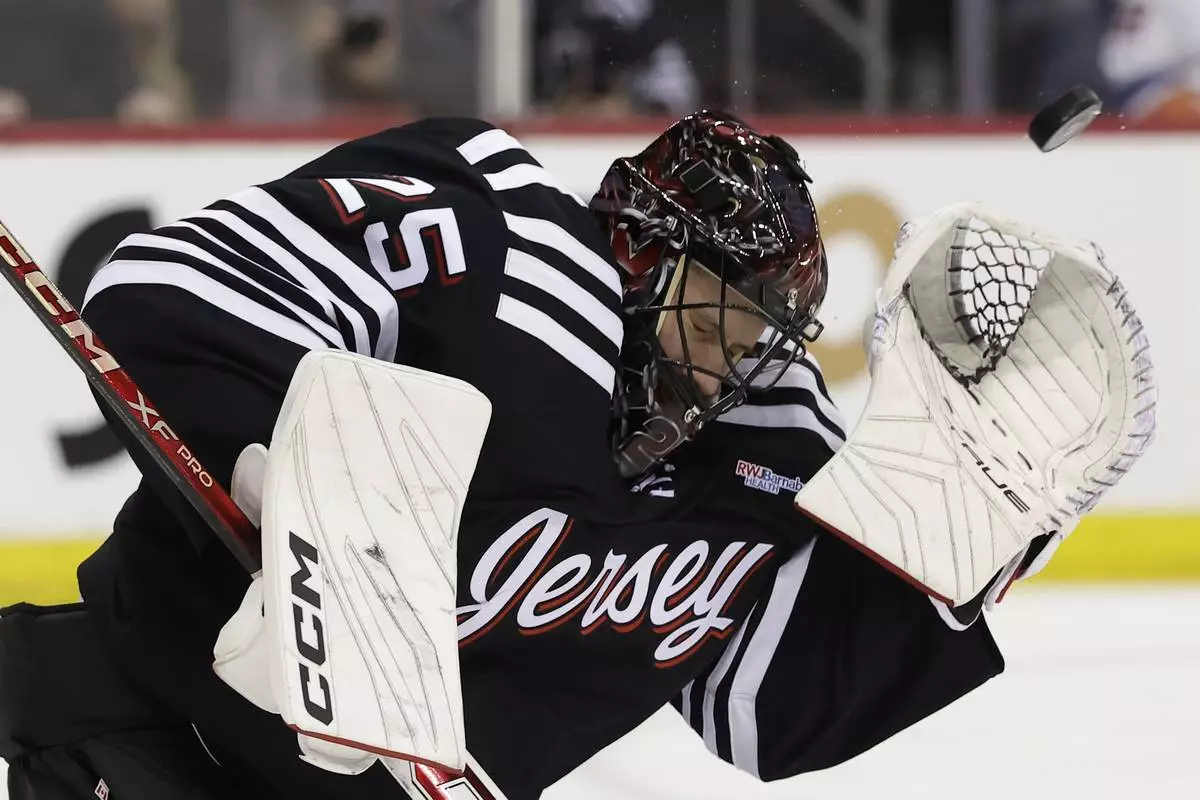
New Jersey Devils goaltender Jacob Markstrom makes a save in the third period of an NHL hockey game against the New York Islanders Sunday, April 13, 2025, in Newark, N.J. (AP Photo/Adam Hunger)
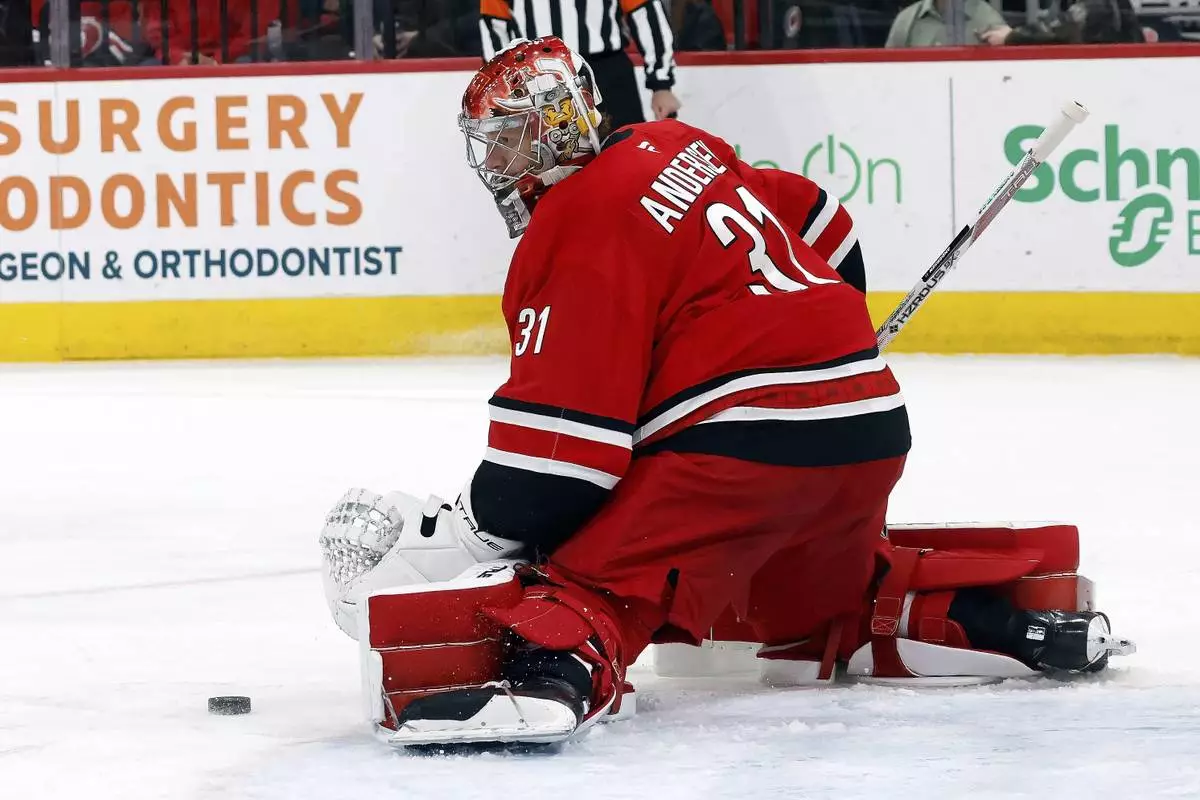
Carolina Hurricanes goaltender Frederik Andersen (31) blocks a shot from the Toronto Maple Leafs during the first period of an NHL hockey game in Raleigh, N.C., Sunday, April 13, 2025. (AP Photo/Karl DeBlaker)

New Jersey Devils head coach Sheldon Keefe directs his team in the third period of an NHL hockey game against the New York Islanders Sunday, April 13, 2025, in Newark, N.J. (AP Photo/Adam Hunger)