Small commodity wholesalers in Yiwu City in east China's Zhejiang Province are exploring new sales channels to cope with challenges brought by rising U.S. tariffs.
Nie Ziqin, the owner of a shop at the Yiwu International Trade Market, the world's largest wholesale market for small commodities, has been selling Halloween products for nearly 20 years. As a leading wholesaler, she was once recognized as one of the best shop owners at the market.
In a normal year, April is the busiest time for Nie, when orders for the entire year are typically confirmed. However, she is now bearing the brunt of U.S. tariffs, as nearly half of her products are exported to the country. With unreasonably high tariffs in place, many U.S. importers have canceled their orders, forcing Nie to suspend production.
"These products were mainly intended for the U.S. market, as Halloween is celebrated there. Our business was concentrated in the first half of the year. Starting early in the year, our customers [from the U.S.] typically selected products and placed orders over a period of about five months," Nie said.
In order to find new buyers and mitigate losses, Nie has resorted to an approach she rarely used before: posting promotional videos on social media platforms.
She also found reassurance after contacting her clients from the European Union (EU).
"I called and texted our EU customers to ask if they had been affected by U.S. tariffs. They said they hadn't been impacted. I'm happy to hear that, because at least my goods have somewhere to go, and they can help me sell part of the products," she said.
One overseas buyer in the shop was quick to point out the appeal of Yiwu-made goods.
"To be honest, I choose your products because they offer better quality at lower prices, and I always receive exactly what I see here," said a buyer from Türkiye.
In addition to Halloween products, Nie has also begun selling traditional Chinese festival items. The positive market feedback from last year's trial run has given her confidence in this business diversification.
"The [Halloween] products are currently piled in the storage room. If the EU customers want them, we will ship the products according to EU packaging standards. We are also reaching out to Latin American countries, such as Brazil, as well as Italian customers, hoping they can help sell our products. If things don't go well with our EU customers this year, we will still be fine and just expand our business in the domestic market," Nie said.
Meanwhile Fu Jiangyan, a 43-year-old wholesaler at the Yiwu Market, now spends 40 minutes a day learning Arabic alongside dozens of other shop owners at a "foreign language corner" established by the market this year.
"We have many customers from the Middle East. They like making phone calls or sending voice messages, but I cannot understand a single word they say. So, I want to learn some Arabic so I can better communicate with them," Fu said.
Fu also leverages AI tools to create product videos for international clients. The AI translates Chinese recordings into 36 languages while naturally adapting voice tones and pronunciations.
"I post videos every day and then translate them into 36 different languages. I think as long as we continue talking with foreign buyers, we will finally make deals. Even if it's just one or two orders, we are getting more customers," Fu said.
Thanks to Fu's efforts in learning foreign languages and sharing videos, the store she runs with her husband now sells 20 million pairs of socks each year.
"Now that I have posted the short videos with AI tools, I want the foreign buyers to see not only that our short videos have Arabic subtitles, but also that we can speak Arabic. So when the opportunity comes, we'll be ready to seize it," Fu said.
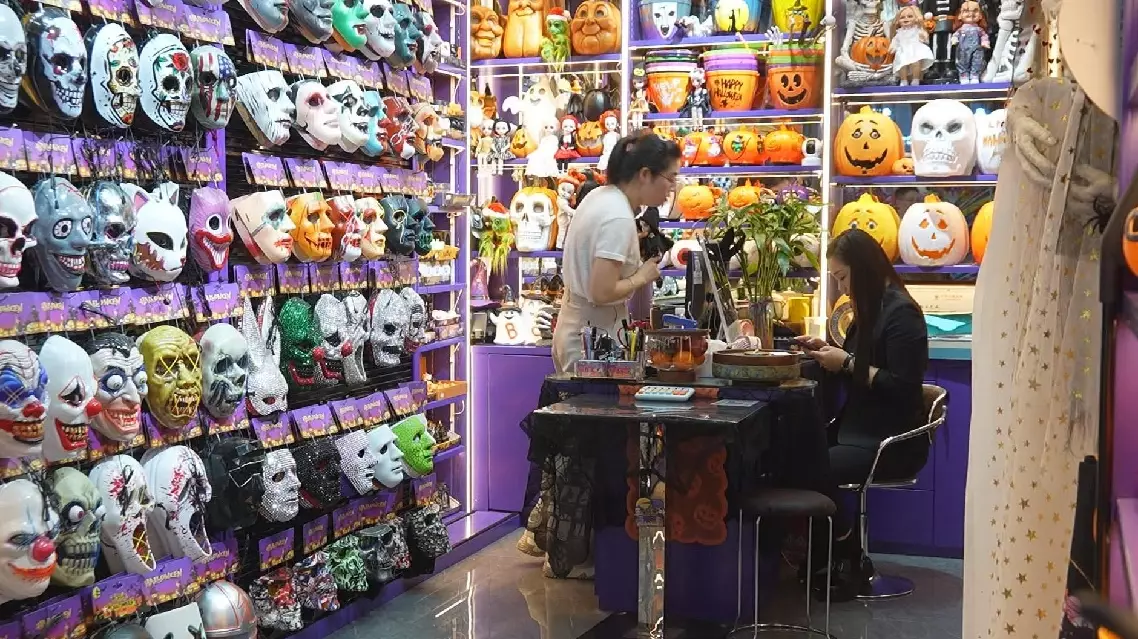
Exporters in China's small commodities hub seek new markets amid rising U.S. tariffs
Exporters in China's small commodities hub seek new markets amid rising U.S. tariffs
Exporters at China’s small commodities hub seek new markets amid rising U.S. tariffs