Taiwan business community has expressed their growing concerns over the U.S. tariffs and shrinking market access, urging stronger cooperation with the Chinese mainland to maintain economic stability and industrial competitiveness.
U.S. President Donald Trump has announced a 32 percent tariff hike on products from Taiwan, accusing the island of "stealing" America's chip industry, prompting moves to relocate chip giant TSMC's operations to the United States.
This move has shattered the illusion of the U.S. support fabricated by Taiwan's Democratic Progressive Party (DPP) authorities, while plunging Taiwan's core industries and small and medium-sized enterprises into an unprecedented crisis.
The Lai Ching-te regime has been accused of misjudging the situation, offering only a symbolic 88 billion new Taiwan dollars (over 2.7 billion U.S. dollars) rescue package in response to growing dissatisfaction from businesses. Despite this, the Lai regime has continued to push for "decoupling" from the Chinese mainland, a policy that has drawn sharp criticism across Taiwan.
Last Friday, representatives from Taiwan-invested enterprises gathered in Nanjing, the provincial capital of Jiangsu in eastern China, for a symposium sponsored by the Taiwan Affairs Office of the Communist Party of China (CPC) Central Committee and the Taiwan Affairs Office of the State Council.
At the event, business leaders voiced deep concerns about the economic impact of U.S. tariffs and questioned the effectiveness of the Lai regime's relief measures. The 88 billion new Taiwan dollars rescue fund was widely criticized as "a drop in the bucket."
"If the profit margin is only 10 percent, a 32 percent tariff increase would make operations unsustainable. That's why many businesses have shut down their factories, and the burden has fallen heavily on grassroots communities," said Hsu Jung-feng, supervisor of the Nanjing Taiwan Compatriots Investment Enterprise Association.
"With 88 billion new Taiwan dollars, how exactly will that benefit enterprises? Given the DPP authorities' way of opaque operations, it appears very difficult for most businesses to access such support," said Han Ying-huan, vice president of the National Association of Taiwan Compatriot Investment Enterprises.
"Calculated on the figures of 2024, Taiwan's exports are projected to reach nearly 111.4 billion U.S. dollars, yet now they're offering only 88 billion new Taiwan dollars -- around 2.7 billion U.S. dollars -- which is less than one-fortieth of the export value. Judging from this figure, the scale of subsidy is far too limited," said Hung Hsiu-chu, former chairperson of Chinese Kuomintang (KMT) party.
Taiwan scholars and business representatives have warned that the DPP's "decoupling" strategy, which involves promoting "non-red supply chains" and shifting toward the Global North, is unrealistic and detrimental to Taiwan's economic interests.
"Over 90 percent of Taiwan's industries are micro, small and medium-sized enterprises. For decades, these businesses have benefited significantly from industrial cooperation and division of labor with the Chinese mainland. They are deeply embedded in this model, and have been accustomed to this model of division of labor with the mainland industrial system. To have them abruptly 'decouple,' 'cut ties with the mainland,' and 'pivot to the Global North' is simply a mission impossible," said Cheng Yu-ping, professor of the Taipei University.
"In 2024, trade exchanges across the Strait was close to 300 billion U.S. dollars, right? Taiwan's exports to the mainland were more, right? Under these circumstances, how could you go for decoupling? It's impossible to decouple. Enterprises will make their own choices. It's not a matter that the decoupling is done once Taiwan's management order to decouple from the Chinese mainland," Han said.
As criticism of the DPP's handling of the situation grows, the Chinese mainland continues to extend support.
Song Tao, head of the Taiwan Affairs Office of both the CPC Central Committee and the State Council, has stated that efforts will be made to address the difficulties faced by Taiwan businesses, encourage their participation in national strategies, and support their integration into the new development pattern.
In contrast to the DPP's push for decoupling, Hung, former chairperson of Chinese Kuomintang (KMT) party, emphasized the global economic context, particularly highlighting the opportunities that lie outside the United States.
"We must remind our Taiwan business community that the United States accounts for only 26 percent of global GDP, leaving 74 percent of market potential still out there. If we can align with the mainland's dual circulation strategy and the Belt and Road Initiative, and integrate into the global multilateral trading system and free trade, it will be better for Taiwan's economic development and industrial sustainability," Hung concluded.
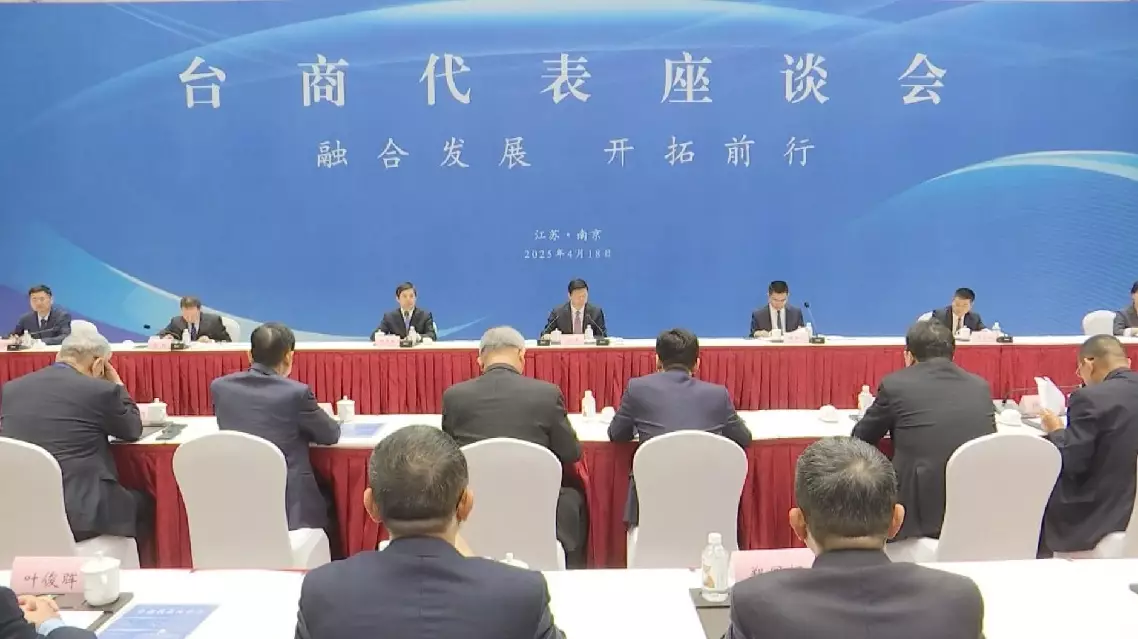
Taiwan businesses urge closer cross-Strait cooperation