A home appliance producer in Cixi, one of China's three major home appliance manufacturing hubs in east China's Zhejiang Province, is coping with the tariff hikes on Chinese goods exported to the United States through branching out to new export markets and tapping in to the growing domestic demand.
While trade tensions between China and the U.S. continue to intensify, the White House has recently raised tariffs to 245 percent on certain Chinese exports.
Exports to the United States account for about 16 percent of the total production in Cixi, which means the gusty trade protection measures imposed by the U.S. will lead to overstock and threaten the capital turnover of exporters.
In the warehouse of Feilong Home Appliances, a local manufacturer, its president Shen Xuejiang walked past stacks of coolers and refrigerators supposed to be on the shelves of U.S. malls.
"There are about 300 machines heading to the U.S. through cross-border e-commerce channels, and there are nearly 1,000 products here also heading to the United States," Shen said.
Shen noted that products exported to the U.S. comprise about one-third of their total exports. Following the U.S. imposition of additional tariffs, the company has nearly 3,000 appliances, including refrigerators and washing machines, stuck in inventory.
But Shen said that there is no need to worry too much, as there are strategies to deal with the breach of bulk orders.
"For now, we will just have to wait. When it is indeed necessary to deal with this situation eventually, it's the customer who breaches the contract for not picking up the goods," he explained.
According to Shen, about 70 percent of the components in washing machines and refrigerators are interchangeable. Even if the U.S. customer backs out, the company can simply repackage the products and put them back on the market.
The 30-percent deposits prepaid by U.S. clients are sufficient to cover the cost of repackaging, he said.
While they can manage existing inventory, the loss of one-third of their export orders remains a significant challenge. In Feilong's planning department, the production line that once focused primarily on U.S. orders is now operating for orders from other countries.
"These are all our foreign trade orders since the beginning of this year, such as those from Italy, Mexico and Argentina. Up to now, we have cooperated with more than 90 countries," said Ma Pinlei, head of the planning department at Feilong's refrigeration product branch.
Fortunately, Feilong has been proactive in diversifying its export markets, a strategy that has proven crucial in the face of the U.S.-China trade dispute.
Leveraging its solid technological edge, Feilong has managed to soften heavy blow of tariffs by exploring smaller markets overseas.
"For example, in the past, we basically would not take orders fewer than 20 TEUs. But now, we are also open to some orders for 10 or eight TEUs, thereby making up for the loss of purchase orders," Shen said.
Fortunately, Feilong has also expanded its domestic market, capitalizing on the Chinese government's trade-in program offering 15 to 20 percent of subsidies for home appliances.
"The goods on this truck are bound for Guangdong. Every day we have goods dispatched to places like Shanghai, Beijing and Zhengzhou. Thanks to the government subsidized trade-in program, our domestic sales channels have grown about 30 percent in the first quarter," Shen said.
Last year, Feilong exported about 20 million dollars worth of products to the U.S. Despite the current pause in that market, Shen noted, his company's annual business targets will remain unchanged.
"We have to cope with it (the U.S. tariffs). But I think we have enough in the toolkit to solve this problem," the CEO said.
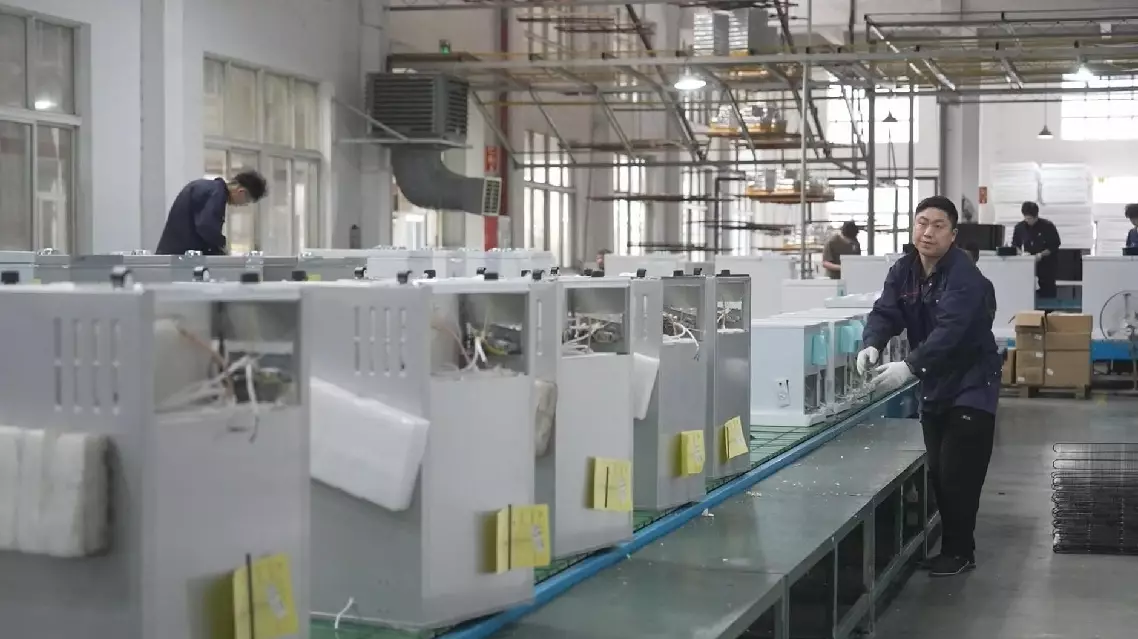
Home appliance exporter counters U.S. tariffs with market diversification, domestic market exploration