Skip to Content Facebook Feature Image

China, GCC countries to deepen peaceful nuclear tech cooperation

China

China

China

China, GCC countries to deepen peaceful nuclear tech cooperation

2025-04-21 22:19 Last Updated At:04-22 01:27

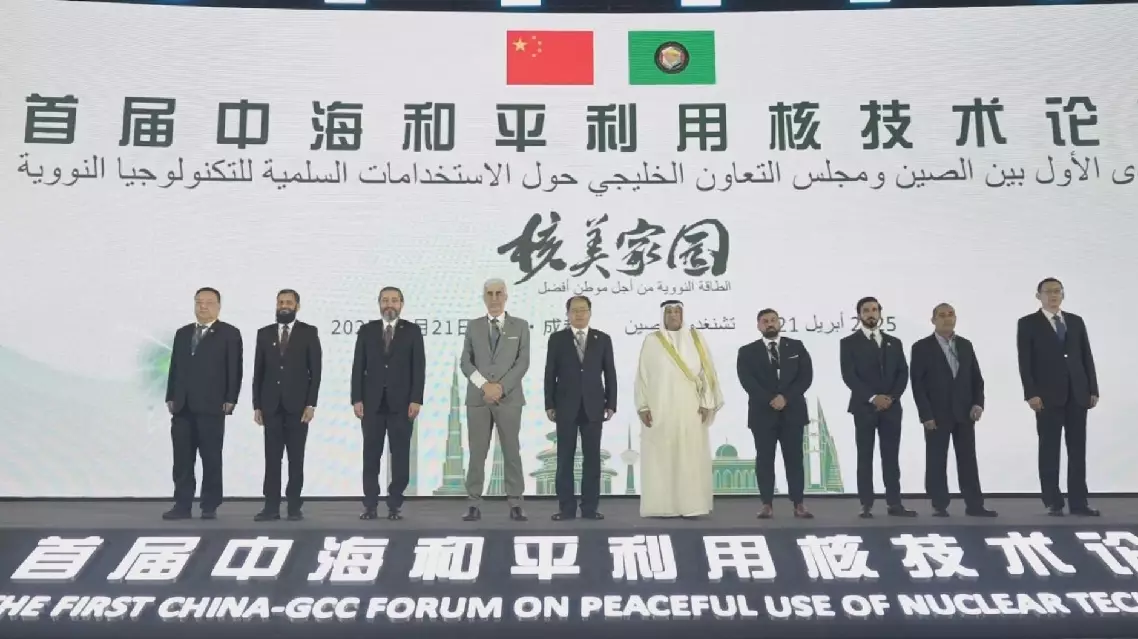
China and Gulf Cooperation Council (GCC) countries pledged on Monday to strengthen collaboration on the peaceful use of nuclear technology during a forum held in Chengdu, capital of southwest China's Sichuan Province.

Hosted by the China Atomic Energy Authority (CAEA), the First China-GCC Forum on Peaceful Use of Nuclear Technology brought together officials and nuclear experts from China, Saudi Arabia, Bahrain, Kuwait, Qatar, the United Arab Emirates (UAE) and other GCC countries.

The participants discussed opportunities, challenges and collaborative solutions for the development of nuclear energy technology, sharing insights on current trends and future prospects.

"Nuclear technology has a really wide range of applications, from industries and agriculture to healthcare, environmental protection. The development of nuclear tech could play a huge role in empowering and driving the growth of various sectors. China's nuclear energy and technology sector is growing fast. Back in 2015, the industry was worth around 300 billion yuan (about 41 billion U.S. dollars), but by 2022, it had jumped to about 700 billion (about 96 billion U.S. dollars)," said Huang Ping, secretary general of the CAEA.

China has strengthened its ties with GCC countries in the field of nuclear technology, with its radiation detection equipment being widely exported to Saudi Arabia, the UAE, and Qatar. This technology has played a key role in major events such as the FIFA World Cup Qatar 2022 and the Dubai Expo

Chinese firms and universities have also partnered with Kuwait, Oman and Bahrain in the fields of nuclear medicine and basic research.

"China is among the leading nations in the nuclear industry and they have the second largest nuclear company that has most of the value or all of the value chain of nuclear industry. And I think we do have a lot of cooperation but the nuclear industry in general, it's still new in the region. But it's growing fast," said Khalid Aleissa, CEO of Saudi Arabia's Nuclear and Radiological Regulatory Commission (NRRC).

Jasem Mohamed Albudaiwi, secretary general of the GCC, said the organization's member states are looking forward to further nuclear technology cooperation with China.

"There are actually many cooperation in nuclear technology between GCC and China. We saw today and heard the possibility that many ways of possibility of cooperation, whether in nuclear energy, nuclear industry, nuclear water desalination, and even nuclear medicine. So we are positive, we are hopeful and we are looking forward for this genuine cooperation with China in the field of nuclear," the secretary general said.
China, GCC countries to deepen peaceful nuclear tech cooperation


China, GCC countries to deepen peaceful nuclear tech cooperation
China's 2026 interim earnings season has officially begun to offer an early snapshot of corporate performance and broader economic trends in the first half of 2026, with the first one released Wednesday.

The first report, released by a Shenzhen-listed chemical company, showed operating revenue of 1.33 billion yuan (about 196.48 million U.S. dollars) in the first half of the year, up 7.87 percent year on year. Net profit surged 103.87 percent to 82,586,300 yuan.

All A-share listed companies are scheduled to publish their full interim reports by August 31.

Meanwhile, earnings forecast disclosures have entered a peak period. As of 17:00 Wednesday, a total of 1,668 A-share listed companies had released performance forecasts for the first half of 2026. Of them, 902 companies expect year-on-year net profit growth, while 181 others anticipate turning losses into profits. More than half of the reporting firms forecast profit increases.

From an industry perspective, companies in such areas as artificial intelligence (AI) computing power, commercial aerospace, electronic manufacturing, chemicals and nonferrous metals, and new energy reported particularly strong expected growth.

"Hard-tech sectors, such as memory chips and fiber-optic communications, have posted sharp profit increases due to rising product prices and expanding market demand, fully demonstrating their growth potential. At present, under the dual drivers of policy guidance and market demand, hard technology and high-end manufacturing are becoming key engines of earnings growth, with the results of China's economic structural adjustment gradually becoming evident," said Tian Lihui, an academic committee member of the China Capital Market Society.

While tech and green energy sectors caught the spotlight, analysts noted traditional blue-chip sectors, including finance, non-ferrous metals and energy, have demonstrated strong resilience and anchored the overall profitability of the A-shares market.

"The AI industrial chain and hardware equipment are experiencing rapid growth. The green and low-carbon sectors remain highly active. Traditional sectors, such as chemicals and non-ferrous metals, are now deeply integrated with the new energy supply chain and have shown the global competitive advantage of Chinese manufacturing under the dual carbon goals [of peaking carbon dioxide emissions before 2030 and achieving carbon neutrality before 2060]," said Fan Wei, general manager of the fixed income financing headquarters at Shenwan Hongyuan Securities.

First 2026 interim reports released as over half of A-share firms forecast profit growth

First 2026 interim reports released as over half of A-share firms forecast profit growth

Recommended Articles