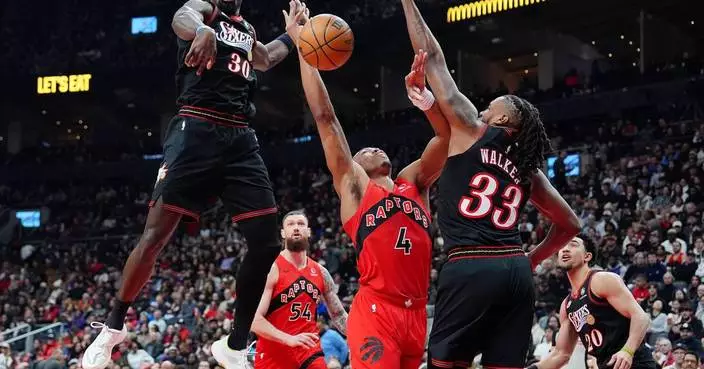
Is it beginning to look a lot like 2023?
The Golden Knights rolled all four lines that year, overwhelming opponents with their depth in winning the Stanley Cup.
Vegas opened this year's playoffs Sunday night by doing much the same in its 4-2 victory over the Wild.
All four lines played more than 10 minutes at 5-on-5, according to Natural Stat Trick, and none more than Jack Eichel's top three going for 12:49. Minnesota relied heavily on its top line, which saw 17:22 of action at 5-on-5, while the other lines each played fewer than nine minutes.
The Golden Knights hope that will be the theme as well for Game 2 on Tuesday (11 p.m. ET, ESPN) in Las Vegas.
“Last night talking about the minutes, if (Eichel) doesn’t have to play 22 minutes every night for us to win, that’s going to keep him fresher as we go along here and give us a good opportunity to have better matchup situations,” Vegas coach Bruce Cassidy said.
Eichel, who led the Golden Knights with a career-high 94 points this season, played 17:12.
The Wild's top line of Kirill Kaprizov, Joel Eriksson Ek and Matt Boldy each were on the ice for more than 20 minutes, though they were effective. Boldy scored both Minnesota goals and Kaprizov assisted on each.
Wild coach John Hynes pushed back on the notion he needed to more evenly distribute the minutes, noting that a lot of teams give that kind of time to the top line. But he acknowledged the Wild need more productivity from their bottom six forwards.
“As we move along going into Game 2, the 12 guys up front, I think we can be better in that area,” Hynes said.
When/Where to Watch: Game 2, 6 p.m. EDT (ESPN)
Series: Hurricanes lead 1-0
Carolina dominated Sunday’s series opener 4-1. To listen to New Jersey’s players and coach Sheldon Keefe, a better response in Game 2 doesn’t come through any complicated changes.
“We’re going to have to above all dig in more and be more competitive when the situation calls for it on these puck battles,” Keefe said Monday.
The Hurricanes scored the game’s first three goals and at one point late in the second period had a 4-to-1 shot advantage, with only Nico Hischier’s 4-on-4 score avoiding the shutout. The shot edge going to Carolina wasn’t a surprise for Keefe, though he pointed to the fact the Devils have to do a better job of getting the puck out of their end to start transition chances and negate the Hurricanes’ aggressive forecheck.
That was immediately evident after the Game 1 loss, with Keefe saying his team was “just overwhelmed” in the second period.
“We knew it was going to be hard to play against them,” forward Ondrej Palat said. “But that was on us, too. We didn’t execute well, we didn’t win enough battles.”
Making matters worse, the Devils had multiple players head to the tunnel early with injuries in defensemen Brenden Dillion and Luke Hughes and forward Cody Glass. Keefe didn’t update any of their statuses Monday for a team already down top center Jack Hughes to a season-ending injury and defenseman Jonas Siegenthaler not expected back this series from a lower-body injury in February.
Luke Hughes exited with an apparent shoulder injury in the third period, but returned late, while Dillion didn’t return after his second-period exit after going down in a tangle with William Carrier.
Then there was Glass, who was hurt on the same play as Hughes. But he was injured when goaltender Jacob Markstrom took a whack at Carolina’s Andrei Svechnikov at the top of the crease only to inadvertently pop Glass with his stick and send the forward crashing to the ice.
“It’s a heat-of-the- moment play unfortunately and I feel bad for Glasser," Markstrom said. "You don’t want to see or be the reason anyone goes down.”
As for Carolina, coach Rod Brind’Amour didn’t specify who would start in goal for Game 2. Frederik Andersen had 23 saves in the opener. The other option is 25-year-old Pyotr Kotchetkov.
When/Where to Watch: Game 2, 7:30 p.m. EDT (ESPN2)
Series: Maple Leafs lead 1-0
The series between Ontario rivals was always going to be intense, and the Maple Leafs made sure to take advantage of that heat.
They scored three power-play goals in their 6-2 victory in the opener, and coach Craig Berube said it was crucial to remain disciplined.
“We've got to play hard between the whistles," Berube said. "We've got to keep being physical. We've got to make it difficult for them as best we can. Just stay composed.”
It's a similar message with the Senators, who found themselves facing six power plays while going on the man advantage just twice.
“I like to think we have a physical team,” Ottawa coach Travis Green said. “There's a fine line between crossing the line and taking penalties.”
AP Sports Writer Aaron Beard in Raleigh, North Carolina, and freelance writer W.G. Ramirez in Las Vegas contributed to this report.
AP NHL playoffs: https://apnews.com/hub/stanley-cup and https://apnews.com/hub/nhl
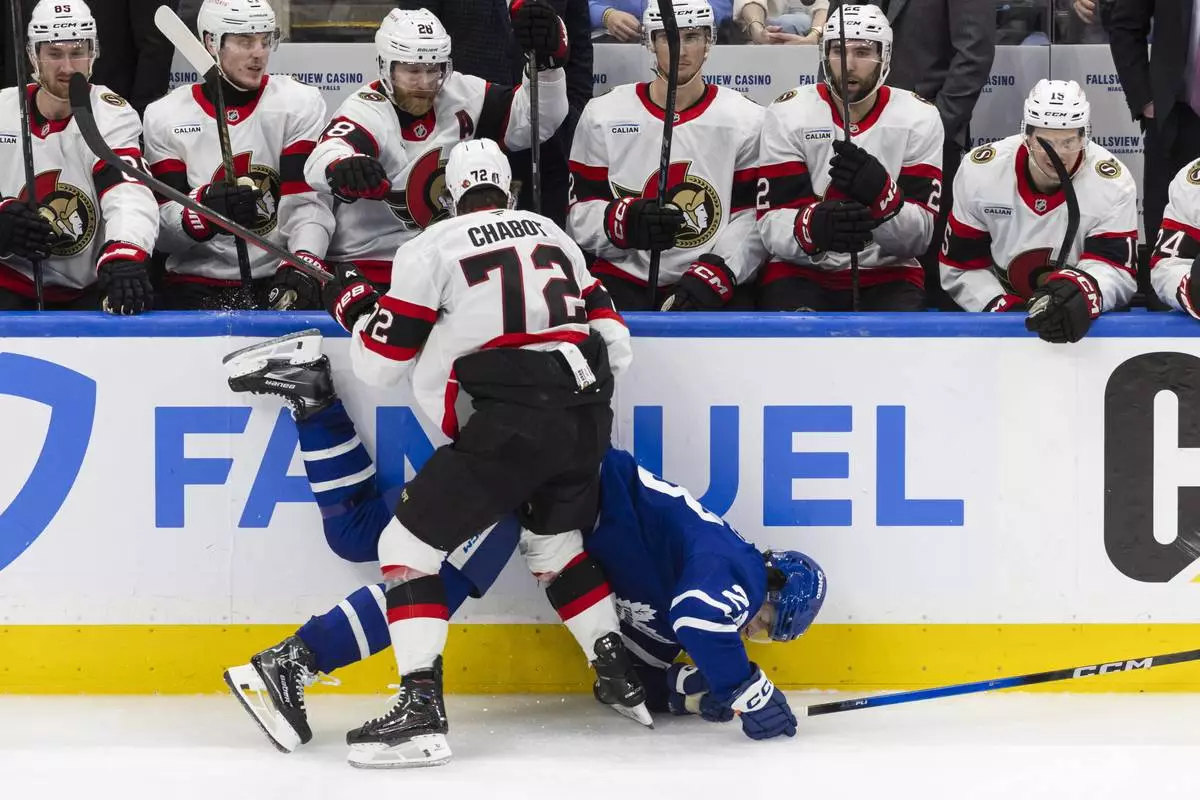
Toronto Maple Leafs‚ Matthew Knies (23) takes a hit from Ottawa Senators‚ Thomas Chabot (72) during third period NHL playoff action in Toronto on Sunday, April 20, 2025. (Nick Iwanyshyn/The Canadian Press via AP)
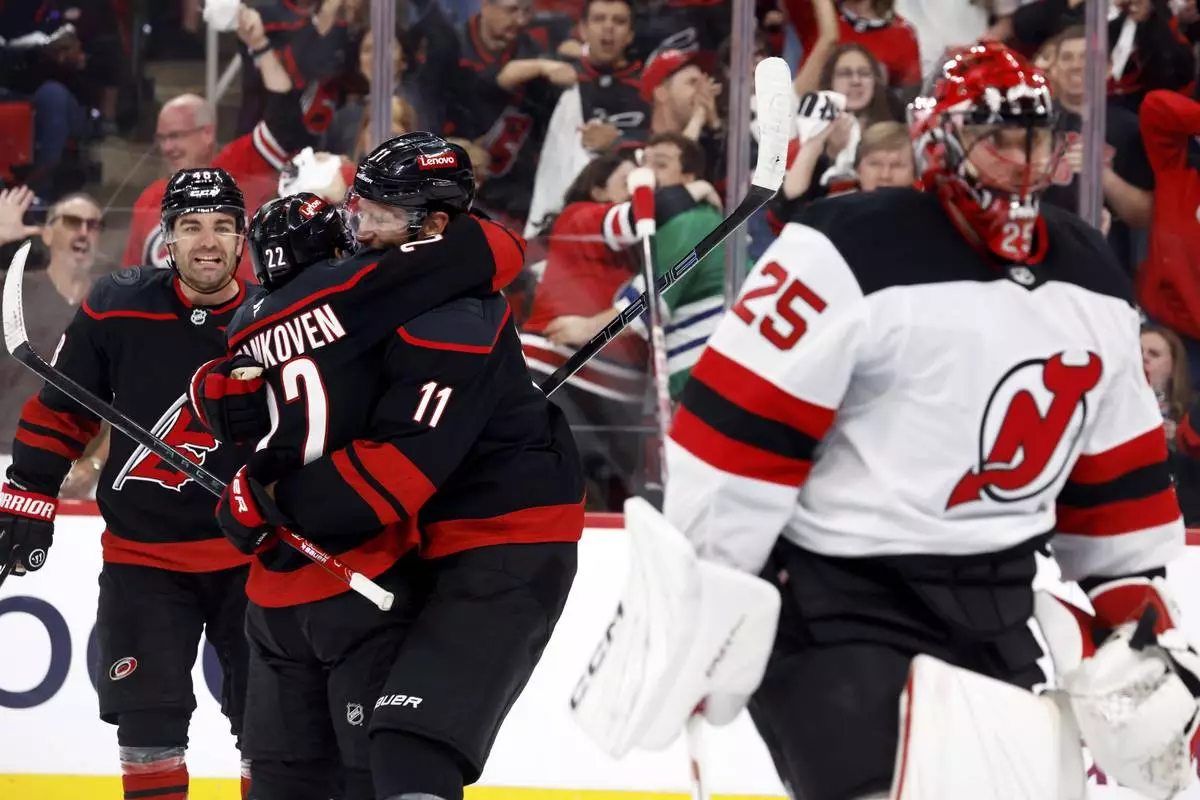
Carolina Hurricanes' Logan Stankoven, left hugs Logan Stankoven (22) following his goal with New Jersey Devils Jacob Markstrom (25) nearby during the second period of Game 1 of an NHL hockey Stanley Cup first-round playoff series in Raleigh, N.C., Sunday, April 20, 2025. (AP Photo/Karl DeBlaker)

Vegas Golden Knights left wing Pavel Dorofeyev (16) celebrates with defenseman Shea Theodore (27) and center Tomas Hertl (48) after Dorofeyev's goal during the second period in Game 1 of an NHL hockey Stanley Cup first-round playoff series against the Minnesota Wild, Sunday, April 20, 2025, in Las Vegas. (AP Photo/Ian Maule)
NEW YORK (AP) — Reviving a campaign pledge, President Donald Trump wants a one-year, 10% cap on credit card interest rates, a move that could save Americans tens of billions of dollars but drew immediate opposition from an industry that has been in his corner.
Trump was not clear in his social media post Friday night whether a cap might take effect through executive action or legislation, though one Republican senator said he had spoken with the president and would work on a bill with his “full support.” Trump said he hoped it would be in place Jan. 20, one year after he took office.
Strong opposition is certain from Wall Street in addition to the credit card companies, which donated heavily to his 2024 campaign and have supported Trump's second-term agenda. Banks are making the argument that such a plan would most hurt poor people, at a time of economic concern, by curtailing or eliminating credit lines, driving them to high-cost alternatives like payday loans or pawnshops.
“We will no longer let the American Public be ripped off by Credit Card Companies that are charging Interest Rates of 20 to 30%,” Trump wrote on his Truth Social platform.
Researchers who studied Trump’s campaign pledge after it was first announced found that Americans would save roughly $100 billion in interest a year if credit card rates were capped at 10%. The same researchers found that while the credit card industry would take a major hit, it would still be profitable, although credit card rewards and other perks might be scaled back.
About 195 million people in the United States had credit cards in 2024 and were assessed $160 billion in interest charges, the Consumer Financial Protection Bureau says. Americans are now carrying more credit card debt than ever, to the tune of about $1.23 trillion, according to figures from the New York Federal Reserve for the third quarter last year.
Further, Americans are paying, on average, between 19.65% and 21.5% in interest on credit cards according to the Federal Reserve and other industry tracking sources. That has come down in the past year as the central bank lowered benchmark rates, but is near the highs since federal regulators started tracking credit card rates in the mid-1990s. That’s significantly higher than a decade ago, when the average credit card interest rate was roughly 12%.
The Republican administration has proved particularly friendly until now to the credit card industry.
Capital One got little resistance from the White House when it finalized its purchase and merger with Discover Financial in early 2025, a deal that created the nation’s largest credit card company. The Consumer Financial Protection Bureau, which is largely tasked with going after credit card companies for alleged wrongdoing, has been largely nonfunctional since Trump took office.
In a joint statement, the banking industry was opposed to Trump's proposal.
“If enacted, this cap would only drive consumers toward less regulated, more costly alternatives," the American Bankers Association and allied groups said.
Bank lobbyists have long argued that lowering interest rates on their credit card products would require the banks to lend less to high-risk borrowers. When Congress enacted a cap on the fee that stores pay large banks when customers use a debit card, banks responded by removing all rewards and perks from those cards. Debit card rewards only recently have trickled back into consumers' hands. For example, United Airlines now has a debit card that gives miles with purchases.
The U.S. already places interest rate caps on some financial products and for some demographics. The Military Lending Act makes it illegal to charge active-duty service members more than 36% for any financial product. The national regulator for credit unions has capped interest rates on credit union credit cards at 18%.
Credit card companies earn three streams of revenue from their products: fees charged to merchants, fees charged to customers and the interest charged on balances. The argument from some researchers and left-leaning policymakers is that the banks earn enough revenue from merchants to keep them profitable if interest rates were capped.
"A 10% credit card interest cap would save Americans $100 billion a year without causing massive account closures, as banks claim. That’s because the few large banks that dominate the credit card market are making absolutely massive profits on customers at all income levels," said Brian Shearer, director of competition and regulatory policy at the Vanderbilt Policy Accelerator, who wrote the research on the industry's impact of Trump's proposal last year.
There are some historic examples that interest rate caps do cut off the less creditworthy to financial products because banks are not able to price risk correctly. Arkansas has a strictly enforced interest rate cap of 17% and evidence points to the poor and less creditworthy being cut out of consumer credit markets in the state. Shearer's research showed that an interest rate cap of 10% would likely result in banks lending less to those with credit scores below 600.
The White House did not respond to questions about how the president seeks to cap the rate or whether he has spoken with credit card companies about the idea.
Sen. Roger Marshall, R-Kan., who said he talked with Trump on Friday night, said the effort is meant to “lower costs for American families and to reign in greedy credit card companies who have been ripping off hardworking Americans for too long."
Legislation in both the House and the Senate would do what Trump is seeking.
Sens. Bernie Sanders, I-Vt., and Josh Hawley, R-Mo., released a plan in February that would immediately cap interest rates at 10% for five years, hoping to use Trump’s campaign promise to build momentum for their measure.
Hours before Trump's post, Sanders said that the president, rather than working to cap interest rates, had taken steps to deregulate big banks that allowed them to charge much higher credit card fees.
Reps. Alexandria Ocasio-Cortez, D-N.Y., and Anna Paulina Luna, R-Fla., have proposed similar legislation. Ocasio-Cortez is a frequent political target of Trump, while Luna is a close ally of the president.
Seung Min Kim reported from West Palm Beach, Fla.
President Donald Trump arrives on Air Force One at Palm Beach International Airport, Friday, Jan. 9, 2025, in West Palm Beach, Fla. (AP Photo/Julia Demaree Nikhinson)
FILE - Visa and Mastercard credit cards are shown in Buffalo Grove, Ill., Feb. 8, 2024. (AP Photo/Nam Y. Huh, File)