The Jiuquan Satellite Launch Center is fully prepared for sandstorms and has intensified meteorological monitoring measures for the upcoming launch of the Shenzhou-20 manned space mission.
At the launch center, engineers are conducting detailed inspections of the enclosed areas of the launch tower and the sand-proof sealing of ground equipment, in order to prevent outdoor facilities, such as the air conditioning system, non-standard tower equipment, and power supply and distribution systems, from being eroded by strong winds and dust storms.
"We have taken protective measures for key parts of the launch tower, particularly the enclosed area of the spacecraft spanning from the 7th to the 9th floors. All holes and crevices have been sealed. We have also protected large mechanical components, bearings and cables on the tower. We have arranged for personnel to stand guard 24 hours a day, closely monitoring the temperature, humidity and cleanliness of the fairing air conditioning. Additionally, based on the previous equipment operation assessment, we have conducted emergency response drills for all typical faults. Currently, the launch site system has sufficient materials and equipment, and the contingency plans have been well rehearsed. We are confident in completing the launch of Shenzhou-20," said Wang Zuobing, an engineer at the launch center.
The ground-based tracking and control systems have also been put under protective enclosures to ensure their smooth operation under challenging conditions.
"After entering the task cycle, we have conducted a daily review of the equipment status. Based on the meteorological conditions, we have formulated four special emergency plans and established a daily inspection system for key components, such as the external interfaces and imaging modules of the equipment. Currently, the equipment is in good condition," explained He Yongfu, another engineer.
In addition, meteorological workers at the Jiuquan Satellite Launch Center are intensifying their monitoring and forecasting efforts by systematically collecting meteorological data from the launch site for the month of April over the past decade and establishing a refined forecasting model.
"We have intensified pre-launch consultations and forecasts. During this phrase, we will generate hourly forecasts for the next 72 hours, which can more intuitively and accurately reflect future weather conditions. This is also beneficial for decision-making authorities to learn about related window forecasts, so as to provide auxiliary support for their decision-making," said Zhang Fang, a meteorological worker at the Jiuquan Satellite Launch Center.
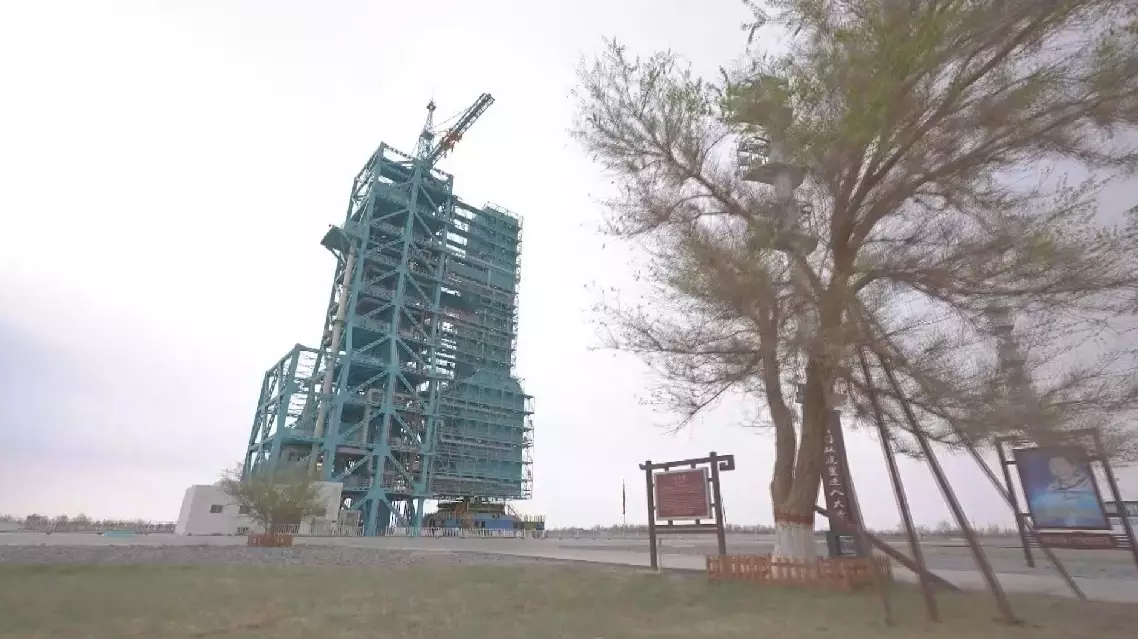
Jiuquan launch center well-prepared to cope with sandstorms
Artists have reimagined ancient themes through a modern lens at the 60th Venice Biennale China National Pavilion Exhibition, now underway in Shanghai.
The main feature of the exhibition is a fully immersive project by artist Che Jianquan, who has placed consecutive screens placed side by side to present his two-decade-long documentation of the same pavilion since 2003.
Through his lens, the artist captures the pavilion, as it emerges and disappears amidst mist and clouds, evoking the aesthetic of misty landscapes in traditional Chinese ink paintings.
"At the beginning, I wanted to use painting to document my feeling, but later I realized that painting was somewhat powerless. So, starting in 2003, I began using the earliest video equipment to start recording. What I care about more is a place—a very small location—and the unique connection it has within that field to history and to the culture of that region. I think this is something I hope to achieve: through a seemingly ordinary scene, to uncover the stories behind it, as well as its possible influence on both the past era and the present," said Chen.
Established in 1895, the Venice Biennale is one of the premier events in the global art world. This year, the China National Pavilion Exhibition, under the theme "Atlas: Harmony in Diversity," presents not only the documentary archives of 100 Chinese paintings held overseas, but also seven contemporary artworks created by seven Chinese artists exploring themes, such as architecture, landscapes, figures, flora and fauna.
"The core of the Venice Biennale is contemporary art, reflecting the spirit of the present era—yet the present and history cannot be separated. This exhibition is rooted in the tradition of Chinese painting across dynasties, drawing from over 20,000 individual works that took us twenty years to collect globally," said Wang Xiaosong, an artist and the curator of the exhibition.
"Notably, we discovered that more than 3,000 of these paintings had been lost overseas, which we spent two decades retrieving through digital tools. This is how we engage with traditional art: through each artist's reflection and a new understanding of the relationship between the ancients, the present, and the future," he added.
Wang drew special attention to a piece by the modern artist Qiu Zhenzhong, who he said merges the art of Chinese gardens with calligraphy using traditional methods to showcase contemporary issues such as environmental and ecological change.
"It's like a dialogue with nature," Wang said.
The exhibition in Shanghai is the final stop of the national tour, following the legs in the southwest Chinese city of Chongqing and the southern Chinese city of Guangzhou, and will run until May 31.
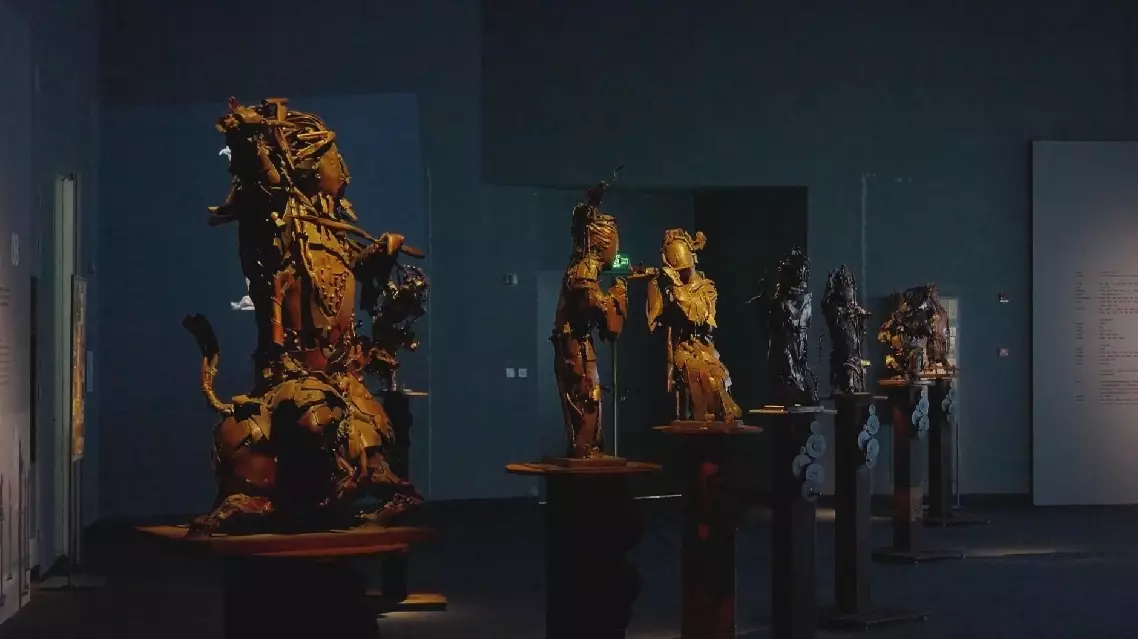
Exhibition in Shanghai bridges contemporary art with centuries of Chinese artistic tradition