Government announces updates to routine drinking water testing programme and Enhanced Water Quality Monitoring Programme
The Water Supplies Department (WSD) has been committed to providing high-quality and reliable drinking water to Hong Kong citizens in accordance with the guidelines of the World Health Organization (WHO). Following the release of the latest Guidelines for Drinking-water Quality (GDWQ) by the WHO in 2022, the Government has commissioned an expert consultant to review the routine drinking water testing programme for Hong Kong Drinking Water Standards. The review also covers the latest developments in drinking water standards/guidelines across a number of jurisdictions. Based on the review findings and recommendations of the expert consultant, the Government will update the routine drinking water testing programme, including the addition of three new parameters, namely "manganese", "cylindrospermopsins" and "saxitoxins", as well as the expansion of the coverage of an existing parameter "microcystin-LR". These revisions were proposed in accordance with the latest WHO's GDWQ and have been submitted to the Drinking Water Safety Advisory Committee, which comprises academics, medical experts and relevant industry stakeholders, for deliberation. The Committee's agreement on the proposed revisions has been obtained.
Regarding two parameters of "tetrachloroethene" and "uranium", covered under the current testing programme, previous routine drinking water quality monitoring data showed that their contents were extremely low or even undetectable, far below the level that would pose a risk to health. These two parameters will be excluded from the routine testing programme, but will still be included in the Surveillance List to facilitate the WSD's surveillance monitoring from time to time. The Committee's agreement on the recommendation has also be obtained.
Under the routine drinking water testing programme, water samples are taken from catchments, impounding reservoirs, water treatment works, service reservoirs, water distribution systems and water taps accessible to the general public (e.g. shopping centres, community facilities, sports venues, government offices, etc) for testing. The parameters covered by the programme are established in accordance with WHO's GDWQ, with testing frequencies ranging from daily to monthly, while the parameters covered by the Surveillance List are usually tested once every six months.
In addition, the WSD expands the scope of drinking-water quality monitoring through the Enhanced Water Quality Monitoring Programme (Enhanced Programme) to cover water taps of all residential and non-residential customers. Each year, about 670 premises will be randomly selected from all water accounts in Hong Kong. Samples will be collected from water taps of these premises for testing of six metals (namely antimony, cadmium, chromium, copper, lead and nickel), residual chlorine and Escherichia coli. According to the monitoring data over the past years, the levels of antimony in drinking water samples collected from these premises have always been below the reporting limit. Based on the advice of the expert consultant, the WSD will stop testing antimony under the Enhanced Programme, while the testing of other items remain unchanged. This arrangement has been agreed by the Committee.
The above proposal will be implemented from June 2025. The public may visit the WSD's website for the latest updates.
Routine drinking water testing programme
www.wsd.gov.hk/en/core-businesses/water-quality/my-drinking-water-quality/index.html
Enhanced Water Quality Monitoring Programme
www.wsd.gov.hk/en/core-businesses/water-quality/action-plan-for-enhancing-of-drinking-water-safety/drinking-water-standards-enhanced-water-quality/index.html
Government announces updates on follow-up work on Tai Po fire
The three task forces set up by the Government for the fire at Wang Fuk Court in Tai Po - the Task Force on Investigation and Regulation, the Task Force on Emergency Support and Fund-Raising, and the Task Force on Emergency Accommodation Arrangements - are making full efforts to follow up on the support, relief, and investigation work related to the incident. Details are as follows:
Financial and welfare support
---------------------------------
For the Support Fund for Wang Fuk Court in Tai Po, established by the Government, donations received are about $3.4 billion as of noon today (December 13). With the start-up capital of $300 million from the Government, the fund's total has now reached around $3.7 billion. The fund will be used to assist residents in rebuilding their homes and providing long-term and sustained support.
Accommodation support
---------------------------
As of this morning, a total of 1 392 residents have been accommodated, through the co-ordination of the Home and Youth Affairs Bureau, in youth hostels, camps, or hotel rooms. Another 3 163 residents are currently living in transitional housing units provided by the Housing Bureau or units from the Hong Kong Housing Society (HKHS).
In consideration of the extremely urgent situation of the residents affected by the fire incident, a special arrangement of a full rent exemption has been made earlier by the Housing Bureau to provide accommodation support to those affected residents moving into transitional housing or HKHS projects. In other words, if needed, the affected residents can stay for a longer period of time. The Government will continue to support the affected residents in terms of accommodation, and the residents in need do not have to worry about the relevant rental expenses or the duration of stay.
In addition, staff from the operating organisations of transitional housing and HKHS, as well as volunteers have been working around the clock to furnish the units with essential supplies. Taking Eminence Tower in Hung Shui Kiu as an example, each unit is equipped, upon move-in, with furniture and appliances such as bed frames, mattresses, pillows, cooking stoves and water heaters. Daily necessities including toilet paper, slippers and basic cleaning supplies, etc. are also provided. Such efforts are intended to help the affected residents settle in as quickly as possible.
At the same time, a number of organisations have proactively stationed their staff in some projects to provide residents in need with various forms of support, including free medical and legal consultation services. The Government has also set up service stations in 18 projects where more residents have moved in, providing consultation and support services for residents in need, standing together with them.
Relief supplies and donations
---------------------------------
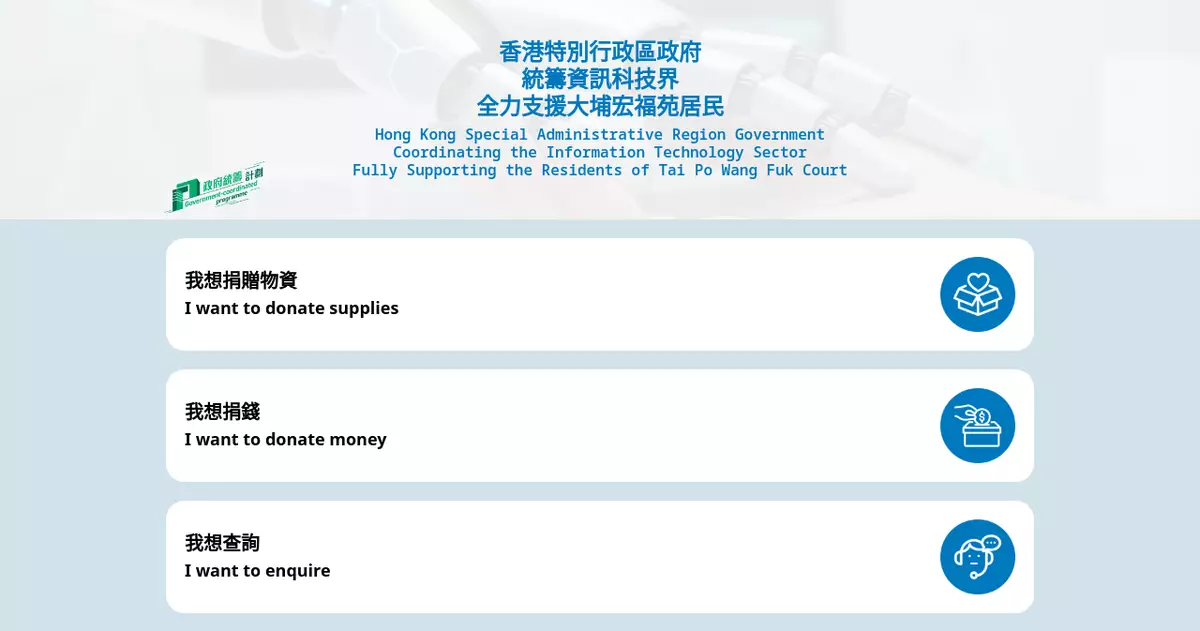
The supplies donation online platform, established by the Government and the information technology sector, continues to operate, facilitating the registration of supplies donations from organisations and the public. The Government has so far received over 1 800 registrations, of which approximately 30 per cent were submitted by organisations, whereas the others were contributed by the public. The various registered donation items include food and beverages, clothing, daily necessities, bedding, and electrical appliances. The Government is actively assessing residents' actual needs through the relevant policy bureau, government departments, and service organisations for the matching of donated supplies in order to distribute appropriate items in phases to places in need. So far, about 19 600 donation items covering various categories have been distributed to different places. The matching and distribution of supplies will continue.
Regulation and inspection work
----------------------------------
The Housing Department today continued to remove the burnt scaffolding on the external walls of Wang Cheong House, Wang Tai House and Wang Sun House. As the environment at scene is narrow and the scaffolding and the protective nets of individual buildings may be subject to more serious damage, for the sake of safety, the Housing Department will conduct assessments with the Police on the timetable of removing the scaffolding of the remaining four affected buildings. In addition, the Independent Checking Unit of the Housing Bureau has also completed the extraction of concrete core samples from the seven affected buildings at Wang Fuk Court today.
The Development Bureau (DEVB) announced on December 11 a new mechanism for sampling and testing scaffold nets for external walls in Hong Kong. The Buildings Department is preparing for the issuance of a new practice note to registered contractors and will meet with the industry next week. The DEVB is moving ahead in full steam the supporting arrangements to ensure that there are sufficient designated laboratories and a suitable site for off-site sampling work.
Source: AI-found images