WASHINGTON (AP) — The height of tax season was the height of turmoil at the IRS.
The agency shuffled through three acting directors over the course of a week. It’s preparing to lose tens of thousands of workers to layoffs and voluntary retirements. And President Donald Trump is weighing in on which nonprofits should lose their tax-exempt status, an incursion into the agency’s typically apolitical stance that threatens to further erode trust in federal institutions and weaponize enforcement efforts.
Just three months into Trump's second term, the government's fly-under-the-radar tax collector has become the latest platform for the Republican administration’s vision to cut and control the federal bureaucracy. Tax policy experts fear that taxpayer services and collection efforts will face prolonged delays as a result of the rapid changes.
The quick turnover in leadership and other changes are likely to dampen employee morale at the IRS and hurt the agency’s ability to serve taxpayers in a timely manner, says Janet Holtzblatt, a senior fellow at the Urban-Brookings Tax Policy Center.
“Leadership sets the tone, particularly in this environment,” she said.
Already, she notes, the agency has lost decades of institutional knowledge from nonpartisan career civil servants who have left over policy disagreements and layoffs.
The upheaval unfolded as Americans dutifully filed their taxes ahead of the April 15 deadline and as a legion of IRS employees undertook work to process returns and dole out refunds. The latest filing season data shows the agency accepted more than 117 million returns this tax season and issued $228.7 billion in refunds.
“We’re committed to improving the efficiency of the Internal Revenue Service," said the agency's newest acting commissioner, Michael Faulkender. "For the last 35 years, we’ve been five years away from the IRS being modernized. Under the direct leadership of Treasury, the modernization will be done in two years at a fraction of the cost.”
Meanwhile, the IRS, like other federal agencies, is hemorrhaging employees over cuts spearheaded by the Department of Government Efficiency, all while the agency churns through acting leaders as it awaits the installation of a permanent leader.
Douglas O'Donnell, the Trump administration's first acting IRS commissioner, announced his retirement in February as furor spread over DOGE gaining access to IRS taxpayer data. Melanie Krause, the second acting commissioner, resigned early this month over a deal between the IRS and the Department of Homeland Security to share immigrants’ tax data with Immigration and Customs Enforcement.
Gary Shapley, an IRS whistleblower who testified publicly about investigations into Hunter Biden’s taxes, was acting commissioner for a matter of days before being replaced by Faulkender, who was elevated just last week. The New York Times reported that Treasury Secretary Scott Bessent had complained to Trump that Shapley had been installed without his knowledge and at the behest of Trump adviser Elon Musk.
Trump's nominee for IRS commissioner, former U.S. Rep. Billy Long of Missouri, is still waiting for a confirmation hearing but faces controversies of his own. Most recently, Senate Democrats have called for a criminal investigation into Long's connections to alleged tax credit loopholes. The lawmakers allege that firms connected to Long duped investors into spending millions of dollars to purchase fake tax credits. Long did not respond to an Associated Press request for comment.
Among other concerns at the agency are fears that Trump will weaponize the IRS against his enemies — and reward his friends.
Some of the Democratic Party’s core political institutions, including fundraising platform ActBlue and the protest group Indivisible, are preparing for the possibility that the federal government may soon launch criminal investigations against them.
Trump said last week at the White House that the administration is looking at the tax-exempt status of Harvard University, which has defied the government's attempts to limit activism on campus, and environmental groups. He also mentioned the ethics watchdog organization Citizens for Responsibility and Ethics in Washington.
“It’s supposed to be a charitable organization,” Trump said of CREW. “The only charity they had is going after Donald Trump. So we’re looking at that. We’re looking at a lot of things.”
Jonathan S. Masur, an administrative law professor at the University of Chicago Law School, said it's unlawful for the president to unilaterally take away organizations' tax-exempt status.
“It's illegal for starters. The Supreme Court has established that that step is not allowed,” he said, adding that he anticipates that the court system will “very quickly block” any such move from the president.
The Trump administration is also watching out for allies of the president.
Treasury official David Eisner sent an email in March to a top IRS official regarding Mike Lindell, the founder of MyPillow and one of the chief proponents of the lie that the 2020 election was stolen from Trump.
“The ‘My Pillow guy’ and a high-profile friend of the President recently received an audit letter, from what I understand, his second in two years,” Eisner wrote in the email, which was viewed by the AP. The president “is concerned that he may have been inappropriately targeted," Eisner wrote. A Treasury spokesperson in an emailed statement said Eisner is a “dedicated public servant” who “acted appropriately with the expectation that this would be sent to the Inspector General.”
“Sharing relevant information with nonpartisan Inspectors General is designed to be an effective and confidential way to help ensure all Americans are treated fairly,” they added.
Among other changes in recent weeks are concerns about the IRS' engagement with the Department of Homeland Security over enforcing a new data-sharing agreement signed earlier this month by Bessent and Homeland Security Secretary Kristi Noem. The agreement will allow ICE to submit names and addresses of immigrants inside the U.S. illegally to the IRS for cross-verification against tax records.
The Treasury Department said the agreement is authorized by a statute that relates to criminal information sharing. However, that agreement is being litigated in federal court.
U.S. District Judge Dabney Friedrich will soon decide whether to refuse or grant a preliminary injunction in a lawsuit filed by nonprofit groups. The groups argue that immigrants in the country illegally who pay taxes are entitled to the same privacy protections as U.S. citizens and immigrants who are legally in the country.
The Treasury Department says the agreement will help carry out Trump’s agenda to secure U.S. borders and is part of his larger nationwide immigration crackdown, which has resulted in deportations, workplace raids and the use of an 18th-century wartime law to deport Venezuelan migrants.
Holtzblatt said the agreement is indicative of the turmoil at the IRS.
“There's an emphasis on improving technology and sharing information," but it's unclear for what reason, she said.
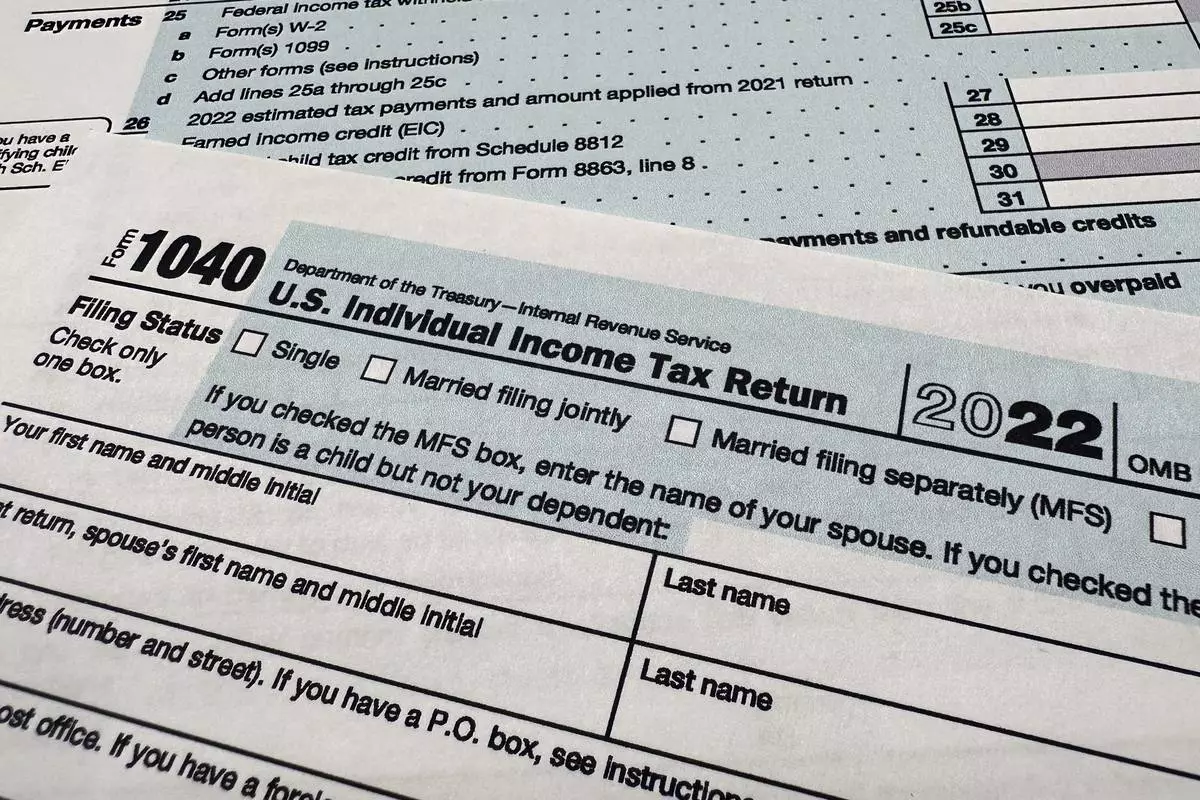
FILE - The Internal Revenue Service 1040 tax form for 2022 is seen on April 17, 2023. (AP Photo/Jon Elswick, File)
WASHINGTON (AP) — Venezuelan opposition leader María Corina Machado said she presented her Nobel Peace Prize medal to President Donald Trump at the White House on Thursday even as he has questioned her credibility to take over her country after the U.S. ousted then-President Nicolás Maduro.
The Nobel Institute has said Machado could not give her prize to Trump, an honor that he has coveted. Even if it the gesture proves to be purely symbolic, it was extraordinary given that Trump has effectively sidelined Machado, who has long been the face of resistance in Venezuela. He has signaled his willingness to work with acting President Delcy Rodríguez, who had been Maduro’s second in command.
“I presented the president of the United States the medal, the Nobel Peace Prize," Machado told reporters after leaving the White House and heading to Capitol Hill. She said she had done so "as a recognition for his unique commitment with our freedom.”
Trump confirmed later on social media that Machado had left the medal for him to keep, and he said it was an honor to meet her.
“She is a wonderful woman who has been through so much. María presented me with her Nobel Peace Prize for the work I have done,” Trump said in his post. “Such a wonderful gesture of mutual respect. Thank you María!”
The White House later posted a photo of Machado standing next to Trump in the Oval Office as he holds the medal in a large frame. A text in the frame reads, "Presented as a personal symbol of gratitude on behalf of the Venezuelan people in recognition of President Trump’s principled and decisive action to secure a free Venezuela.”
Trump has raised doubts about his stated commitment to backing democratic rule in Venezuela, giving no timetable on when elections might be held. Machado indicated that he had provided few specifics on that front during their discussion.
She did not provide more information on what was said.
After the closed-door meeting, Machado greeted dozens of cheering supporters waiting for her near the White House gates, stopping to hug many.
“We can count on President Trump,” she told them without elaborating, prompting some to briefly chant, “Thank you, Trump.”
Before her visit to Washington, Machado had not been seen in public since she traveled last month to Norway, where her daughter received the peace prize on her behalf. She had spent 11 months in hiding in Venezuela before she appeared in Norway after the ceremony.
The jubilant scene after her meeting with Trump stood in contrast to political realities in Venezuela. Rodríguez remains in charge of day-to-day government operations, along with others in Maduro’s inner circle. In her first state of the union speech Thursday, the interim president promoted the resumption of diplomatic ties between the historic adversaries and advocated for opening the state-run oil industry to more foreign investment after Trump pledged to seize control of Venezuelan crude sales.
Trump has said it would be difficult for Machado to lead because she “doesn’t have the support within or the respect within the country.” Her party is widely believed to have won 2024 elections rejected by Maduro.
White House press secretary Karoline Leavitt called Machado “a remarkable and brave voice” but also said the meeting didn’t mean Trump’s opinion of her changed, calling it “a realistic assessment.”
Leavitt told reporters that Trump supported new Venezuelan elections “when the time is right” but did not say when he thought that might be.
Leavitt said Machado had sought the face-to-face meeting without setting expectations for what would occur. She spent about two and a half hours at the White House.
“I don’t think he needs to hear anything from Ms. Machado," the press secretary said while the meeting was still going on, other than to have a ”frank and positive discussion about what’s taking place in Venezuela.”
After leaving the White House, Machado went on to a closed-door meeting with a bipartisan group of senators.
Sen. Chris Murphy, D-Conn., said Machado told them that “if there’s not some progress, real progress towards a transition in power, and/or elections in the next several months, we should all be worried.”
“She reminded us that Delcy Rodríguez is, in many ways, worse than Maduro,” he added.
Asked if Machado had heard any commitment from the White House on holding elections in Venezuela, Murphy said, “No, I don’t think she got any commitment from them."
Sen. Bernie Moreno, an Ohio Republican, was exultant following the meeting, saying Machado "delivered a message that loud and clear: What President Trump did was the most important, significant event in Latin America. That getting rid of Maduro was absolutely essential.”
Machado's Washington stop coincided with U.S. forces in the Caribbean Sea seizing another sanctioned oil tanker that the Trump administration says had ties to Venezuela. It is part of a broader U.S. effort to take control of the South American country’s oil after U.S. forces captured Maduro and his wife less than two weeks ago at a heavily guarded compound in the Venezuelan capital of Caracas and brought them to New York to stand trial on drug trafficking charges.
Leavitt said Venezuela's interim authorities have been fully cooperating with the Trump administration and noted that Rodríguez's government said it planned to release more prisoners detained under Maduro. Among those released were five Americans this week.
Trump said Wednesday that he had a “great conversation” with Rodríguez, their first since Maduro was ousted.
Just hours after Maduro's capture, Trump said of Machado that “it would be very tough for her to be the leader.” Machado had steered a careful course to avoid offending Trump, notably after winning the peace prize, and had sought to cultivate relationships with him and key administration voices like Secretary of State Marco Rubio.
The industrial engineer and daughter of a steel magnate, Machado began challenging the ruling party in 2004, when the nongovernmental organization she co-founded, Súmate, promoted a referendum to recall then-President Hugo Chávez. The initiative failed, and Machado and other Súmate executives were charged with conspiracy.
A year later, she drew the anger of Chávez and his allies again for traveling to Washington to meet President George W. Bush, whom Chávez considered an adversary.
Almost two decades later, she marshaled millions of Venezuelans to reject Chávez’s successor, Maduro, for another term in the 2024 election. But ruling party-loyal electoral authorities declared him the winner despite ample credible evidence to the contrary. Ensuing anti-government protests ended in a brutal crackdown.
Garcia Cano reported from Caracas, Venezuela. Associated Press writers Lisa Mascaro, Stephen Groves, Michelle L. Price and Matthew Lee in Washington, and Megan Janetsky in Mexico City contributed to this report.
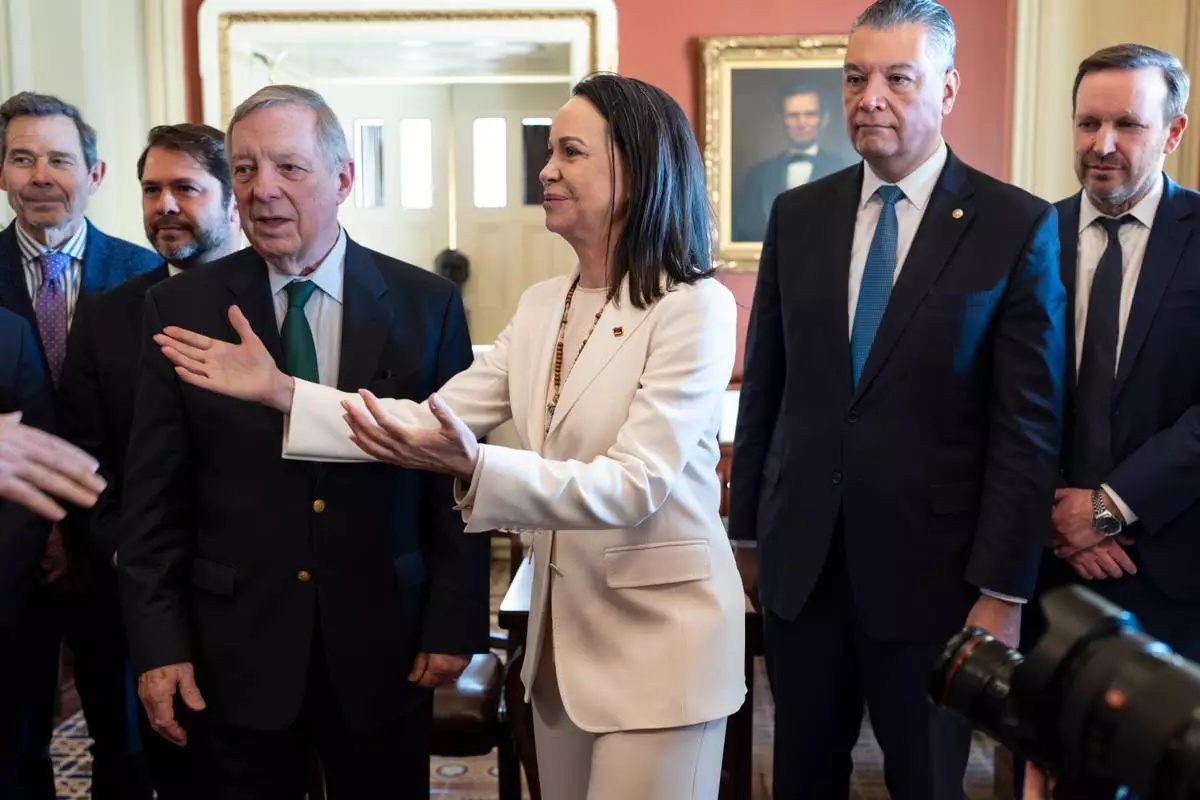
Venezuelan opposition leader Maria Corina Machado is welcomed at the Capitol before a meeting with senators, from left, Sen. John Curtis, R-Utah, Sen. Ruben Gallego, D-Ariz., Sen. Dick Durbin, D-Ill., Sen. Alex Padilla, D-Calif., and Sen. Chris Murphy, D-Conn., as the Nobel Peace Prize recipient visits American leaders two weeks after President Donald Trump toppled Venezuelan president Nicolas Maduro in a stunning military raid, at the Capitol in Washington, Thursday, Jan. 15, 2026. (AP Photo/J. Scott Applewhite)
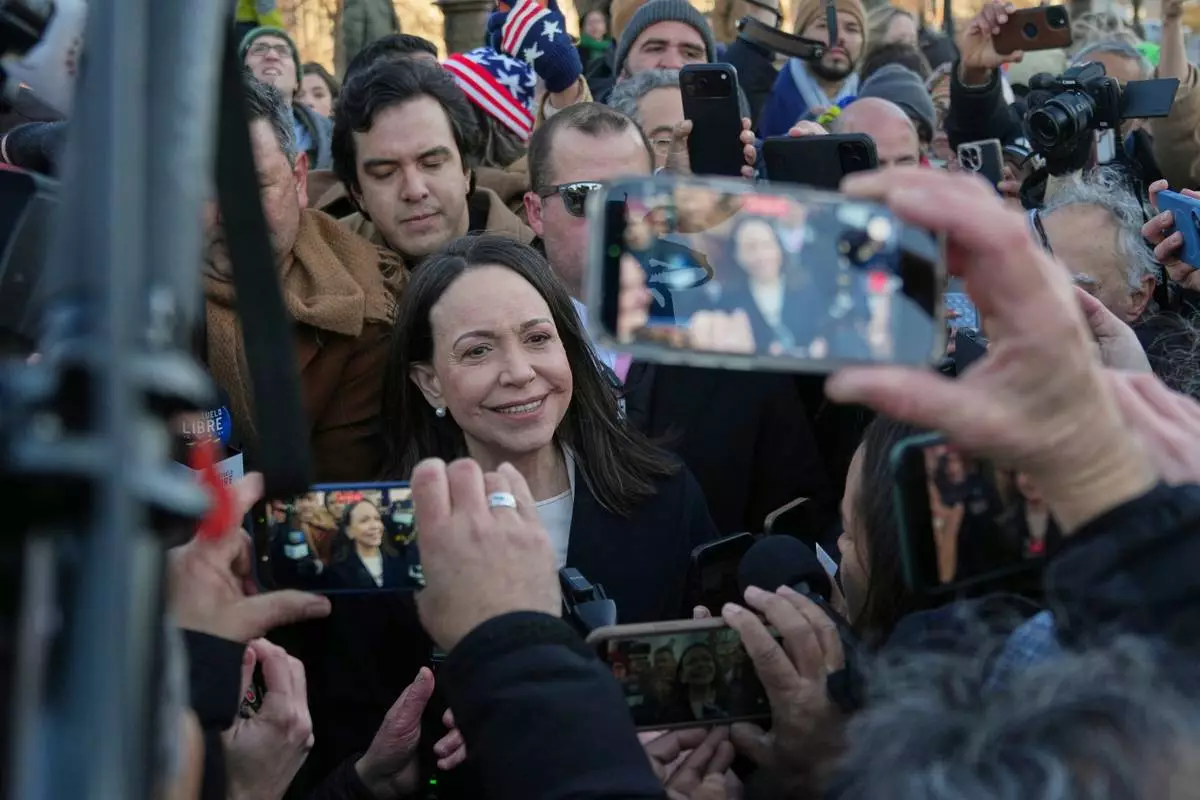
Venezuelan opposition leader María Corina Machado, center, leaves the Capitol, Thursday, Jan. 15, 2026, in Washington. (AP Photo/Allison Robbert)
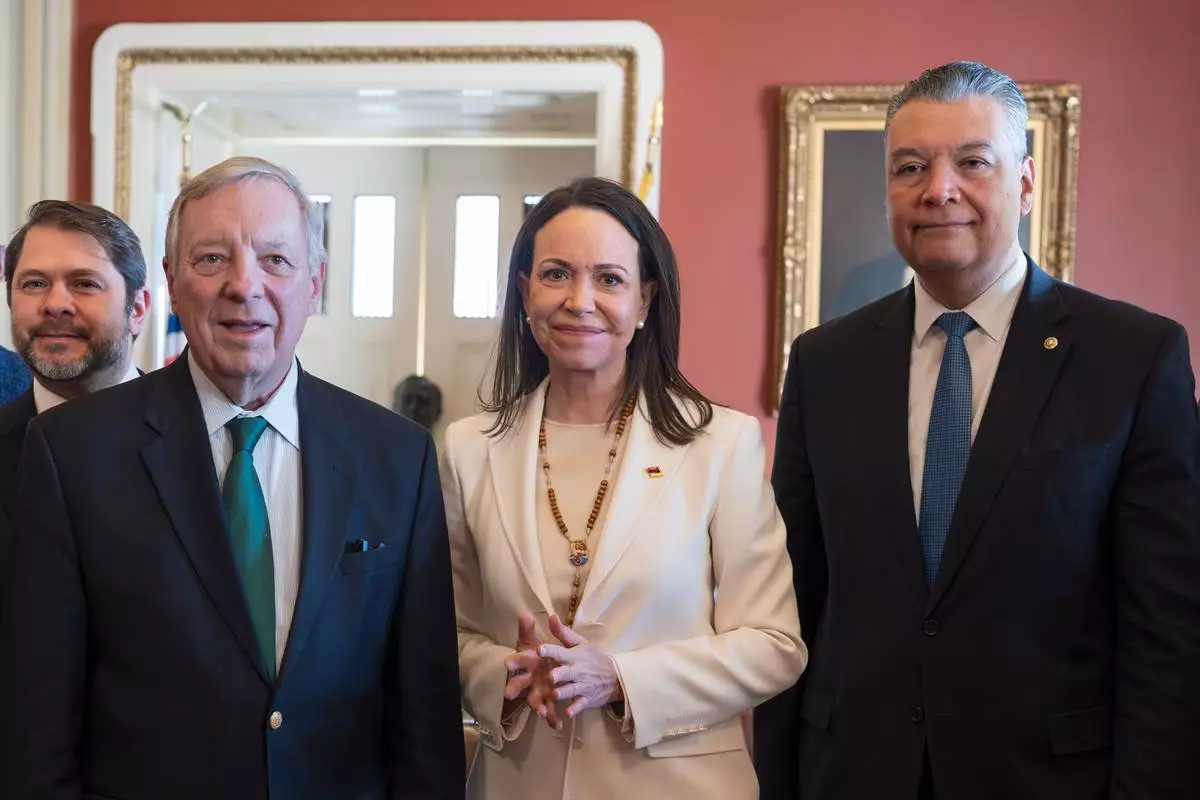
Venezuelan opposition leader Maria Corina Machado, center, is welcomed by Sen. Dick Durbin, D-Ill., left, Sen. Ruben Gallego, D-Ariz., far left, and Sen. Alex Padilla, D-Calif., right, as the Nobel Peace Prize recipient visits American leaders at the Capitol in Washington, Thursday, Jan. 15, 2026. (AP Photo/J. Scott Applewhite)
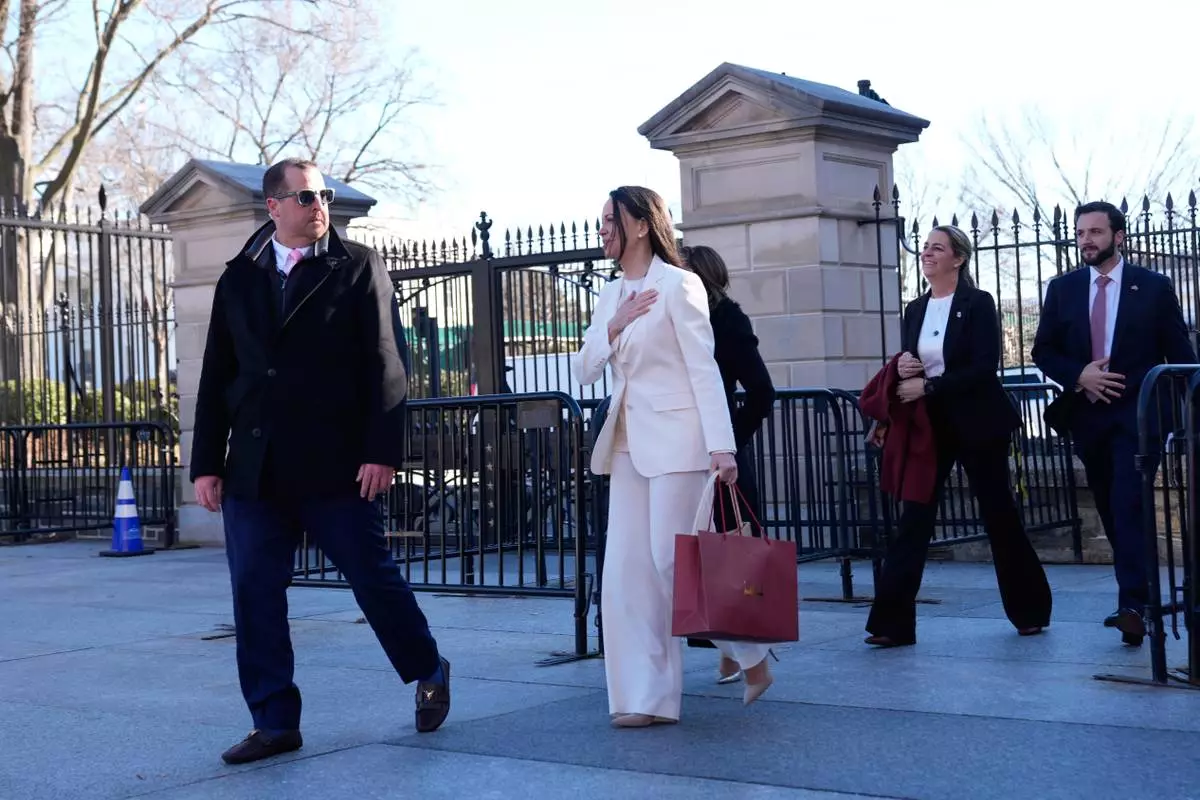
Venezuelan opposition leader María Corina Machado gestures to supporters on Pennsylvania Avenue as she leaves the White House after meeting with President Donald Trump Thursday, Jan. 15, 2026, in Washington. (AP Photo/Pablo Martinez Monsivais)
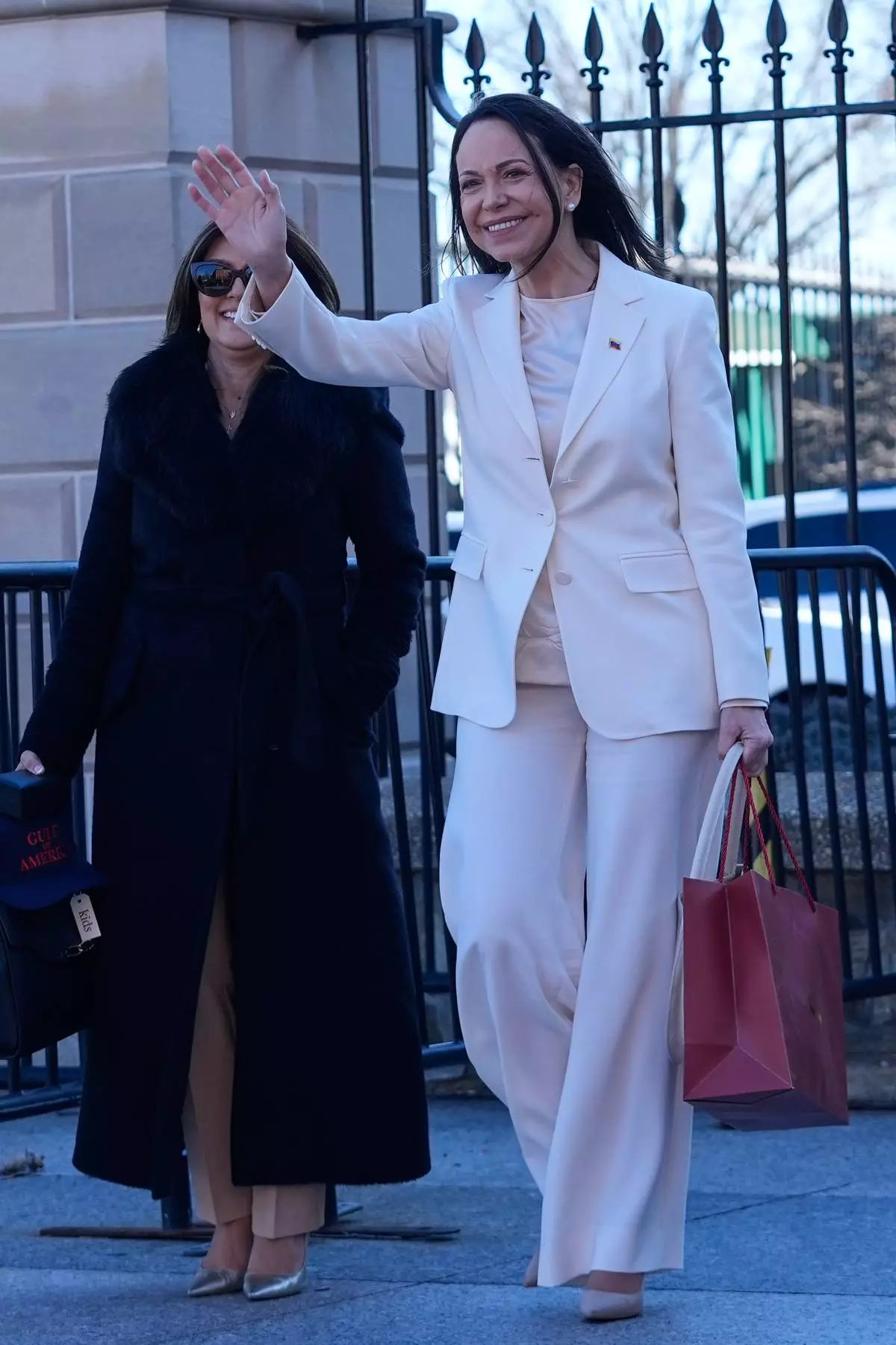
Venezuelan opposition leader María Corina Machado waves to supporters on Pennsylvania Avenue as she leaves the White House after meeting with President Donald Trump Thursday, Jan. 15, 2026, in Washington. (AP Photo/Pablo Martinez Monsivais)
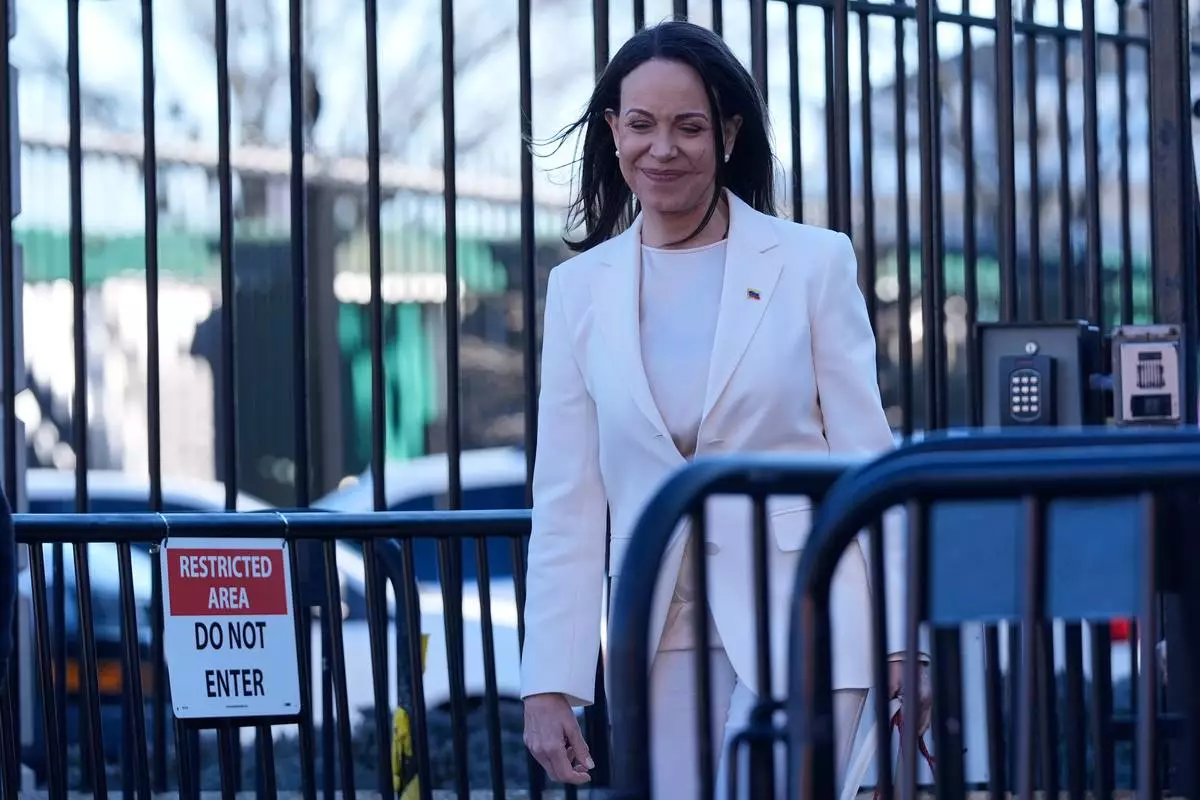
Venezuelan opposition leader María Corina Machado smiles on Pennsylvania Avenue as she leaves the White House after meeting with President Donald Trump Thursday, Jan. 15, 2026, in Washington. (AP Photo/Pablo Martinez Monsivais)
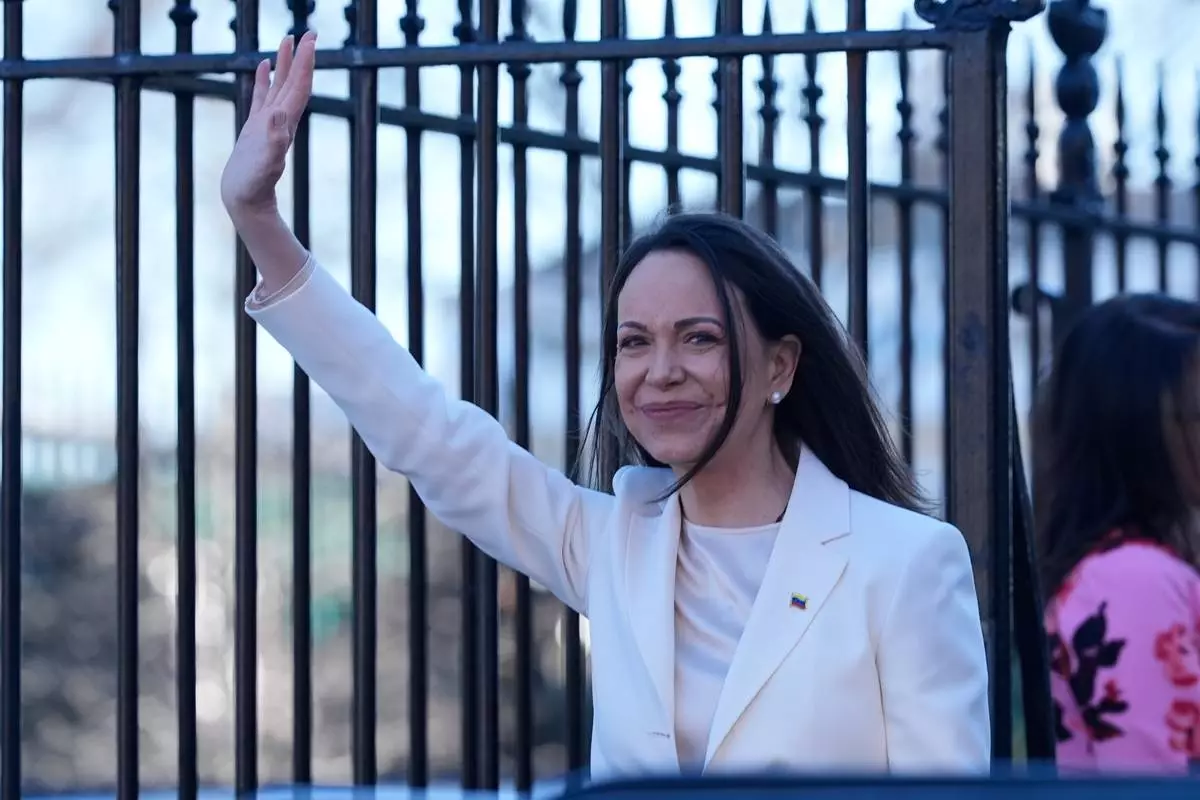
Venezuelan opposition leader María Corina Machado waves to supporters on Pennsylvania Avenue as she leaves the White House after meeting with President Donald Trump Thursday, Jan. 15, 2026, in Washington. (AP Photo/Pablo Martinez Monsivais)
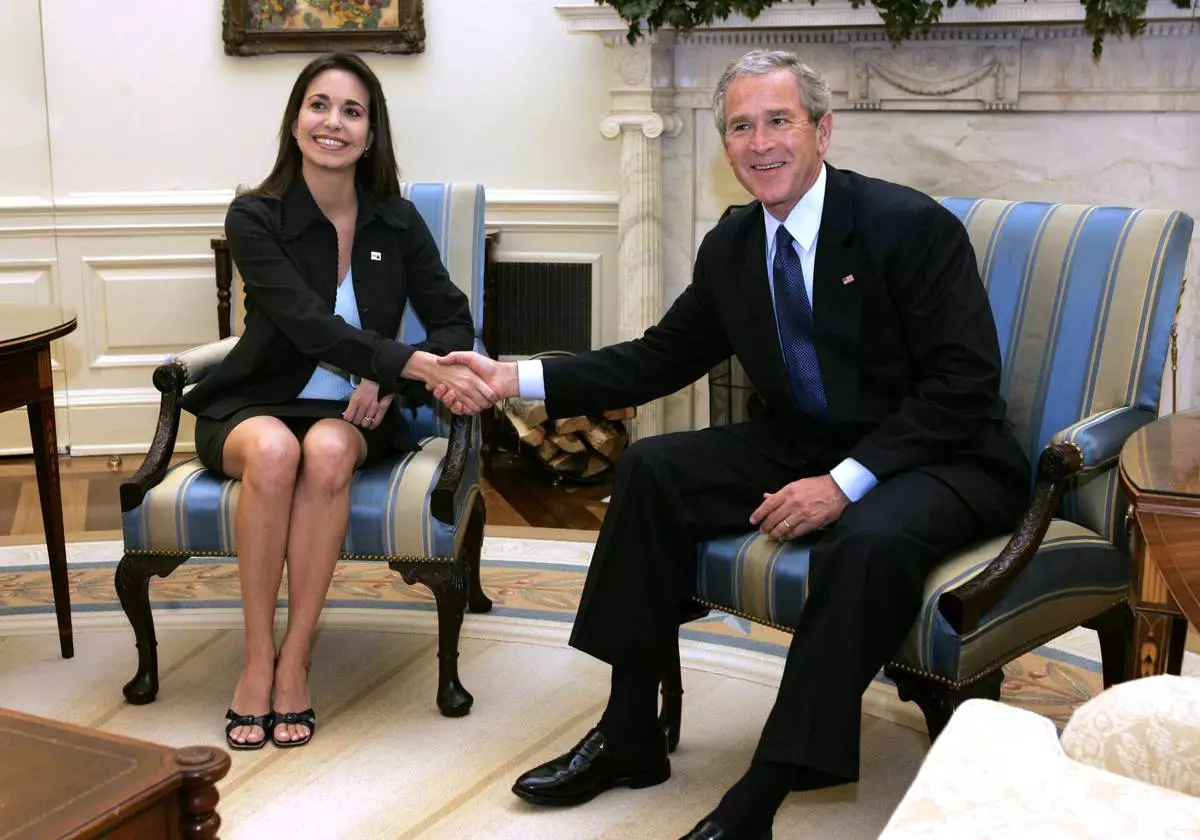
FILE - U.S. President George Bush, right, meets with Maria Corina Machado, executive director of Sumate, a non-governmental organization that defends Venezuelan citizens' political rights, in the Oval Office of the White House, Washington, May 31, 2005. (AP Photo/Charles Dharapak, File)
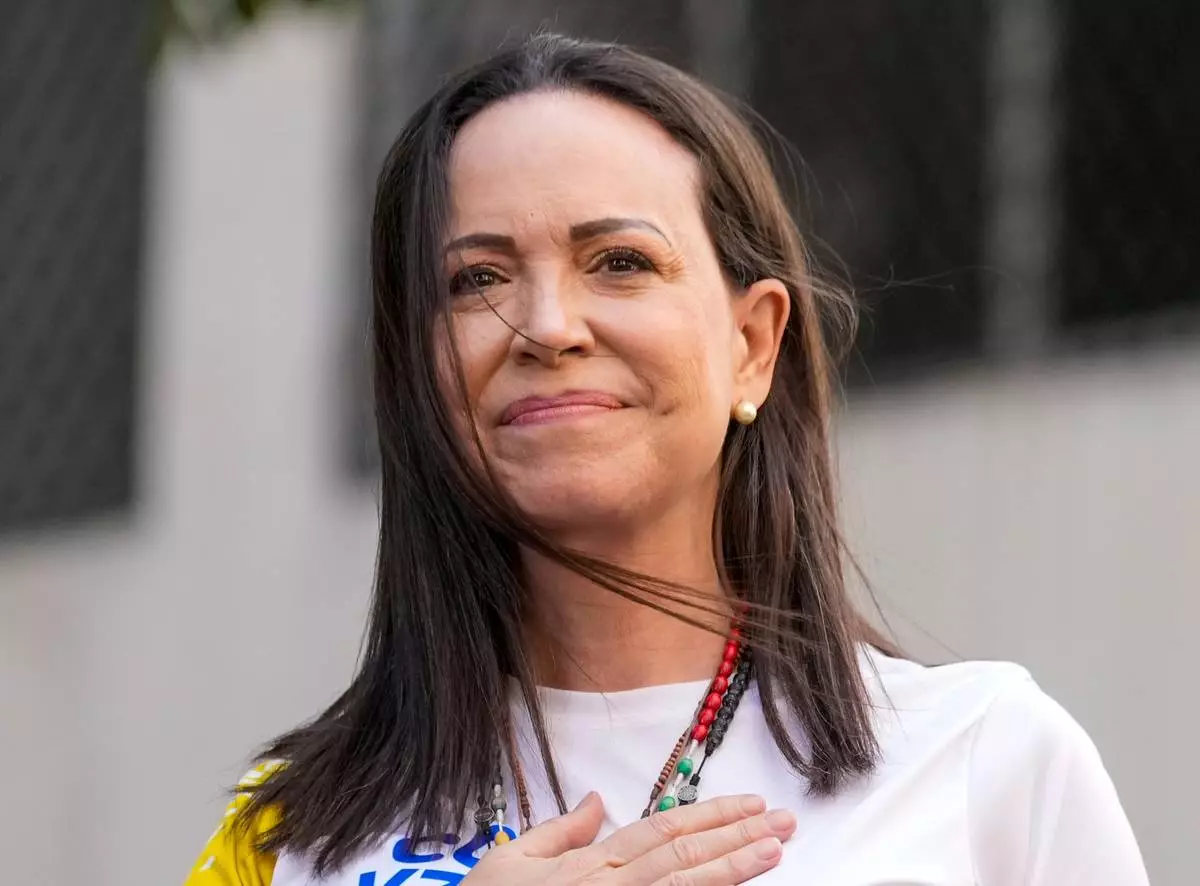
FILE - Opposition leader Maria Corina Machado gestures to supporters during a protest against President Nicolas Maduro the day before his inauguration for a third term, in Caracas, Venezuela, Thursday, Jan. 9, 2025. (AP Photo/Ariana Cubillos, file)