BISMARCK, N.D. (AP) — A federal judge on Wednesday found the state of North Dakota entitled to nearly $28 million for responding to protests of the Dakota Access oil pipeline in 2016 and 2017 — a win for the state in its multiyear effort to recoup the costs from the federal government.
The state filed the lawsuit in 2019, seeking $38 million for policing the protests. The sometimes-chaotic demonstrations drew international attention for the Standing Rock Sioux Tribe’s opposition to the pipeline’s Missouri River crossing upstream of the tribe’s reservation. The tribe has long opposed the pipeline, fearing an oil spill polluting its water supply.
A trial played out over several weeks in early 2024 in federal court in Bismarck, the state capital. People who testified included former North Dakota governors Doug Burgum, who took office in December 2016 during the protests’ height, and Jack Dalrymple, whose administration responded to the protests’ early months.
U.S. District Judge Daniel Traynor found the United States liable to the state on all claims and for more than $27.8 million in damages.
The judge wrote: “The bottom line: United States had a mandatory procedure, it did not follow that procedure, and harm occurred to the state of North Dakota. The law allows reimbursement for this harm. More than that, the rule of law requires this Court to hold the United States liable to remind it of its role in the larger picture of ensuring peace, not chaos.”
Thousands of people camped and demonstrated against the pipeline near the crossing for months, resulting in hundreds of arrests. Sometimes-violent clashes occurred between protesters and law enforcement officers. Law enforcement officers from around the state and region responded to the protests.
The protest camps were cleared in February 2017. An attorney for the state said the protests ended in a response of more than seven months involving 178 agencies, resulting in 761 arrests and requiring four days of cleanup of the camp to remove millions of pounds of trash.
In a joint statement, Gov. Kelly Armstrong and Attorney General Drew Wrigley said: “As outlined in trial testimony and Judge Traynor’s ruling, decisions made by the Obama administration emboldened protestors and ultimately caused millions of dollars in damage to North Dakota, while endangering the health and safety of North Dakota communities, families and law enforcement officers who responded to the protests.”
The state's claims included negligence, gross negligence, civil trespass and public nuisance.
Attorneys for the government said at trial that U.S. Army Corps of Engineers officials “acted reasonably given limited options at their disposal” during the protests, and that the state's claim is “greatly overstated." The government asked the judge to find a lack of legal jurisdiction for the state's claims, that the state hasn't proven its claims and is not entitled to damages.
The Associated Press sent an email to an attorney who argued for the federal government at trial seeking comment.
The pipeline has been transporting oil since June 2017. Many state government officials and industry leaders support the pipeline as crucial infrastructure in the country’s No. 3 oil-producing state. The pipeline carries roughly 5% of the United States' daily oil production.
In 2017, the pipeline company, Energy Transfer, donated $15 million to help cover the response costs. That same year, the U.S. Justice Department gave a $10 million grant to the state for reimbursing the response. The judge found the former to be a gift and reduced the latter from the state's total recovery.
Then-President Donald Trump denied a 2017 request from the state for the federal government to cover the costs through a disaster declaration.
The pipeline is operating while a court-ordered environmental review of the river crossing is carried out.
A North Dakota jury recently found Greenpeace liable for defamation and other claims brought by the pipeline's builder in connection with protest activities, with damages surpassing $660 million against three Greenpeace organizations.
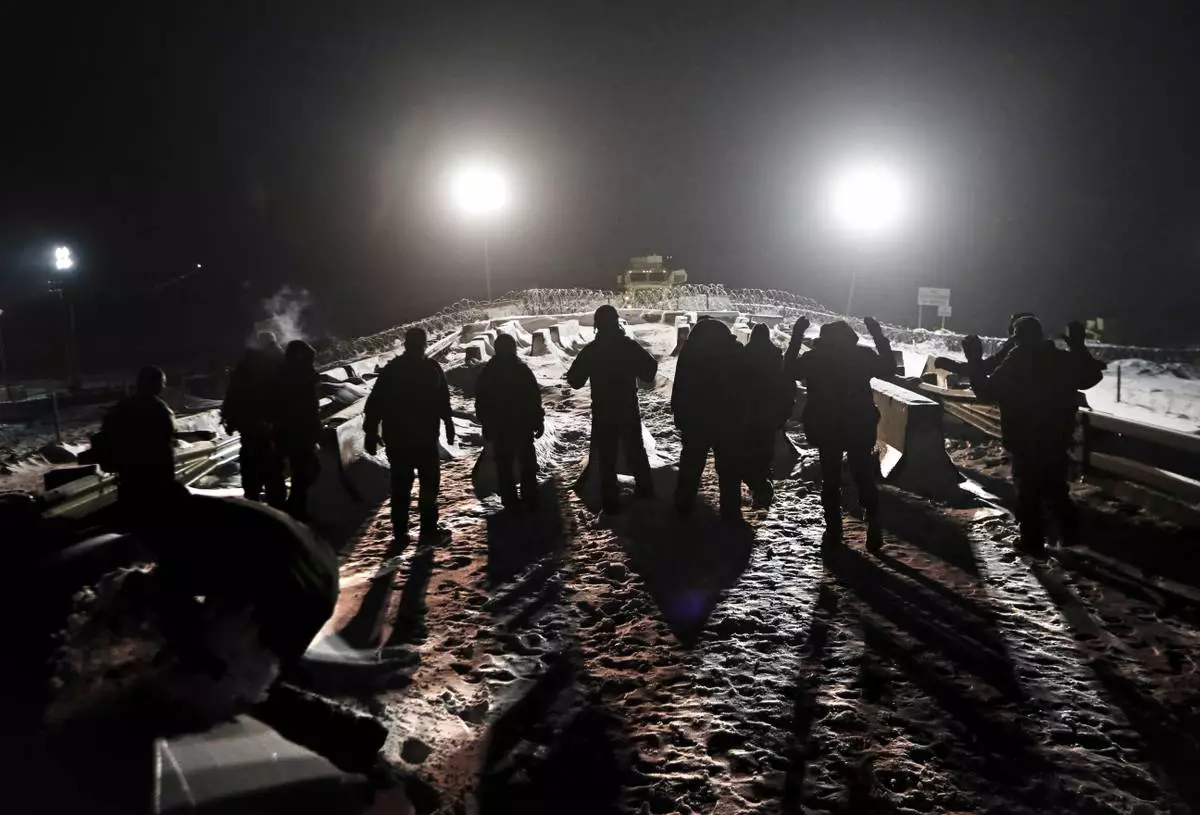
FILE - Military veterans walk onto a closed bridge to protest across from police protecting the Dakota Access oil pipeline site in Cannon Ball, N.D., Thursday, Dec. 1, 2016. (AP Photo/David Goldman, File)