Skip to Content Facebook Feature Image

Canadian lumber industry braces for steep US tariff hikes

China

China

China

Canadian lumber industry braces for steep US tariff hikes

2025-04-25 19:52 Last Updated At:21:27

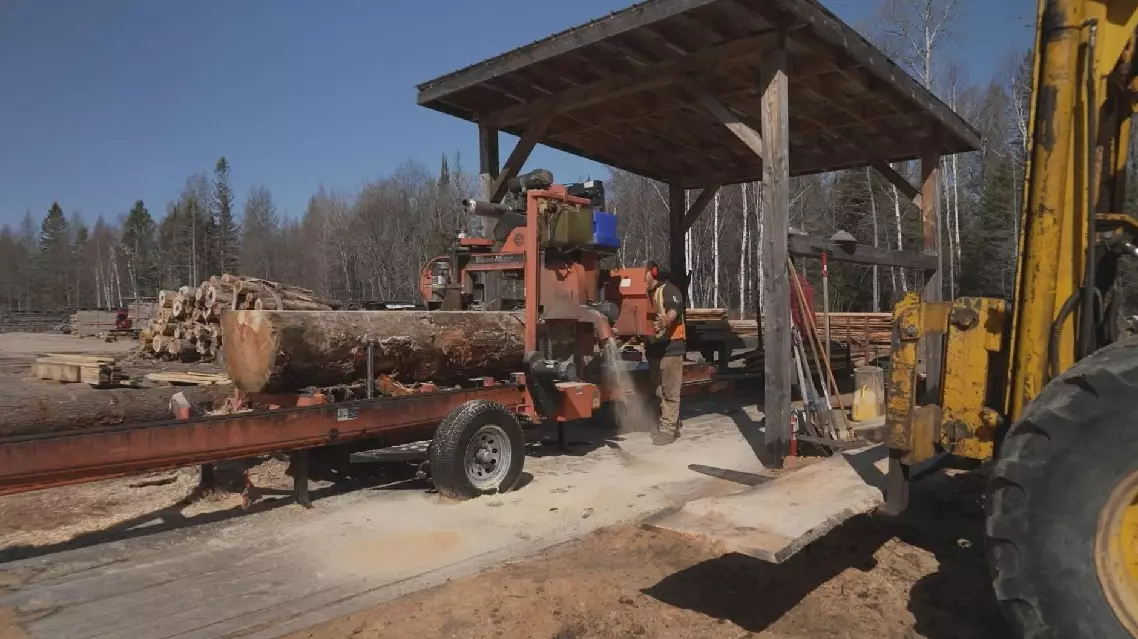
Canada's century-old lumber industry faces mounting pressure as U.S. tariffs on Canadian softwood exports are set to more than double by October, threatening rural communities built on forestry while potentially accelerating a domestic shift toward addressing Canada's own housing crisis.

Softwood lumber, a key export, is currently subject to a 14.54-percent U.S. tariff, but this rate is expected to more than double to 34.45 percent later this year, with a potential additional 25-percent tariff at some point threatened by U.S. President Donald Trump.

In Sundridge, Ontario -- the largest Canadian province, a lakeside community nicknamed the "Pearl of the North", Tim Bryson's family has been logging since 1878. But the challenges for the industry have mounted in recent years. Bryson watches the trade dispute unfold with concern.

"Certainly, the 2009-kind of global recession was a housing crisis that happened in the (United) States, [and that] reverberated all around the world and ever since then, it's been tough, for sure," he said.

The industry is big business. Last year Canada exported some 15 billion dollars' worth of lumber and other sawmill products to the United States. But over the last decade, several Canadian mills have moved their operations to the U.S., hollowing out Canada's output. Against that backdrop, there's a further challenge from the trade dispute between the U.S. and Canada. Tariffs on Canada's lumber exports to the U.S. threaten to undermine the industry.

"I think it's an existential threat to rural communities all over Canada. Sometimes you go north and they're just one-horse towns. The whole town is built on the forest industry. It's not just the logger or the saw mill, but then it's the restaurants. It's hard to understand the actual impacts," said Bryson.

The ripple effects already reach beyond mills to Main Street businesses. Gift shop owner Margaret McDonald shared, "I think it trickles down the line. I think it starts with the logging industry in this area. It's quite prevalent. So when one industry gets hit with tariffs, we all feel the brunt of it, because it does trickle down the line."

Canada's lumber sector has shed thousands of jobs in recent years, with many mills relocating south of the border.

Yet Bryson sees potential silver linings. With Canada grappling with severe housing unaffordability, he suggests redirecting lumber inward.

"We have more room here in Canada than just about any place in the world, and more wood to build houses with. Yet we have a housing crisis. There is an opportunity for us to build kind of a nation, build the housing here. I think it is time for us to really look in the mirror and start fixing our own problems here," he said.

In the meantime, Bryson continues the hard work of logging. But he's hopeful that, at some point, demand for his products will increase significantly within Canada's borders.
Canadian lumber industry braces for steep US tariff hikes
Canadian lumber industry braces for steep US tariff hikes


Canadian lumber industry braces for steep US tariff hikes
Canadian lumber industry braces for steep US tariff hikes
The Iranian government is focusing on public concerns and maintaining stable supplies of essential goods amid recent protests, Iranian President Masoud Pezeshkian said in a televised interview on Sunday.

In the city of Karaj, northwest of the capital Tehran, daily life has largely continued as normal. A video filmed by a local resident on Sunday shows food stores open and grocery shelves fully stocked.

"This is the block near my home, and there are some food stores here. Daily life continues here. Last night we did not see many protests in Karaj. Right now the city is very safe. This is a grocery store close to my home. All the food is available; nothing is in shortage. Here are noodles and different types of beans. Here are dairy products, cheese, and yogurt. I also checked other grocery stores and didn't see any shortages. Everything is available," said local resident Ali Reza.

Iranian officials have described recent disturbances as acts orchestrated by the "enemy," including some carried out by well-trained and armed "terrorists." The incidents have caused casualties among security personnel and civilians, as well as property damage.

The Secretary of Iran's Supreme National Security Council Ali Larijani has directed authorities to severely punish the "terrorists."

Meanwhile, Iran's police chief Ahmad-Reza Radan said on Sunday that the police had raised alert levels and arrested several leaders of the troublemakers during the operations on Saturday.

President Pezeshkian noted in the interview that the normal demands of the Iranian people are reasonable and justified, but they must realize that triggering riots and carrying out terrorist acts are the enemy's attempts to undermine the country. He urged the public to remain vigilant.

Also on Sunday, Iranian Parliament Speaker Mohammad Baqer Qalibaf warned that Tehran would regard U.S. and Israeli bases and facilities in the Middle East as "legitimate targets" if Washington takes military action against Iran. His remarks followed media reports saying U.S. President Donald Trump is "seriously considering authorizing a strike" against Iran.

Iranian state media reported that at least 109 members of Iran's security forces have been killed in clashes since the protests began 14 days ago. Meanwhile, human rights groups based outside the country said the number of protesters killed has exceeded 200, though the figure could not be independently verified.

The protests initially erupted over a sharp depreciation of the rial and sweeping subsidy reforms. Iranian authorities have blamed the unrest on foreign-linked agents and sanctions imposed by the United States.

Iranian president says government focusing on ensuring supplies amid protests

Iranian president says government focusing on ensuring supplies amid protests

Recommended Articles