The Dongfeng landing site in north China's Inner Mongolia Autonomous Region is ready to welcome the return of the Shenzhou-19 crew upon completion of a six-month mission aboard China's space station Tiangong in orbit.
To ensure search and rescue readiness, a final comprehensive drill was conducted at the Dongfeng landing site earlier Friday.
The return capsule of the Shenzhou-19 manned spacecraft, carrying three astronauts Cai Xuzhe, Song Lingdong, and Wang Haoze, is scheduled to touch down at the Dongfeng landing site on April 29.
At around 10:00 on Friday, nearly 100 vehicles were deployed to support the ground search and rescue operations.
By 14:30, after receiving information on the landing location of the return capsule from the Beijing Aerospace Control Center, five helicopters from the air unit executed precision landings around the location and promptly carried out operations following established procedures.
At 14:45, upon the arrival of the ground search and rescue team, operations including simulating the opening of the hatch and lifting the astronauts out of the capsule were carried out.
The search and rescue team members responded swiftly and executed the tasks meticulously, ensuring that all operations, from the timing of the astronauts exiting the capsule to their adaptation to the external environment and the transfer process, were conducted with absolute safety.
According to the plan, the entire return and landing process of the Shenzhou-19 manned spacecraft is expected to take about 50 minutes.
At present, all personnel and equipment at the Dongfeng landing site are ready to be deployed to support the search and rescue operations.
On Thursday, a Long March 2F rocket carrying the Shenzhou-20 manned spacecraft lifted off from the Jiuquan Satellite Launch Center in northwest China.
The three astronauts on Shenzhou-20 entered the Tiangong space station and met with the Shenzhou-19 crew later on, beginning a new round of in-orbit crew handover. The six crew members then had group pictures taken for the sixth space get-together in China's aerospace history. They will live and work together for about five days to complete planned tasks and handover work.
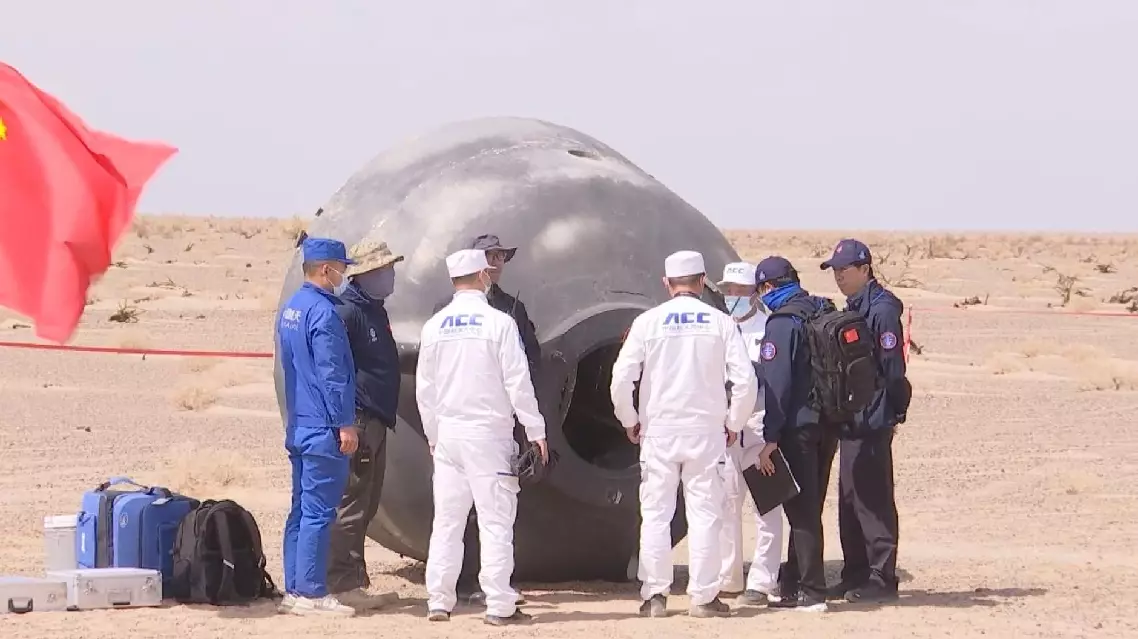
Landing site ready to welcome return of Shenzhou-19 astronauts
The annual number of inbound and outbound travelers passing through Hong Kong's West Kowloon Station on the Guangzhou-Shenzhen-Hong Kong Express Rail Link exceeded 30 million for the first time on Sunday, fueled by accelerated regional integration and relaxed visa policies.
The daily average number of border crossings through West Kowloon Station reached 85,000 this year, while the highest single-day figure hit 136,000, according to the Shenzhen General Station of Exit and Entry Frontier Inspection in south China's Guangdong Province.
The West Kowloon Station connects Hong Kong with 96 stations in 19 provincial-level regions on the Chinese mainland.
"We mainly want to visit the Canton Tower in Guangzhou and experience the cruise on the Pearl River," said Mr. Sun, a Hong Kong resident, at the station.
The accelerated integration is also boosting study trips between Hong Kong and Guangdong Province.
"Today we will go to Xingning in Meizhou to film our Classical Prose Recitation Competition. We hope that during this trip, students will be able to learn about the culture of our motherland," said Lin Qing, a teacher at Hong Kong's South Yuen Long Government Primary School.
"I'm really looking forward to this trip because we can learn about Guangzhou, and also about some of the development and culture of the Maritime Silk Road," said a student from Hong Kong's Tseung Kwan O Government Secondary School.
This year, nearly 1.4 million foreign tourists have made entry and exit trips via West Kowloon Station, up 24 percent year on year.
China's National Immigration Administration (NIA) in November expanded the country's 240-hour visa-free transit program to five additional ports, including West Kowloon Station on the Guangzhou-Shenzhen-Hong Kong Express Rail Link.
"We want to go to Guangzhou and to Shenzhen. Guangzhou -- we know a little bit about older culture -- and Shenzhen I know a little bit because it's a tech hub. I love tech, so I really want to see more," said a tourist from the Netherlands at West Kowloon Station.
"We are going to Huizhou, and also to Shenzhen. Yeah," said a tourist from Spain.
"Because also we are content creators about drones. I think China brands are innovating in the technology world. So it's incredible, because I love to fly drones and try new technology," another Spanish tourist said.
China's new policy introduced in November raised the total number of ports eligible for the 240-hour visa-free transit from 60 to 65.
Under the policy, travelers from 55 eligible countries who meet certain criteria can enter China through any of these ports in 24 provincial-level regions and stay for up to 240 hours, or 10 days, without a visa before heading to a third destination, according to the NIA.
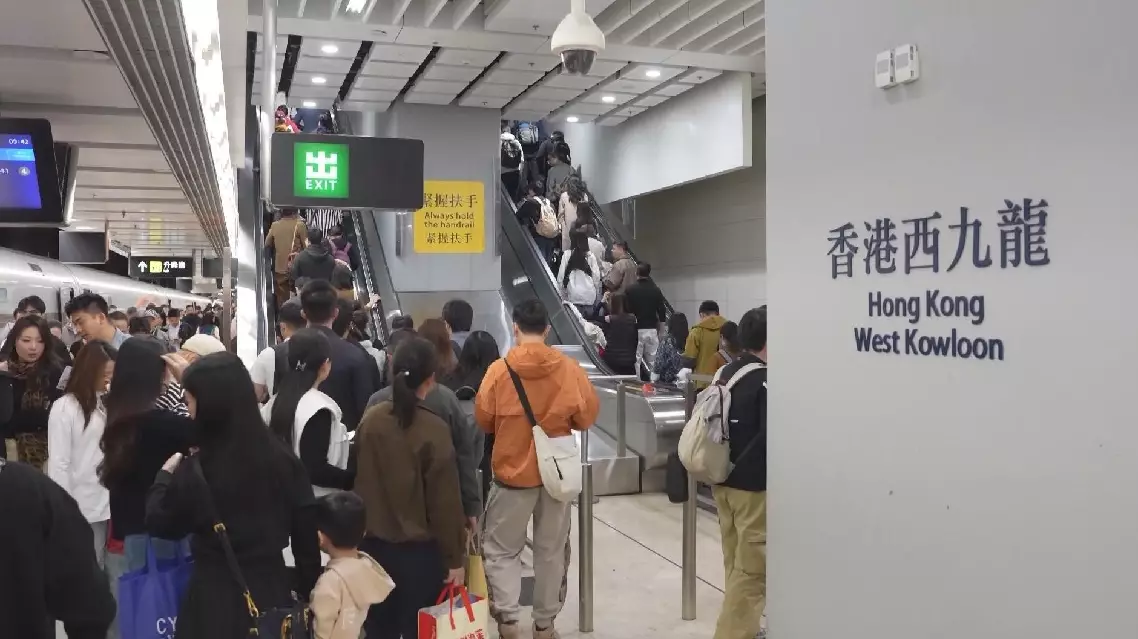
HK's West Kowloon Station sees annual passenger flow exceed 30 million