Plenty of playmakers remain for teams to pick through Saturday in the NFL draft's final four rounds, Shedeur Sanders stunningly among them.
Sanders is the biggest name still on the board more than 48 hours after he was widely expected to hear his name called, a spectacular slide for a quarterback who has gotten snubbed through 102 selections so far.
Even before plunging through Day 2 on Friday, the former Colorado star's plight caught the attention of the White House.
In a post on his Truth Social platform Friday afternoon, President Donald Trump criticized teams for not selecting Sanders on Day 1 and suggested he should be picked immediately in Round 2.
NFL franchises, however, plucked 70 more players from the college ranks and left Sanders still waiting for his phone to ring.
Sanders and Miami's Cam Ward were considered the top two passing prospects in this year's draft with some analysts even rating Sanders higher than Ward, whom the Tennessee Titans made the top overall pick Thursday night.
Four other quarterbacks have leap-frogged Sanders. In a surprise in the first round, the Giants took Jaxson Dart of Ole Miss. And in Round 2, the Saints selected Louisville's Tyler Shough, who began his college career at Oregon in 2018 and who will be 26 in September, and two more QBs went in the third round: Alabama's Jalen Milroe to the Seahawks and Oregon's Dillon Gabriel to the Browns.
At best, Sanders will be the sixth QB drafted in 2025, and he won't even be the first Sanders selected. That honor went to South Carolina defensive tackle T.J. Sanders (no relation), who went 41st overall in Round 2 to Buffalo.
One possible reason cited for Shedeur Sanders' slide is his size — 6-foot-1, which is short for a QB by today's standards — and yet, Gabriel is even shorter at 5-11 and 201 pounds, 15 pounds lighter than Sanders, who's an accurate thrower and quick processor but who took a combined 94 sacks in his two seasons in Boulder.
One team that isn't looking for a quarterback after finally landing one a year ago is the Denver Broncos, and their coach, Sean Payton, expressed dismay at Sanders' slide into Day 3 of this year's draft.
“There will be this chip on his shoulder and beware because this guy's going to play in this league," Payton said. "... yeah, I think it's surprising.”
Sanders is the highest-ranked player left on the board of several draft analysts, including the NFL Network's Daniel Jeremiah, who has him as the 20th-ranked prospect, and ESPN senior writer Jeff Legwold, who ranked Sanders 32nd in his annual ranking of the top 100 college prospects.
Legwold noted that although Sanders' nearly 72% completion rate in two seasons at Colorado was an FBS career record, he is undersized and doesn't throw the ball quickly, which led to many of the FBS-leading 94 sacks he took the last two seasons.
Among the other best available prospects when the draft resumes with the Titans choosing 103rd overall are 5-foot-8 Tennessee running back Dylan Sampson, who scored a school-record 22 touchdowns last season, and Arizona State's bruising running back Cam Skattebo, who rushed for 1,711 yards and 21 TDs last season.
Other top candidates for Round 4 include LSU guard Miles Frazier, Ohio State edge rusher Jack Sawyer and Colorado State wide receiver Tory Horton.
AP NFL: https://apnews.com/hub/nfl
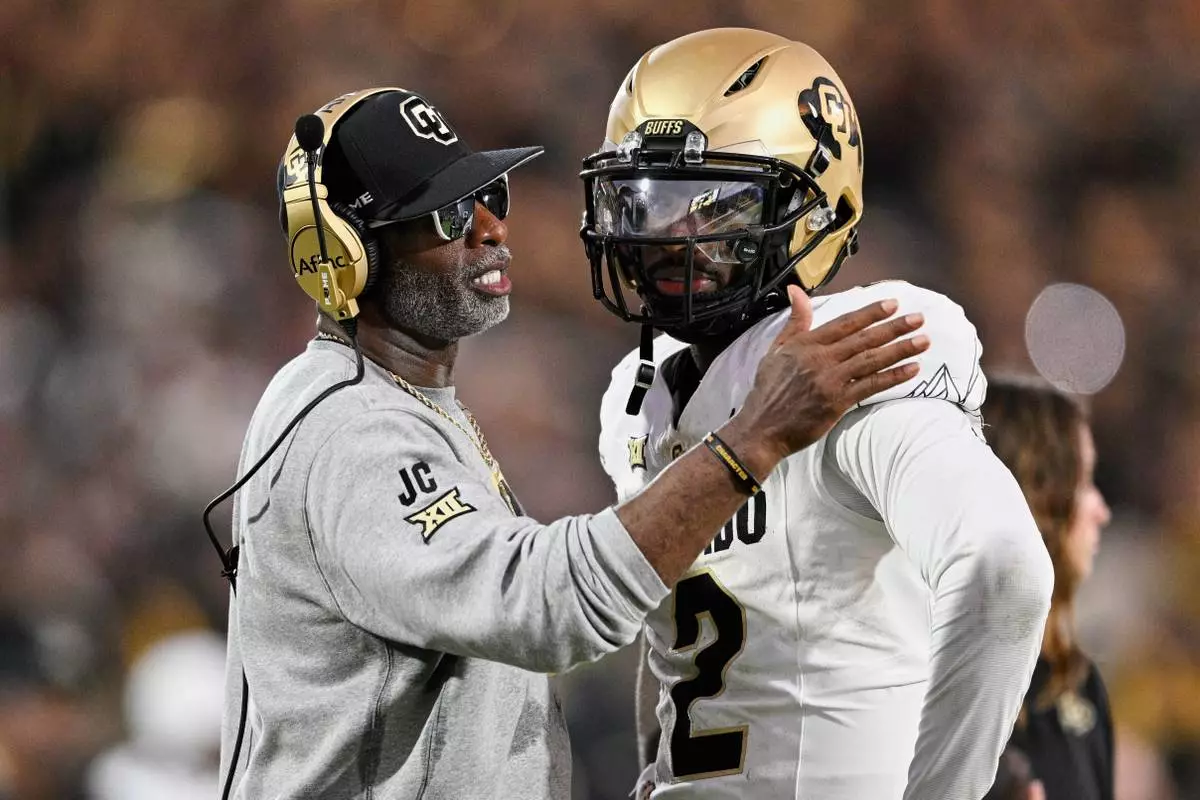
FILE - Colorado head coach Deion Sanders, left, talks with quarterback Shedeur Sanders (2) during a timeout in the second half of an NCAA college football game against Central Florida, Saturday, Sept. 28, 2024, in Orlando, Fla. (AP Photo/Phelan M. Ebenhack, File)
MANILA, Philippines (AP) — Philippine President Ferdinand Marcos Jr. will deliver his annual state of the nation speech Monday with a bleak backdrop of a major corruption scandal that he exposed last year but has implicated his key allies; his estranged vice president’s impeachment trial; and the global economic fallout from a resurgent war in Iran.
More than 23,000 police were deployed to secure the House of Representatives in suburban Quezon city, where Marcos will deliver his penultimate annual address before his six-year term ends in mid-2028. Key roads to the presidential palace in Manila were barricaded with barbed wire and riot police to deter protesters.
Security concerns were heightened after a small homemade bomb exploded before dawn on Monday near the gate of the Department of Justice in Manila, causing no injuries or major damage. Separately, bomb parts were found near the Senate in suburban Pasay city which had not been assembled and apparently aimed “only to sow terror or fear,” national police chief Gen. Jose Melencio Nartatez jr. told reporters.
Marcos is expected to outline in his speech new programs to mitigate the impact of the renewed hostilities in the Middle East. He declared a yearlong national energy emergency in March as the war in the Middle East raged to ensure the adequate supply of fuel, food and agricultural products and prevent hoarding.
In last year's state-of-the-nation speech, Marcos railed against widespread corruption in flood-control projects as the Philippines struggled to recover from deadly flooding and landslides that killed dozens of villagers and displaced more than 200,000.
Separate government and congressional investigations that followed implicated dozens of House and Senate members along with government public works engineers and officials, who allegedly pocketed huge kickbacks from flood-control projects. Their lavish lifestyles, including fleets of private jets and European cars, sparked public outrage and protests.
A current and a former member of the 24-member Senate have been indicted and detained for largescale corruption in connection with the anomalies. A leading suspect and former House member fled to Europe. Former Public Works Secretary Manuel Bonoan, who served under Marcos, has denied any wrongdoing but has also been indicted in connection with the anomalies and is in hospital detention.
Many, however, have clamored for more influential legislators to be rapidly prosecuted. Critics have asked why one of the leading suspects, former House Speaker Martin Romualdez — the president’s cousin and key ally who denies any wrongdoing — had not been charged. Marcos has pledged that even his allies will be locked up in jail if there is evidence.
“We have done enough because we’re not done yet,” Marcos said. “Unfortunately, the more we look, the more we find.”
The impeachment trial of Vice President Sara Duterte, his former ally, for charges that includes corruption and threatening the president, is also underway.
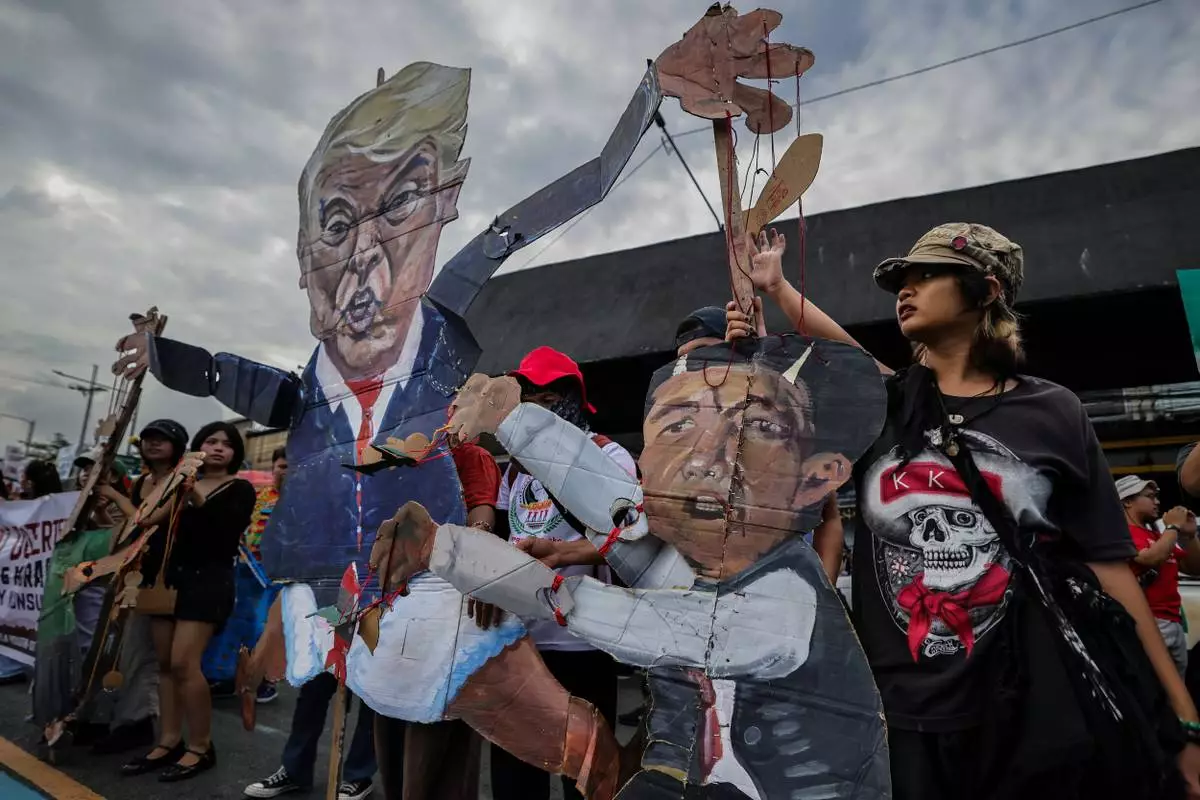
Protesters carry an effigy of U.S. President Donald Trump and Philippine President Ferdinand Marcos Jr. during a protest march in Quezon City, Philippines Monday, July 27, 2026, ahead of the State of the Nation Address by President Marcos Jr. (AP Photo/Gerard Carreon)
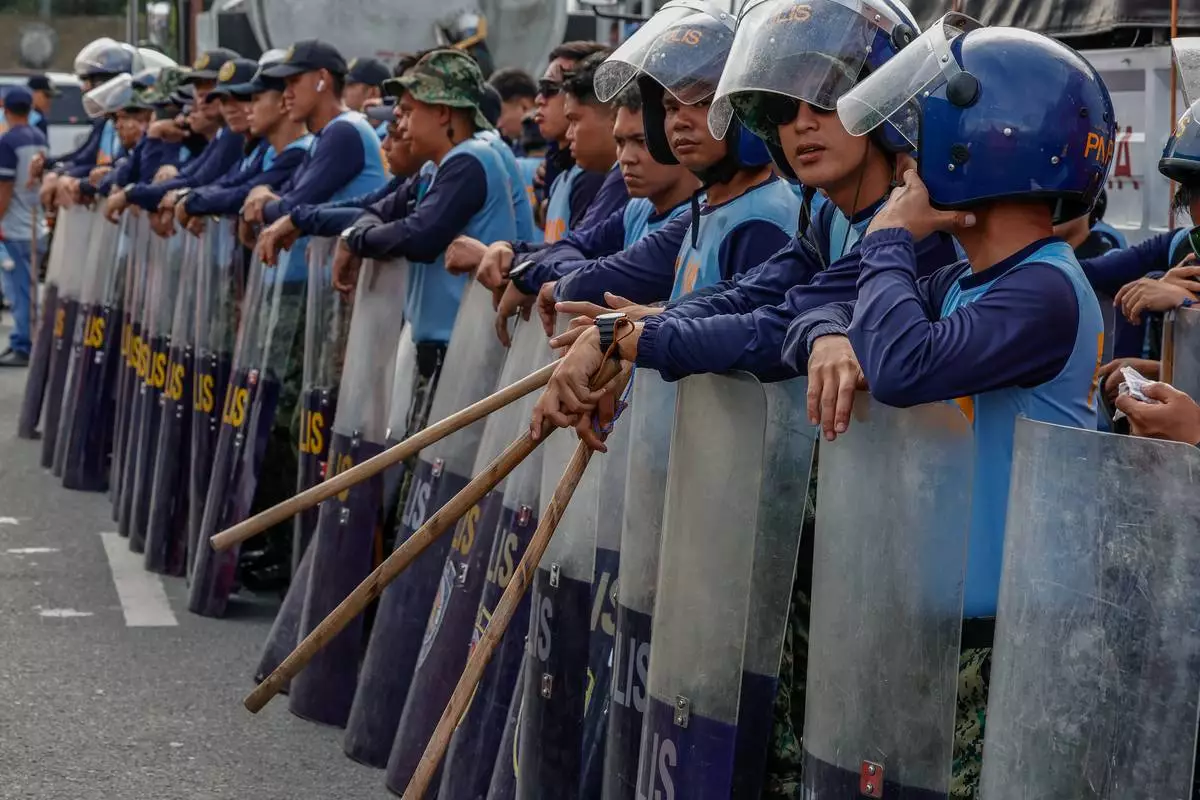
Police personnel line up and secure a road near a protest march in Quezon City, Philippines Monday, July 27, 2026, ahead of the State of the Nation Address by President Marcos Jr. (AP Photo/Gerard Carreon)
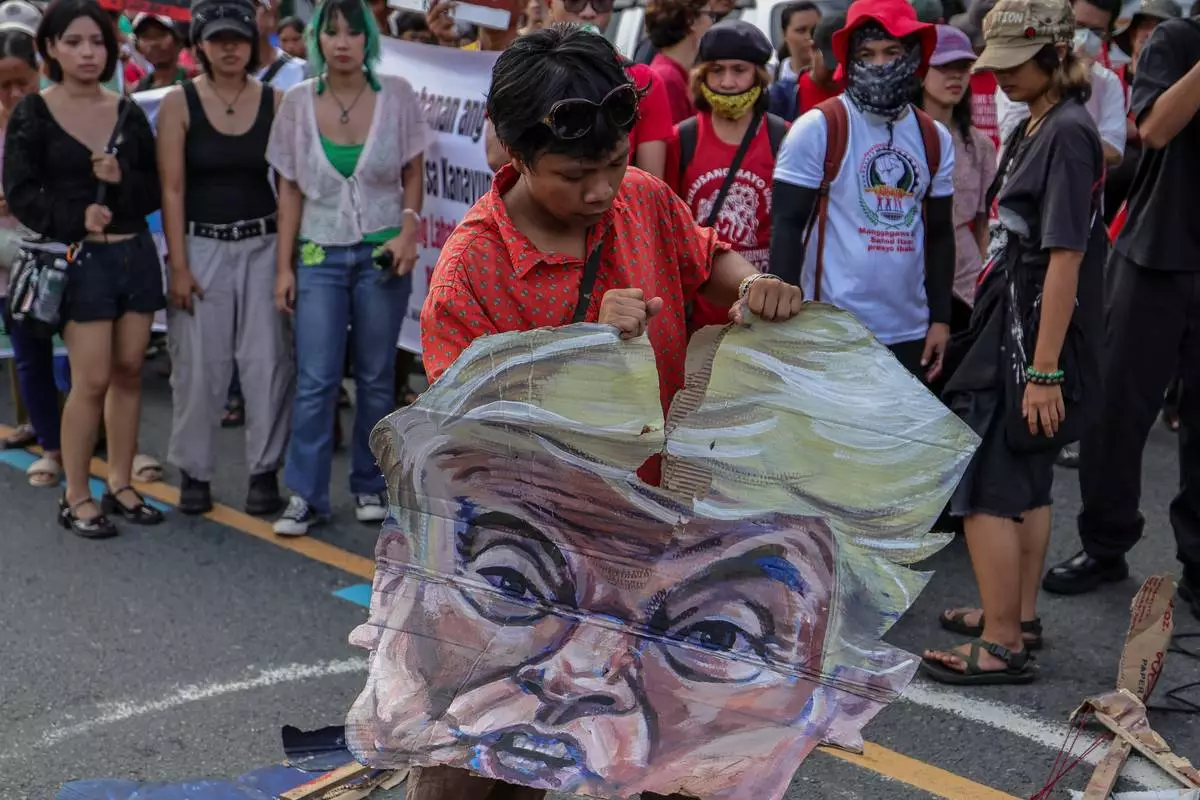
A protester destroys an effigy of U.S. President Donald Trump during a protest march in Quezon City, Philippines Monday, July 27, 2026, ahead of the State of the Nation Address by President Marcos Jr. (AP Photo/Gerard Carreon)