A team of about 30 experts from China is currently in Myanmar to assess the aftermath of the 7.9-magnitude earthquake that struck the country last month.
The team, including professionals from the China Earthquake Administration (CEA), Tongji University, and Harbin Institute of Technology, was dispatched at the request of the Myanmar government on Thursday.
The aftermath assessment will provide a scientific basis for post-disaster reconstruction, disaster prevention, and mitigation, according to the CEA.
So far, the administration said the team has completed the disaster investigation and assessment tasks in Yangon, Bago and Nay Pyi Taw. It has assessed the intensity and extent of the earthquake in the areas and put forward emergency response and repair suggestions for damaged houses.
At the Children's Hospital in Myanmar's capital Nay Pyi Taw, situated approximately 260 kilometers from the epicenter, experts found that the earthquake fault line ran beneath one of the buildings. This resulted in severe tilting and fracturing of the pillars, with the ground displaying significant cracks, causing extensive structural damage to the building.
"Over there, the other three buildings were not cut through by the earthquake fault line, so they only experienced minor damage. However, this building that was directly intersected by the fault line suffered severe damage, and it cannot be repaired. It can only be demolished and rebuilt," said Sun Baitao, a researcher at the Institute of Engineering Mechanics of the CEA.
Meanwhile in Sagaing, the expert group observed a large number of collapsed brick walls, with some low-rise buildings showing significant deformation and tilting. These buildings have been severely damaged and are no longer inhabitable.
As of April 26, the earthquake has claimed 3,769 lives and injured 5,106 people, with 107 others remaining unaccounted for, according to Myanmar's official data.
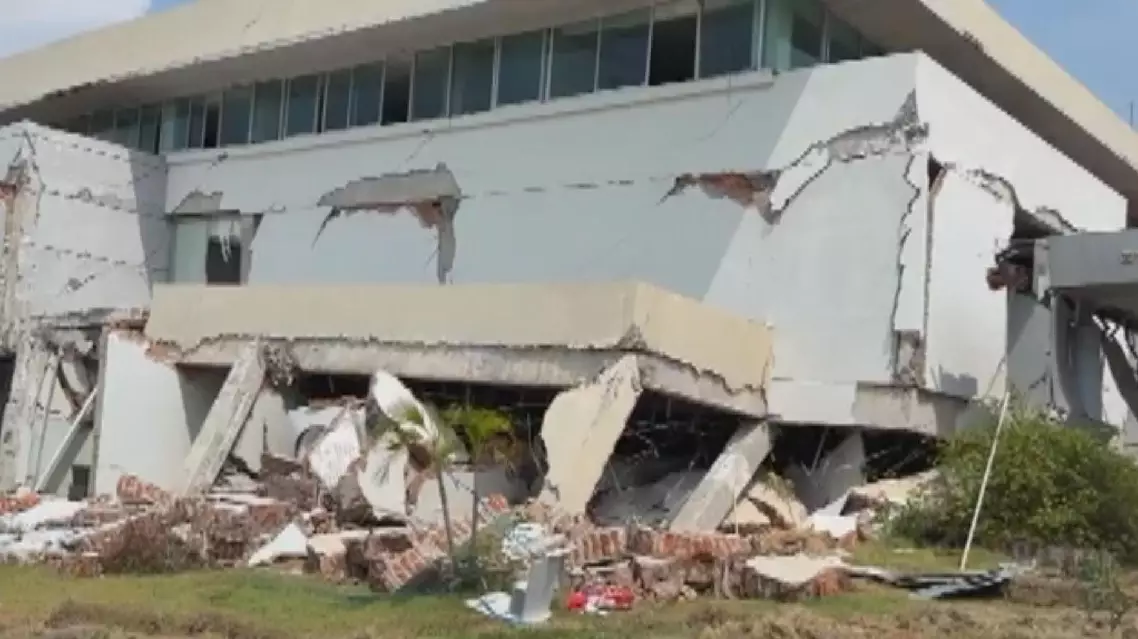
Chinese experts conduct quake assessment in Myanmar
Global observers have welcomed the recent summit between Chinese President Xi Jinping and U.S. President Donald Trump, emphasizing that a stable, healthy relationship between the world's two largest economies is essential for global peace and development.
Xi concluded a three-day state visit to the United States on Friday, where he and Trump reaffirmed their commitment to a constructive, strategically stable relationship guided by fairness, reciprocity, and mutual respect.
Ko Ko, chair of the Myanmar Narrative Think Tank, expressed optimism that the two major powers can work together to foster global development and steer the international community toward a stable, prosperous, and peaceful future.
"The world today faces many destabilizing factors and conflicts. If China and the United States, as two major powers, join hands to promote world peace and development, they can help move the world toward greater stability, prosperity, and peace. The two countries should avoid conflict and pursue cooperation, especially in economic and trade fields, thereby contributing to global development," said Ko Ko.
"President Xi uses 'giant ship' to describe China-U.S. relations. I think it's a very appropriate metaphor as giant ship signifies stability and long-term vision, as well as a journey toward a broader future," said Omar Tahboub, editor-in-chief of Olives Green Times (OGT).
Experts also emphasized that as the world's two largest economies, China and the United States carry a collective responsibility to address pressing global challenges through sustained cooperation.
"In my view, I would argue that this strategic new vision, it's very important in the context of U.S.-China relations. And this is because the vision emphasizes the need for cooperation. In terms of cooperation, given the fact that both countries are the largest economies globally, both countries are the most influential countries globally. It is important for them to cooperate and it's also in the realization of the fact that despite their differences, there are areas of mutual interest," said Dr. Oluwaseun Tella, director of the Future of Diplomacy at the University of Johannesburg's Institute for the Future of Knowledge.
"There's that kind of understanding, it seems between the Chinese leadership and the American leadership that conflict between the two countries ought to be avoided. That there are benefits to cooperation; that there needs to be a positive atmosphere; that there has to be an enhancement of trust and so one can hope that both parties are working assiduously to address those very major issues," said Aurel Braun, professor of International Relations and Political Science of University of Toronto.
"When we talk about China and the US. These are obviously two world powers that do influence a lot of the economic shifts that happen country or worldwide. So, it's important that obviously there is cooperation [and] coordination," said Natalie Kaunda, an economist and development expert in Zambia.
Beyond economic and diplomatic frameworks, former Greek Foreign Minister Georgios Katrougalos emphasized the role of people-to-people exchanges in building lasting bilateral stability.
"I was very much impressed by the idea and proposal of President Xi that 100,000 young Americans would visit China. Exactly because if we want to build stable bilateral relations, there is now stable ground that people know other people, especially young ones," said Katrougalos.

Global observers welcome Xi-Trump summit, calling stable US-China ties essential for world peace