NIO, the Chinese electric vehicle (EV) maker known for its premium models and innovative battery-swapping technology, is facing significant challenges as it navigates a competitive market, according to company founder and CEO Li Bin, who shared plans on the sidelines of this year's Shanghai Auto Show to push through these challenges and achieve its goals.
The 21st Shanghai International Automobile Industry Exhibition, also known as Auto Shanghai 2025, is currently in full swing. The event started on April 23 and will conclude on May 2.
At the show, Li said the brand still has a bright future, with strong investment in its products and operations. He said that 2025 is nonetheless a critical year for NIO, with the implementation of new technology, new product launches, and a major expansion of infrastructure.
"Look at our highly competitive products. We've invested heavily in research and development in past years. This year, these investments will turn into real product strength. We are launching nine new models this year. Our battery-swap stations have grown into a huge network, and its network effect is getting stronger and stronger. This year, we aim to cover every county in 27 provincial regions with swap stations," he said.
Li also said that the company will enter a major new product cycle starting in Q2 this year.
"Our Q1 sales grew 40 percent compared to the same period of last year. Of course, deliveries of our most premium ET9 model only started at the end of March. From Q2, we'll enter a major new product cycle. In the auto industry, growth relies heavily on new product launches. That's why we're very confident in the second half of the year," said Li.
Reflecting on comments he made two years ago at the Shanghai Auto Show that the next two to three years would be crucial for auto industry transformation, Li acknowledged the rapid transformation of the auto industry.
"Many companies are launching new products, whether in intelligence, electrification, or entire vehicles. Smart and electric technologies have completely reshaped the industry. It really is a dramatic transformation. Of course, in the next two to three years, how we continue to compete and stay in the 'finals' is a question not just for NIO, but for every car company," he said.
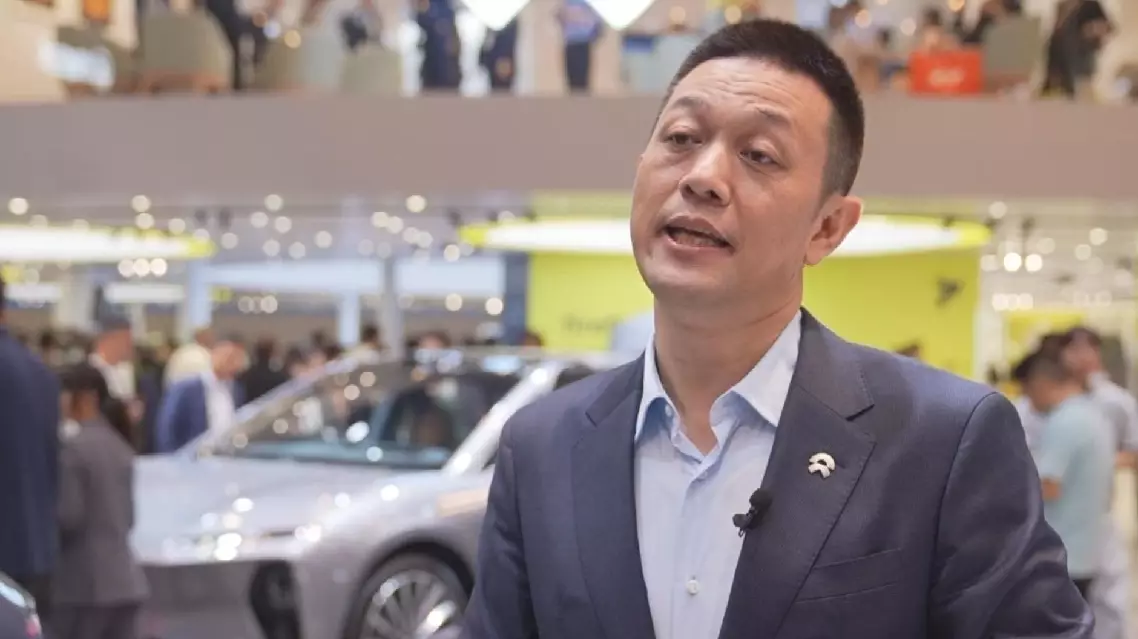
CEO of Chinese EV maker NIO shares company strategy at Shanghai Auto Show

China will strengthen fiscal and financial coordination to amplify policy effectiveness, experts said as the draft central and local budgets for 2026 were unveiled on Friday at the ongoing fourth session of the 14th National People's Congress.
According to the draft central and local budgets for 2026, 1.3 trillion yuan (190 billion U.S. dollars) of ultra-long special treasury bonds will be issued to provide continued support for the implementation of major national strategies and security capacity-building in key areas and for large-scale equipment upgrades and consumer goods trade-in programs.
Ultra-long special treasury bonds totaling 800 billion yuan will be allocated to support the implementation of major national strategies and security capacity-building in key areas, and 250 billion yuan in ultra-long special treasury bonds will be earmarked for consumer goods trade-in programs.
The country will refine these programs in terms of their scope and subsidy standards, and continue to support the scrapping and replacement of automobiles, home appliance trade-in schemes, and purchases of new digital and smart products.
China will also set up a 100-billion-yuan fiscal-financial coordination fund to boost domestic demand. The fund will support consumption and private investment through loan interest subsidies, financing guarantee, and risk compensation.
"Fiscal and monetary policies are the two major macroeconomic tools for macro-control, and their coordination is crucial. For instance, fiscal funds primarily serve as a guiding role, while financial institutions provide the capital. When fiscal guidance and financial resources are combined, the synergistic effect creates a result greater than the sum of its parts," said Yang Zhiyong, director of the Chinese Academy of Fiscal Sciences.
"By leveraging interest subsidies, we can mobilize substantial credit from financial institutions, thereby naturally stimulating consumption. The Ministry of Finance, in collaboration with the People's Bank of China, has introduced highly innovative measures, such as providing guarantees for the issuance of corporate bonds by small and medium-sized enterprises (SMEs), and compensating investors for losses. I believe the leveraging effect, making minimal efforts for maximum results, will become even more potent," said Yao Dongmin, director of the Center for China Fiscal Development under the Central University of Finance and Economics.
China's top legislature opened its annual session on Thursday morning at the Great Hall of the People in Beijing, with Chinese President Xi Jinping and other Party and state leaders attending the opening meeting alongside more than 2,700 NPC deputies. This year's NPC session is scheduled to run till March 12.
China to strengthen fiscal, financial coordination to amplify policy effectiveness: experts