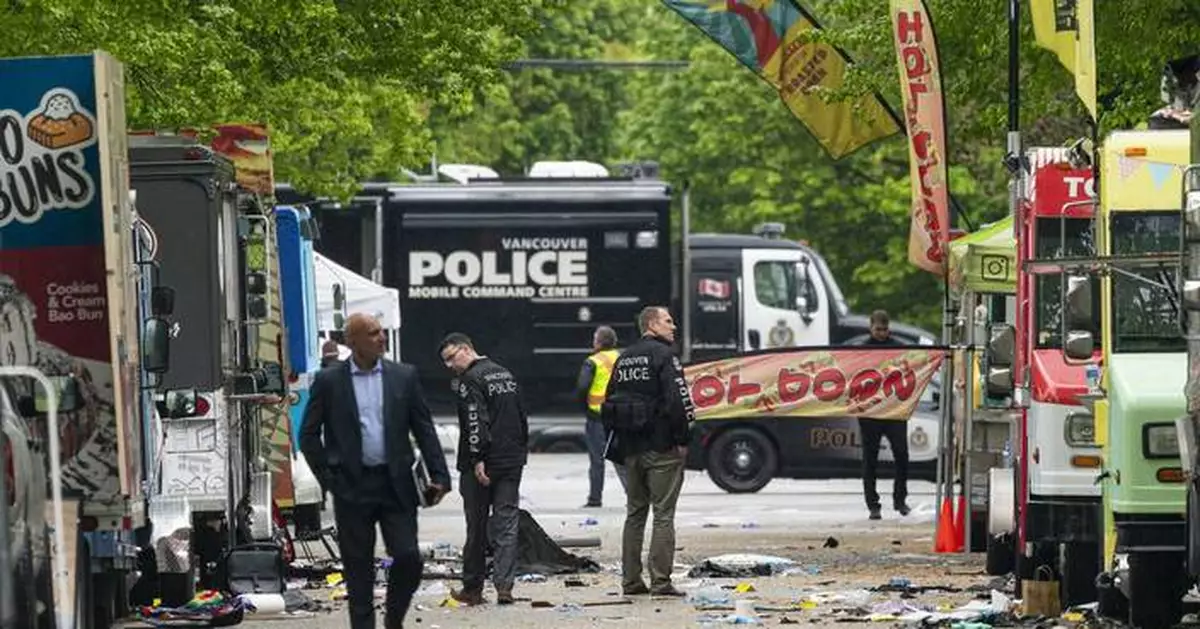
An SUV crashed into a crowd at a Filipino heritage festival in Vancouver over the weekend, killing 11 people and injuring dozens of others in the latest deadly car ramming attack across the globe.
Other such attacks in recent decades have been inspired by extremist politics or been blamed on mental illness or misogyny.
What authorities call “vehicle as a weapon attacks” have reshaped cities, with concrete barriers around public spaces and anti-vehicle obstacles in new developments. In the 2025 attack along Bourbon Street that took place just before New Orleans hosted the Super Bowl, officials added blast barriers for added safety.
Here are the details of some major vehicle attacks:
VANCOUVER, British Columbia, April 26, 2025 — A suspect has been charged with multiple counts of murder after an Audi SUV sped down a closed, food-truck-lined street and hit people attending a festival. Officials say 32 people were hurt, and those killed ranged in age from 5 to 65. Authorities say the suspect, a 30-year-old man, had a history of mental health issues.
NEW ORLEANS, Jan. 1, 2025 — At least 15 people are killed and dozens are injured after a U.S. citizen from Texas rams a vehicle into a crowd of pedestrians in New Orleans’ bustling French Quarter district at 3:15 a.m. on New Year’s Day. The FBI identifies the suspect as 42-year-old Shamsud-Din Jabbar. He is killed in a firefight with police. The FBI says several possible explosive devices were recovered and that a flag associated with the Islamic State group was found in the truck.
MAGDEBURG, Germany, Dec. 20. 2024 — At least five people are killed and more than 200 are injured when a car slams into a Christmas market in eastern Germany. Police arrest a 50-year-old doctor from Saudi Arabia who has renounced Islam and supports the far-right AfD party.
ZHUHAI, China, Nov. 11, 2024 — A 62-year-old driver rams his car into people exercising at a sports complex in southern China, killing 35, in the country’s deadliest attack in years. Authorities say the suspect is upset about his divorce. He pleads guilty to endangering public safety by dangerous means and is sentenced to death.
WAUKESHA, Wisconsin, Nov. 21, 2021 — Six people are killed and dozens injured when a man drove his SUV through a Christmas parade in suburban Milwaukee. Darrell Brooks Jr., who drove into the crowd after getting into a fight with his ex-girlfriend, has been sentenced to life in prison with no chance of release. The judge rejects arguments from him and his family that mental illness drove him to do it.
LONDON, Ontario, June 6, 2021 — Four members of a Muslim family are killed when an attacker hits them with a pickup truck. Canadian Prime Minister Justin Trudeau calls it “a terrorist attack, motivated by hatred.” White nationalist Nathaniel Veltman is sentenced to life in prison.
TORONTO, April 23, 2018 — A 25-year-old Canadian man, Alek Minassian, drives a rental van into mostly female pedestrians on Yonge Street, the main thoroughfare in Toronto, killing 10 people and injuring 16. Minassian tells police he belongs to an online “incel” community of sexually frustrated men. He is sentenced to life in prison.
NEW YORK, Oct. 31, 2017 — Sayfullo Saipov, an Islamic extremist from Uzbekistan, drives a pickup truck onto a popular New York City bike path, killing eight people. He is convicted of terrorism and sentenced to 10 life sentences plus 260 years in prison.
BARCELONA, Spain, Aug. 17, 2017 — A man rams a van into people on the Spanish city’s crowded Las Ramblas boulevard, killing 14 and injuring others. The Islamic State group claims responsibility. Several members of the same cell carry out a similar attack in the nearby resort town of Cambrils, killing one person.
CHARLOTTESVILLE, Virginia, Aug. 12, 2017 — During a “Unite the Right” rally, white supremacist James Alex Fields Jr. drives his car into a crowd of counter-protesters, killing one woman and injuring dozens of people. Fields is serving a life sentence for murder and hate crimes.
LONDON, June 19, 2017 — Darren Osborne, a man radicalized by far-right ideas, drives a van into worshippers outside a mosque in Finsbury Park, killing one man and injuring 15 people. Osborne is sentenced to life in prison.
LONDON, June 3, 2017 — Three attackers drive a van into pedestrians on London Bridge before stabbing people in nearby Borough Market. Eight people are killed and the attackers are shot dead by police.
LONDON, March 22, 2017 — British man Khalid Masood rams an SUV into people on Westminster Bridge, killing four, then fatally stabs a policeman guarding the Houses of Parliament. Masood is shot dead.
MELBOURNE, Australia, Jan. 20, 2017 – Six people are killed and more than 30 injured when a car hits lunchtime crowds at a pedestrian mall in Australia’s second-largest city. James Gargasoulas is found to have been in a state of drug-induced psychosis and is sentenced to life in prison.
BERLIN, Dec. 19, 2016 — Anis Amri, a rejected asylum-seeker from Tunisia, plows a hijacked truck into a Christmas market in the German capital, killing 13 people and injuring dozens. The attacker is killed days later in a shootout in Italy.
NICE, France, July 14, 2016 — Tunisian-born French resident Mohamed Lahouaiej-Bouhlel drives a rented truck for more than a mile (almost 2 kilometers) along a packed seaside promenade in the French Riviera resort on the Bastille Day holiday, killing 86 people in the deadliest attack of its kind. He is killed by police, but eight other people are sentenced to prison for helping orchestrate the attack.
STILLWATER, Oklahoma, Oct. 24, 2015 — A woman plows a car into a crowd at an Oklahoma State University homecoming parade, killing four people, including a toddler, and injuring many others. Adacia Chambers, who pleaded no contest to more than 40 felony charges, will serve four concurrent life sentences for the deaths. Witnesses have described a scene of chaos as bodies flew into the air from the impact and landed on the road.
APELDOORN, Netherlands, April 28, 2009 – Former security guard Karst Tates drives a car into parade spectators in an attempt to hit an open-topped bus carrying members of the Dutch royal family. Six people are killed and Tates dies of injuries the next day, leaving his full motive a mystery.
CHAPEL HILL, North Carolina, March 3, 2006 — University of North Carolina graduate Mohammed Taheri-Azar drives an SUV into a crowd at the university, lightly injuring nine people, in a self-professed bid to avenge Muslim deaths overseas. He is sentenced to up to 33 years in prison.
SANTA MONICA, California, July 16, 2003 — An 86-year-old man crashes into a farmers’ market, killing 10 people and injuring dozens of others. He was sentenced to probation after being convicted of 10 counts of vehicular manslaughter with gross negligence.

Vancouver Police detectives walk along where a car drove through a crowd killing multiple people on the weekend in Vancouver, British Columbia, Monday April 28, 2025. (Rich Lam/The Canadian Press via AP)