PALM BEACH, Fla. (AP) — President Donald Trump has indicated that the U.S. has “hit” a dock facility along a shore as he wages a pressure campaign on Venezuela, but the U.S. offered few details.
Trump initially seemed to confirm a strike in what appeared to be an impromptu radio interview Friday, and when questioned Monday by reporters about “an explosion in Venezuela,” he said the U.S. struck a facility where boats accused of carrying drugs “load up."
“There was a major explosion in the dock area where they load the boats up with drugs," Trump said as he met in Florida with Israeli Prime Minister Benjamin Netanyahu. "They load the boats up with drugs, so we hit all the boats and now we hit the area. It’s the implementation area. There’s where they implement. And that is no longer around.”
It is part of an escalating effort to target what the Trump administration says are boats smuggling drugs bound for the United States. It moves closer to shore strikes that so far have been carried out by the military in international waters in the Caribbean Sea and eastern Pacific Ocean.
Trump declined to say if the U.S. military or the CIA carried out the latest strike or where it occurred. He did not confirm it happened in Venezuela.
“I know exactly who it was, but I don’t want to say who it was. But you know it was along the shore," Trump said.
Trump first referenced the strike on Friday, when he called radio host John Catsimatidis during a program on WABC radio and discussed the U.S. strikes on alleged drug-carrying boats. The attacks have killed at least 105 people in 29 known strikes since early September.
“I don’t know if you read or saw, they have a big plant or a big facility where they send the, you know, where the ships come from," Trump said. "Two nights ago, we knocked that out. So, we hit them very hard.”
Trump did not offer any additional details in the interview.
Defense Secretary Pete Hegseth or one of the U.S. military's social media accounts has in the past typically announced every boat strike in a post on X, but there has been no post of any strike on a facility.
The Pentagon on Monday referred questions to the White House, which did not immediately respond to a message seeking more details. The press office of Venezuela’s government did not immediately respond to a request for comment on Trump’s statement.
Trump for months has suggested he may conduct land strikes in South America, in Venezuela or possibly another country, and in recent weeks has been saying the U.S. would move beyond striking boats and would strike on land “soon.”
In October, Trump confirmed he had authorized the CIA to conduct covert operations in Venezuela. The agency did not immediately respond to a message seeking comment Monday.
Along with the strikes, the U.S. has sent warships, built up military forces in the region, seized two oil tankers and pursued a third.
The Trump administration has said it is in “armed conflict” with drug cartels and seeking to stop the flow of narcotics into the United States.
Venezuelan President Nicolás Maduro has insisted the real purpose of the U.S. military operations is to force him from power.
White House chief of staff Susie Wiles said in an interview with Vanity Fair published this month that Trump “wants to keep on blowing boats up until Maduro ‘cries uncle.’”
Price reported from Washington. Associated Press writers Konstantin Toropin in Washington and Regina Garcia Cano in Caracas, Venezuela, contributed to this report.

President Donald Trump attends a joint news conference with Ukraine's President Volodymyr Zelenskyy following a meeting at Trump's Mar-a-Lago club, Sunday, Dec. 28, 2025, in Palm Beach, Fla. (AP Photo/Alex Brandon)
A strengthening bomb cyclone barreled across the northern U.S. on Monday, unleashing severe winter weather in the Midwest as it took aim at the East Coast.
The storm brought blizzard conditions, treacherous travel and widespread power outages to parts of the Plains and Great Lakes on Monday as sharply colder air, strong winds and a mix of snow, ice and rain swept through.
Forecasters said the storm intensified quickly enough to meet the criteria of a bomb cyclone, a system that rapidly strengthens as surface pressure drops. The sharp cold front left parts of the central U.S. waking up Monday to temperatures as much as 50 degrees Fahrenheit (28 degrees Celsius) colder than the day before.
The driving wind and snow created “a pretty significant system for even this part of the country,” said Cody Snell, a meteorologist with the Weather Prediction Center. Forecasters expect the storm to intensify as it moves east, fueled by a sharp clash between frigid Canadian air and lingering warmth across the southern United States.
The plunging temperatures, combined with strong winds, created dangerous wind chills as low as minus 30 degrees Fahrenheit (minus 34 degrees Celsius) across parts of North Dakota and Minnesota. The National Weather Service warned of whiteout conditions beginning Sunday that could make travel impossible in some places.
In Iowa, blizzard conditions eased but high winds were still blowing fallen snow across roadways, keeping more than 200 miles (320 kilometers) of Interstate 35 closed Monday morning. State troopers reported dozens of crashes during the storm, including one that killed a person.
The strong area of low pressure tracking from the Great Lakes into southeast Canada brought heavy snow to parts of Michigan on Monday, with powerful winds and intense lake-effect snow expected across the Great Lakes into New York.
In Detroit, three semi-trailers and roughly 20 other vehicles crashed on Interstate 75, injuring one person, said Michigan Department of Transportation spokesperson Diane Cross, as strong winds whipped newly fallen snow into a sudden squalls.
Nationwide, about 400,000 customers were without power Monday morning, nearly a third of them in Michigan, according to Poweroutage.us. U.S. airports reported around 5,000 flight delays and around 700 cancellations.
Snow piled up quickly in Michigan’s Upper Peninsula, where as much as 2 feet (60 centimeters) fell in some areas, according to the National Weather Service. Meteorologist Ryan Metzger said additional snow was expected in the coming days, although totals would be far lighter than what fell overnight.
Rain and a wintry mix fell farther east across parts of the Northeast. Freezing rain was reported in parts of northern New York, with the threat extending into Vermont, New Hampshire and Maine. Forecasters warned the ice could strain power lines and trees. State police in Vermont said they responded to 92 crashes overnight, three of which resulted in injuries.
On the West Coast, the National Weather Service warned that moderate to strong Santa Ana winds were expected in parts of Southern California through Tuesday, raising concerns about downed trees in areas where soils have been saturated by recent storms. Two more storms were forecast later this week, with rain on New Year’s Day potentially soaking the Rose Parade in Pasadena for the first time in about two decades.
A weekend snowstorm hit Alaska’s northern panhandle with 15 to 40 inches (38 to 102 centimeters), according to the National Weather Service, keeping the region under a winter storm warning Monday as Juneau braced for up to 9 more inches (23 centimeters) and possible freezing rain. City facilities were closed and road crews piled snow into towering berms, while communities farther south faced flood watches from snowmelt and heavy rain.
And in central Illinois, an EF1 tornado with peak winds of 98 mph (158 kph) damaged buildings and snapped power poles on Sunday.
Associated Press writers Julie Walker in New York; Corey Williams in Detroit; Margery Beck in Omaha, Nebraska; and Becky Bohrer in Junea, Alaska, contributed.
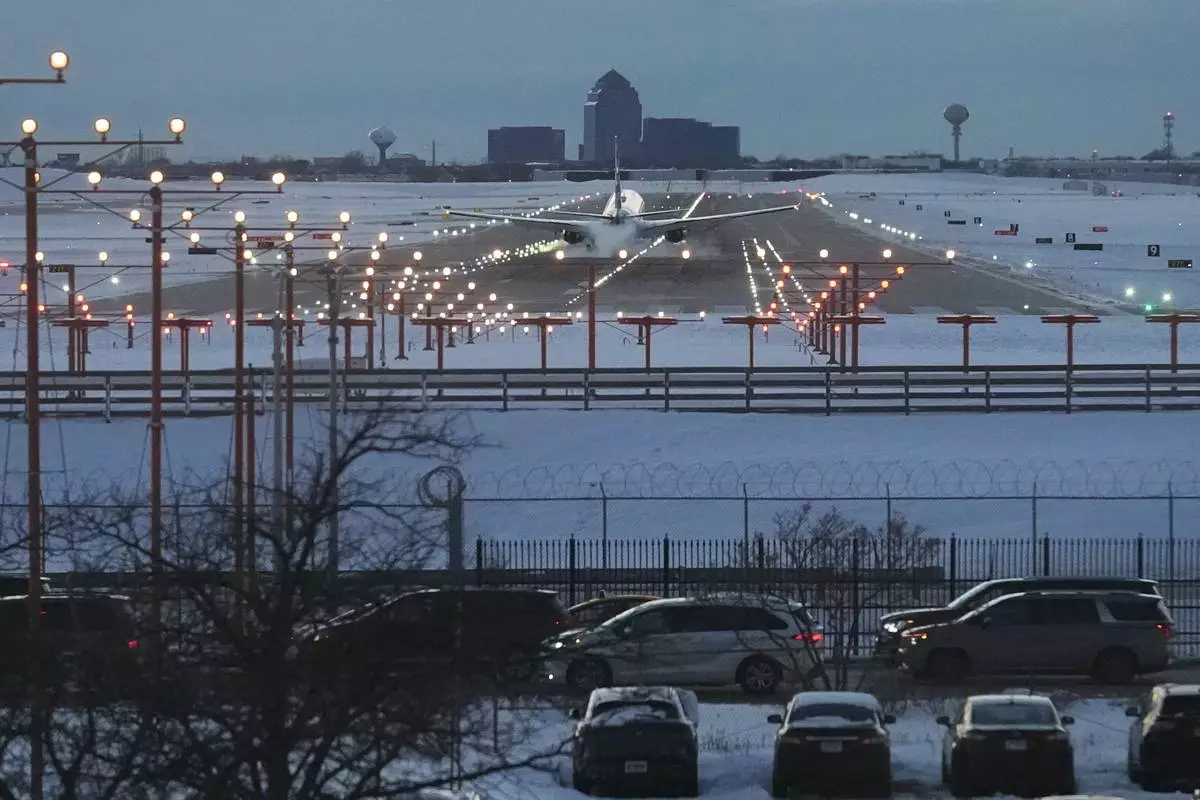
FILE - An American Airlines plane arrives at the O'Hare International Airport in Chicago, Sunday, Nov. 30, 2025. (AP Photo/Nam Y. Huh, File)
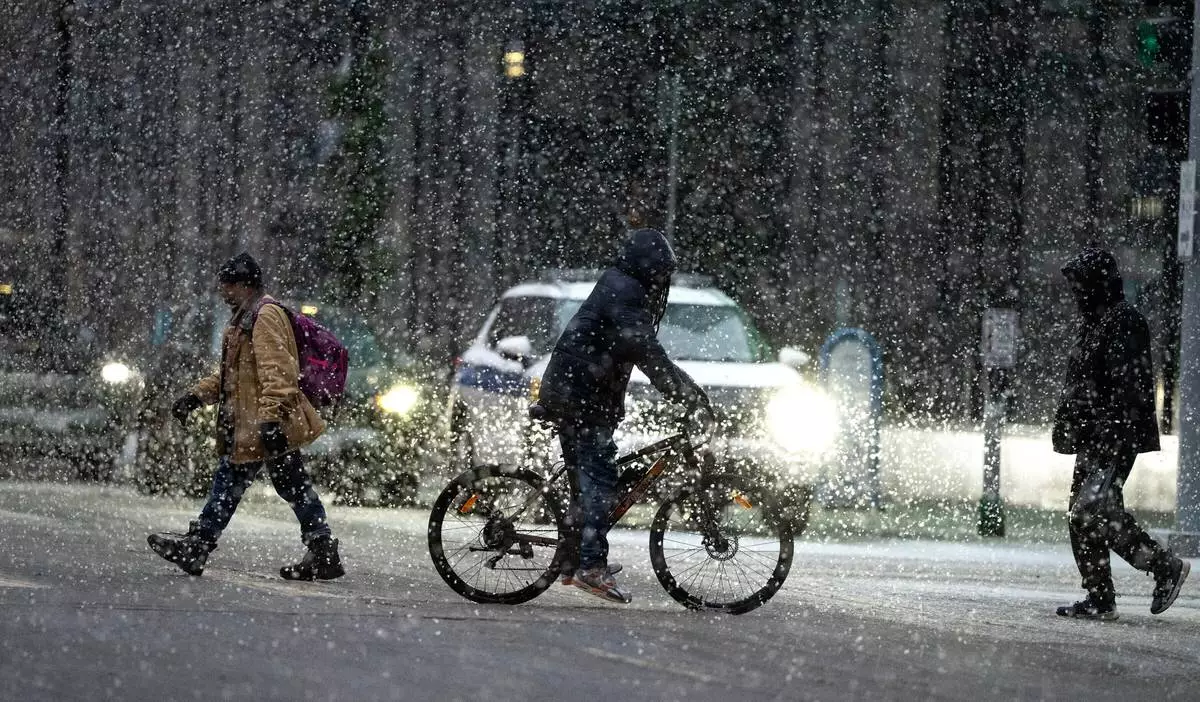
People cross 7th street in the heavy snow on Sunday Dec. 28, 2025 in downtown Minneapolis. (Jerry Holt /Star Tribune via AP)
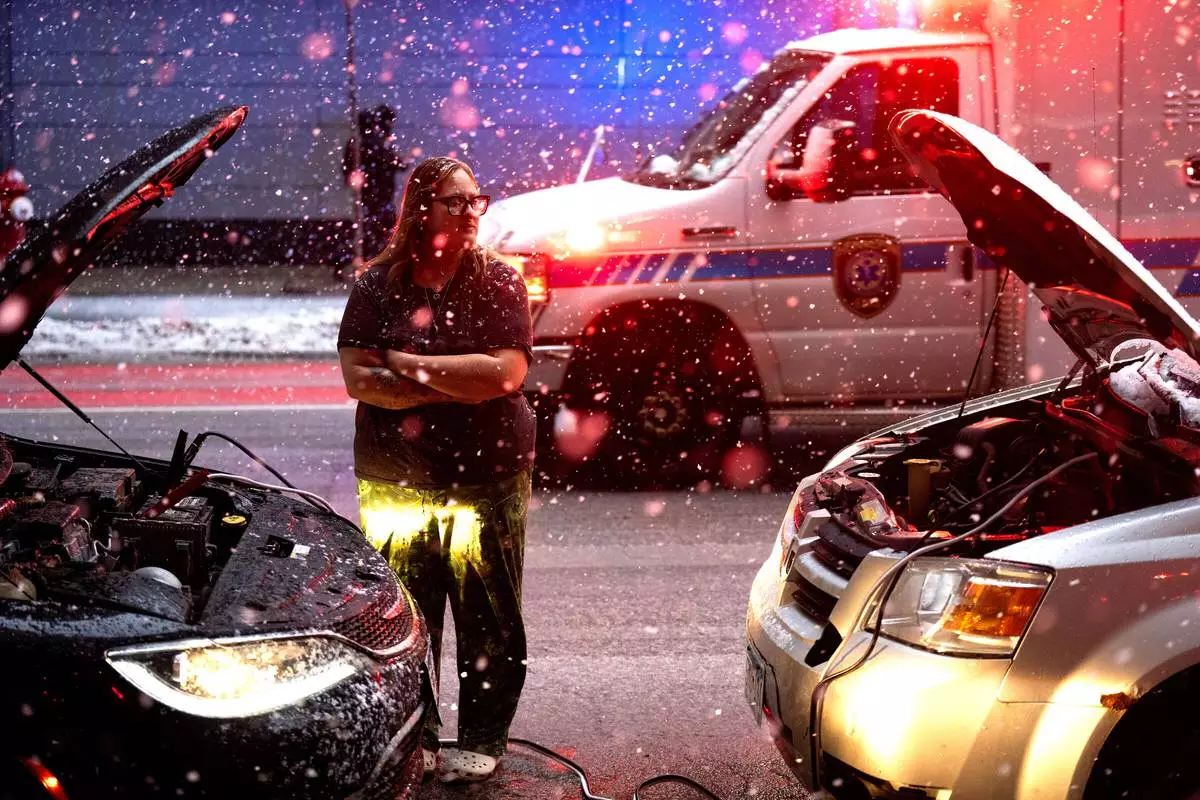
Devon Jordan, of Brainerd , helps a person start their car durning heavy snow fall on Sunday, Dec. 28, 2025 in downtown Minneapolis. (Jerry Holt /Star Tribune via AP)
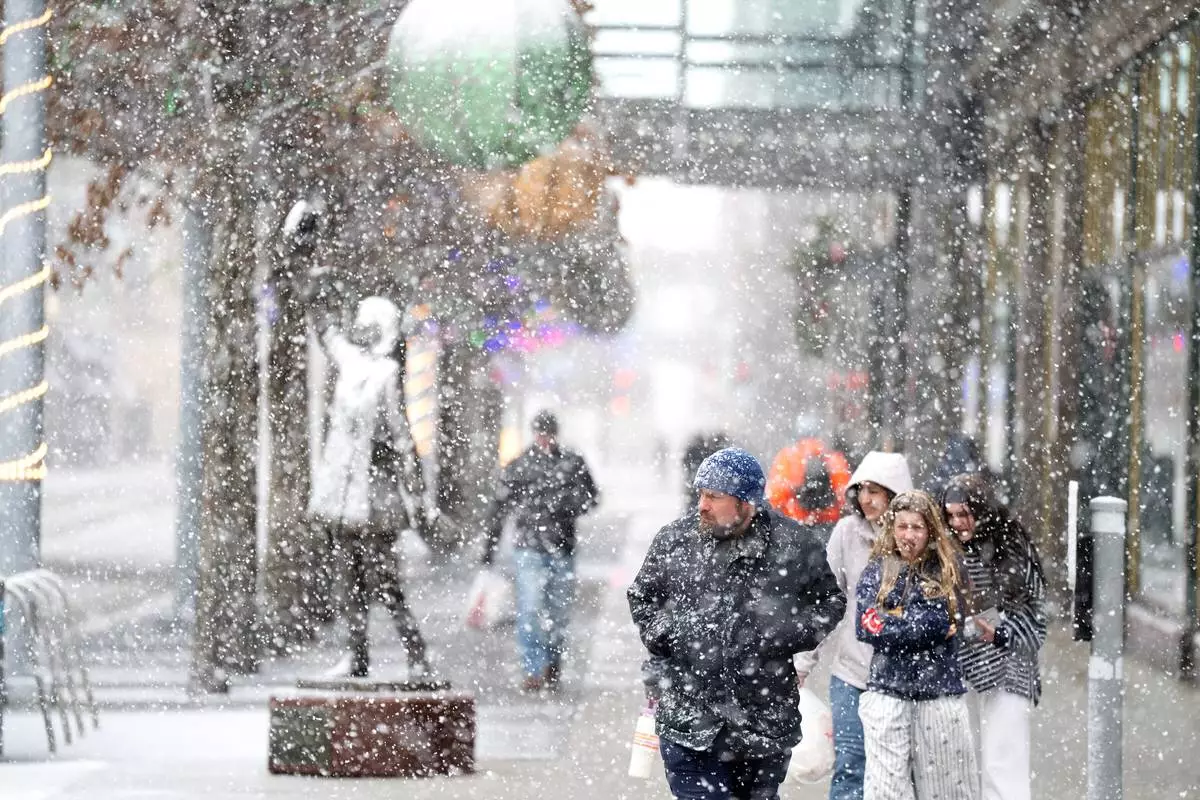
Heavy snow falls along Nicollet Mall Sunday Dec.28, 2025 in Minneapolis. (Jerry Holt /Star Tribune via AP)