Skip to Content Facebook Feature Image

Numbers that matter from the first 100 days of Trump's second term

News

Numbers that matter from the first 100 days of Trump's second term
News

News

Numbers that matter from the first 100 days of Trump's second term

2025-04-29 23:23 Last Updated At:23:30

WASHINGTON (AP) — President Donald Trump's first 100 days back in the White House have been a demolition job — and that's a point of pride for his administration.

For the Republican administration, the raw numbers on executive actions, deportations, reductions in the federal workforce, increased tariff rates and other issues point toward a renewed America. To Trump's critics, though, he's wielding his authority in ways that challenge the Constitution's separation of powers and pose the risk of triggering a recession.

More Images
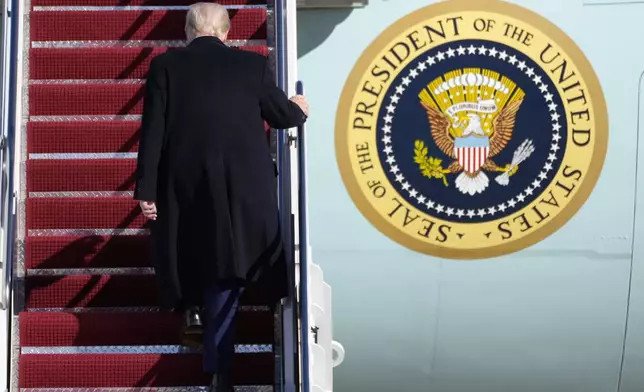
President Donald Trump boards Air Force One at Joint Base Andrews, Md., Friday, Feb. 14, 2025, en route to West Palm Beach, Fla. (AP Photo/Ben Curtis)
President Donald Trump boards Air Force One at Joint Base Andrews, Md., Friday, Feb. 14, 2025, en route to West Palm Beach, Fla. (AP Photo/Ben Curtis)

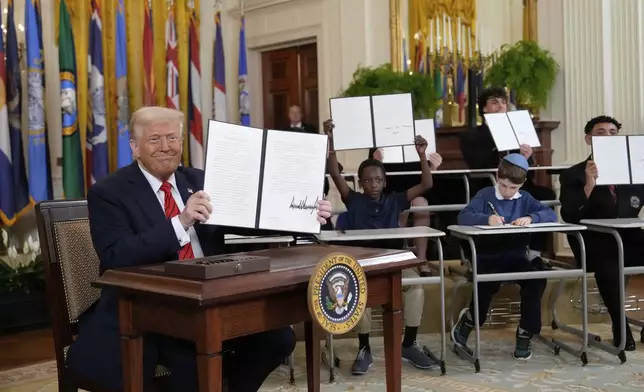
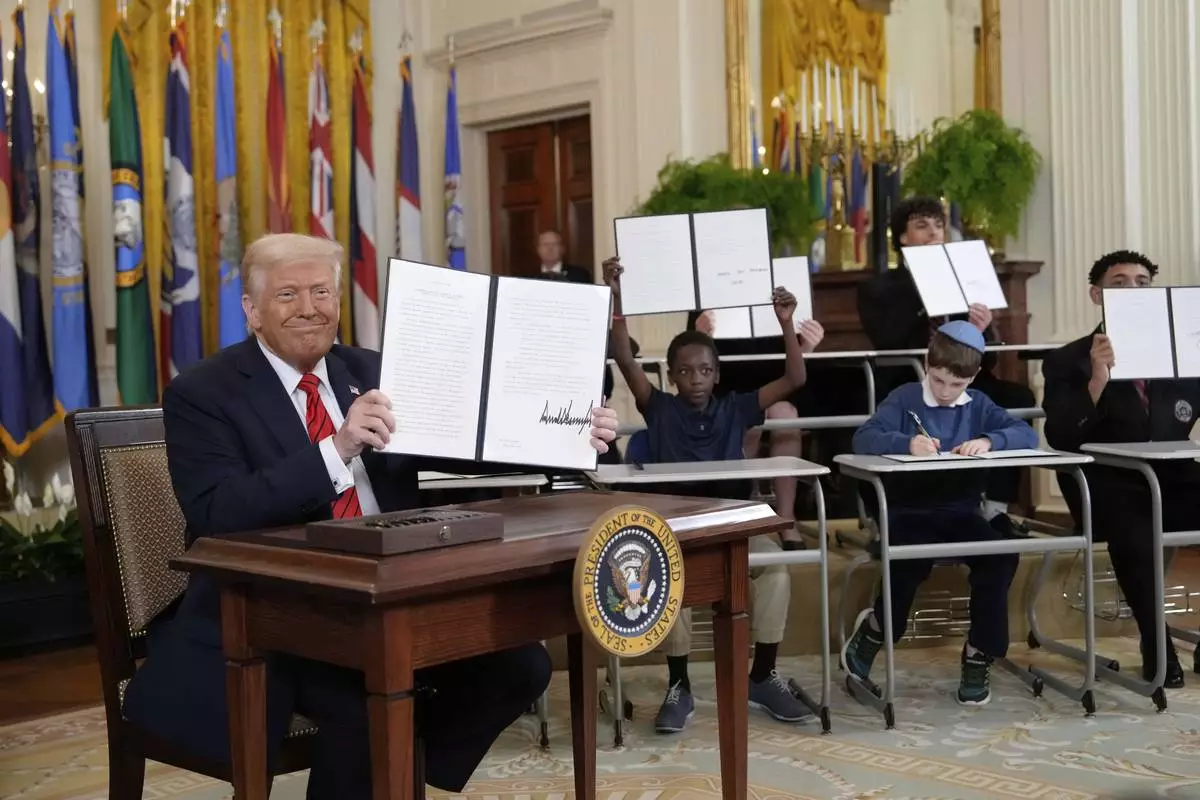
President Donald Trump, left, holds up a signed executive order as young people hold up copies of the executive order they signed at an education event in the East Room of the White House in Washington, Thursday, March 20, 2025. (AP Photo/Ben Curtis)

President Donald Trump, left, holds up a signed executive order as young people hold up copies of the executive order they signed at an education event in the East Room of the White House in Washington, Thursday, March 20, 2025. (AP Photo/Ben Curtis)

President Donald Trump gestures to supporters gathered for a Presidents Day rally as he leaves the Trump International Golf Club, Monday, Feb. 17, 2025, in West Palm Beach, Fla. (AP Photo/Ben Curtis)
President Donald Trump gestures to supporters gathered for a Presidents Day rally as he leaves the Trump International Golf Club, Monday, Feb. 17, 2025, in West Palm Beach, Fla. (AP Photo/Ben Curtis)

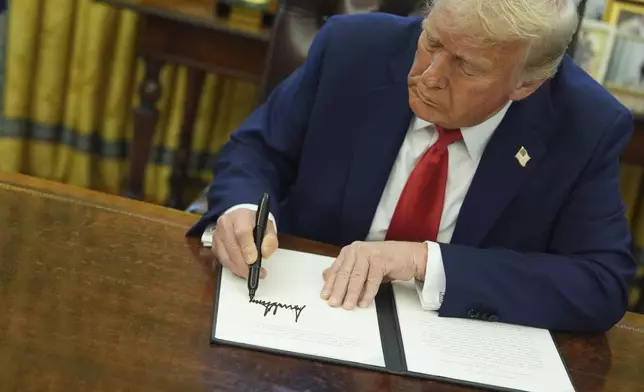
President Donald Trump signs an executive order in the Oval Office of the White House, Monday, Feb. 3, 2025, in Washington. (AP Photo/Evan Vucci)
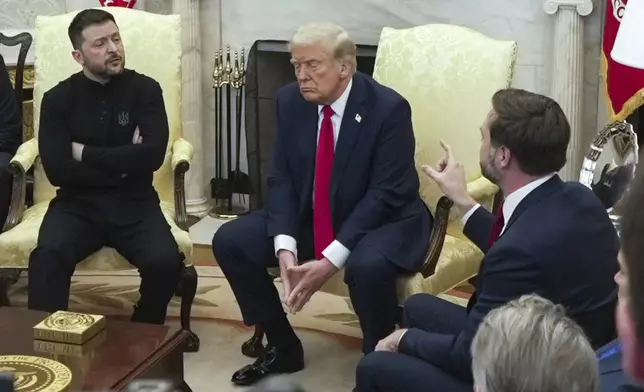
President Donald Trump signs an executive order in the Oval Office of the White House, Monday, Feb. 3, 2025, in Washington. (AP Photo/Evan Vucci)

Vice President JD Vance, right, speaks with Ukrainian President Volodymyr Zelenskyy, left, as President Donald Trump listens in the Oval Office at the White House, Friday, Feb. 28, 2025, in Washington. (AP Photo/ Mystyslav Chernov)
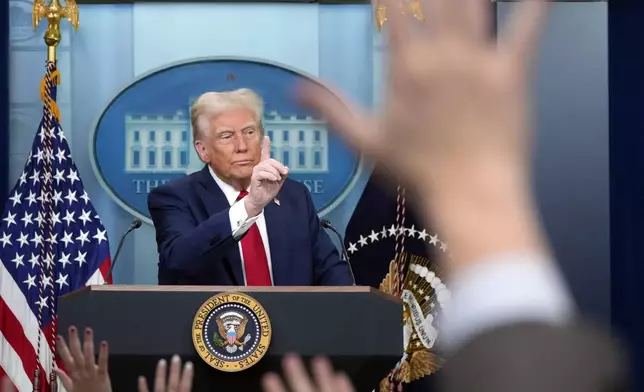
Vice President JD Vance, right, speaks with Ukrainian President Volodymyr Zelenskyy, left, as President Donald Trump listens in the Oval Office at the White House, Friday, Feb. 28, 2025, in Washington. (AP Photo/ Mystyslav Chernov)

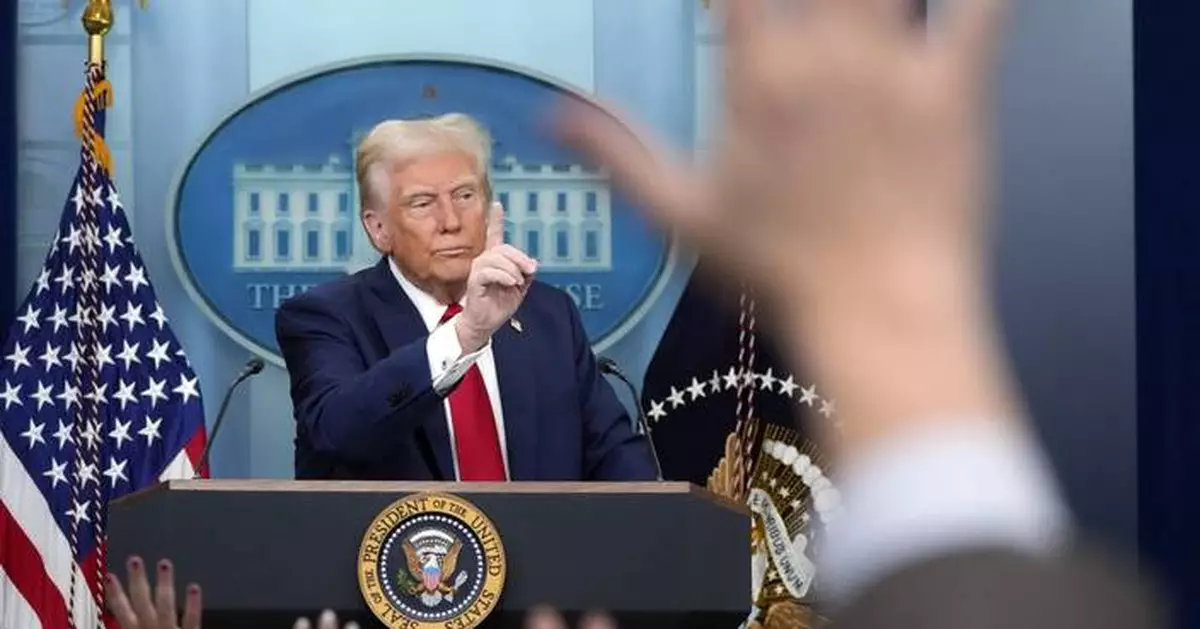
President Donald Trump speaks in the James Brady Press Briefing Room at the White House, Thursday, Jan. 30, 2025, in Washington. (AP Photo/Alex Brandon)

President Donald Trump speaks in the James Brady Press Briefing Room at the White House, Thursday, Jan. 30, 2025, in Washington. (AP Photo/Alex Brandon)

From executive orders to deportations, some defining numbers from Trump’s first 100 days:

In just 100 days, Trump has nearly matched the number of executive orders that his predecessor, Democrat Joe Biden, signed during the previous four years, 162. Trump, at roughly 140, is essentially moving at a pace not seen since Franklin Delano Roosevelt's presidency, when the Great Depression necessitated urgent action.

But the number alone fails to capture the unprecedented scope of Trump's actions. Without seeking congressional approval, Trump has used his orders and directives to impose hundreds of billions of dollars annually in new import taxes and reshape the federal bureaucracy by enabling mass layoffs.

John Woolley, a professor at the University of California, Santa Barbara and co-director of the American Presidency Project, sees “very aggressive assertions of presidential authority in all kinds of ways” that are far more audacious than anything done by former presidents. That includes Biden's student debt forgiveness program and Barack Obama's decision to allow residency for immigrants who arrived in the country illegally as children.

“None of those had the kind of arbitrary, forceful quality of Trump’s actions,” Woolley said.

Trump's tariff agenda has unnerved the global economy. He's gone after the two biggest U.S. trade partners, Mexico and Canada, with tariffs of as much as 25% for fentanyl trafficking. He's put import taxes on autos, steel and aluminum. On his April 2 “Liberation Day,” he slapped tariffs on dozens of countries that were so high that the financial markets panicked, causing him to pull back and set a 10% baseline tax on imports instead to allow 90 days of negotiations on trade deals.

But that pales in comparison to the 145% tariff he placed on China, which prompted China to fight back with a 125% tax on U.S. goods. There are exemptions to the U.S. tariffs for electronics. But inflationary pressures and recession fears are both rising as a trade war between the world's two largest economies could spiral out of control in dangerous ways.

The U.S. president has said that China has been talking with his administration, but he's kept his description of the conversations vague. The Chinese government says no trade negotiations of any kind are underway. Trump is banking on the tariffs raising enough revenue for him to cut taxes, even as he simultaneously talks up the prospect of an agreement.

So far, despite the economic risks, the Trump team shows little desire to budge, even as the president claims a deal with China will eventually happen.

“I believe that it’s up to China to de-escalate because they sell five times more to us than we sell to them,” Treasury Secretary Scott Bessent told CNBC on Monday.

Trump said during his presidential campaign that he could quickly defuse the Russian-started war in Ukraine. But European allies and others say the U.S president's statements about how to end the war reflect a troubling affinity for Russian leader Vladimir Putin.

Trump's peace proposal says that Ukraine must recognize Russian authority over the more than 10,000 square miles (26,000 square kilometers) of the Crimean Peninsula. Ukrainian President Volodymr Zelenskyy rejected the idea out of hand: “There is nothing to talk about — it is our land, the land of the Ukrainian people.”

The U.S. president is essentially asking Ukraine to surrender any claims to a land mass slightly larger than Maryland. Russia annexed the area in 2014 when Obama was president, and Trump says he's simply being realistic about its future.

The four meetings that Trump's envoy, Steve Witkoff, has had with Putin have yet to produce a trustworthy framework for the deal that Trump wants to deliver.

After recent Russian missile attacks on Ukrainian cities and towns, Trump posted on social media that perhaps Putin “doesn’t want to stop the war, he’s just tapping me along.”

Trump was eager to take credit for an “epic ceasefire” agreement in the Israel-Hamas War in order to restart the release of hostages taken in Hamas' Oct. 7, 2023, attack. But the ceasefire ended in March, and more than 2,000 Palestinians have died since the temporary truce collapsed. Palestinian officials have put the total number of deaths above 52,200. Food, fuel and medicine have not entered the Gaza Strip for almost 60 days.

Trump said in February that he would remove the Palestinians from the Gaza Strip and relocate them elsewhere, suggesting that the United States could take over the area, level the destroyed buildings and construct a luxurious “Riviera of the Middle East.”

The Department of Government Efficiency, led by tech billionaire and adviser Elon Musk, is dramatically shrinking the government workforce. Across all agencies, there have been about 60,000 firings, including at the IRS, which might make it harder to collect taxes and reduce the budget deficit. Another 75,000 federal workers accepted administration buyout offers. And the Trump administration has floated at least another 145,000 job cuts.

Those estimated job losses don't include the possible layoffs and hiring freezes at nonprofits, government contractors and universities that had their federal funding frozen by the Trump administration.

The federal government had about 3 million federal employees, including at the U.S. Postal Service, when Trump became president, according to the Labor Department.

The Trump administration says it has deported 139,000 people who were in the United States without proper legal authority. Trump’s first months also have produced a sharp drop in crossings at the Southwest border, with Border Patrol tracking 7,181 encounters in March, down from 137,473 the same month last year.

Deportations have occasionally lagged behind Biden’s numbers, but Trump officials reject the comparison as not “apples to apples” because fewer people are crossing the border now.

The administration maintains that it's getting rid of violent and dangerous criminals. But many migrants who assert their innocence have been deported without due process.

In April, the Supreme Court directed the Trump administration to “facilitate” the return to the U.S. of Kilmar Abrego Garcia, an El Salvador citizen who was deported to his home country. Abrego Garcia had been living in Maryland and had an immigration court order preventing his deportation to his native country over fears he would face persecution from local gangs. So far, Abrego Garcia remains held in a Salvadoran prison.

Trump said last week that he won the presidential election on the promise of deportations and that the courts are interfering with his efforts.

“We’re getting them out, and a judge can say, ‘No, you have to have a trial,’" Trump said. "The trial's going to take two years, and now we’re going to have a very dangerous country if we’re not allowed to do what we’re entitled to do.”
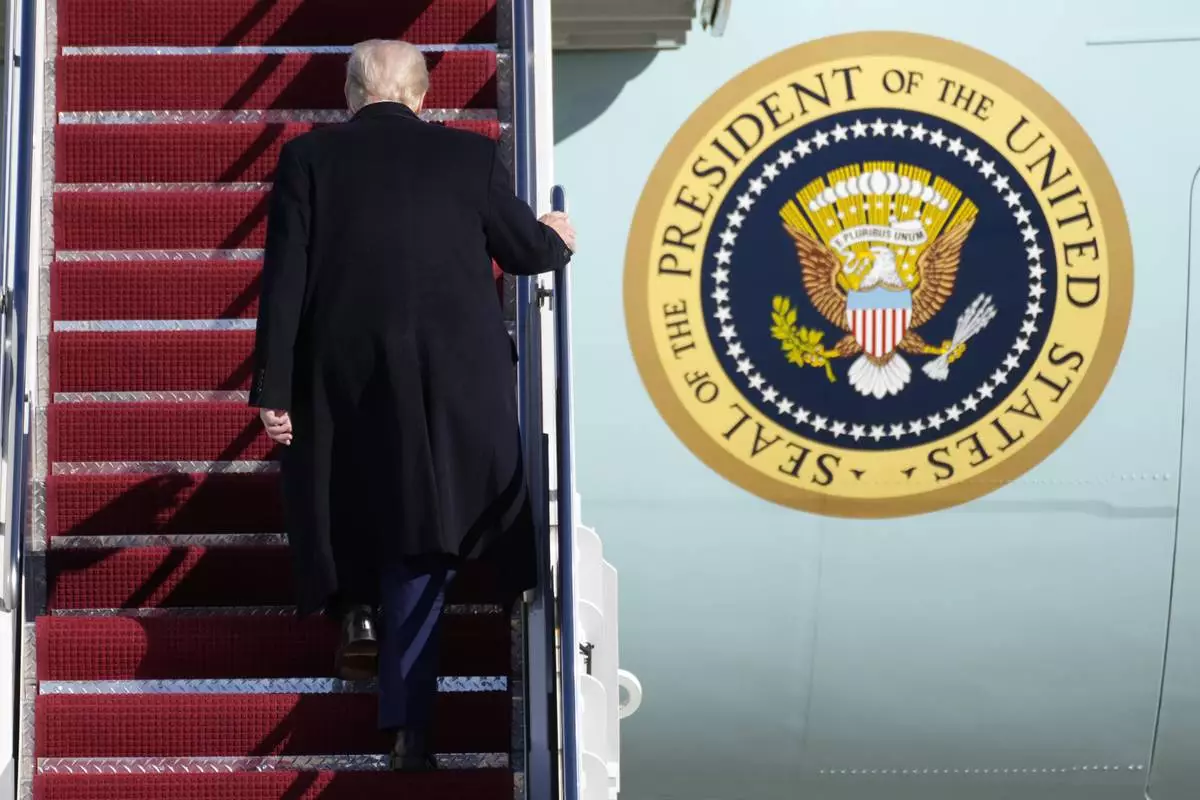
President Donald Trump boards Air Force One at Joint Base Andrews, Md., Friday, Feb. 14, 2025, en route to West Palm Beach, Fla. (AP Photo/Ben Curtis)
President Donald Trump boards Air Force One at Joint Base Andrews, Md., Friday, Feb. 14, 2025, en route to West Palm Beach, Fla. (AP Photo/Ben Curtis)

President Donald Trump, left, holds up a signed executive order as young people hold up copies of the executive order they signed at an education event in the East Room of the White House in Washington, Thursday, March 20, 2025. (AP Photo/Ben Curtis)

President Donald Trump, left, holds up a signed executive order as young people hold up copies of the executive order they signed at an education event in the East Room of the White House in Washington, Thursday, March 20, 2025. (AP Photo/Ben Curtis)

President Donald Trump gestures to supporters gathered for a Presidents Day rally as he leaves the Trump International Golf Club, Monday, Feb. 17, 2025, in West Palm Beach, Fla. (AP Photo/Ben Curtis)
President Donald Trump gestures to supporters gathered for a Presidents Day rally as he leaves the Trump International Golf Club, Monday, Feb. 17, 2025, in West Palm Beach, Fla. (AP Photo/Ben Curtis)

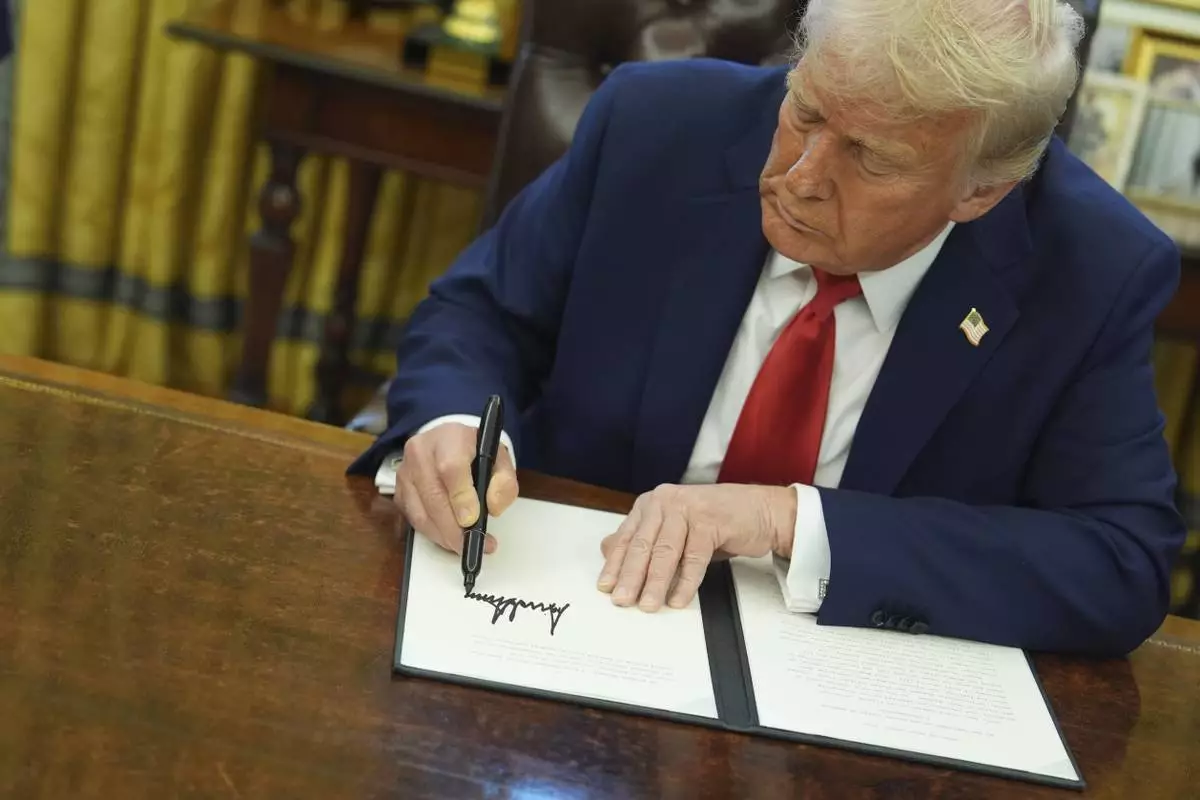
President Donald Trump signs an executive order in the Oval Office of the White House, Monday, Feb. 3, 2025, in Washington. (AP Photo/Evan Vucci)
President Donald Trump signs an executive order in the Oval Office of the White House, Monday, Feb. 3, 2025, in Washington. (AP Photo/Evan Vucci)

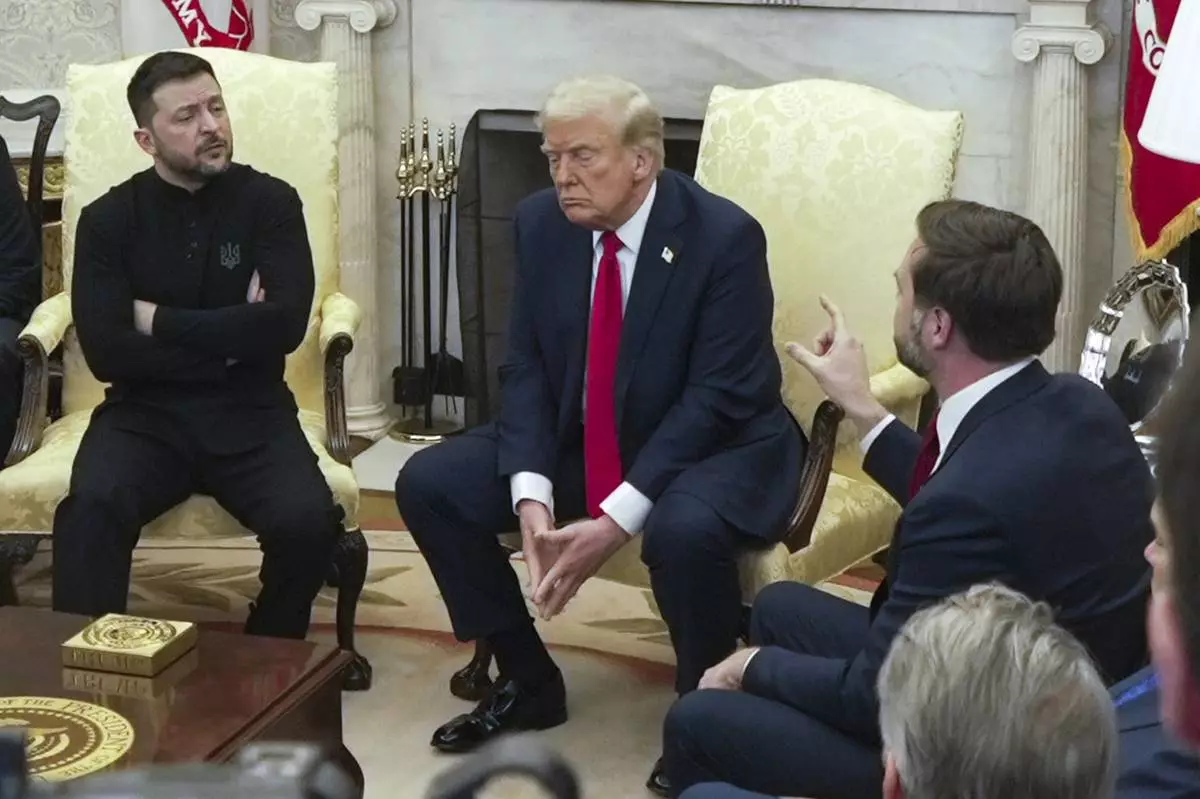
Vice President JD Vance, right, speaks with Ukrainian President Volodymyr Zelenskyy, left, as President Donald Trump listens in the Oval Office at the White House, Friday, Feb. 28, 2025, in Washington. (AP Photo/ Mystyslav Chernov)
Vice President JD Vance, right, speaks with Ukrainian President Volodymyr Zelenskyy, left, as President Donald Trump listens in the Oval Office at the White House, Friday, Feb. 28, 2025, in Washington. (AP Photo/ Mystyslav Chernov)

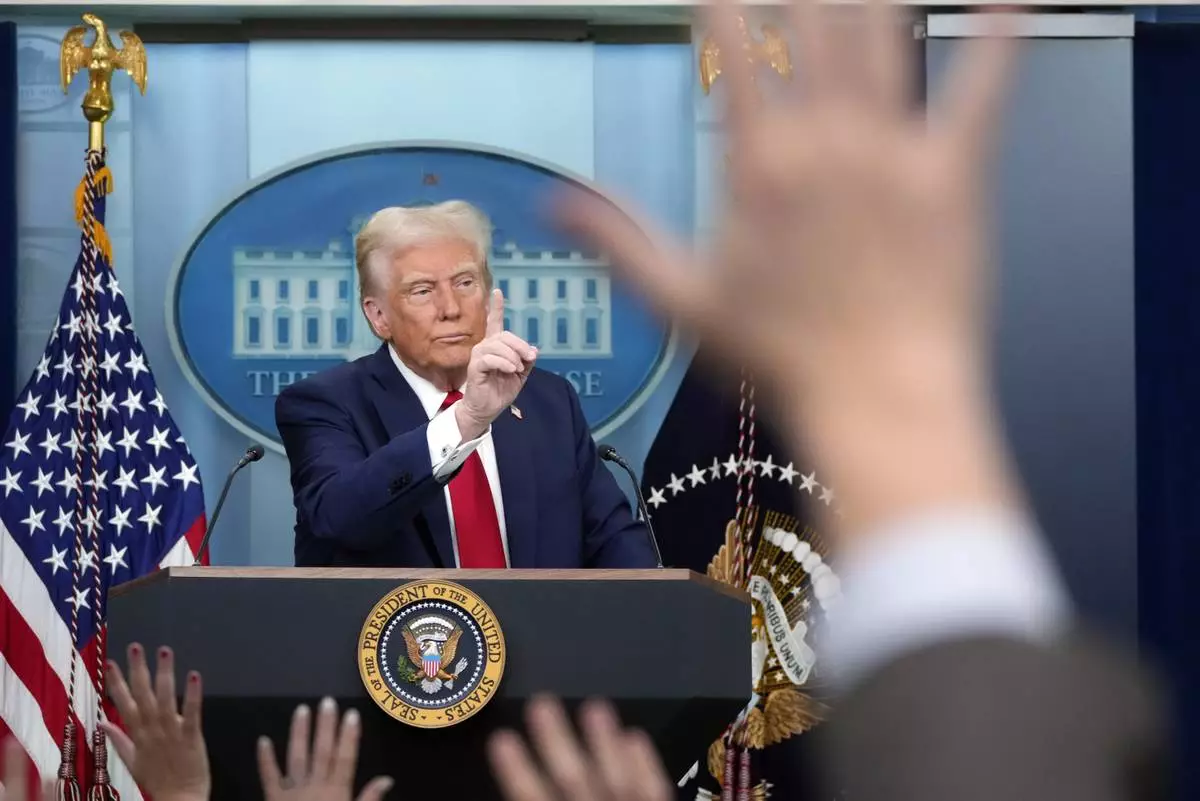
President Donald Trump speaks in the James Brady Press Briefing Room at the White House, Thursday, Jan. 30, 2025, in Washington. (AP Photo/Alex Brandon)
President Donald Trump speaks in the James Brady Press Briefing Room at the White House, Thursday, Jan. 30, 2025, in Washington. (AP Photo/Alex Brandon)
When Indiana adopted new U.S. House districts four years ago, Republican legislative leaders lauded them as “fair maps” that reflected the state's communities.

But when Gov. Mike Braun recently tried to redraw the lines to help Republicans gain more power, he implored lawmakers to "vote for fair maps.”

What changed? The definition of “fair.”

As states undertake mid-decade redistricting instigated by President Donald Trump, Republicans and Democrats are using a tit-for-tat definition of fairness to justify districts that split communities in an attempt to send politically lopsided delegations to Congress. It is fair, they argue, because other states have done the same. And it is necessary, they claim, to maintain a partisan balance in the House of Representatives that resembles the national political divide.

This new vision for drawing congressional maps is creating a winner-take-all scenario that treats the House, traditionally a more diverse patchwork of politicians, like the Senate, where members reflect a state's majority party. The result could be reduced power for minority communities, less attention to certain issues and fewer distinct voices heard in Washington.

Although Indiana state senators rejected a new map backed by Trump and Braun that could have helped Republicans win all nine of the state’s congressional seats, districts have already been redrawn in Texas, California, Missouri, North Carolina and Ohio. Other states could consider changes before the 2026 midterms that will determine control of Congress.

“It’s a fundamental undermining of a key democratic condition,” said Wayne Fields, a retired English professor from Washington University in St. Louis who is an expert on political rhetoric.

“The House is supposed to represent the people,” Fields added. “We gain an awful lot by having particular parts of the population heard.”

Under the Constitution, the Senate has two members from each state. The House has 435 seats divided among states based on population, with each state guaranteed at least one representative. In the current Congress, California has the most at 52, followed by Texas with 38.

Because senators are elected statewide, they are almost always political pairs of one party or another. Pennsylvania and Wisconsin are the only states now with both a Democrat and Republican in the Senate. Maine and Vermont each have one independent and one senator affiliated with a political party.

By contrast, most states elect a mixture of Democrats and Republicans to the House. That is because House districts, with an average of 761,000 residents, based on the 2020 census, are more likely to reflect the varying partisan preferences of urban or rural voters, as well as different racial, ethnic and economic groups.

This year's redistricting is diminishing those locally unique districts.

In California, voters in several rural counties that backed Trump were separated from similar rural areas and attached to a reshaped congressional district containing liberal coastal communities. In Missouri, Democratic-leaning voters in Kansas City were split from one main congressional district into three, with each revised district stretching deep into rural Republican areas.

Some residents complained their voices are getting drowned out. But Govs. Gavin Newsom, D-Calif., and Mike Kehoe, R-Mo., defended the gerrymandering as a means of countering other states and amplifying the voices of those aligned with the state's majority.

Indiana's delegation in the U.S. House consists of seven Republicans and two Democrats — one representing Indianapolis and the other a suburban Chicago district in the state's northwestern corner.

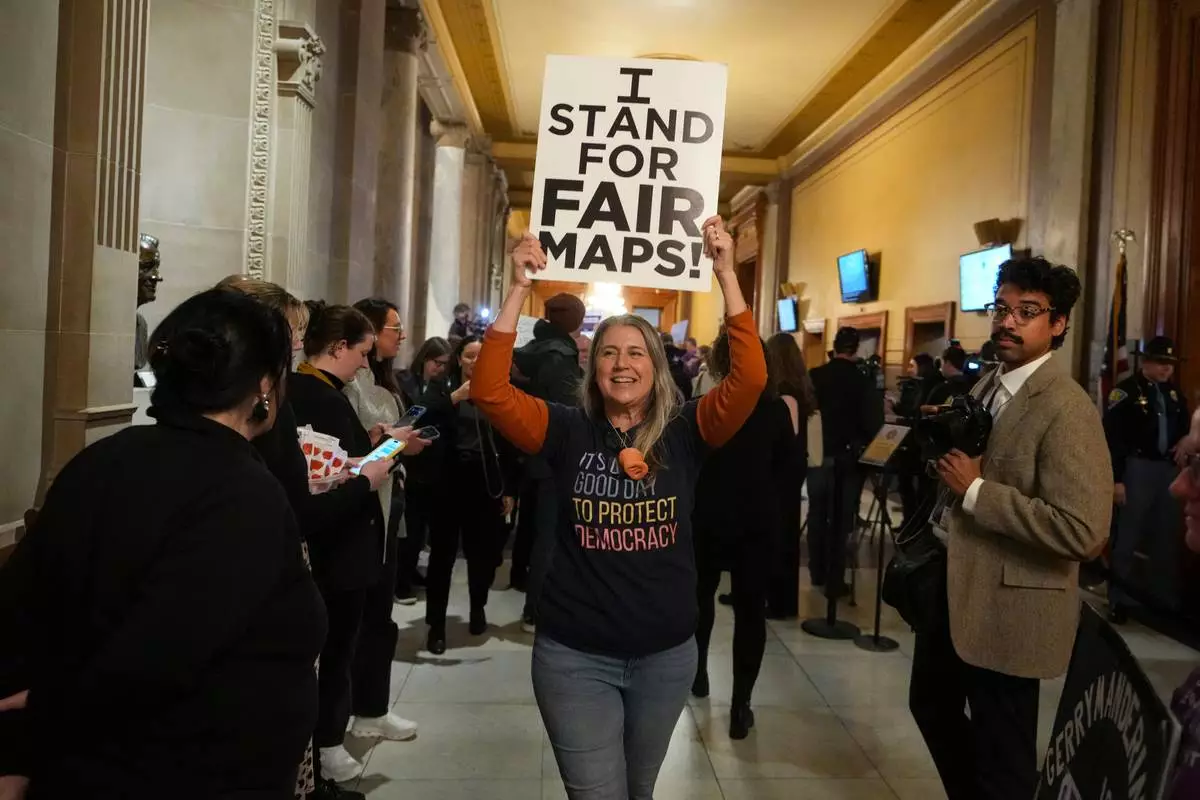
Dueling definitions of fairness were on display at the Indiana Capitol as lawmakers considered a Trump-backed redistricting plan that would have split Indianapolis among four Republican-leaning districts and merged the Chicago suburbs with rural Republican areas. Opponents walked the halls in protest, carrying signs such as “I stand for fair maps!”

Ethan Hatcher, a talk radio host who said he votes for Republicans and Libertarians, denounced the redistricting plan as “a blatant power grab" that "compromises the principles of our Founding Fathers" by fracturing Democratic strongholds to dilute the voices of urban voters.

“It’s a calculated assault on fair representation," Hatcher told a state Senate committee.

But others asserted it would be fair for Indiana Republicans to hold all of those House seats, because Trump won the “solidly Republican state” by nearly three-fifths of the vote.

“Our current 7-2 congressional delegation doesn’t fully capture that strength,” resident Tracy Kissel said at a committee hearing. "We can create fairer, more competitive districts that align with how Hoosiers vote.”

When senators defeated a map designed to deliver a 9-0 congressional delegation for Republicans, Braun bemoaned that they had missed an “opportunity to protect Hoosiers with fair maps.”

By some national measurements, the U.S. House already is politically fair. The 220-215 majority that Republicans won over Democrats in the 2024 elections almost perfectly aligns with the share of the vote the two parties received in districts across the country, according to an Associated Press analysis.

But that overall balance belies an imbalance that exists in many states. Even before this year's redistricting, the number of states with congressional districts tilted toward one party or another was higher than at any point in at least a decade, the AP analysis found.

The partisan divisions have contributed to a “cutthroat political environment” that “drives the parties to extreme measures," said Kent Syler, a political science professor at Middle Tennessee State University. He noted that Republicans hold 88% of congressional seats in Tennessee, and Democrats have an equivalent in Maryland.

“Fairer redistricting would give people more of a feeling that they have a voice," Syler said.

Rebekah Caruthers, who leads the Fair Elections Center, a nonprofit voting rights group, said there should be compact districts that allow communities of interest to elect the representatives of their choice, regardless of how that affects the national political balance. Gerrymandering districts to be dominated by a single party results in “an unfair disenfranchisement" of some voters, she said.

“Ultimately, this isn’t going to be good for democracy," Caruthers said. "We need some type of détente.”

A protester celebrates as they walk outside the Indiana Senate Chamber after a bill to redistrict the state's congressional map was defeated, Thursday, Dec. 11, 2025, at the Statehouse in Indianapolis. (AP Photo/Michael Conroy)

A protester celebrates as they walk outside the Indiana Senate Chamber after a bill to redistrict the state's congressional map was defeated, Thursday, Dec. 11, 2025, at the Statehouse in Indianapolis. (AP Photo/Michael Conroy)

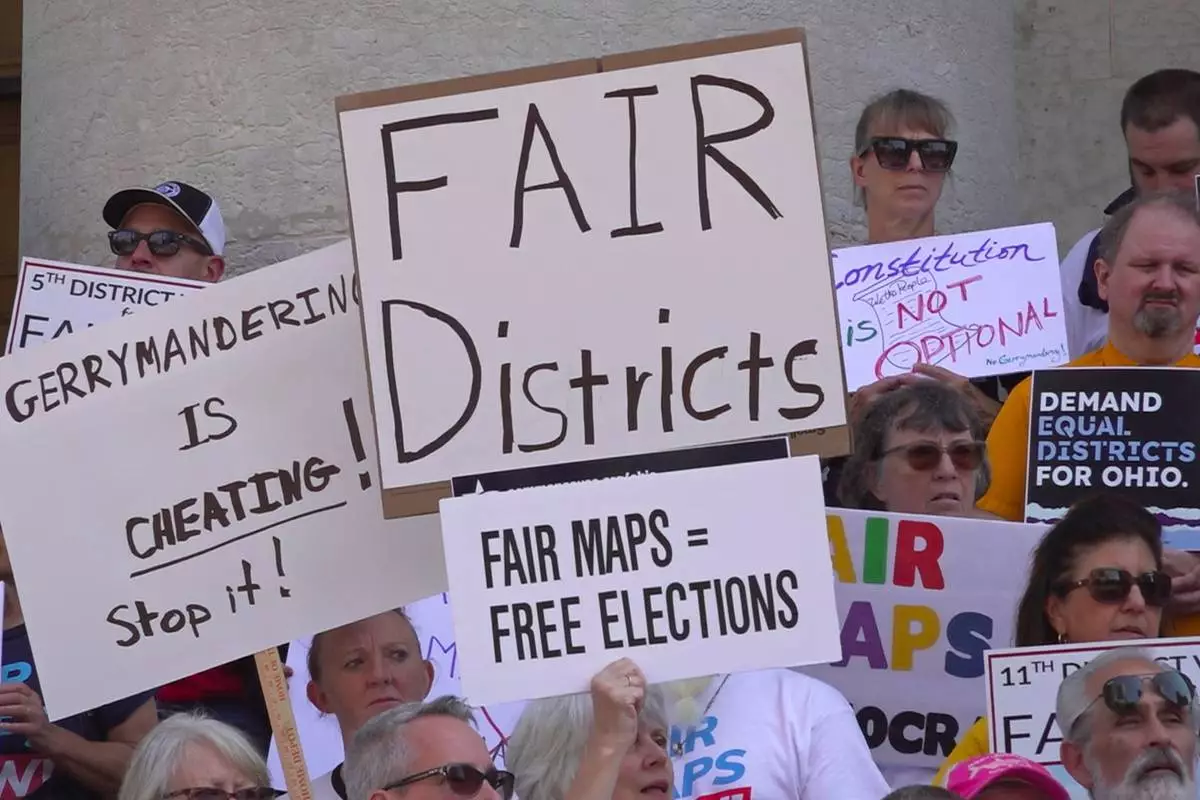
FILE - This photo taken from video shows organizers rallying outside of the Ohio Statehouse to protest gerrymandering and advocate for lawmakers to draw fair maps in Columbus, Ohio, Sept. 17, 2025. (AP Photo/Patrick Aftoora-Orsagos, File)

FILE - This photo taken from video shows organizers rallying outside of the Ohio Statehouse to protest gerrymandering and advocate for lawmakers to draw fair maps in Columbus, Ohio, Sept. 17, 2025. (AP Photo/Patrick Aftoora-Orsagos, File)

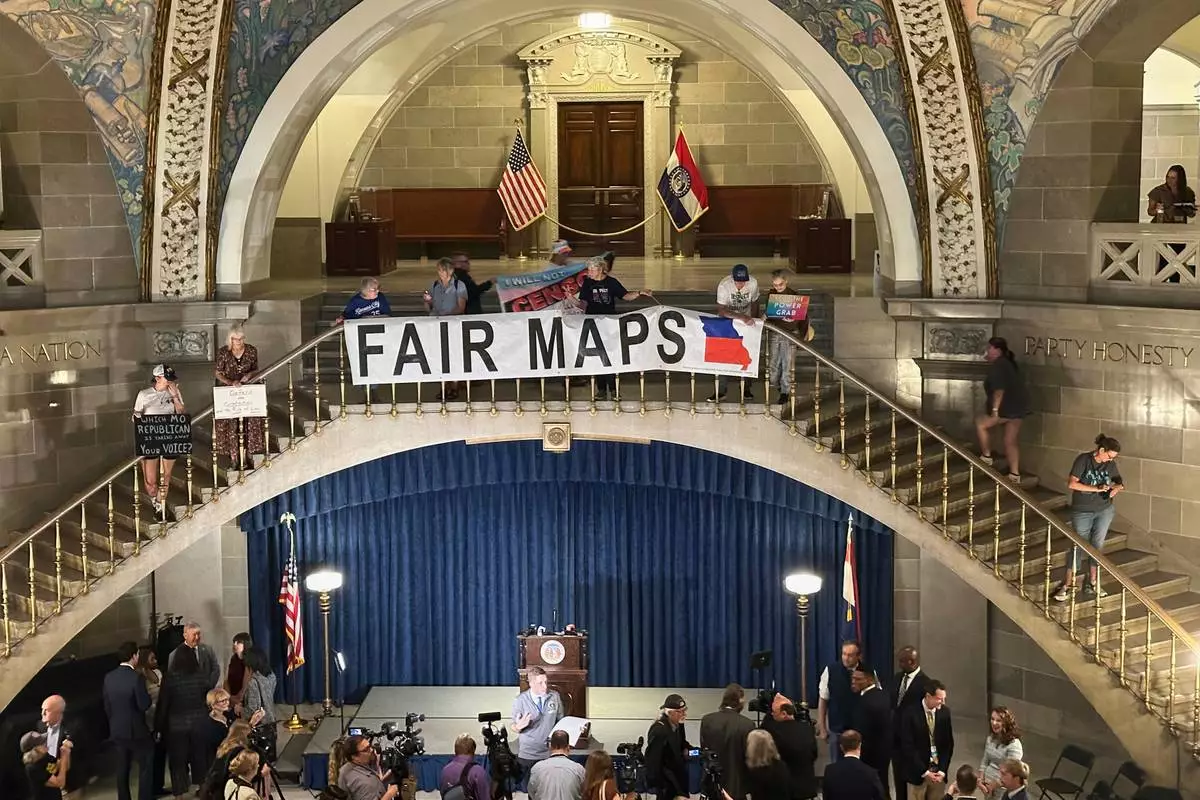
Opponents of Missouri's Republican-backed congressional redistricting plan display a banner in protest at the State Capitol in Jefferson City, Missouri, Sept. 10, 2025. (AP Photo/David A. Lieb)

Opponents of Missouri's Republican-backed congressional redistricting plan display a banner in protest at the State Capitol in Jefferson City, Missouri, Sept. 10, 2025. (AP Photo/David A. Lieb)

Recommended Articles