SAN JUAN, Puerto Rico (AP) — A Canadian company announced Tuesday that its U.S. subsidiary submitted applications to the National Oceanic and Atmospheric Administration to mine the seafloor, sparking outrage by bypassing a U.N. agency that regulates deep international waters.
The Metals Company said it was seeking two exploration licenses and a commercial recovery permit, marking the first time a company applies to commercially mine the seabed.
The filing is expected to spark a complex legal battle since the Jamaica-based International Seabed Authority, a U.N. agency that regulates international deep-sea waters, has the power to authorize exploitation permits.
“Any commercial exploitation outside of national jurisdiction carried out without the authorization of ISA would constitute a violation of international law,” the authority said in late March after The Metals Company announced its intention to seek permission from the U.S. government to start deep-sea mining in international waters.
There are currently no regulations in place to oversee such mining as scientists warn that extracting minerals from vital ecosystems that help regulate climate change could cause permanent damage.
The filing comes less than a week after U.S. President Donald Trump issued an executive order that directs the Secretary of Commerce to expedite the review and issuance of exploration and commercial recovery permits, among other things.
“With these applications, we are offering the United States a shovel-ready path to new and abundant supplies of nickel, copper, cobalt, and manganese — critical metals for energy, infrastructure and defense,” Gerard Barron, chairman and CEO of The Metals Company, said in a statement.
Environmentalists and activists decried the move, saying that ISA has the sole power to authorize exploitation permits.
“This unilateral American effort to carve up the Pacific Ocean already faces fierce international opposition,” said Ruth Ramos, Greenpeace’s international senior campaigner. “Governments around the world must now step up to defend international rules and cooperation against rogue deep-sea mining.”
For years, members of the authority’s council have debated how and if to allow deep-sea mining. So far, the authority has only issued exploration licenses, with most of the current exploratory activity concentrated in the Clarion-Clipperton Fracture Zone, which covers 1.7 million square miles (4.5 million square kilometers) between Hawaii and Mexico. At least 17 of 31 licenses have been issued for this zone, with exploration occurring at depths ranging from 13,000 to 19,000 feet (4,000 to 6,000 meters).
The International Seabed Authority was created in 1994 by the U.N. Convention on the Law of the Sea, which is ratified by more than 165 nations — but not the United States.
The Metals Company has argued that the U.S. seabed mining code would allow it to start operations in international waters, since it’s not a member of the authority and therefore not bound by its rules.
“After continuous delay at the international level, the United States now has a clear opportunity to reclaim its leadership role in the deep sea and set a global standard for responsible, science-based deep-seabed resource development,” Barron said.
But Emily Jeffers, senior attorney for the U.S.-based nonprofit Center for Biological Diversity, said it's not a foregone conclusion that the company will be given permission to mine under the U.S. seabed mining code, which requires a full environmental analysis.
“This statute has been on the books for 45 years, and there’s a reason why no other companies have used it to extract minerals from the seafloor,” she said in a phone interview. “The science is clear that companies cannot satisfy the standard demanded by the statute. There’s no way to do deep-sea mining without having a significant and catastrophic effect on the environment.”
Jeffers said that if the Trump administration approves the permit, it would face legal challenges from environmental organizations.
In late March, the Vancouver-based company announced that it would seek permission from the U.S. to start deep-sea mining in international waters to extract minerals used in electric car batteries and other green technology.
The announcement was made just hours before the council of the ISA met on the last day of a two-week conference focused on how and whether to allow such mining. Scientists have said that a rush to collect minerals that take millions of years to form could unleash noise, light and smothering dust storms deep in the Earth’s oceans.
“Deep-sea mining has the potential to impact not just the seabed environment, but all of the life in between,” said Jeff Watters, external affairs vice president for the U.S.-based nonprofit Ocean Conservancy. “There are so many mysteries about this part of the ocean where we’ve just been able to scratch the surface.”
He said deep-sea mining is “not an experiment that we should be conducting.”
Watters said in a phone interview that the area The Metals Company is seeking to explore is larger than the size of South Dakota and the extraction area larger than the size of Vermont.
“The size and scale is just huge,” he said.
Mining companies have said that harvesting minerals from the seafloor instead of from land is cheaper and has less of an environmental impact.
A spokesperson for the authority declined comment and referred to statements it made earlier this year.
The authority has said that it has the sole legal mandate to regulate mineral-related activities in the international seabed. It noted that the international legal regime established by the U.N. Convention on the Law of the Sea applies to all states, regardless of whether they are members or not.
“Any endeavor undertaken outside the recognized and consensual international framework, or in an attempt to circumvent international law, may incur legal, diplomatic, economic, security, financial and reputational risks,” the authority said.
Follow AP’s coverage of Latin America and the Caribbean at https://apnews.com/hub/latin-america
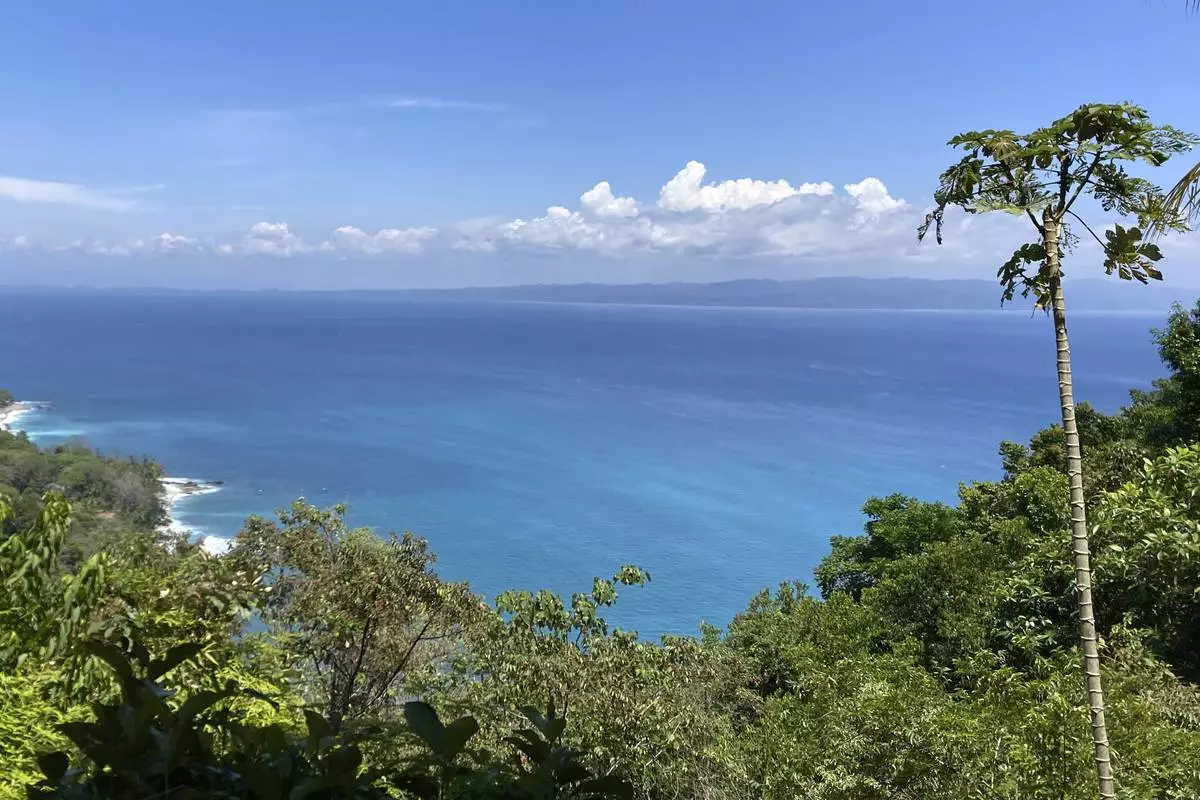
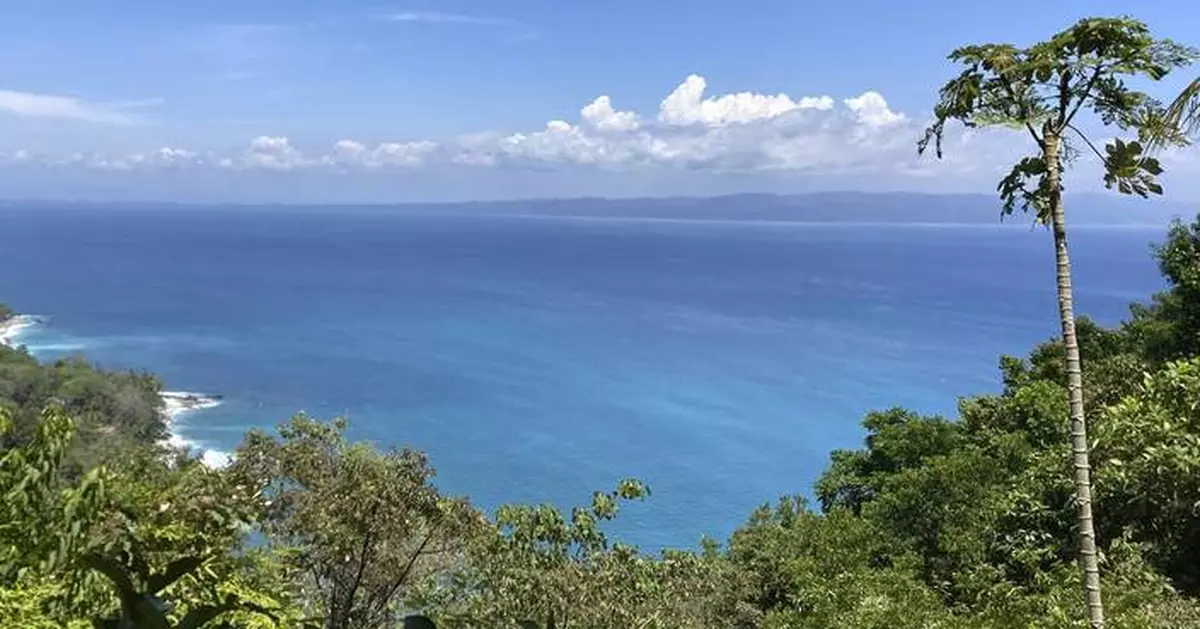
FILE - The view of Golfo Dulce and the Pacific Ocean is seen from a rainforest on the Osa Peninsula near Cabo Matapalo, Costa Rica, March 20, 2023. (AP Photo/Matt O'Brien, File)
Federal Reserve Chair Jerome Powellsaid Sunday the Department of Justice has served the central bank with subpoenas and threatened it with a criminal indictment over his testimony this summer about the Fed’s building renovations.
The move represents an unprecedented escalation in President Donald Trump’s battle with the Fed, an independent agency he's repeatedly attacked for not cutting its key interest rate as sharply as he prefers. The renewed fight will likely rattle financial markets Monday and could over time escalate borrowing costs for mortgages and other loans.
The subpoenas relate to Powell’s testimony before the Senate Banking Committee in June, the Fed chair said, regarding the Fed’s $2.5 billion renovation of two office buildings, a project Trump has criticized as excessive.
Here's the latest:
Stocks are falling on Wall Street after Federal Reserve Chair Jerome Powell said the Department of Justice had served the central bank with subpoenas and threatened it with a criminal indictment over his testimony about the Fed’s building renovations.
The S&P 500 fell 0.3% in early trading Monday. The Dow Jones Industrial Average lost 384 points, or 0.8%, and the Nasdaq composite fell 0.2%.
Powell characterized the threat of criminal charges as pretexts to undermine the Fed’s independence in setting interest rates, its main tool for fighting inflation. The threat is the latest escalation in President Trump’s feud with the Fed.
▶ Read more about the financial markets
She says she had “a very good conversation” with Trump on Monday morning about topics including “security with respect to our sovereignties.”
Last week, Sheinbaum had said she was seeking a conversation with Trump or U.S. Secretary of State Marco Rubio after the U.S. president made comments in an interview that he was ready to confront drug cartels on the ground and repeated the accusation that cartels were running Mexico.
Trump’s offers of using U.S. forces against Mexican cartels took on a new weight after the Trump administration deposed Venezuelan President Nicolás Maduro. Sheinbaum was expected to share more about their conversation later Monday.
A leader of the Canadian government is visiting China this week for the first time in nearly a decade, a bid to rebuild his country’s fractured relations with the world’s second-largest economy — and reduce Canada’s dependence on the United States, its neighbor and until recently one of its most supportive and unswerving allies.
The push by Prime Minster Mark Carney, who arrives Wednesday, is part of a major rethink as ties sour with the United States — the world’s No. 1 economy and long the largest trading partner for Canada by far.
Carney aims to double Canada’s non-U.S. exports in the next decade in the face of President Trump’s tariffs and the American leader’s musing that Canada could become “the 51st state.”
▶ Read more about relations between Canada and China
The comment by a Chinese Foreign Ministry spokesperson came in response to a question at a regular daily briefing. President Trump has said he would like to make a deal to acquire Greenland, a semiautonomous region of NATO ally Denmark, to prevent Russia or China from taking it over.
Tensions have grown between Washington, Denmark and Greenland this month as Trump and his administration push the issue and the White House considers a range of options, including military force, to acquire the vast Arctic island.
Danish Prime Minister Mette Frederiksen has warned that an American takeover of Greenland would mark the end of NATO.
▶ Read more about the U.S. and Greenland
Trump said Sunday that he is “inclined” to keep ExxonMobil out of Venezuela after its top executive was skeptical about oil investment efforts in the country after the toppling of former President Nicolás Maduro.
“I didn’t like Exxon’s response,” Trump said to reporters on Air Force One as he departed West Palm Beach, Florida. “They’re playing too cute.”
During a meeting Friday with oil executives, Trump tried to assuage the concerns of the companies and said they would be dealing directly with the U.S., rather than the Venezuelan government.
Some, however, weren’t convinced.
“If we look at the commercial constructs and frameworks in place today in Venezuela, today it’s uninvestable,” said Darren Woods, CEO of ExxonMobil, the largest U.S. oil company.
An ExxonMobil spokesperson did not immediately respond Sunday to a request for comment.
▶ Read more about Trump’s comments on ExxonMobil
Trump’s motorcade took a different route than usual to the airport as he was departing Florida on Sunday due to a “suspicious object,” according to the White House.
The object, which the White House did not describe, was discovered during security sweeps in advance of Trump’s arrival at Palm Beach International Airport.
“A further investigation was warranted and the presidential motorcade route was adjusted accordingly,” White House press secretary Karoline Leavitt said in a statement Sunday.
The president, when asked about the package by reporters, said, “I know nothing about it.”
Anthony Guglielmi, the spokesman for U.S. Secret Service, said the secondary route was taken just as a precaution and that “that is standard protocol.”
▶ Read more about the “suspicious object”
Trump said Iran wants to negotiate with Washington after his threat to strike the Islamic Republic over its bloody crackdown on protesters, a move coming as activists said Monday the death toll in the nationwide demonstrations rose to at least 544.
Iran had no direct reaction to Trump’s comments, which came after the foreign minister of Oman — long an interlocutor between Washington and Tehran — traveled to Iran this weekend. It also remains unclear just what Iran could promise, particularly as Trump has set strict demands over its nuclear program and its ballistic missile arsenal, which Tehran insists is crucial for its national defense.
Iranian Foreign Minister Abbas Araghchi, speaking to foreign diplomats in Tehran, insisted “the situation has come under total control” in fiery remarks that blamed Israel and the U.S. for the violence, without offering evidence.
▶ Read more about the possible negotiations and follow live updates
Fed Chair Powell said Sunday the DOJ has served the central bank with subpoenas and threatened it with a criminal indictment over his testimony this summer about the Fed’s building renovations.
The move represents an unprecedented escalation in Trump’s battle with the Fed, an independent agency he has repeatedly attacked for not cutting its key interest rate as sharply as he prefers. The renewed fight will likely rattle financial markets Monday and could over time escalate borrowing costs for mortgages and other loans.
The subpoenas relate to Powell’s testimony before the Senate Banking Committee in June, the Fed chair said, regarding the Fed’s $2.5 billion renovation of two office buildings, a project that Trump has criticized as excessive.
Powell on Sunday cast off what has up to this point been a restrained approach to Trump’s criticisms and personal insults, which he has mostly ignored. Instead, Powell issued a video statement in which he bluntly characterized the threat of criminal charges as simple “pretexts” to undermine the Fed’s independence when it comes to setting interest rates.
▶ Read more about the subpoenas
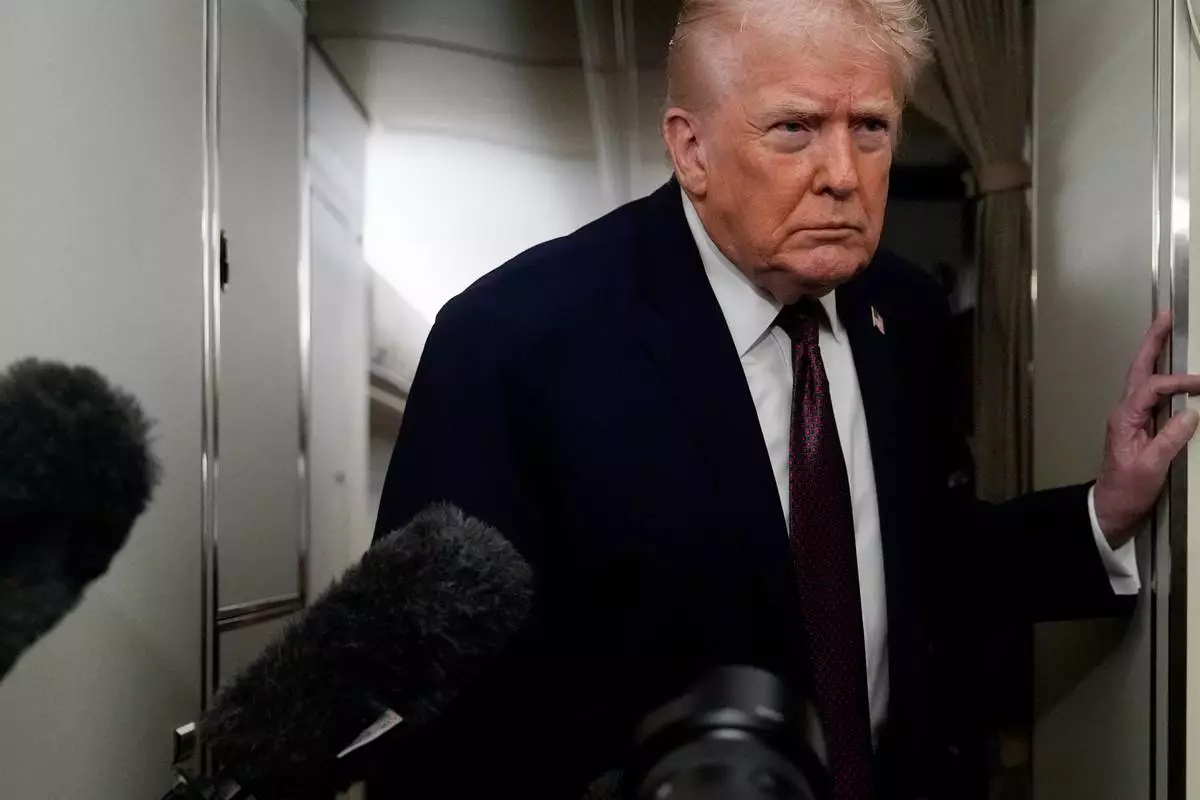
President Donald Trump speaks to reporters while in flight on Air Force One to Joint Base Andrews, Md., Sunday, Jan. 11, 2026. (AP Photo/Julia Demaree Nikhinson)
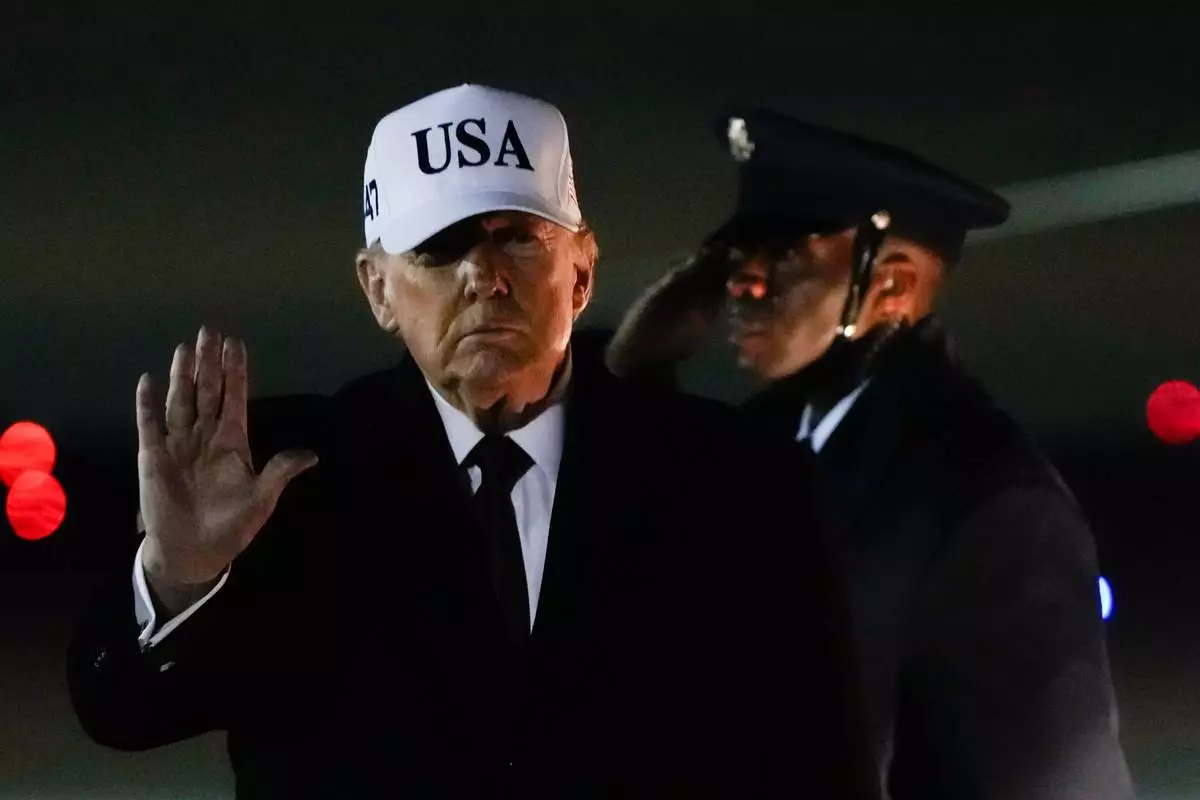
President Donald Trump waves after arriving on Air Force One from Florida, Sunday, Jan. 11, 2026, at Joint Base Andrews, Md. (AP Photo/Julia Demaree Nikhinson)