WASHINGTON (AP) — The U.S. government has begun shedding new light on a crackdown on international students, spelling out how it targeted thousands of people and laying out the grounds for terminating their legal status.
The new details emerged in lawsuits filed by some of the students who suddenly had their status canceled in recent weeks with little explanation.
In the past month, foreign students around the U.S. have been rattled to learn their records had been removed from a student database maintained by Immigration and Customs Enforcement. Some went into hiding for fear of deportation or abandoned their studies to return home.
On Friday, after mounting court challenges, federal officials said the government was restoring international students' legal status while it developed a framework to guide future terminations. In a court filing Monday, it shared the new policy: a document issued over the weekend with guidance on a range of reasons students' status can be canceled, including the revocation of the visas they used to enter the U.S.
Brad Banias, an immigration attorney representing a student whose status was terminated, said the new guidelines vastly expand ICE's authority beyond previous policy, which did not count visa revocation as grounds for losing legal status. In the past, if a student had their visa revoked, they could stay in the U.S. to finish their studies — they simply would not be able to reenter if they left the country.
“This just gave them carte blanche to have the State Department revoke a visa and then deport those students even if they’ve done nothing wrong,” Banias said.
Many of the students who had visas revoked or lost their legal status said they had only minor infractions on their record, including traffic violations. Some did not know why they were targeted at all.
Lawyers for the government provided some explanation at a hearing Tuesday in the case of Banias' client Akshar Patel, an international student studying information systems in Texas. Patel's status was terminated — and then reinstated — this month, and he is seeking a preliminary court ruling to keep him from being deported.
In court filings and in the hearing, Department of Homeland Security officials said they ran the names of student visa holders through the National Crime Information Center, an FBI-run database that contains reams of information related to crimes. It includes the names of suspects, missing persons and people who have been arrested, even if they have never been charged with a crime or had charges dropped.
In total, about 6,400 students were identified in the database search, U.S. District Judge Ana Reyes said in the hearing Tuesday. One of the students was Patel, who had been pulled over and charged with reckless driving in 2018. The charge was ultimately dropped — information that is also in NCIC.
Patel appears in a spreadsheet with 734 students whose names had come up in NCIC. That spreadsheet was forwarded to a Homeland Security official, who, within 24 hours of receiving it, replied: “Please terminate all in SEVIS.” That's a different database listing foreigners who have legal status as students in the U.S.
Reyes said the short time frame suggested that no one had reviewed the records individually to find out why the students' names came up in NCIC.
“All of this could have been avoided if someone had taken a beat,” said Reyes, who was appointed by President Joe Biden. She said the government had demonstrated “an utter lack of concern for individuals who have come into this country.”
When colleges discovered the students no longer had legal status, it prompted chaos and confusion. In the past, college officials say, legal statuses typically were updated after colleges told the government the students were no longer studying at the school.
In some cases this spring, colleges told students to stop working or taking classes immediately and warned them they could be deported.
Still, government attorneys said the change in the database did not mean the students actually lost legal status, even though some of the students were labeled “failure to maintain status.” Instead, lawyers said, it was intended to be an “investigative red flag.”
“Mr. Patel is lawfully present in the U.S.,” Andre Watson of the Department of Homeland Security said. “He is not subject to immediate detention or removal.”
Reyes declined to issue a preliminary injunction and urged lawyers from both sides to come to a settlement to ensure Patel could stay in the U.S.
The Associated Press’ education coverage receives financial support from multiple private foundations. AP is solely responsible for all content. Find AP’s standards for working with philanthropies, a list of supporters and funded coverage areas at AP.org.
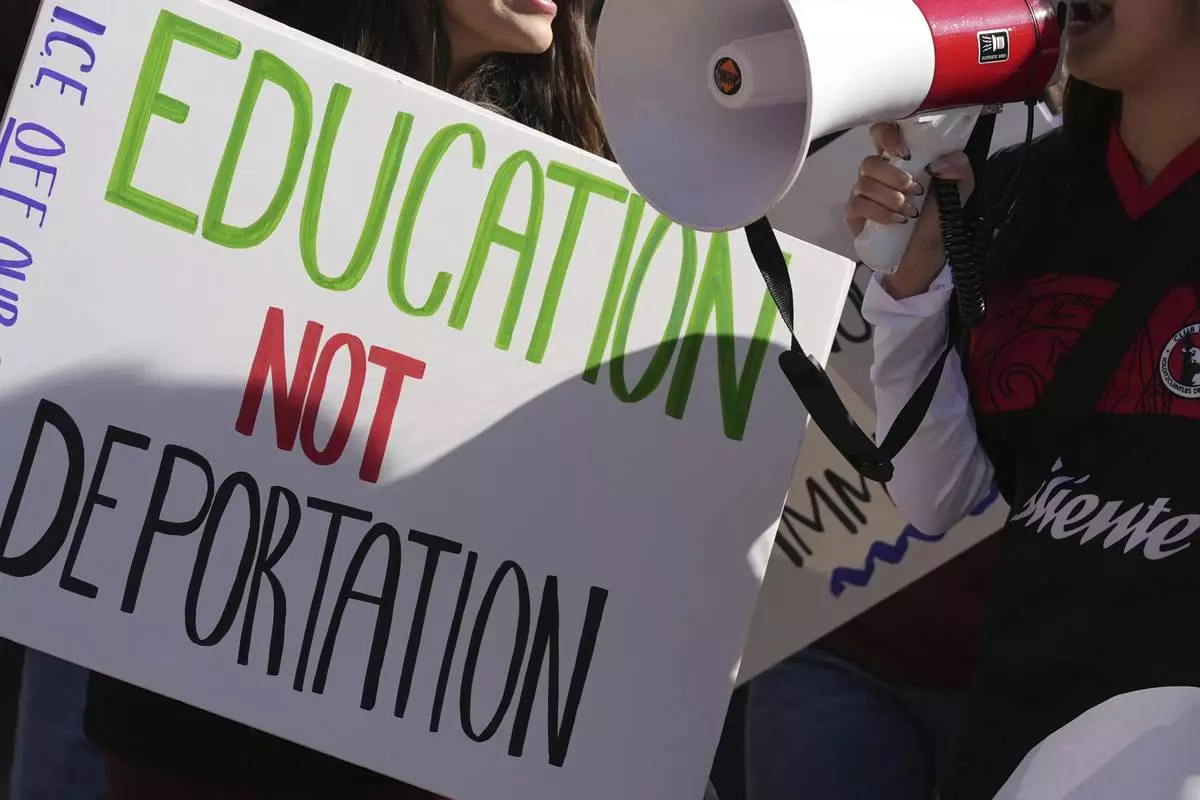
FILE - Students march at Arizona State University in protest of ASU's chapter of College Republicans United-led event encouraging students to report "their criminal classmates to ICE for deportations", Jan. 31, 2025, in Tempe, Ariz. (AP Photo/Ross D. Franklin, File)
The NFL set a record for fewest punts per game in 2025, and wild-card weekend was filled with fourth-down fun and folly as punters were mostly spectators, especially Chicago's Tory Taylor, who never stepped off the sideline in the Bears' come-from-behind win over the Green Bay Packers.
In all, teams converted 15 of 29 fourth down attempts on wild-card weekend, when there were only 41 punts, nine of them Monday night in the Houston Texans' 30-6 rout of Aaron Rodgers and the Pittsburgh Steelers.
Bears first-year coach Ben Johnson was particularly aggressive, going for it a half-dozen times on fourth down Saturday night, including two backfires in the first half that led to a pair of Green Bay touchdowns and put the Bears in a 21-3 halftime hole.
Caleb Williams was intercepted on fourth-and-6 from the Packers 40-yard line, leading to Jordan Love's 18-yard touchdown throw, and Williams threw incomplete on fourth-and-5 from his own 32. That one led to Love's TD throw on fourth-and-goal from the Bears 2 that gave Green Bay an 18-point halftime cushion.
The Packers couldn't capitalize on another turnover on downs by Chicago just before halftime because Brandon McManus missed a 55-yard field goal on the final play after Williams threw incomplete deep on fourth-and-4 from the Green Bay 37.
When Prime Video's sideline reporter Kaylee Hartung asked the Bears' coach about his aggressive approach and going for it on fourth down multiple times on his own side of the field, Johnson replied, “Yeah, we want to maximize our possessions and we want to go for fourth-down plays."
Her follow-up was about how to slow down Green Bay's efficient offense.
“That's a big reason why we're being aggressive on offense, so that we can extend our drives and score points ourselves,” Johnson said. “It's a really good offense we're going against.”
Although the Bears would convert just twice on their six fourth downs — Green Bay was 3 for 3 on fourth down — that strategy paid off in the end. Williams threw a 27-yard pass to Rome Odunze to the Packers' 30-yard line, which led to the TD that pulled Chicago to 27-24 with 4:21 remaining.
Johnson said the game plan featured an aggressive fourth-down mentality, and "I think where it gets misconstrued is, there’s a lack of confidence in your defense when you do that. I think the opposite, I think it’s because I have confidence in our defense and their ability to stop teams in the red zone."
“I’m never going to apologize for being aggressive or doing things that might be a little unorthodox,” Johnson added, "if it’s what we deem is best for us to win a ballgame.”
Johnson was the Lions' offensive coordinator when Detroit blew a 17-point halftime lead and lost the NFC championship to San Francisco 34-31 after the 2023 season. In that game, Lions coach Dan Campbell went for it on fourth down twice in field-goal range but came up short, later saying he'd do it again if he could.
Those failures didn't curtail the Lions' aggressive fourth-down philosophy, one that Johnson took to Chicago when he was hired by the Bears a year ago.
He had plenty of company over the weekend as a trend from the regular season continued. There were just 3.55 punts per game per team this season and that figure fell in the first round of the playoffs with teams averaging just 3.41 punts per game.
The Panthers and Rams got the fun going Saturday when early fourth-down failures led to touchdowns by each team.
Trevor Lawrence thought he had the first down when the Jaguars went for it on fourth-and-2 from the Buffalo 9 only to see the review reveal his shin had hit the ground shy of the first-down marker, a fourth-down faux pas that proved pivotal in Jacksonville's 27-24 loss to the Bills.
The Bills twice went for it on fourth-and-1 deep in Jaguars territory. Josh Allen had a four-yard keeper on the first one and was carried nine yards on an astonishing tush push to the 1 that also led to a Buffalo touchdown.
The 49ers didn't attempt a single fourth-down conversion in their 23-19 win at Philadelphia, where the Eagles were 3-for-5 on fourth down.
The Patriots converted their only fourth-down try, on fourth-and-4 from the Chargers' 30, which led to a field goal. When the Chargers took a delay after failing to induce an offsides call and then punted from midfield, NBC analyst Cris Collinsworth said, “I think Jim Harbaugh's been watching the games this weekend.”
And when Steelers coach Mike Tomlin chose to take the three points with a 32-yard field goal try rather that chancing it on fourth-and-3 from the Houston 14 Monday night, ESPN analyst Troy Aikman commented: “We're in a time as we all know when a lot of offenses would be going for it. ... But points are going to be (at) a premium. You've got two defenses that are capable of dominating their opponent. Get 'em when you can.”
Well, points certainly were at a premium for Pittsburgh, which hung in there most of the night before the Texans' 23-0 fourth-quarter blitz in what might have been Rodgers' farewell game.
If so, Rodgers' final pass was a pick-6 by safety Calen Bullock, whose 50-yard interception return for a touchdown came on ... you guessed it, fourth down.
AP NFL: https://apnews.com/hub/NFL
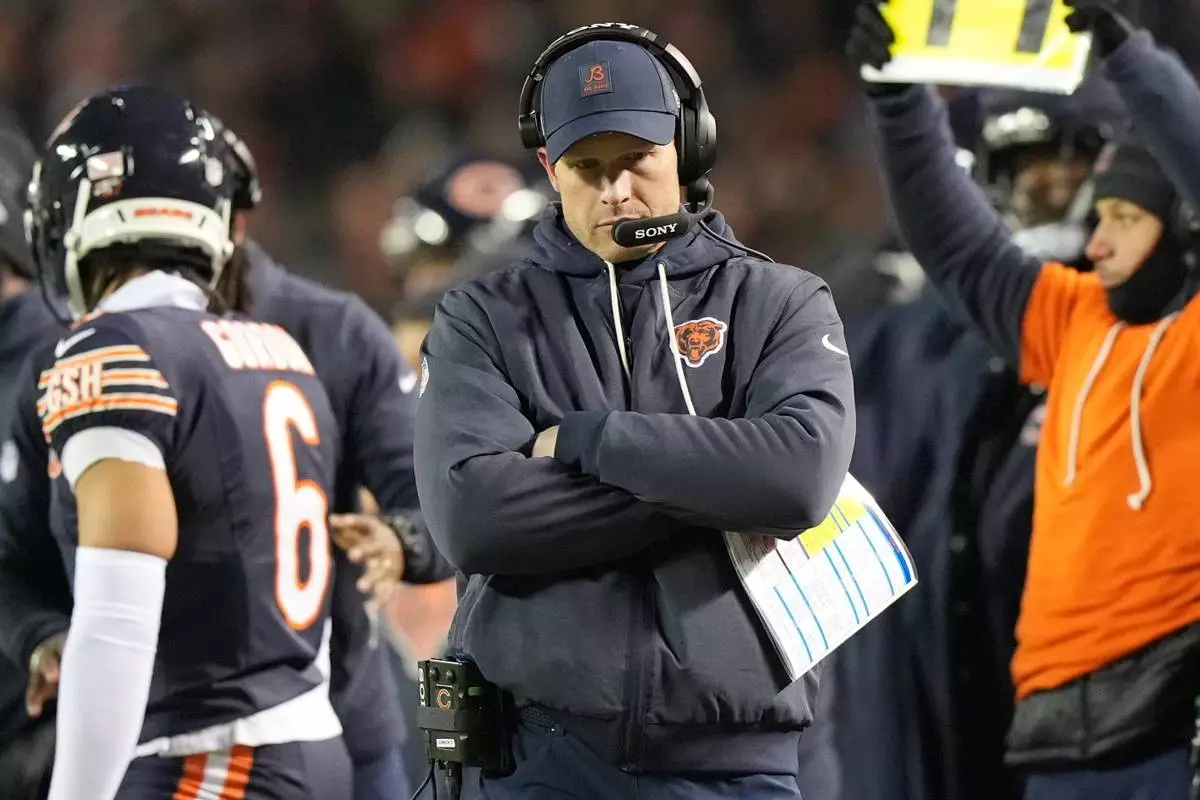
Chicago Bears head coach Ben Johnson reacts during the first half of an NFL wild-card playoff football game against the Green Bay Packers Saturday, Jan. 10, 2026, in Chicago. (AP Photo/Nam Huh)