NEW YORK (AP) — After a brutal year of headlines about The Washington Post, Executive Editor Matt Murray sounded almost relieved to be talking about journalism.
In an interview, he was touting “100 scoops in 100 days” about the Post's coverage of the Trump administration's first weeks. What sounds like a publicist's confection has truth behind it, with reporters putting their heads down and working, notably on stories involving the federal workforce and spending cuts.
Most stories about the Post in the past few months have been negative, including publisher Will Lewis' botched reorganization that led to former Executive Editor Sally Buzbee's resignation last June, owner Jeff Bezos asserting himself over the opinion section and defections among journalists worried about the outlet's direction.
“Great stories and great scoops are always good to remind people — both externally and internally — that it's all about the journalism at the end of the day,” Murray said.
Dan Diamond, Hannah Natanson, Carolyn Y. Johnson and Lena H. Sun are among the reporters who have dug into specifics about Department of Government Efficiency-inspired cuts and what they've meant for medical research and services for Social Security recipients. Natanson, Rachel Siegel and Laura Meckler have explored the use of government data to go after undocumented immigrants.
Adam Taylor and John Hudson have dug into proposed cuts at the State Department. Maria Sacchetti and Artur Galocha showed how half of the people the White House reported as immigration enforcement arrests were already behind bars. Jacob Bogage wrote about a Trump appointee asking the IRS to review an audit of conservative personality Mike Lindell.
It's grunt work, developing sources and stories that build upon other stories, many involving federal workers — the industry that the city is built upon.
“The Post has an historic obligation — it's right in our name, Washington — to write aggressively, truthfully, thoughtfully about the government and what's happening there,” Murray said. “Obviously the Trump administration, whatever one thinks of them, has the most aggressive change program that we've seen in many administrations.”
The work breaking stories has been noticeable, said Margaret Sullivan, a former media columnist at the Post who still writes, teaches at Columbia University and runs the Craig Newmark Center for Journalism Ethics and Security there.
“I've been happy to see that,” she said. “The place has been through such a difficult time and it's not due to the journalists there. It's because of the ownership and management.”
The Post hasn't yet earned its own Truth Social post about its reporting since President Donald Trump's return — the ultimate sign it has gotten under the Republican president's skin — but the White House labeled one of its stories about health funding “fake news.” Tulsi Gabbard, national intelligence director, cited a Post story about Israel and Iran among her reasons to seek out internal leakers.
The work has also calmed fears about whether owner Bezos' newfound friendliness with Trump would impact news coverage. Last fall, Bezos ordered a planned endorsement of Trump's Democratic opponent, Kamala Harris, spiked, triggering an exodus of angry subscribers. He was a prominently visible guest at Trump's second inauguration and soon after said the Post's opinion pages should focus primarily on personal liberties and the free market.
That change in direction led to the resignations of editorial page editor David Shipley and two long-time Post columnists, Ruth Marcus and Eugene Robinson.
Bezos' actions with the opinion section have hurt the Post's reputation when the country really needs it, and when its news coverage has been excellent, said Robert McCartney, a retired Post columnist. “Their DOGE coverage has been really good, as good as anybody's,” he said. “They have broken a lot of news. They have done a lot of important accountability reporting.”
Between the turmoil and a sea of red ink resulting in layoffs, the Post suffered a significant talent defection at the end of last year. Journalists like Matea Gold, the respected managing editor, and journalists Josh Dawsey, Ashley Parker, Philip Rucker and Michael Scherer took new jobs. That exposed some thin skin; Murray, then only interim editor, briefly banned goodbye emails believing they were bad for morale, before the decision was reversed, the Guardian reported. The paper has banned its media writers from reporting stories about the newspaper.
“The reporters are doing good work, by and large,” said Richard Prince, a reporter and editor who spent 20 years at the Post in two stints. “It's a shame there is all this turmoil that is coming from the top. It seems like they lost more talent than they gained.”
At a time there are more journalists than jobs, the Post is still a desired destination. “Many other people are stepping up and have had new opportunities and are showing their chops,” said Murray, who had the “interim” removed from his title with no fanfare earlier this year.
The Post is still in transition; Murray appointed some key deputies last week. It is still sorting out coverage areas that need more attention and those that don't. He promised more resources to follow technology, artificial intelligence and the markets.
The Post reportedly lost some 325,000 subscribers after the Harris non-endorsement and editorial policy change; the newspaper won't say whether it has recovered that number since through new or returned subscribers. The newspaper is more aggressively seeking new readers and says 100,000 more new subscribers signed up this year than did over the same period in 2024.
It's spring; consider them all shoots popping up from the ground after a damaging winter.
“I would not quit the Post,” Sullivan said. “If I were a regular reader, I would still find it very interesting and necessary.”
This story has been corrected to show Richard Prince is a journalist, not a retired journalist.
David Bauder writes about the intersection of media and entertainment for the AP. Follow him at http://x.com/dbauder and https://bsky.app/profile/dbauder.bsky.social.
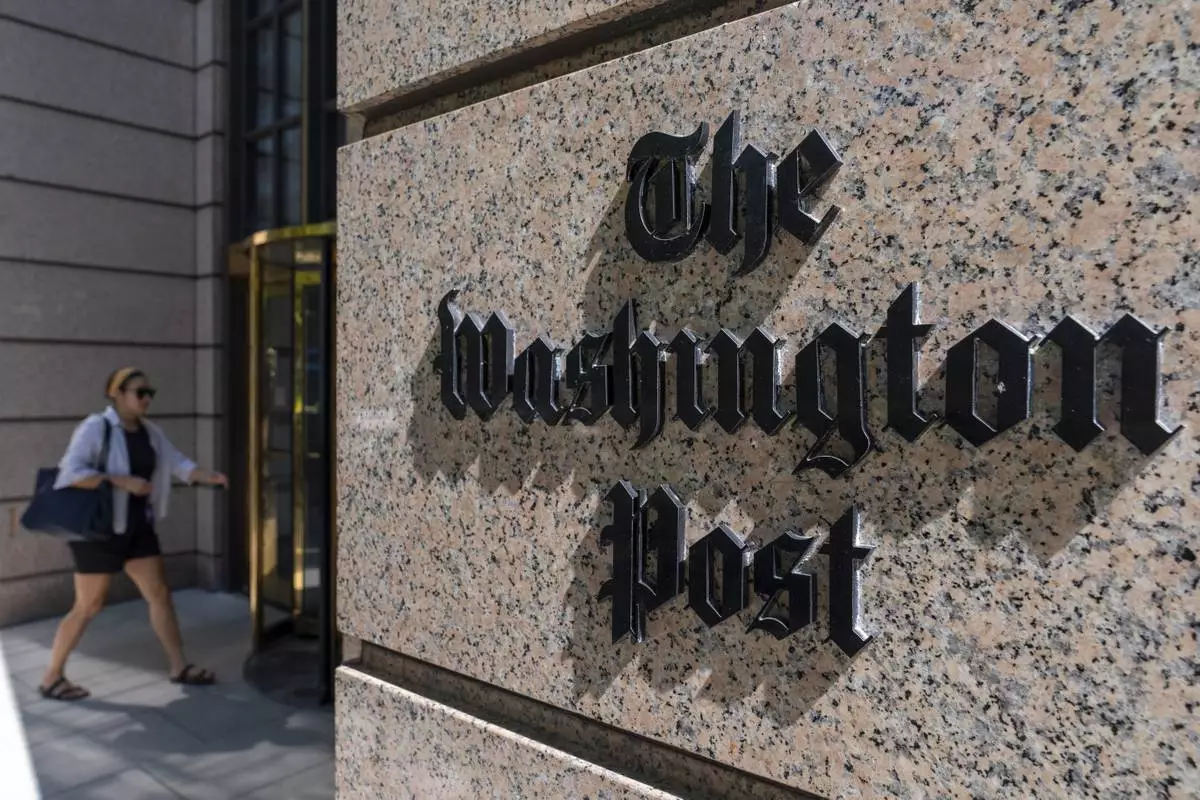
FILE - A person walks into the One Franklin Square Building, home of The Washington Post newspaper, Friday, June 21, 2024, in Washington. (AP Photo/Alex Brandon, File)