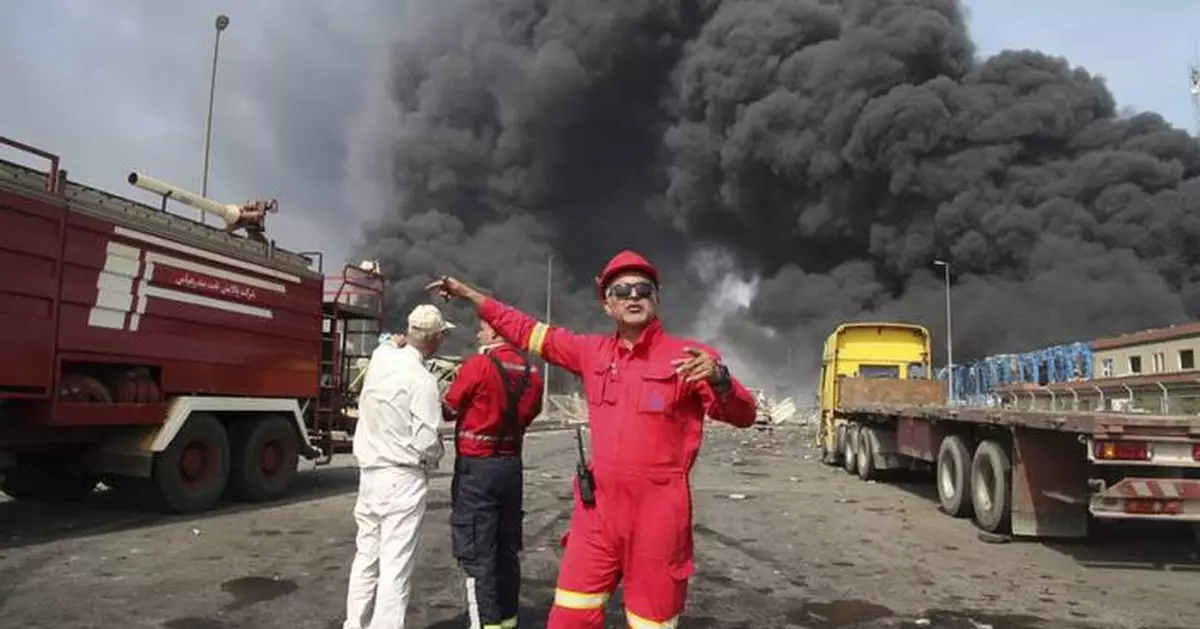
DUBAI, United Arab Emirates (AP) — The explosion that rocked an Iranian port, killing at least 70 people and injuring more than 1,000 others, had its epicenter at a facility ultimately owned by a charitable foundation overseen by Supreme Leader Ayatollah Ali Khamenei's office.
That foundation, known as Bonyad Mostazafan, faces American sanctions over it helping the 86-year-old Khamenei “to enrich his office, reward his political allies and persecute the regime’s enemies,” the U.S. Treasury has said. Its top personnel also have direct ties to Iran's paramilitary Revolutionary Guard, which oversees Tehran's ballistic missile arsenal and operations abroad targeting the Islamic Republic's enemies.
Those associations come as authorities still haven't offered a cause for the blast Saturday at the Shahid Rajaei port near Bandar Abbas. The port reportedly took in a chemical component needed for solid fuel for ballistic missiles — something denied by authorities though local reports now increasingly point toward a mysterious, highly explosive cargo being delivered there.
“It's known that Iran has been doing all kinds of sanctions busting and so on in order to supply their weapons program,” said Andrea Sella, a professor of chemistry at the University College London. “The surprising thing is the fact that this cargo, given that it's a highly energetic material ... was sitting right in the middle of the port warehousing area.”
He added: “That strikes me as nuts.”
A bonyad, the Farsi word for “foundation,” wields tremendous power in Iran. The bonyads take their root in foundations set up by Shah Mohammad Reza Pahlavi during his rule.
After the 1979 Islamic Revolution toppled the shah, Grand Ayatollah Ruhollah Khomeini set up the bonyads to manage those assets, as well as companies seized from supporters of the shah and religious minorities, like the Baha’i and Jews.
Bonyad Mostazafan, or the “Foundation of the Oppressed,” is believed to be the largest in the country by assets, with a 2008 U.S. Congressional Research Service report suggesting it represented 10% of Iran's entire gross domestic product at the time. The Treasury in 2020 put its worth into the billions of dollars. Its network includes interests in mining, railroads, energy, steel and shipping through its Sina Port and Marine Services Development Co.
Satellite photos analyzed by The Associated Press show the epicenter of Saturday's explosion struck just next to Sina's terminal at the port, shredding the facility and the containers stacked nearby.
Late Sunday, Iran’s semiofficial ILNA news agency quoted Saeed Jafari, the CEO of Sina, as saying there had been false statements about the cargo that detonated, which he called “very dangerous.”
“The incident happened following a false statement about the dangerous goods and delivering it without documents and tags,” Jafari said. He didn't elaborate and access to the site has been restricted by authorities since the blast.
Since its creation, Bonyard Mostazafan has been linked to the Guard. Its current president, Hossein Dehghan, reached the rank of general in the Guard and serves as a military adviser to Khamenei. Other leaders in the foundation's history have had direct and indirect ties back to the Guard.
The U.S. Treasury separately describes the foundation as having business relationships or cash transactions with the country's police, the Defense Ministry and the Guard as well.
“Mostazafan has de-facto been functioning as the IRGC’s ‘money box,’ whereby its financial assets and resources are made available to senior IRGC commanders, not least to fund terrorist activities,” alleges United Against Nuclear Iran, a New York-based pressure group, using an acronym for the Guard.
In sanctioning Bonyad Mostazafan in 2020, the first Trump administration described the foundation as being used by Khamenei to “line the pockets of his allies.”
“Despite its outsized influence in the Iranian economy, Bonyad Mostazafan operates outside of government oversight and, due to a 1993 decree by the Supreme Leader, is exempt from paying taxes on its multibillion-dollar earnings,” the U.S. Treasury said. The foundation says its affiliated companies pay taxes.
On Tuesday, the Treasury issued new sanctions on China and Iran over the transshipment of sodium perchlorate and dioctyl sebacate to the Islamic Republic. Sodium perchlorate is used to produce ammonium perchlorate, a key ingredient to make solid fuel for ballistic missiles. The Treasury identified one individual from an Iranian firm as being linked to the Guard.
The Financial Times in January first reported that two loads of sodium perchlorate were coming to Iran from China. Tracking data showed that one of the ships identified as carrying the load was near Shahid Rajaei in recent weeks. The private security firm Ambrey separately said that the port received the sodium perchlorate, which is described as a white, sand-like solid.
Iranian Defense Ministry spokesperson Gen. Reza Talaeinik denied earlier this week that missile fuel had been imported through the port. Iranian Cabinet spokesperson Fatemeh Mohajerani separately described the explosion Wednesday as coming from "human error, probably.”
However, no official in Iran has offered any explanation for what material detonated with such incredible force at the site.
A reddish cloud could be seen in surveillance camera footage before the blast Saturday. That suggests a chemical compound like ammonia being involved in the blast, like the 2020 Beirut port explosion, in which ammonium nitrate caught fire and exploded.
That cloud also resembled one seen in footage from a 1988 massive explosion in Nevada at the PEPCON plant that killed two people and injured hundreds. PEPCON, or the Pacific Engineering and Production Company of Nevada, made rocket fuel for NASA and had accumulated ammonium perchlorate that went unused after the Challenger disaster, leading to the blast.
Similar reddish smoke could be seen just before a 2013 explosion at a Texas fertilizer plant filled with ammonium nitrate that killed 15 people.
Sella, the chemistry professor, said the reddish cloud likely was nitrogen dioxide, which can be produced when burning ammonium perchlorate or ammonium nitrate. However, the reports about the missile fuel shipment suggests it was ammonium perchlorate, he said.
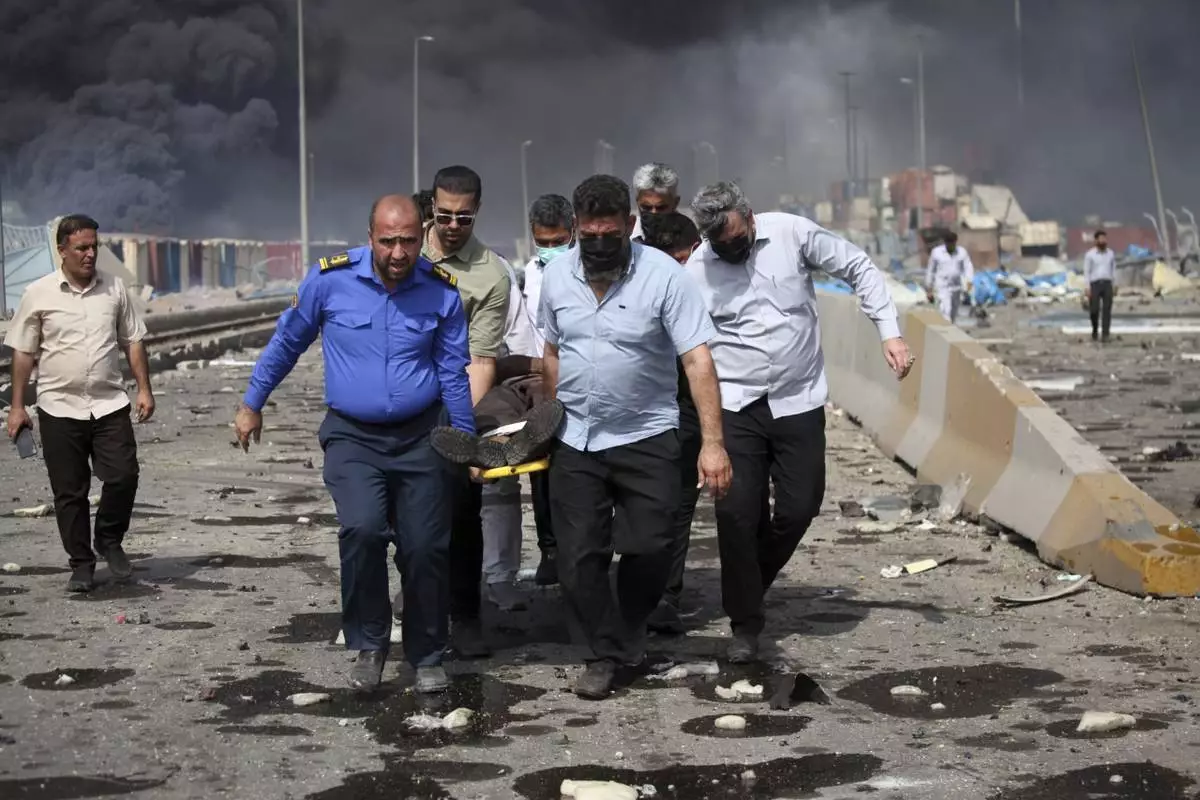
In this photo provided by Islamic Republic News Agency, IRNA, men carry an injured man after a massive explosion near the southern port city of Bandar Abbas, Iran, Saturday, April 26, 2025. (Mohammad Rasoul Moradi/IRNA via AP)
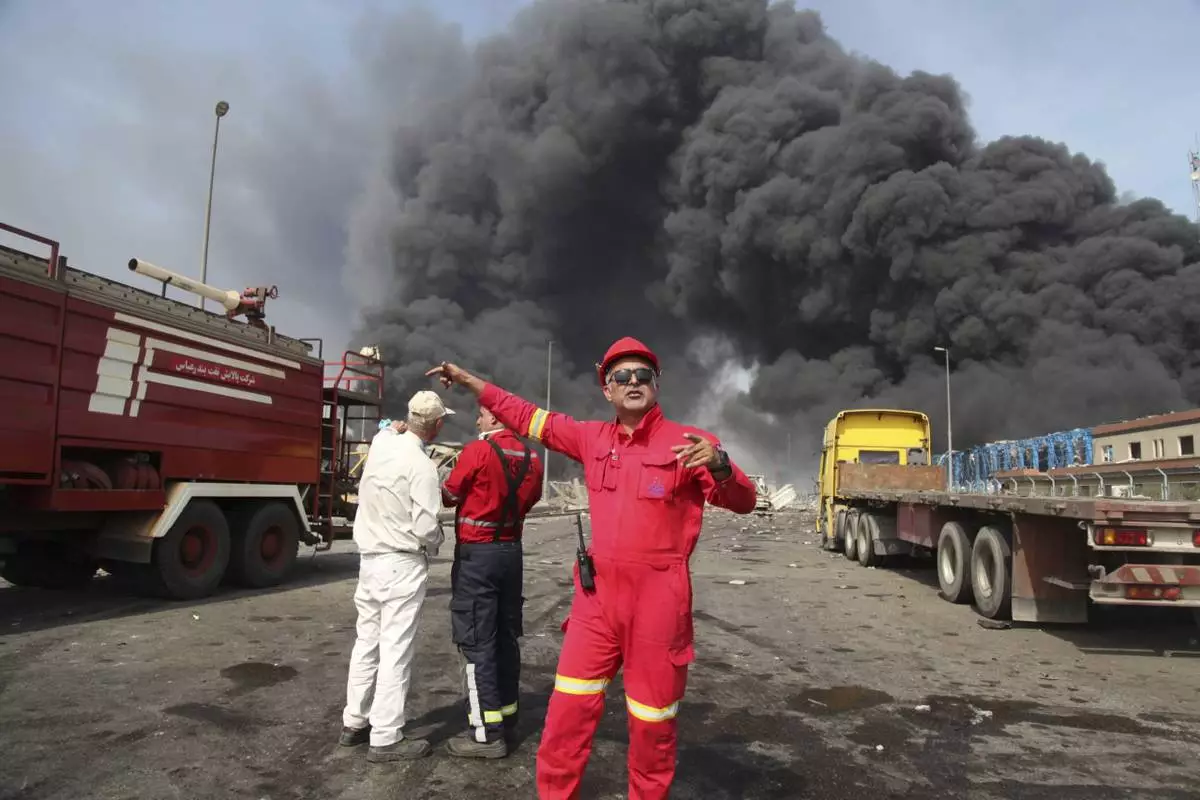
In this photo provided by Islamic Republic News Agency (IRNA) firefighters work as black smoke rises in the sky after a massive explosion rocked a port near the southern city of Bandar Abbas, Iran, Saturday, April 26, 2025. (Mohammad Rasoul Moradi/IRNA via AP)
Federal Reserve Chair Jerome Powellsaid Sunday the Department of Justice has served the central bank with subpoenas and threatened it with a criminal indictment over his testimony this summer about the Fed’s building renovations.
The move represents an unprecedented escalation in President Donald Trump’s battle with the Fed, an independent agency he's repeatedly attacked for not cutting its key interest rate as sharply as he prefers. The renewed fight will likely rattle financial markets Monday and could over time escalate borrowing costs for mortgages and other loans.
The subpoenas relate to Powell’s testimony before the Senate Banking Committee in June, the Fed chair said, regarding the Fed’s $2.5 billion renovation of two office buildings, a project Trump has criticized as excessive.
Here's the latest:
Stocks are falling on Wall Street after Federal Reserve Chair Jerome Powell said the Department of Justice had served the central bank with subpoenas and threatened it with a criminal indictment over his testimony about the Fed’s building renovations.
The S&P 500 fell 0.3% in early trading Monday. The Dow Jones Industrial Average lost 384 points, or 0.8%, and the Nasdaq composite fell 0.2%.
Powell characterized the threat of criminal charges as pretexts to undermine the Fed’s independence in setting interest rates, its main tool for fighting inflation. The threat is the latest escalation in President Trump’s feud with the Fed.
▶ Read more about the financial markets
She says she had “a very good conversation” with Trump on Monday morning about topics including “security with respect to our sovereignties.”
Last week, Sheinbaum had said she was seeking a conversation with Trump or U.S. Secretary of State Marco Rubio after the U.S. president made comments in an interview that he was ready to confront drug cartels on the ground and repeated the accusation that cartels were running Mexico.
Trump’s offers of using U.S. forces against Mexican cartels took on a new weight after the Trump administration deposed Venezuelan President Nicolás Maduro. Sheinbaum was expected to share more about their conversation later Monday.
A leader of the Canadian government is visiting China this week for the first time in nearly a decade, a bid to rebuild his country’s fractured relations with the world’s second-largest economy — and reduce Canada’s dependence on the United States, its neighbor and until recently one of its most supportive and unswerving allies.
The push by Prime Minster Mark Carney, who arrives Wednesday, is part of a major rethink as ties sour with the United States — the world’s No. 1 economy and long the largest trading partner for Canada by far.
Carney aims to double Canada’s non-U.S. exports in the next decade in the face of President Trump’s tariffs and the American leader’s musing that Canada could become “the 51st state.”
▶ Read more about relations between Canada and China
The comment by a Chinese Foreign Ministry spokesperson came in response to a question at a regular daily briefing. President Trump has said he would like to make a deal to acquire Greenland, a semiautonomous region of NATO ally Denmark, to prevent Russia or China from taking it over.
Tensions have grown between Washington, Denmark and Greenland this month as Trump and his administration push the issue and the White House considers a range of options, including military force, to acquire the vast Arctic island.
Danish Prime Minister Mette Frederiksen has warned that an American takeover of Greenland would mark the end of NATO.
▶ Read more about the U.S. and Greenland
Trump said Sunday that he is “inclined” to keep ExxonMobil out of Venezuela after its top executive was skeptical about oil investment efforts in the country after the toppling of former President Nicolás Maduro.
“I didn’t like Exxon’s response,” Trump said to reporters on Air Force One as he departed West Palm Beach, Florida. “They’re playing too cute.”
During a meeting Friday with oil executives, Trump tried to assuage the concerns of the companies and said they would be dealing directly with the U.S., rather than the Venezuelan government.
Some, however, weren’t convinced.
“If we look at the commercial constructs and frameworks in place today in Venezuela, today it’s uninvestable,” said Darren Woods, CEO of ExxonMobil, the largest U.S. oil company.
An ExxonMobil spokesperson did not immediately respond Sunday to a request for comment.
▶ Read more about Trump’s comments on ExxonMobil
Trump’s motorcade took a different route than usual to the airport as he was departing Florida on Sunday due to a “suspicious object,” according to the White House.
The object, which the White House did not describe, was discovered during security sweeps in advance of Trump’s arrival at Palm Beach International Airport.
“A further investigation was warranted and the presidential motorcade route was adjusted accordingly,” White House press secretary Karoline Leavitt said in a statement Sunday.
The president, when asked about the package by reporters, said, “I know nothing about it.”
Anthony Guglielmi, the spokesman for U.S. Secret Service, said the secondary route was taken just as a precaution and that “that is standard protocol.”
▶ Read more about the “suspicious object”
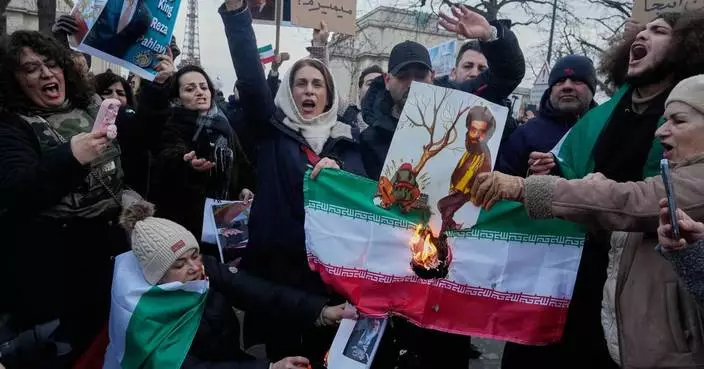
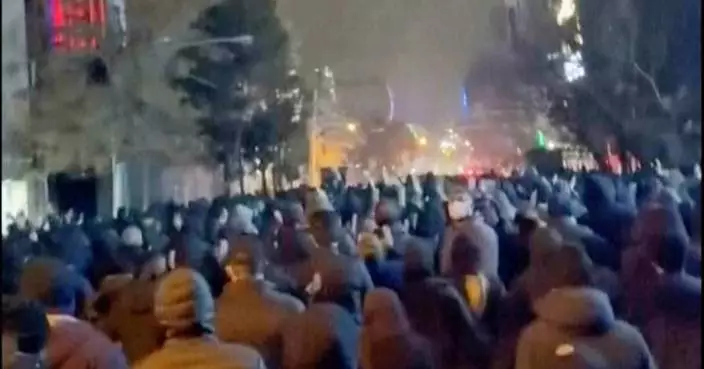
Trump said Iran wants to negotiate with Washington after his threat to strike the Islamic Republic over its bloody crackdown on protesters, a move coming as activists said Monday the death toll in the nationwide demonstrations rose to at least 544.
Iran had no direct reaction to Trump’s comments, which came after the foreign minister of Oman — long an interlocutor between Washington and Tehran — traveled to Iran this weekend. It also remains unclear just what Iran could promise, particularly as Trump has set strict demands over its nuclear program and its ballistic missile arsenal, which Tehran insists is crucial for its national defense.
Iranian Foreign Minister Abbas Araghchi, speaking to foreign diplomats in Tehran, insisted “the situation has come under total control” in fiery remarks that blamed Israel and the U.S. for the violence, without offering evidence.
▶ Read more about the possible negotiations and follow live updates
Fed Chair Powell said Sunday the DOJ has served the central bank with subpoenas and threatened it with a criminal indictment over his testimony this summer about the Fed’s building renovations.
The move represents an unprecedented escalation in Trump’s battle with the Fed, an independent agency he has repeatedly attacked for not cutting its key interest rate as sharply as he prefers. The renewed fight will likely rattle financial markets Monday and could over time escalate borrowing costs for mortgages and other loans.
The subpoenas relate to Powell’s testimony before the Senate Banking Committee in June, the Fed chair said, regarding the Fed’s $2.5 billion renovation of two office buildings, a project that Trump has criticized as excessive.
Powell on Sunday cast off what has up to this point been a restrained approach to Trump’s criticisms and personal insults, which he has mostly ignored. Instead, Powell issued a video statement in which he bluntly characterized the threat of criminal charges as simple “pretexts” to undermine the Fed’s independence when it comes to setting interest rates.
▶ Read more about the subpoenas
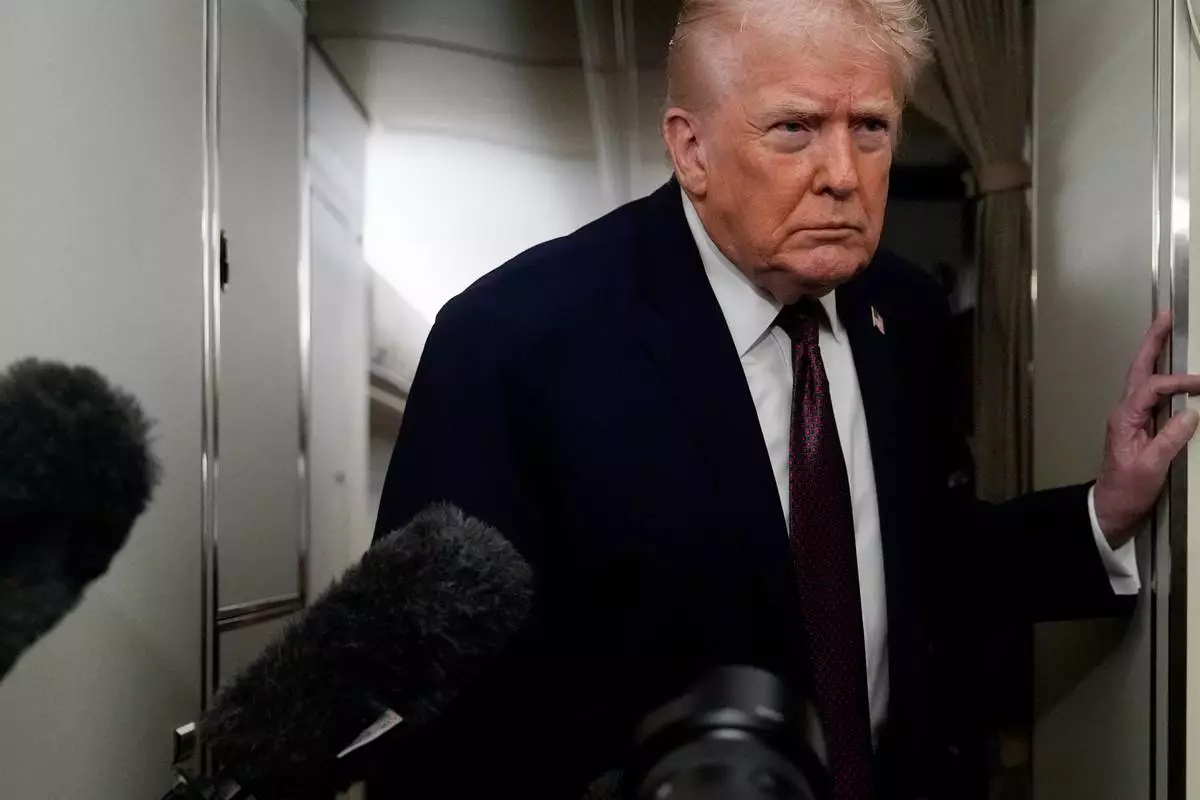
President Donald Trump speaks to reporters while in flight on Air Force One to Joint Base Andrews, Md., Sunday, Jan. 11, 2026. (AP Photo/Julia Demaree Nikhinson)
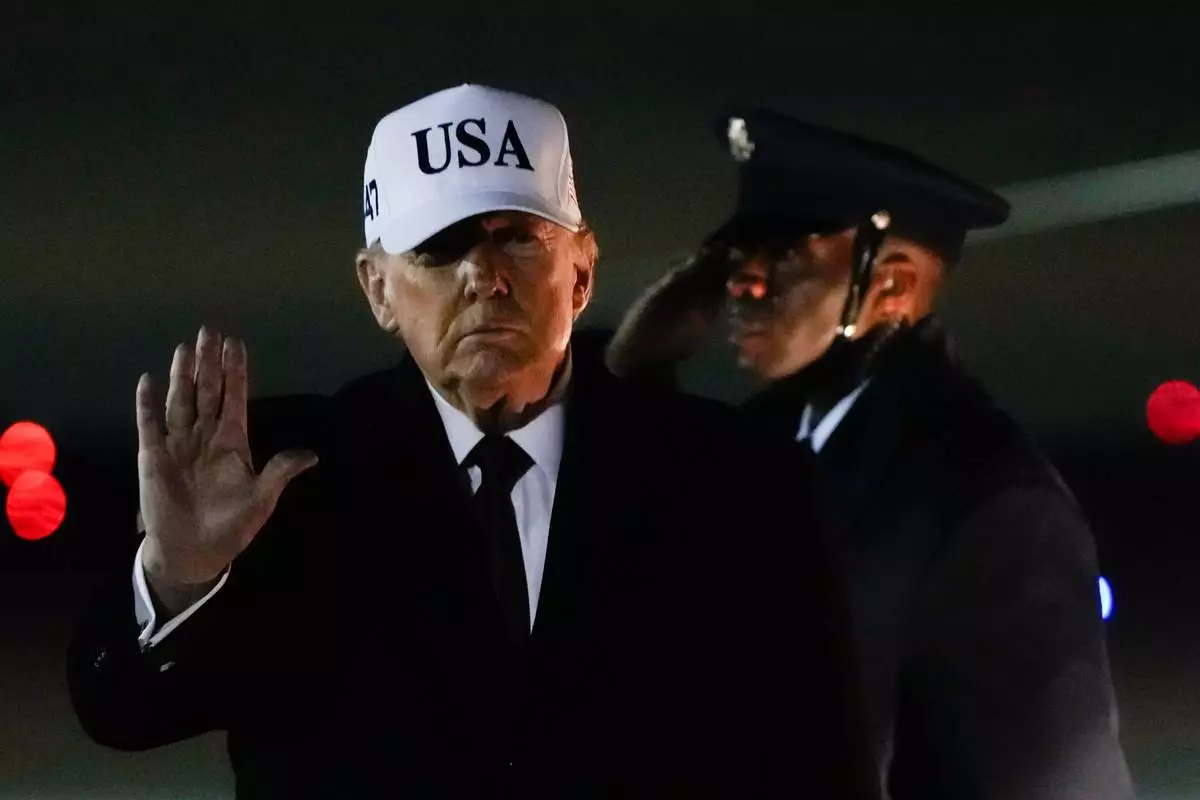
President Donald Trump waves after arriving on Air Force One from Florida, Sunday, Jan. 11, 2026, at Joint Base Andrews, Md. (AP Photo/Julia Demaree Nikhinson)