The three astronauts of the Shenzhou-19 crewed mission are readapting smoothly to Earth's gravity after returning from space, with full gravity adjustment expected within hours, said an official at the China Astronaut Research and Training Center on Wednesday.
The return capsule of the Shenzhou-19 crewed spaceship, carrying astronauts Cai Xuzhe, Song Lingdong and Wang Haoze, touched down at the Dongfeng landing site in north China's Inner Mongolia Autonomous Region on Wednesday.
The three astronauts are all in good health, according to the China Manned Space Agency.
"According to our assessment, all three astronauts are in excellent health, with their gravity readapting proceeding smoothly. Currently, they are undergoing further medical examinations in three separate medical monitoring vehicles, including thorough physical exams, electrocardiograms, ultrasounds, imaging studies, and the assessment of body fluid and physiological indicators," said Xu Chong, the official.
Upon returning to Earth, the astronauts' immediate priority is to re-adapt to gravity. Xu explained the time needed for this critical physiological adjustment process.
"Overall, the astronauts' readapting to gravity is actually a very rapid process. From the moment the return capsule touches down on Earth, the various organ systems of the astronauts start to swiftly adjust to the gravitational environment. Whether in the return capsule, or just outside it, including inside the current medical monitoring vehicles, the astronauts' different organ systems further adapt to gravity. Therefore, it can be said that the entire rapid adaptation process typically takes place within a few hours. Upon returning to Beijing, within a day or two, the astronauts' orthostatic tolerance, muscle coordination, and balance function will undergo further recovery," Xu said.
The three astronauts are scheduled to arrive in Beijing on Wednesday, where they will immediately begin an isolation recovery period.
The Shenzhou-19 crew was sent into space from the Jiuquan Satellite Launch Center in northwest China on Oct 30, 2024. Prior to the return, the crew handed over the space station to the Shenzhou-20 astronauts who got on board on Friday.

Shenzhou-19 astronauts re-adapt smoothly to Earth's gravity: official
Industry insiders warn that the deep integration of the North American automotive industry means U.S. tariff measures targeting Canadian vehicle products are poised to backfire, with businesses and consumers in the United States ultimately paying the price.
Trade tensions have been rising between the two North American neighbors in recent weeks, with the U.S. imposing a 50-percent tariff on about 20-billion-dollars' worth of Canadian goods last month, before Canada hit back with matching tariffs on an equivalent value of U.S. imports.
With concerns over the escalating dispute already on the rise, U.S. President Donald Trump has threatened a further 50-percent tariff on all Canadian automotive and steel imports beginning next year.
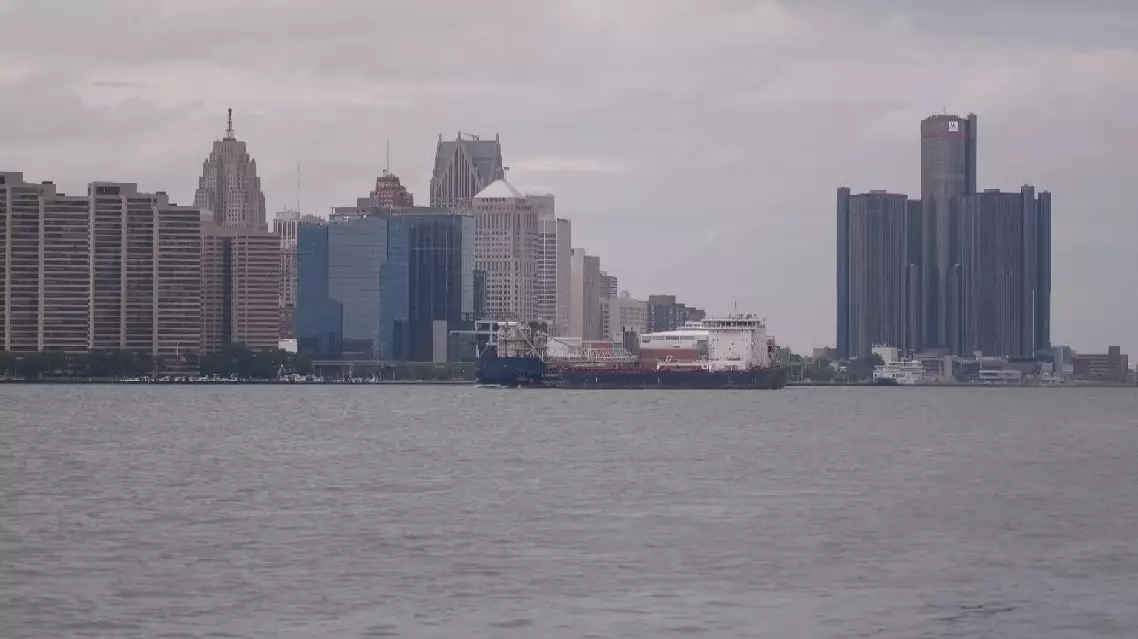
Sitting right across the river from Detroit, Windsor is widely recognized as Canada's auto capital and America's auto powerhouse. Since the signing of the Canada-U.S. Automotive Products Agreement in 1965, the automotive supply chains on both sides have been deeply integrated.
Boasting a highly concentrated industrial ecosystem, Windsor hosts hundreds of premium auto parts and mold suppliers, most of which directly serve American automakers. However, the tariff tensions between the two countries have cast a shadow over the border city that thrives on cross-border industrial cooperation.
"Some companies are definitely experiencing a slowdown in activity because of the tariffs. And probably the bigger reason is uncertainty. So a lot of product that they normally would make is not being made because their customers, the American customers, are uncertain of their costs," said Louis Jahn, president of the Canadian Tooling and Machining Association.
Industry insiders also note the relatively co-dependent nature of the Canadian and U.S. auto manufacturing sectors, where components for a single vehicle model are often produced alternately in factories of both countries, with some parts crossing the border seven or eight times before final assembly.
Constrained by limitations in cost, production capacity, manpower and equipment, many U.S. enterprises have no choice but to continue sourcing Canadian auto products even after the tariff hikes, which means the additional tariff costs will be fully passed on to American consumers.
"My American counterparts are complaining to me that the tariffs are impacting their business because when they go to buy equipment, they have to pay a 50-percent tariff on the new equipment going into their facility. So now their operating costs just went up by 50 percent, so they can't afford it. The net result could end up making American vehicles uncompetitive in the world market, because their costs are too high," said Jahn.
"The tariff is paid by the organization that imports the tariffed good, the thing that it has a tariff on, and they pass along the price increase to the consumers. So, when President Trump puts a tariff on something, the American consumer pays it," said Peter Frise, Professor of Mechanical, Automotive and Materials Engineering at the University of Windsor.
Many experts say that as the Canadian and U.S. automotive industries largely operate as an indivisible unified production line, imposing hefty tariffs on Canadian vehicles and auto parts will inevitably generate counterproductive costs and risks that hurt the U.S. domestic auto industry.
Integrated nature of North American auto industry means US tariffs will backfire: insiders