Dr. Google is often on call for worried patients, but it may not give the best advice.
Doctors say internet searches for medical information should be done cautiously, especially with artificial intelligence playing a growing role.
Information from the right websites can teach patients about symptoms and prepare them for a doctor’s visit. But a poorly done search might inflame anxiety well before someone reaches the waiting room. It’s important to know the source of the information you find and to avoid trying to diagnose your health issue.
Here are questions to keep in mind if you seek medical help online.
When you do a search, don’t automatically click the first link. It may not contain the best answers.
Some companies pay to have their websites listed at the top of a results page. Those links may be listed as sponsored.
Scroll for results that come from a source you can trust for medical information. That can include big health systems like the Mayo Clinic or sites run by government agencies like the Centers for Disease Control and Prevention.
“We've gotten so used to clicking on that first link,” says John Grohol, a psychologist who specializes in online behavior. “For your health information, especially when it is personal, you want to think about it.”
That depends on what it tells you.
More people are using artificial intelligence to get quick answers pulled from a variety of internet sources. Some searches also will generate an AI summary at the top of the results page.
But an AI answer may not say where it got the information. That makes it hard to judge credibility.
AI also can be prone to “ hallucinations,” an industry term for issues that cause the technology to make stuff up. Be especially wary of this if no source is cited.
How you phrase a question plays a big role in the results you see. Doctors say patients should search for information based on symptoms, not an expected diagnosis.
“You’ve got to ask at the very beginning the right questions,” said Dr. Eric Boose of the Cleveland Clinic.
That means asking, “What could cause a lump to form under my skin?” instead of “Is the lump under my skin cancer?”
Focusing on a diagnosis means you may miss other explanations, especially if you just click the first few links listed in the results.
For some issues, you should skip the search altogether. If you are having chest pains, experiencing dizziness of showing signs of a stroke, seek help immediately.
“You don’t want to delay something that should be treated within a certain amount of time,” said Dr. Olivier Gherardi, medical director of Brown University Health Urgent Care.
No. Leave that to the real doctors who are trained to ask questions that lead to a diagnosis.
Blood in your urine could mean cancer. It also might be caused by kidney stones or an infection.
Unexplained weight loss also could be a sign of cancer. Or it could reflect an overactive thyroid or a new job that causes you to move around more.
Some testing and a visit with a doctor who knows your medical history may be the best medicine in these situations.
“There are a lot of symptoms that overlap between minor conditions and major medical problems,” said Dr. Sarah Sams, a board member with the American Academy of Family Physicians.
The Associated Press Health and Science Department receives support from the Howard Hughes Medical Institute’s Science and Educational Media Group. The AP is solely responsible for all content.

A health-related query on Google is displayed on a computer screen in New York on Thursday, April 24, 2025. (AP Photo/Patrick Sison)
DHAKA, Bangladesh (AP) — Former Bangladeshi Prime Minister Khaleda Zia, whose archrivalry with another former premier defined the country’s politics for a generation, has died, her Bangladesh Nationalist Party said in a statement Tuesday. She was 80.
Zia was the first woman elected prime minister of Bangladesh.
Bangladesh's interim government announced a three-day mourning period. A general holiday also was announced for Wednesday when Zia’s funeral prayers are scheduled be held in front of the country's national Parliament building in Dhaka.
Bangladesh's interim leader Muhammad Yunus issued a statement Tuesday citing Zia's contributions to the country.
“Her role in the struggle to establish democracy, a multi-party political culture, and the rights of the people in Bangladesh will be remembered forever,” Yunus said.
Indian Prime Minister Narendra Modi offered condolences in a statement Tuesday, noting that “as the first woman Prime Minister of Bangladesh, her important contributions toward the development of Bangladesh, as well as India-Bangladesh relations, will always be remembered.”
Sajeeb Wazed, son of former Bangladesh Prime Minister Sheikh Hasina, said in a statement Tuesday that Zia’s demise “will leave a deep impact on the country’s (democratic) transition.”
“She will be remembered for her contributions in nation building but her death is a blow to stabilize Bangladesh,” said Wazed, whose mother was Zia’s greatest political rival.
Hasina issued a statement from exile in India saying Zia's death was “an irreparable loss” for politics in Bangladesh and recalled her contributions in establishing the nation's democracy.
Zia had faced corruption cases she said were politically motivated, but in January 2025 the Supreme Court acquitted Zia in the last corruption case against her, which would have let her run in February’s general election.
The BNP said that after she was released from prison due to illness in 2020, her family sought permission for treatment abroad at least 18 times from Hasina's administration, but the requests were rejected.
Following Hasina’s ouster in 2024, the Yunus-led interim government finally allowed her to go. She went to London in January and returned to Bangladesh in May.
Bangladesh’s early years of independence, gained in a bloody 1971 war against Pakistan, were marked by assassinations, coups and countercoups as military figures and secular and Islamic leaders jockeyed for power.
Zia’s husband, President Ziaur Rahman, had grabbed power as a military chief in 1977 and a year later formed the Bangladesh Nationalist Party. He was credited with opening democracy in the country but was killed in a 1981 military coup. Zia’s uncompromising stance against the military dictatorship helped build a mass movement against it, culminating with the ousting of dictator and former army chief H.M. Ershad in 1990.
Zia’s opponent when she won her first term in 1991 and in several elections after that was Hasina, the daughter of independence leader Sheikh Mujibur Rahman, who was assassinated in a 1975 coup.
Zia was criticized over an early 1996 election in which her party won 278 of the 300 parliamentary seats during a wide boycott by other leading parties including Hasina’s Awami League, which demanded an election-time caretaker government. Zia’s government lasted only 12 days before a nonpartisan caretaker government was installed and the new election was held that June.
Zia returned to power in 2001 in a government shared with the country’s main Islamist party, Jamaat-e-Islami, which had a dark past involving Bangladesh’s independence war.
Zia’s Bangladesh Nationalist Party was previously closely allied with the party and her government maintained the confidence of the business community by following pro-investment, open market policies. Zia was known to have a soft spot for Pakistan and used to deliver anti-Indian political speeches. India alleged insurgents were allowed to use Bangladesh’s soil to destabilize India’s northeastern states under Zia, especially during her term from 2001-2006.
During that term, Zia also was tainted by allegations that her elder son, Tarique Rahman, was running a parallel government and was involved in widespread corruption.
In 2004, Hasina blamed Zia’s government and Rahman for grenade attacks in Dhaka that killed 24 members of her Awami League party and wounded hundreds of people. Hasina narrowly escaped the attack, which she characterized as an assassination attempt, and subsequently won the 2008 general election.
Zia’s party and its partners boycotted the 2014 election in a dispute over a caretaker government, giving a one-sided victory to the increasingly authoritarian regime of Hasina. Her party joined the national elections in 2018 but boycotted again in 2024, allowing Hasina to return to power for a fourth consecutive time through controversial elections.
Zia was sentenced to 17 years in jail in two separate corruption cases for misuse of power in embezzling funds meant for a charity named after her late husband. Her party said the charges were politically motivated to weaken the opposition, but the Hasina government said it did not interfere and the case was a matter for the courts.
Hasina was bitterly criticized by both her opponents and independent critics for sending Zia to jail.
Zia was released from jail by Hasina’s government in 2020 and was moved to a rented home, from where she regularly visited a private hospital. Her family repeatedly requested Hasina’s administration to allow Zia to travel abroad for medical treatment, but was refused.
After 15 years in power, Hasina was ousted in a mass uprising in August 2024 and fled the country. Zia was given permission to travel abroad by an interim government led by Nobel Peace Prize laureate Muhammad Yunus.
Zia was silent about politics for years and did not attend political rallies, but she remained the BNP chairperson until her death. Rahman has been the party’s acting chair since 2018.
She was last seen at an annual function of the Bangladesh military in Dhaka Cantonment on Nov. 21, when Yunus and other political leaders met her. She was in a wheelchair and appeared pale and tired.
She is survived by Rahman, her elder son and heir apparent in the political dynasty. Her younger son, Arafat, died in 2015.
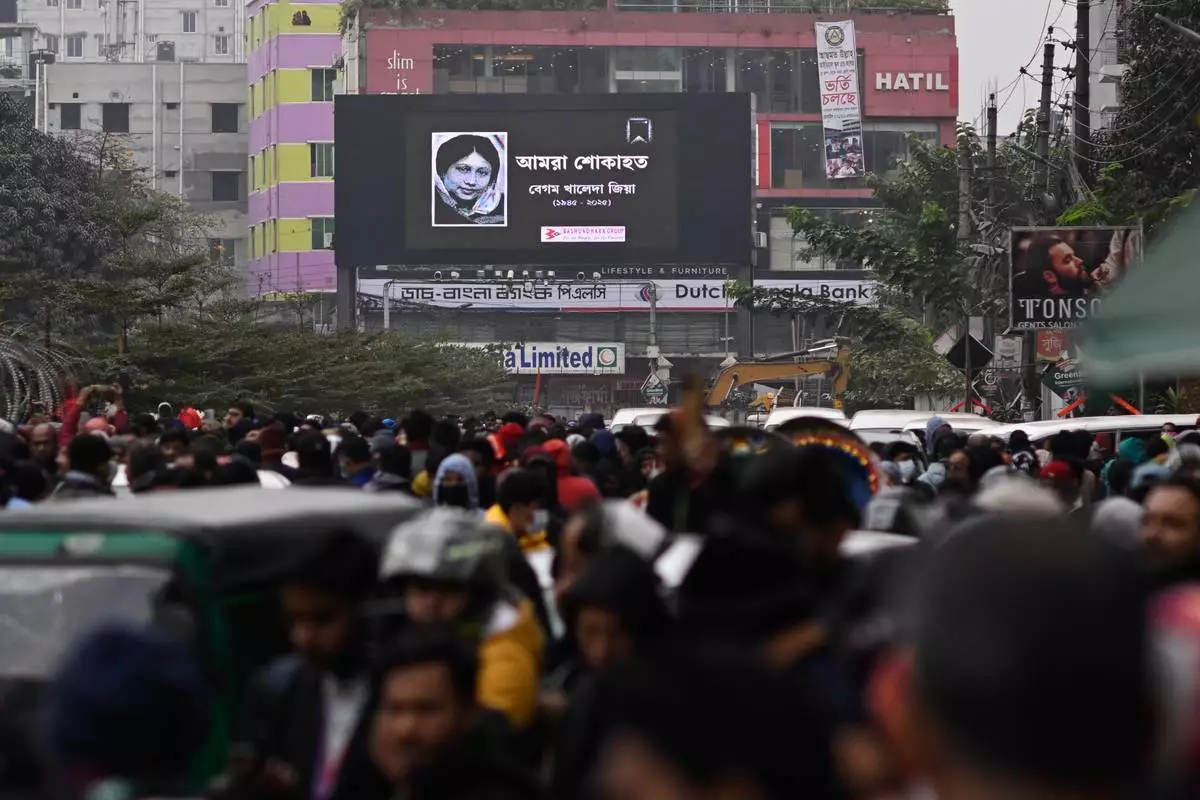
A portrait of former Bangladeshi Prime Minister Khaleda Zia is displayed on a digital screen near the hospital where she died, in Dhaka, Bangladesh, Monday, Dec. 30, 2025. (AP Photo/Mahmud Hossain Opu)
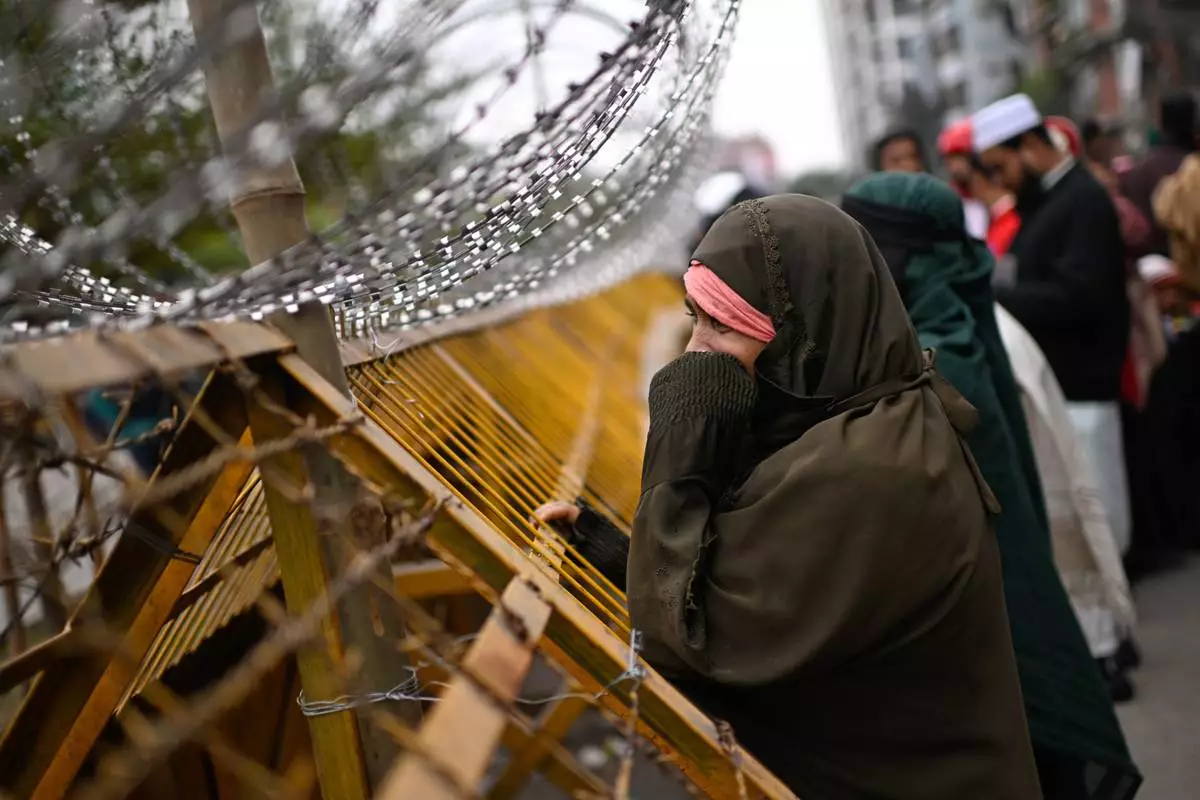
A woman reacts while waiting behind barricades outside the hospital where former Bangladeshi Prime Minister Khaleda Zia died, in Dhaka, Bangladesh, Monday, Dec. 30, 2025. (AP Photo/Mahmud Hossain Opu)
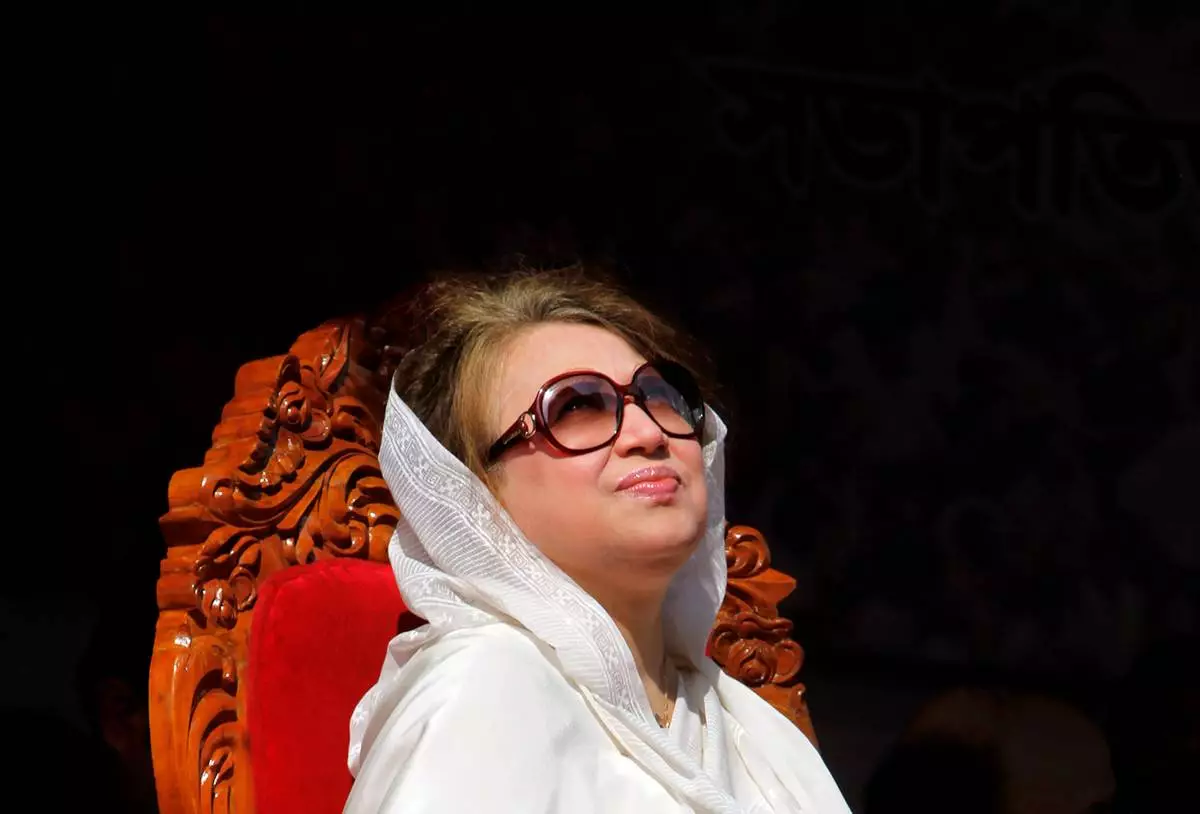
FILE - Bangladesh's main opposition Bangladesh Nationalist Party chief and former Prime Minister Khaleda Zia looks upwards as she attends a rally of her supporters outside their party headquarters in Dhaka, Bangladesh, Monday, March 12, 2012. (AP Photo/Aijaz Rahi, File)
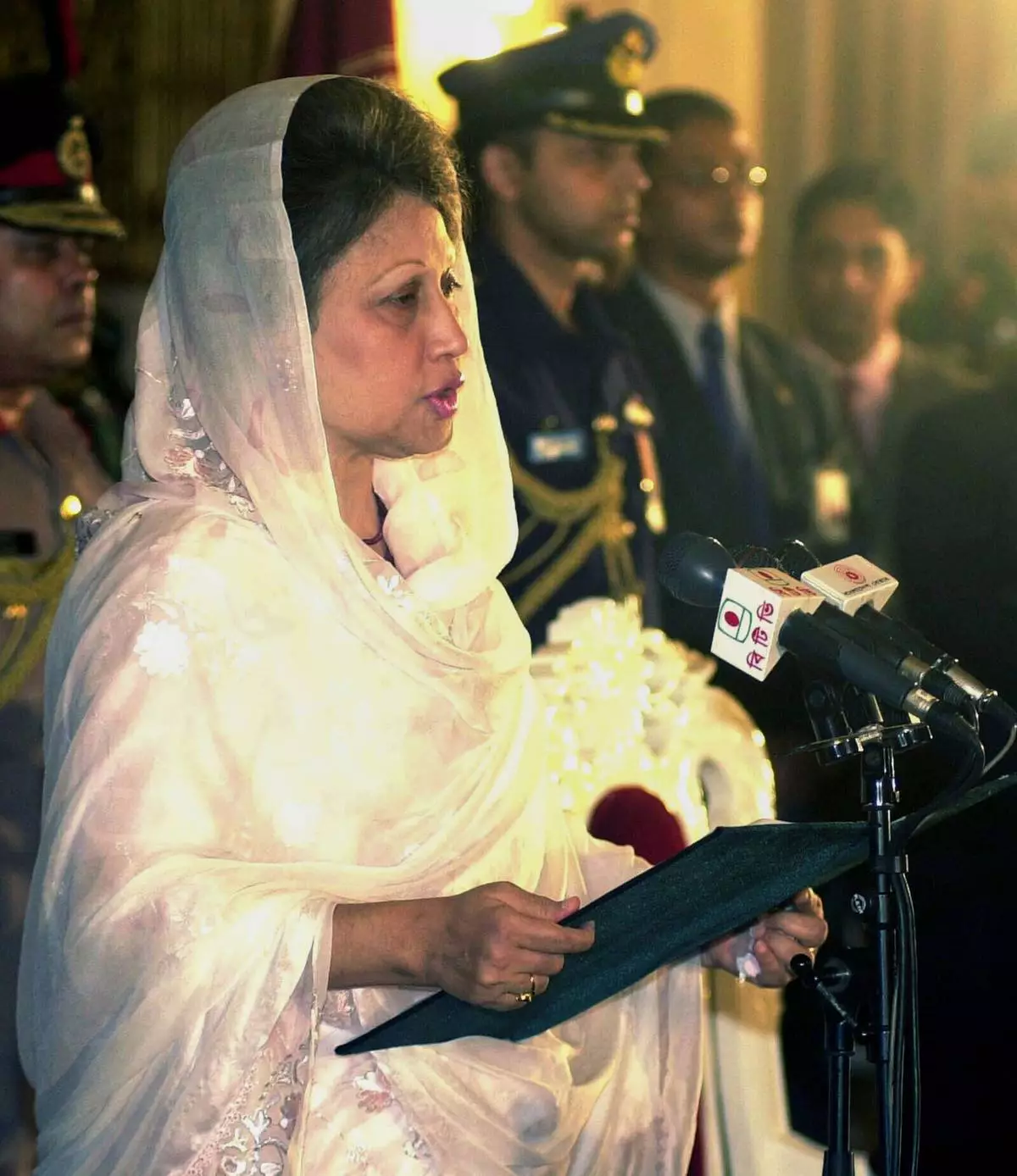
FILE - Khaleda Zia takes an oath of office as the prime minister in Dhaka, Bangladesh, Oct. 10, 2001. (AP Photo/Pavel Rahman, File)

FILE - Bangladesh's former prime minister and Bangladesh Nationalist Party leader Khaleda Zia, center, leaves court after a hearing in Dhaka, Bangladesh, Aug. 10, 2016. (AP Photo, File)

FILE - Bangladesh's ailing former Prime Minister Khaleda Zia leaves the airport in a car after arriving from London, May 6, 2025, in Dhaka, Bangladesh. (AP Photo/Mahud Hossain Opu, File)
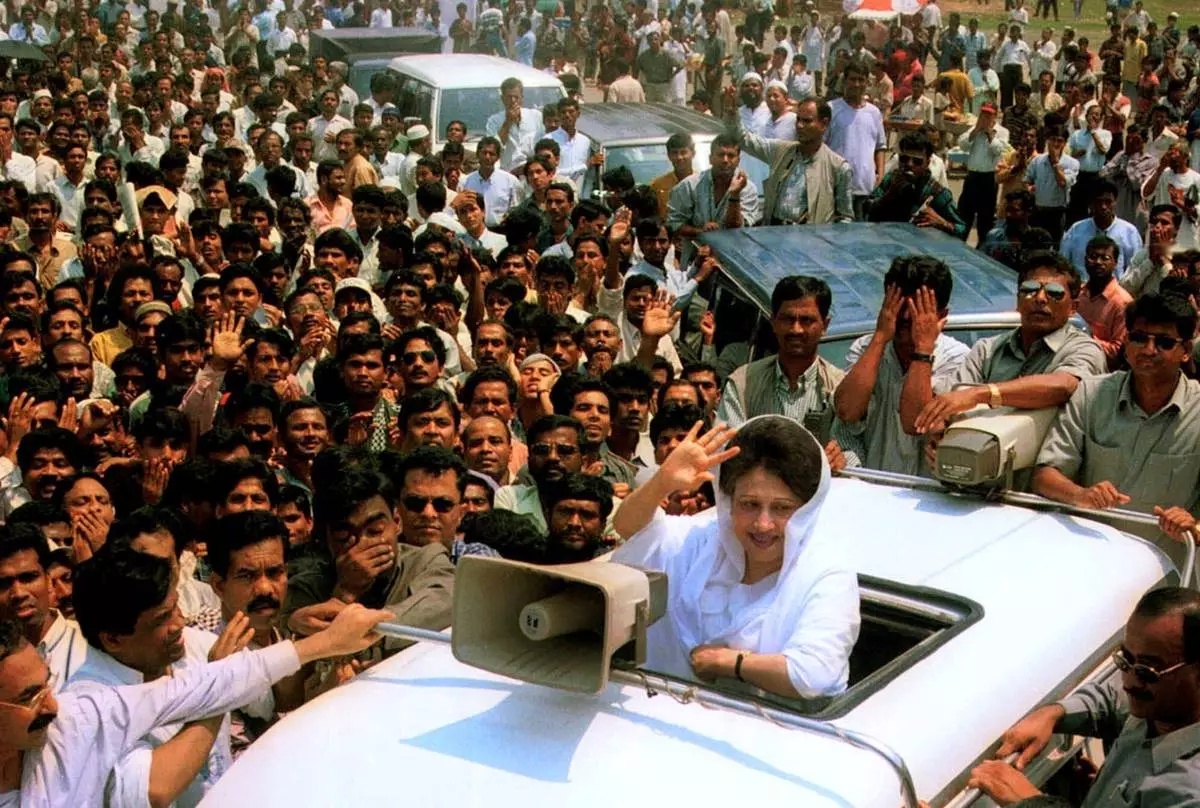
FILE - Khaleda Zia, Bangladeshi opposition leader and former prime minister, waves at the start of a 400-kilometer protest march from Dhaka to the northern village of Dinajpur, May 16, 1999. (AP Photo/Pavel Rahman, File)

FILE - Former Bangladesh Prime Minister Khaleda Zia waves to supporters after she was arrested, in Dhaka, Bangladesh, Sept. 3, 2007. (AP Photo/Pavel Rahman, File)