Skip to Content Facebook Feature Image

Ukraine and the US have finally signed a minerals deal. What does it include?

ENT

Ukraine and the US have finally signed a minerals deal. What does it include?
ENT

ENT

Ukraine and the US have finally signed a minerals deal. What does it include?

2025-05-02 02:45 Last Updated At:02:50

KYIV, Ukraine (AP) — After months of tense negotiations, the U.S. and Ukraine signed a deal that is expected to give Washington access to the country’s critical minerals and other natural resources, an agreement Kyiv hopes will secure long-term support for its defense against Russia.

According to Ukrainian officials, the version of the deal signed Wednesday is far more beneficial to Ukraine than previous versions, which they said reduced Kyiv to a junior partner and gave Washington unprecedented rights to the country's resources.

The agreement — which the Ukrainian parliament must ratify — would establish a reconstruction fund for Ukraine that Ukrainian officials hope will be a vehicle to ensure future American military assistance. A previous agreement was nearly signed before being derailed in a tense Oval Office meeting involving U.S. President Donald Trump, U.S. Vice President JD Vance and Ukrainian President Volodymyr Zelenskyy.

“We have formed a version of the agreement that provides mutually beneficial conditions for both countries. This is an agreement in which the United States notes its commitment to promoting long-term peace in Ukraine and recognizes the contribution that Ukraine has made to global security by giving up its nuclear arsenal,” Economy Minister Yulia Svyrydenko, who signed the deal for Ukraine, said in a post on Facebook.

The signing comes during what U.S. Secretary of State Marco Rubio said would be a “very critical” week for U.S.-led efforts to end the war that appear to have stalled. Ukraine sees the deal as a way to ensure that its biggest and most consequential ally stays engaged and doesn’t freeze military support, which has been key in its 3-year-old fight against Russia’s full-scale invasion.

“This agreement signals clearly to Russia that the Trump administration is committed to a peace process centered on a free, sovereign, and prosperous Ukraine over the long term,” Treasury Secretary Scott Bessent, who signed for the U.S., said in a statement.

Here is a look at the deal.

The deal covers minerals, including rare earth elements, but also other valuable resources, including oil and natural gas, according to the text released by Ukraine's government.

It does not include resources that are already a source of revenue for the Ukrainian state. In other words, any profits under the deal are dependent on the success of new investments. Ukrainian officials have also noted that it does not refer to any debt obligations for Kyiv, meaning profits from the fund will likely not go toward paying the U.S. back for its previous support.

Officials have also emphasized that the agreement ensures full ownership of the resources remains with Ukraine, and the state will determine what can be extracted and where.

It does not mention any explicit security guarantees to deter future Russian aggression that Ukraine has long insisted on.

The text of the deal lists 55 minerals but says more can be agreed to.

Trump has repeatedly expressed interest in Ukraine's rare earth elements, and some of them are included in the list, as are other critical minerals, such as titanium, lithium and uranium.

They are a group of 17 elements that are essential to many kinds of consumer technology, including cellphones, hard drives and electric and hybrid vehicles.

China is the world’s largest producer of rare earth elements, and both the U.S and Europe have sought to reduce their dependence on Beijing, Trump’s chief geopolitical adversary.

They include elements such as lanthanum, cerium and scandium, which are listed in the deal.

The agreement establishes a reconstruction investment fund, and both the U.S. and Ukraine will have an equal say in its management, according to Svyrydenko.

The fund will be supported by the U.S. government through the U.S. International Development Finance Corporation agency, which Ukraine hopes will attract investment and technology from American and European countries.

Ukraine is expected to contribute 50% of all future profits from government-owned natural resources into the fund. The United States will also contribute in the form of direct funds and equipment, including badly needed air defense systems and other military aid.

Contributions to the fund will be reinvested in projects related to mining, oil and gas as well as infrastructure.

No profits will be taken from the fund for the first 10 years, Svyrydenko said.

Trump administration officials initially pushed for a deal in which Washington would receive $500 billion in profits from exploited minerals as compensation for its wartime support.

But Zelenskyy rejected the offer, saying he would not sign off on an agreement “that will be paid off by 10 generations of Ukrainians.”

Ukraine’s rare earth elements are largely untapped because of state policies regulating the industry, a lack of good information about deposits, and the war.

The industry’s potential is unclear since geological data is thin because mineral reserves are scattered across Ukraine, and existing studies are considered largely inadequate, according to businessmen and analysts.

In general, however, the outlook for Ukrainian natural resources is promising. The country's reserves of titanium, a key component for the aerospace, medical and automotive industries, are believed to be among Europe’s largest. Ukraine also holds some of Europe’s largest known reserves of lithium, which is required to produce batteries, ceramics and glass.

In 2021, the Ukrainian mineral industry accounted for 6.1% of the country’s gross domestic product and 30% of exports.

An estimated 40% of Ukraine's metallic mineral resources are inaccessible because of Russian occupation, according to data from We Build Ukraine, a Kyiv-based think tank. Ukraine has argued that it's in Trump’s interest to develop the remainder before Russian advances capture more.
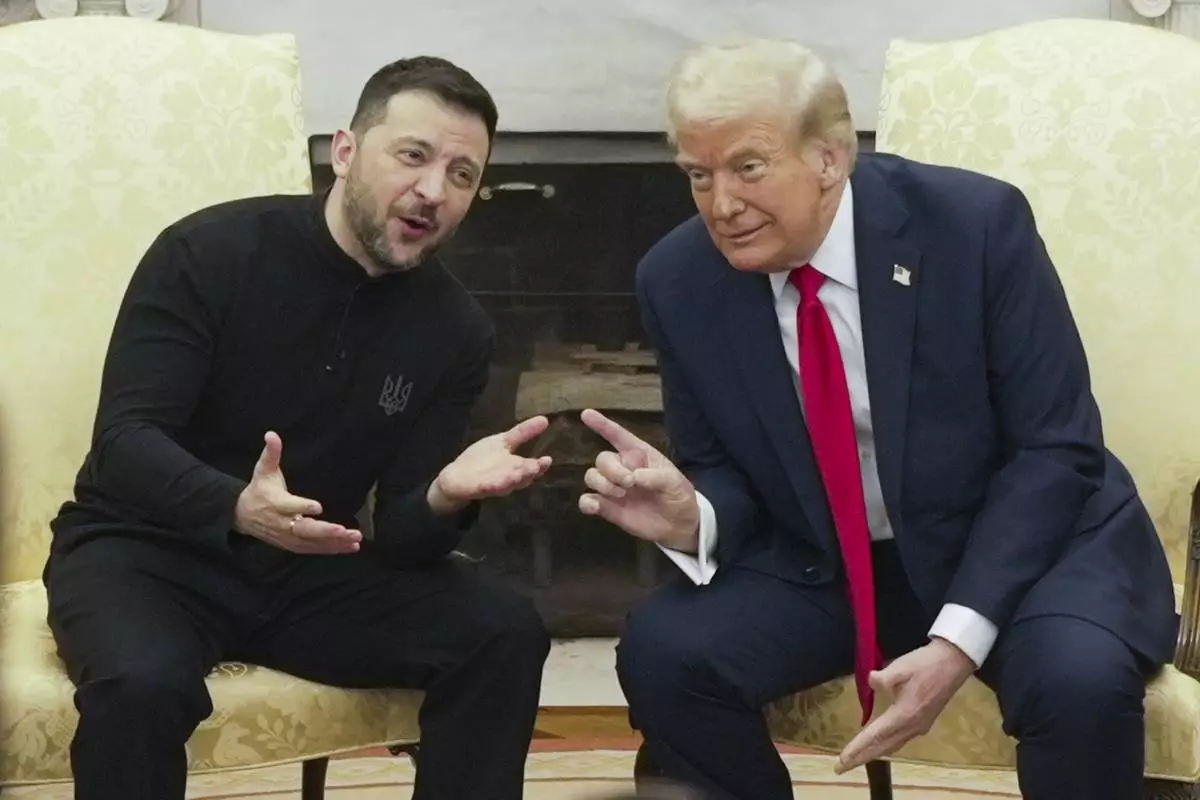
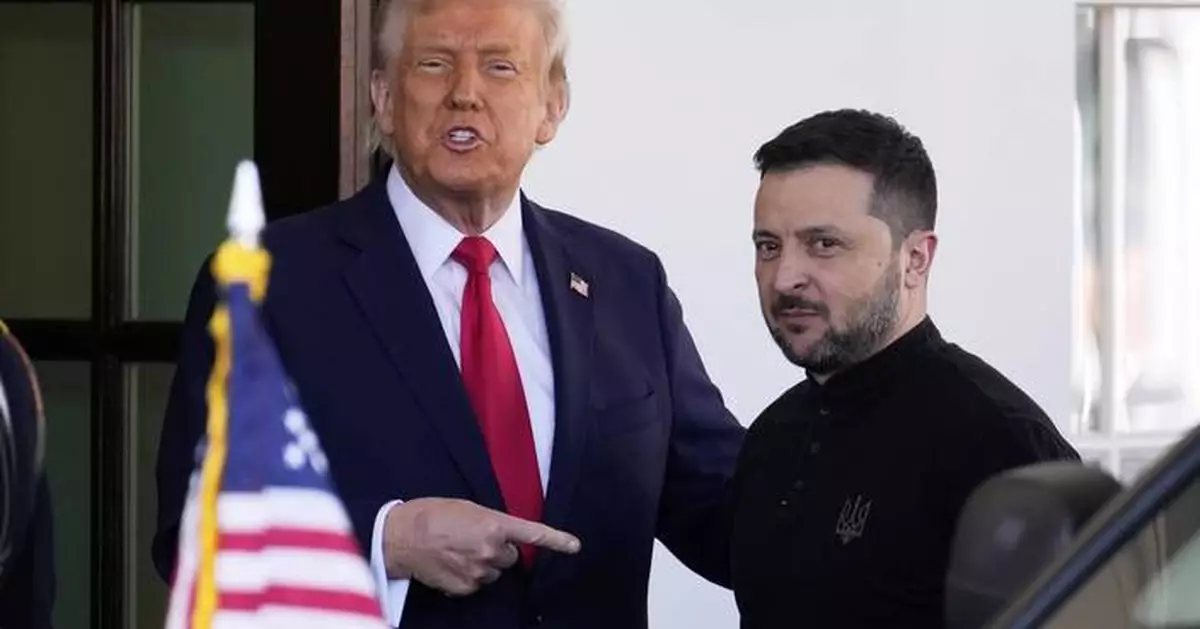
FILE - President Donald Trump, right, meets with Ukrainian President Volodymyr Zelenskyy in the Oval Office at the White House, Feb. 28, 2025, in Washington. (AP Photo/ Mystyslav Chernov, File)
FILE - President Donald Trump, right, meets with Ukrainian President Volodymyr Zelenskyy in the Oval Office at the White House, Feb. 28, 2025, in Washington. (AP Photo/ Mystyslav Chernov, File)

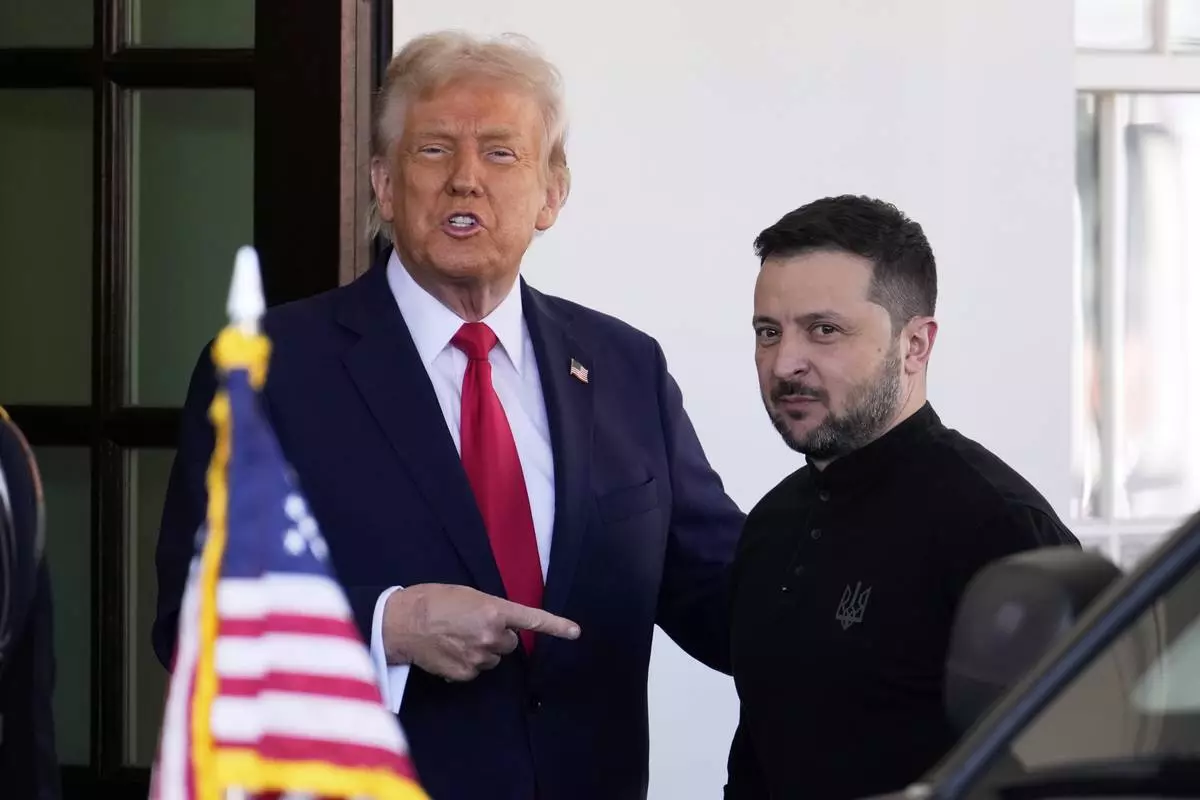
President Donald Trump welcomes Ukraine President Volodymyr Zelenskyy at the White House in Washington, Friday, Feb. 28, 2025. (AP Photo/Ben Curtis)

President Donald Trump welcomes Ukraine President Volodymyr Zelenskyy at the White House in Washington, Friday, Feb. 28, 2025. (AP Photo/Ben Curtis)

WASHINGTON (AP) — President Donald Trump said he’s dropping — for now — his push to deploy National Guard troops in Chicago, Los Angeles and Portland, Oregon, a move that comes after legal roadblocks held up the effort.

“We will come back, perhaps in a much different and stronger form, when crime begins to soar again - Only a question of time!" he said in a social media post Wednesday.

Governors typically control states' National Guardsmen, and Trump had deployed troops to all three cities against the wishes of state and local Democratic leaders. He said it was necessary as part of a broader crackdown on immigration, crime and protests.

The president has made a crackdown on crime in cities a centerpiece of his second term — and has toyed with the idea of invoking the Insurrection Act to stop his opponents from using the courts to block his plans. He has said he sees his tough-on-crime approach as a winning political issue ahead of next year’s midterm elections.

Troops had already left Los Angeles after the president deployed them earlier this year as part of a broader crackdown on crime and immigration.

In his post, Trump said the troops' presence was responsible for a drop in crime in the three cities, though they were never on the streets in Chicago and Portland as legal challenges played out. When the Chicago deployment was challenged in court, a Justice Department lawyer said the Guard’s mission would be to protect federal properties and government agents in the field, not “solving all of crime in Chicago.”

Portland Mayor Keith Wilson’s office in a statement said the city’s reduction in crime was due to the efforts of local police and public safety programs. Chicago officials echoed the sentiment, saying in a release Tuesday that the city had 416 homicides in 2025 — the fewest since 2014.

Trump’s push to deploy the troops in Democrat-led cities has been met with legal challenges at nearly every turn.

The Supreme Court in December refused to allow the Trump administration to deploy National Guard troops in the Chicago area. The order was not a final ruling but was a significant and rare setback by the high court for the president’s efforts.

Illinois Gov. JB Pritzker wrote on X Wednesday that Trump “lost in court when Illinois stood up against his attempt to militarize American cities with the National Guard. Now Trump is forced to stand down.”

Hundreds of troops from California and Oregon were deployed to Portland, but a federal judge barred them from going on the streets. A judge permanently blocked the deployment of National Guard troops there in November after a three-day trial.

Oregon Gov. Tina Kotek said in a statement Wednesday that her office had not yet received “official notification that the remaining federalized Oregon National Guard troops can return home. They were never lawfully deployed to Portland and there was no need for their presence. If President Trump has finally chosen to follow court orders and demobilize our troops, that’s a big win for Oregonians and for the rule of law.”

Trump's decision to federalize National Guard troops began in Los Angeles in June, when protesters took to the streets in response to a blitz of immigration arrests in the area. He deployed about 4,000 troops and 700 Marines to guard federal buildings and, later, to protest federal agents as they carried out immigration arrests.

The number of troops slowly dwindled until just several hundred were left. They were removed from the streets by Dec. 15 after a lower court ruling that also ordered control to be returned to Gov. Gavin Newsom. But an appeals court had paused the second part of the order, meaning control remained with Trump. In a Tuesday court filing, the Trump administration said it was no longer seeking a pause in that part of the order.

The U.S. Court of Appeals for the Ninth Circuit on Wednesday ordered the Trump administration to return control of the National Guard to Newsom.

“About time (Trump) admitted defeat,” Newsom said in a social media post. “We’ve said it from day one: the federal takeover of California’s National Guard is illegal.”

Troops will remain on the ground in several other cities. The U.S. Court of Appeals for the District of Columbia Circuit in December paused a lower court ruling that had called for an end to the deployment of National Guard troops in Washington, D.C., where they’ve been deployed since August after Trump declared a “crime emergency.”

Trump also ordered the deployment of the Tennessee National Guard to Memphis in September as part of a larger federal task force to combat crime, a move supported by the state’s Republican Gov. Bill Lee and senators. A Tennessee judge blocked the use of the Guard, siding with Democratic state and local officials who sued. However, the judge stayed the decision to block the Guard as the state appeals, allowing the deployment to continue.

In New Orleans, about 350 National Guard troops deployed by Trump arrived in the city's historic French Quarter on Tuesday and are set to stay through Mardi Gras to help with safety. The state's Republican governor and the city's Democratic mayor support the deployment.

Ding reported from Los Angeles. Associated Press reporters John O'Connor in Springfield, Illinois, Becky Bohrer in Juneau, Alaska, Jack Brook in New Orleans and Adrian Sanz in Memphis contributed.

FILE - A protester confronts a line of U.S. National Guard members in the Metropolitan Detention Center of downtown Los Angeles, Sunday, June 8, 2025. (AP Photo/Eric Thayer, File)

FILE - A protester confronts a line of U.S. National Guard members in the Metropolitan Detention Center of downtown Los Angeles, Sunday, June 8, 2025. (AP Photo/Eric Thayer, File)

FILE - Protesters stand off against California National Guard soldiers at the Federal Building in downtown Los Angeles, during a "No Kings" protest, June 14, 2025. (AP Photo/Richard Vogel, File)

FILE - Protesters stand off against California National Guard soldiers at the Federal Building in downtown Los Angeles, during a "No Kings" protest, June 14, 2025. (AP Photo/Richard Vogel, File)

President Donald Trump speaks during a news conference with Israel's Prime Minister Benjamin Netanyahu at Mar-a-Lago, Monday, Dec. 29, 2025, in Palm Beach, Fla. (AP Photo/Alex Brandon)

President Donald Trump speaks during a news conference with Israel's Prime Minister Benjamin Netanyahu at Mar-a-Lago, Monday, Dec. 29, 2025, in Palm Beach, Fla. (AP Photo/Alex Brandon)

Recommended Articles