Skip to Content Facebook Feature Image

China's first cargo ship along new 'dual-express' combined route sets sail for Germany

China

China

China

China's first cargo ship along new 'dual-express' combined route sets sail for Germany

2025-05-01 21:06 Last Updated At:05-02 08:12

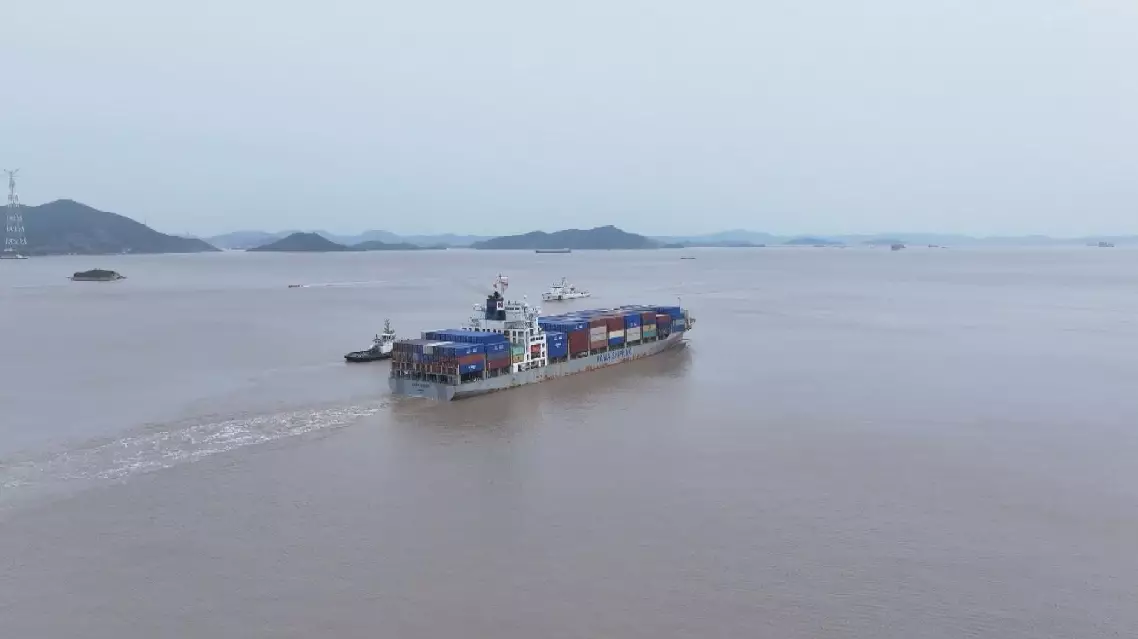
China has launched a new cargo route combining sea-rail intermodal transport with the China-Europe Express service, aiming to speed up delivery of high-tech exports to Europe.

A cargo ship carrying domestically produced goods such as photovoltaic panels and lithium batteries departed from the Ningbo-Zhoushan Port in eastern China's Zhejiang Province on Wednesday. The shipment is expected to reach Wilhelmshaven, Germany, 26 days after departure. This marks the first shipment from Ningbo-Zhoushan Port under the new "dual-express" model. Domestically, the goods are gathered to the port from inland exporters at Hefei North Railway Station in Anhui Province. Internationally, Germany’s Wilhelmshaven Port serves as a hub to extend distribution across Northern, Central and Eastern Europe, as well as the Baltic region.

"The transportation time has been reduced from the original 45 days to 30 days, saving 15 days for clients. This provides a good option for some clients with high requirements for transportation timeliness," said Zhang Bangmin, director of the Hefei branch of Hefei Railway Logistics Center.

The European Union is Ningbo-Zhoushan Port's largest trading partner, with its trade with the EU reached 115.92 billion yuan in the first quarter of 2025, up 21.5 percent year on year.

In addition to routes for the China-Europe Express, the Ningbo-Zhoushan Port has also opened new routes to South America in the first quarter of this year, bringing its total number of the shipping routes to over 300.

"At present, the shipping routes of Ningbo-Zhoushan Port connect over 600 ports in more than 200 countries and regions. Besides its largest trading partner, the European Union, it also increasingly trades with ASEAN countries and Brazil," said Hu Feng, an officer from Ningbo Customs.

Many other major ports in China are also exploring new routes to other markets as they face a decrease in shipments to the United States.

Shenzhen Yantian Port has opened new routes to Europe, the Mediterranean, South America and other Asian countries, while the Qingdao Port is about to open new routes to South America and the Middle East.
China's first cargo ship along new 'dual-express' combined route sets sail for Germany


China's first cargo ship along new 'dual-express' combined route sets sail for Germany
The United States cannot legitimize an operation that attacked Venezuela and captured its president, a Chinese scholar said Sunday.

On Saturday, the United States launched a large-scale strike on Venezuela, during which Venezuelan President Nicolas Maduro and his wife were 'captured and flown out of Venezuela' according to a post by U.S. President Donald Trump on his Truth Social account.

Teng Jianqun, director of the Center for Diplomatic Studies at Hunan Normal University, said in an interview with China Global Television Network (CGTN) that the aim of this operation is to take full control of Venezuela’s natural resources.

"I don't think the United States can legitimize this operation to take custody of the president of Venezuela. And also I don't think the United States can legitimize its any action in taking the oil reserves of that country. This is actually a very dangerous game played by the Trump administration. And of course, the United States would like to take full control of that country and to take full control of the natural resources, especially the large reserve of oil in Venezuela," said Teng.

Teng said Venezuela is not an isolated case but a common practice by the United States. The United States launched an invasion of Panama on Dec. 20, 1989, which continued until January 1990, with the stated objective of capturing Panamanian strongman Manuel Noriega on charges of drug trafficking and organized crime.

"We still remember the so-called sentence of the former president of Panama in the late 1980s. And this time, the president of Venezuela will be under some judicial condition (judicial proceedings) for the so-called drug trafficking and some other crimes. So I think this is not a single case for the Venezuela country, but also this is actually a practice by the United States -- to use force, to use so-called justice under law against any leaders in Latin America and the Caribbean waters," he said.

US cannot legitimize operation against Venezuela: Chinese scholar

US cannot legitimize operation against Venezuela: Chinese scholar

Recommended Articles