The launch of the "Flower Viewing Express" in Xi'an, northwest China's Shaanxi Province, has turned once routine commuter routes into vibrant seasonal journeys, with trains departing every eight minutes to ancient city of Hanzhong and other scenic destinations in the province.
Passengers can reach golden rapeseed fields, blooming cherry trees, and lush pear blossoms, all within a one-hour ride from urban centers.
"This line was traditionally dominated by business commuters, but since mid-March, its transformed into a hotspot for sightseers - young travelers and families with children - all cameras in hand. The Flower Viewing Express has driven a major surge in passengers, and we now operate approximately 160 daily departures," said Guo Dingjing, train captain with the Xi'an Passenger Transport Division.
One of the most popular destinations is Hanzhong, where vast fields of rapeseed flowers create a golden sea each spring. With high-speed rail now connecting Xi'an to Hanzhong in about an hour, office workers can leave their desks and reach the flower fields in roughly the time it takes to finish lunch.
"The operation of the Flower Viewing Express has changed tourism here overnight. Last weekend broke all records with 100,000 visitors in a single day! We've evolved way beyond just flower viewing. Now visitors can dress up in traditional hanfu, sample amazing local food, even get professional photos taken. People come for the flowers, but stay longer because of all these new experiences," said Long Mei, community development director of the Laojun Town of Hanzhong City.
Hanfu refers to the traditional clothing system of the Han people -- China's ethnic majority.
With efficient scheduling and smooth connections, high-speed trains have turned scattered scenic spots into a unified spring circuit.
"I'm not local. Before, I rarely came to see the flowers because it required driving or taking a bus. Now, with the special 'flower express' running every weekend, I can come all the time to take photos," said a tourist.

China's high-speed trains for viewing flowers fuel spring tourism boom
Artists have reimagined ancient themes through a modern lens at the 60th Venice Biennale China National Pavilion Exhibition, now underway in Shanghai.
The main feature of the exhibition is a fully immersive project by artist Che Jianquan, who has placed consecutive screens placed side by side to present his two-decade-long documentation of the same pavilion since 2003.
Through his lens, the artist captures the pavilion, as it emerges and disappears amidst mist and clouds, evoking the aesthetic of misty landscapes in traditional Chinese ink paintings.
"At the beginning, I wanted to use painting to document my feeling, but later I realized that painting was somewhat powerless. So, starting in 2003, I began using the earliest video equipment to start recording. What I care about more is a place—a very small location—and the unique connection it has within that field to history and to the culture of that region. I think this is something I hope to achieve: through a seemingly ordinary scene, to uncover the stories behind it, as well as its possible influence on both the past era and the present," said Chen.
Established in 1895, the Venice Biennale is one of the premier events in the global art world. This year, the China National Pavilion Exhibition, under the theme "Atlas: Harmony in Diversity," presents not only the documentary archives of 100 Chinese paintings held overseas, but also seven contemporary artworks created by seven Chinese artists exploring themes, such as architecture, landscapes, figures, flora and fauna.
"The core of the Venice Biennale is contemporary art, reflecting the spirit of the present era—yet the present and history cannot be separated. This exhibition is rooted in the tradition of Chinese painting across dynasties, drawing from over 20,000 individual works that took us twenty years to collect globally," said Wang Xiaosong, an artist and the curator of the exhibition.
"Notably, we discovered that more than 3,000 of these paintings had been lost overseas, which we spent two decades retrieving through digital tools. This is how we engage with traditional art: through each artist's reflection and a new understanding of the relationship between the ancients, the present, and the future," he added.
Wang drew special attention to a piece by the modern artist Qiu Zhenzhong, who he said merges the art of Chinese gardens with calligraphy using traditional methods to showcase contemporary issues such as environmental and ecological change.
"It's like a dialogue with nature," Wang said.
The exhibition in Shanghai is the final stop of the national tour, following the legs in the southwest Chinese city of Chongqing and the southern Chinese city of Guangzhou, and will run until May 31.
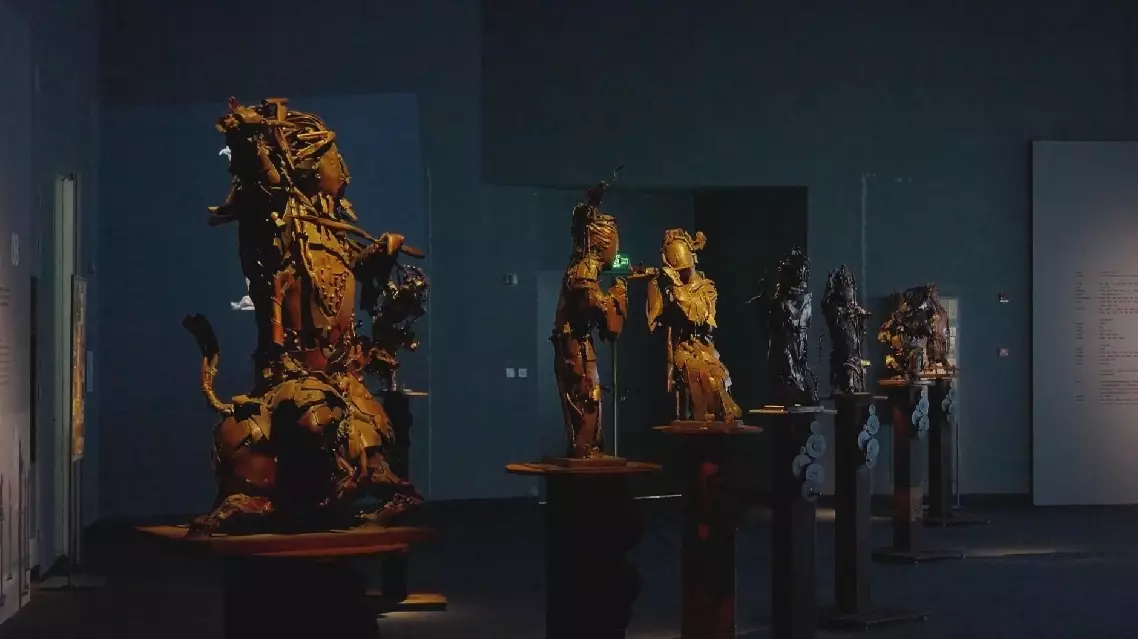
Exhibition in Shanghai bridges contemporary art with centuries of Chinese artistic tradition