BALTIMORE (AP) — If the second half of 2024 was a reality check for the Baltimore Orioles — their first real stretch of mediocrity since they became contenders again — the start of this season is a near-crisis.
This young Baltimore team experienced very little failure while winning 101 games in 2023, but now the Orioles are well aware of what baseball's more humbling side feels like.
“I think we’re getting a little more familiar (with adversity) than we wanted to be," general manager Mike Elias said before Friday night's 3-0 win over Kansas City.
Elias met with reporters to address his team's 12-18 record in April. The Orioles aren't just in last place in the AL East, they also had the worst run differential in the American League before Friday's game.
The young core of hitters that was so fearsome early last year has struggled mightily in 2025. Elias has reason to view that as a temporary blip, but the other main culprit this year — the collapse of the starting rotation — might be harder to fix.
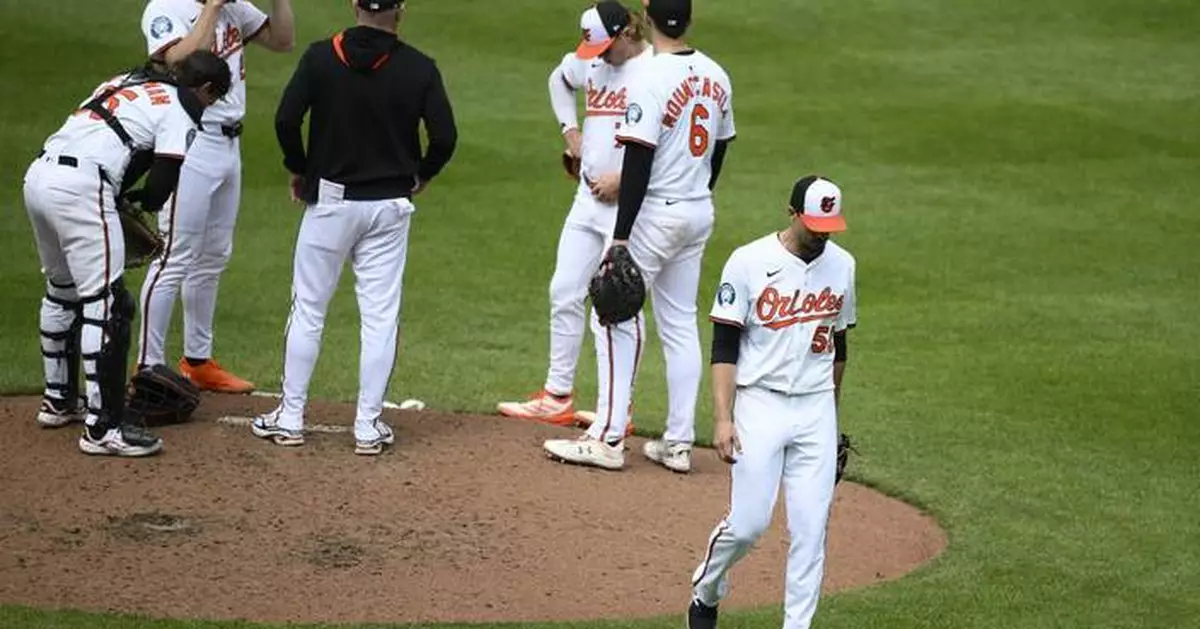
Zach Eflin, Grayson Rodriguez and Albert Suarez are on the injured list and Dean Kremer took a 7.04 ERA into Friday's start before breaking through with seven scoreless innings. Tomoyuki Sugano has been fine, but Charlie Morton is 0-6 with a 9.45 ERA and will work out of the bullpen for now. Kyle Gibson allowed homers to four of the first five batters Tuesday in his first big league start of the season.
“It is difficult to contend with that level of injuries, but even that aside, they’ve had a poor start, and that’s my responsibility. I’m in charge of baseball operations," Elias said. "When we have a bad record to start the year, that’s my responsibility.”
Elias opened himself up to second-guessing in the offseason when the Orioles lost Corbin Burnes to free agency and he gave one-year contracts to Sugano, Morton and Gibson. One-year deals are usually considered pretty safe — even if they work out badly, they expire quickly. But Baltimore committed over $33 million to that trio, so if they keep performing this poorly as a group it would constitute a real misuse of resources.
In fairness, a rotation of Rodriguez, Eflin, Sugano, Kremer and Cade Povich could have been serviceable — with Kyle Bradish and Tyler Wells expected back at some point from elbow surgery — but the injuries to Eflin and Rodriguez have forced Morton and Gibson to produce, and thus far they haven't.
Baltimore's 5.47 ERA entering Friday ranked 29th among the 30 teams, lower than only Miami’s 5.89.
The Orioles did manage to take two of three from the first-place New York Yankees earlier this week, but even that required a pair of one-run wins sandwiched around a 15-3 loss. There have simply been too many games in which Baltimore finds itself way behind because of poor pitching.
“Nobody’s happy with how we’ve performed so far. We have higher expectations for ourselves," manager Brandon Hyde said. "I talk with Mike multiple times a day. We’re not satisfied in the least bit. We know our team can play better than we have.”
Elias said he remains confident in Hyde.
"When things are going great — and they have at times here, we’ve had that — and then when we’re experiencing failure, it’s really important in that job and in my job too to be consistent with your approach," Elias said. "He’s doing that.”
Eflin (lat strain) and reliever Andrew Kittredge (knee) are expected to make minor league rehab appearances Sunday, and Elias said Rodriguez (elbow inflammation) might be able to throw by the end of this month.
“We are all working very hard and we have a lot of faith in this very talented group," Elias said. "Piece by piece, step by step, we're going to get guys healthier, we're going to get guys performing more to their norms. If there's something we can fix with a player, we're working on that.”
AP MLB: https://apnews.com/mlb
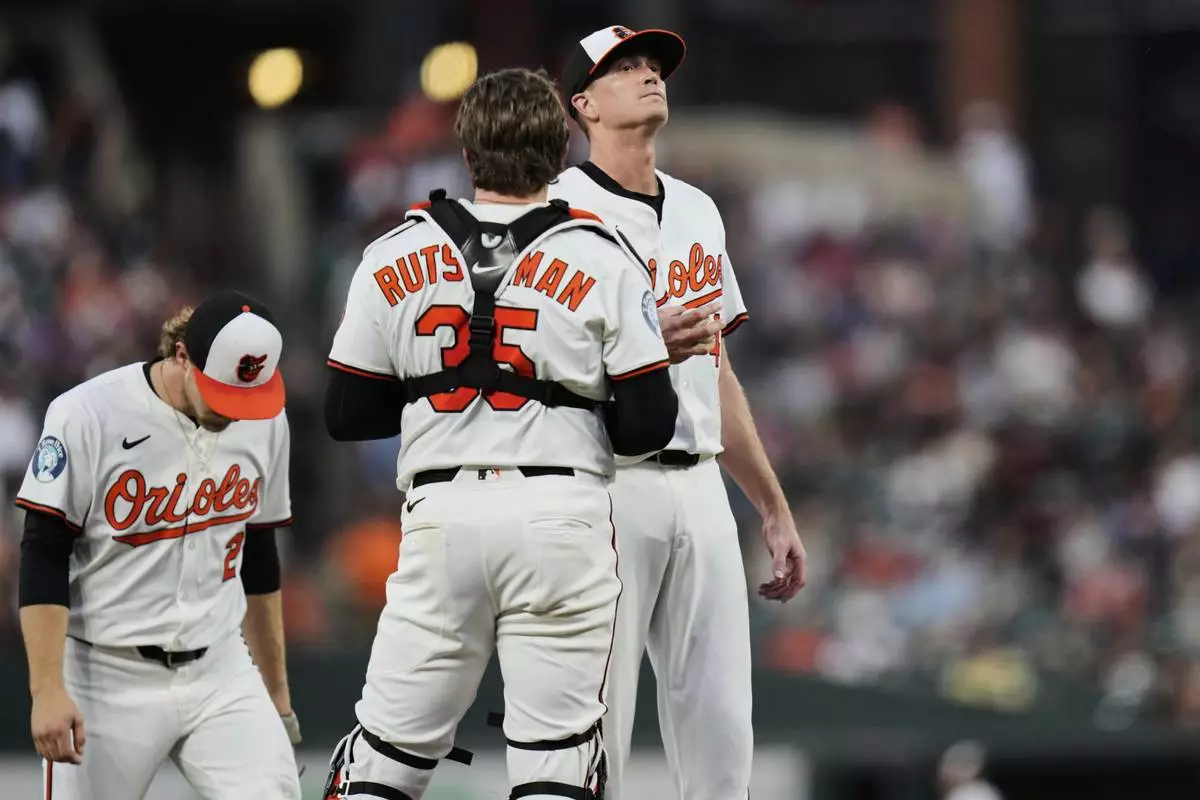
Baltimore Orioles starting pitcher Kyle Gibson, right, reacts during a pitching change in the fourth inning of a baseball game against the New York Yankees, Tuesday, April 29, 2025, in Baltimore. (AP Photo/Stephanie Scarbrough)
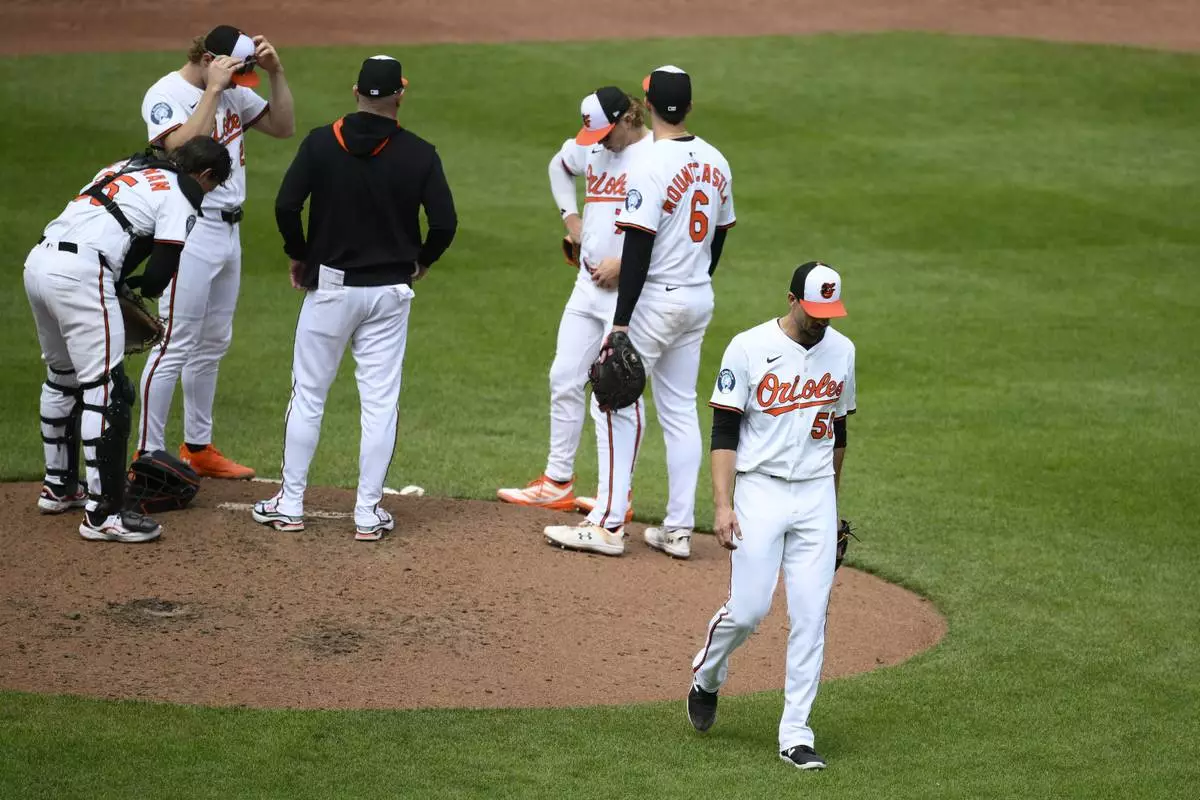
Baltimore Orioles starting pitcher Charlie Morton, front, walks back to the dugout after he was pulled during the third inning of a baseball game against the Cincinnati Reds, Sunday, April 20, 2025, in Baltimore. (AP Photo/Nick Wass)
SEOUL, South Korea (AP) — Ahn Sung-ki, one of South Korean cinema’s biggest stars whose prolific 60-year career and positive, gentle public image earned him the nickname “The Nation’s Actor,” died Monday. He was 74.
Ahn, who had suffered blood cancer for years, was pronounced dead at Seoul's Soonchunhyang University Hospital, his agency, the Artist Company, and hospital officials said.
“We feel deep sorrow at the sudden, sad news, pray for the eternal rest of the deceased and offer our heartfelt condolences to his bereaved family members," the Artist Company said in a statement.
President Lee Jae Myung issued a condolence message saying Ahn provided many people with comfort, joy and time for reflection. “I already miss his warm smile and gentle voice,” Lee wrote on Facebook.
Born to a filmmaker in the southeastern city of Daegu in 1952, Ahn made his debut as a child actor in the movie “The Twilight Train” in 1957. He subsequently appeared in about 70 movies as a child actor before he left the film industry to live an ordinary life.
In 1970, Ahn entered Seoul’s Hankuk University of Foreign Studies as a Vietnamese major. Ahn said he graduated with top honors but failed to land jobs at big companies, who likely saw his Vietnamese major largely useless after a communist victory in the Vietnam War in 1975.
Ahn returned to the film industry in 1977 believing he could still excel in acting. In 1980, he rose to fame for his lead role in Lee Jang-ho’s “Good, Windy Days,” a hit coming-of-age movie about the struggle of working-class men from rural areas during the country’s rapid rise. Ahn won the best new actor award in the prestigious Grand Bell Awards, the Korean version of the Academy Awards.
He later starred in a series of highly successful and critically acclaimed movies, sweeping best actor awards and becoming arguably the country’s most popular actor in much of the 1980-90s.
Some of his memorable roles included a Buddhist monk in 1981’s “Mandara,” a beggar in 1984’s “Whale Hunting,” a Vietnam War veteran-turned-novelist in 1992’s “White Badge,” a corrupt police officer in 1993’s “Two Cops,” a murderer in 1999’s “No Where To Hide,” a special forces trainer in 2003’s “Silmido” and a devoted celebrity manager in 2006’s “Radio Star.”
Ahn had collected dozens of trophies in major movie awards in South Korea, including winning the Grand Bell Awards for best actor five times, an achievement no other South Korean actors have matched yet.
Ahn built up an image as a humble, trustworthy and family-oriented celebrity who avoided major scandals and maintained a quiet, stable personal life. Past public surveys chose Ahn as South Korea’s most beloved actor and deserving of the nickname “The Nation’s Actor.”
Ahn said he earlier felt confined with his “The Nation's Actor” labeling but eventually thought that led him down the right path. In recent years, local media has given other stars similar honorable nicknames, but Ahn was apparently the first South Korean actor who was dubbed “The Nation's Actor.”
“I felt I should do something that could match that title. But I think that has eventually guided me on a good direction,” Ahn said in an interview with Yonhap news agency in 2023.
In media interviews, Ahn couldn’t choose what his favorite movie was, but said that his role as a dedicated, hardworking manger for a washed-up rock singer played by Park Jung-hoon resembled himself in real life the most.
Ahn was also known for his reluctance to do love scenes. He said said he was too shy to act romantic scenes and sometimes asked directors to skip steamy scenes if they were only meant to add spice to movies.
“I don’t do well on acting like looking at someone who I don’t love with loving eyes and kissing really romantically. I feel shy and can’t express such emotions well,” Ahn said in an interview with the Shindonga magazine in 2007. “Simply, I’m clumsy on that. So I couldn’t star in such movies a lot. But ultimately, that was a right choice for me.”
Ahn is survived by his wife and their two sons. A mourning station at a Seoul hospital was to run until Friday.

FILE - South Korean actor Ahn Sung-ki smiles for a photo on the red carpet at the 56th Daejong Film Awards ceremony in Seoul, South Korea, June 3, 2020. (AP Photo/Ahn Young-joon, File)

FILE - South Korean actor Ahn Sung-ki attends an event as part of the 11th Pusan International Film Festival in Busan, South Korea, Oct. 13, 2006. (AP Photo/Kin Cheung, File)