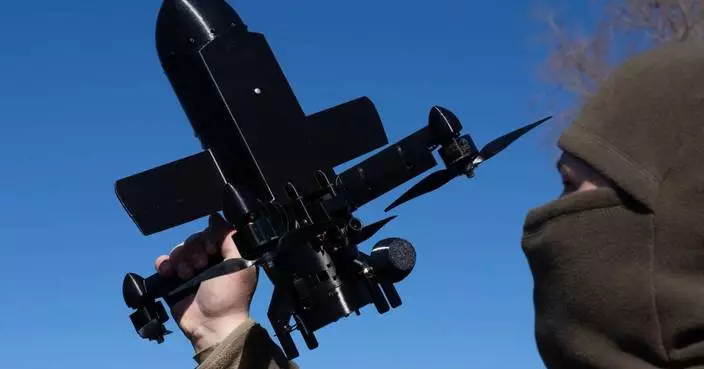
As drone technology continues to advance, its application is expanding across various sectors, including logistics, aerial photography, industrial inspections and more.
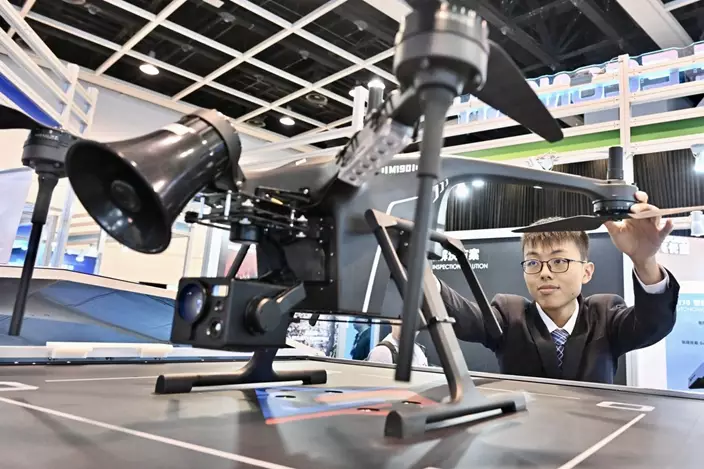
Innovative solutions: Kun Li’s company is one of the participants in the first batch of low-altitude economy Regulatory Sandbox pilot projects and is working with a construction firm to apply drone inspections for site safety. Source from news.gov.hk
In response to the growing potential of the low-altitude economy (LAE), the Government has established the Working Group on Developing Low-altitude Economy to formulate development strategies and inter-departmental action plans regarding the trend.
The Government announced the first batch of 38 low-altitude economy Regulatory Sandbox pilot projects earlier and some of them are commencing progressively. They cover various fields and application scenarios such as emergency and rescue, drone delivery, inspection and safety maintenance, surveillance and low-altitude infrastructure.
Business springboard
Kun Li’s company is one of the participants in the first batch of pilot projects. It set up a branch in Hong Kong last year, focusing primarily on the application of drone technology in areas such as urban management and inspection. Their flagship product is a self-docking and charging drone station. The company hopes it can be used by all kinds of drones in the future.
As part of the pilot project, the company joined forces with a construction company to apply drone inspections for site safety.
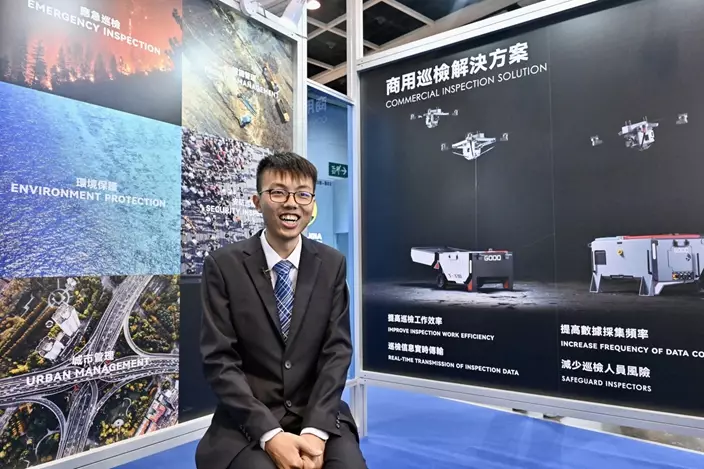
Opportunities ahead: Mr Li says Hong Kong provides exceptional avenues for financing and a springboard for entering overseas markets. Source from news.gov.hk
Mr Li pointed out that Hong Kong, with its unique combination of rich natural landscapes and high-density urban development, offers diverse scenarios for testing drone technology. He also believes Hong Kong’s status and function as an international financial centre, provides exceptional avenues for financing and a springboard for promoting their products to overseas markets.
Nonetheless, Mr Li acknowledged there are challenges for drone technology development in the city, including relevant policies and regulations.
Industry facilitation
Invest Hong Kong Head of Innovation & Technology Andy Wong believes that developing a low-altitude economy will bring significant benefits to Hong Kong's society and economy, including enhanced smart city management, and promoting innovation and technology development. He also noted that as an emerging industry, low-altitude economy-related business will create employment opportunities, such as for drone operators in the city.

Reaching businesses: Invest Hong Kong Head of Innovation & Technology Andy Wong says it provides information and platforms for companies to explore business opportunities. Source from news.gov.hk
In addition, Mr Wong highlighted that Hong Kong has a rich talent pool and a robust and efficient financial market which are the key advantages that attract low-altitude economy firms to set up operations in the city. Moreover, Invest Hong Kong has been providing platforms for companies to explore business opportunities.
Invest Hong Kong will hold a low-altitude economy seminar on June 27, inviting industry representatives and professionals to share their latest insights.
In 2025, the Food & Environmental Hygiene Department (FEHD) cracked a case of illegal goat slaughtering. The premises involved were located in a remote rural area and concealed from view. Accordingly, a key factor in foiling the perpetrators was the use of aerial intelligence.
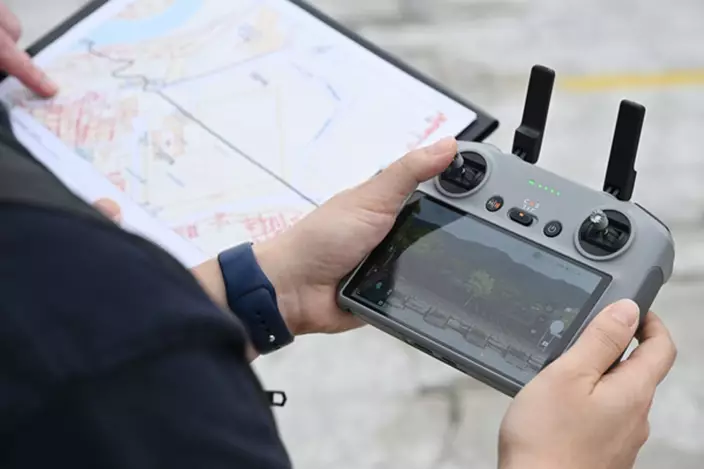
Aerial surveillance : The FEHD cracked a case of illegal goat slaughtering last year, with drones serving as a key investigative tool. Image source: www.news.gov.hk
Officers used drones to capture footage, then cross-referenced this with aerial photographs taken by the Lands Department. This allowed them to identify suspicious locations.
The FEHD outlined that using drones to collect evidence reduces the need for manned patrols, boosts efforts to combat illegal slaughtering activities, illegal meat distribution centres and unlicensed food premises, and improves staff safety.
Expanded capabilities
Explaining the limitations of traditional methods, Food & Environmental Hygiene Department Senior Superintendent (Operations) Lo Chi-man remarked: “Relying solely on manpower-based patrols, plain-clothes operatives could only conduct surveillance in the vicinity of the target premises. Operatives also faced significant safety risks such as potential violence, aggressive dogs and structural hazards.”
After the introduction of drones, however, intelligence can now be gathered at high altitude, adopting a bird’s eye view. This allows operatives to clearly map entry or exit points, personnel distribution, suspicious vehicle locations and escape routes in advance.

Risk reduction: FEHD Senior Superintendent (Operations) Lo Chi-man says that operatives using traditional detection methods faced greater safety risks. The deployment of drones can therefore improve staff safety while boosting efficiency. Image source: www.news.gov.hk
Smart inspections
Beyond intelligence gathering, the FEHD has been working with the Electrical & Mechanical Services Department since 2025 to study the feasibility of using drones to support street cleanliness inspections.
Under planned trials, drones will conduct automated aerial patrols along pre-set routes in order to detect accumulated rubbish, overflowing litter bins and damaged refuse collection facilities. The captured images will then be analysed using artificial intelligence, enabling the FEHD to arrange timely follow-up actions.
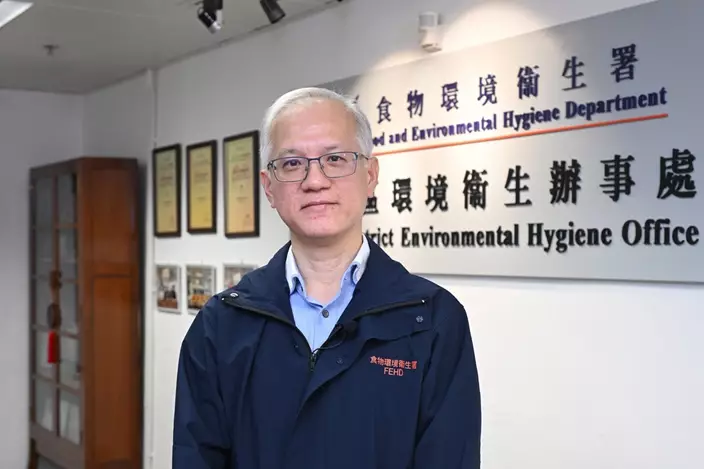
Enhanced efficiency: FEHD Senior Superintendent (Innovation & Technology) Kuan Man-hou says adopting an automated inspection system will allow the department to analyse street cleanliness more quickly and accurately. Image source: www.news.gov.hk
Food & Environmental Hygiene Department Senior Superintendent (Innovation & Technology) Kuan Man-hou highlighted that street cleaning inspections largely depend on frontline staff making in-person site visits. Officers are required to carry out visual checks and take photos to record conditions. However, some locations are remote and transport can be inconvenient, so the trips are often time-consuming.
With the automated inspection system, however, the FEHD will be able to analyse street cleanliness more quickly and accurately, enabling more effective deployment of manpower and resources.
Drone docking stations are expected to be installed on top of public toilets managed by the FEHD, serving as bases for take-off, landing and charging. The team revealed that flight tests for the project will commence soon.

Phased trials: Electrical & Mechanical Services Department Senior Engineer (Drones, Robotics & Automation) Vanessa Yau says her team is seeking operational approval from the Civil Aviation Department for drone use. Image source: www.news.gov.hk
Phased trials
Electrical & Mechanical Services Department Senior Engineer (Drones, Robotics & Automation) Vanessa Yau said her team is applying to the Civil Aviation Department for operational approvals.
”The trials will be conducted in two main stages. In the first stage, flights under visual line of sight and extended visual line of sight will be tested. Once stable performance is achieved, beyond-visual-line-of-sight operations will be tested for fully automated aerial patrols.”
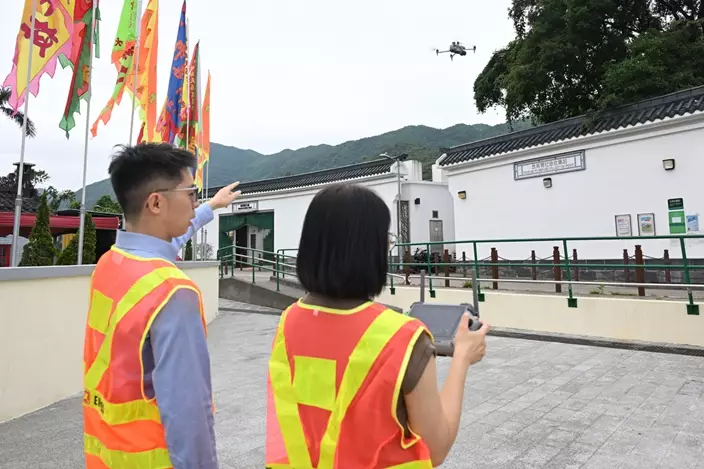
Joint project: The FEHD is working with the Electrical & Mechanical Services Department to study the feasibility of using drones to support street cleanliness inspections. Image source: www.news.gov.hk