Fueled by favorable factors such as optimized visa policies, robust tourism interest, and increased international flight capacity, China has witnessed a notable rise in foreign arrivals at major international airports during the five-day May Day holiday.
According to the Beijing Border Inspection Station, a total of 162,000 passenger trips were recorded in the first three days of the May Day holiday, representing a 21.5 percent increase over last year.
During this period, ports across the city recorded 27,000 inbound trips, an 80.8 percent year-on-year increase. Notably, Daxing International Airport alone saw over 7,200 foreign arrivals, doubling last year's figure.
Among these, 16,000 passenger trips were made by international travelers benefiting from visa exemptions and the 240-hour visa-free transit policy, marking a 2.2-fold increase over the previous year. In Shanghai, international arrivals also saw a sharp increase. The Shanghai Border Inspection Station projected that total passenger trips at the city's various ports would reach 594,000 between May 1 and 5, a 30.7 percent year-on-year rise.
Foreign visitor numbers at both Pudong and Hongqiao airports are also expected to rise significantly compared with the same period last year.
"We've introduced a new system allowing international passengers to fill out their arrival cards on the plane and submit their entry details online. We also distribute arrival cards to airlines in advance and have set up self-service printing machines in waiting areas to save time and improve overall border-crossing efficiency," said Miao Ye, a police officer with the Shanghai Border Inspection Station.
Guangzhou, capital of south China's Guangdong Province, has also attracted a significant influx of international tourists during the holiday. According to the Guangzhou Border Inspection Station, the combination of visa-exemption policies and the third phase of the 137th China Import and Export Fair, or Canton Fair, has contributed greatly to the growth in inbound tourism.
Official data show that 32,000 inbound trips were recorded in the first three days of the holiday, a 43 percent rise from last year. The majority of visitors were from Malaysia, Thailand, India, and South Korea, with more than 50 percent traveling for business and tourism purposes.
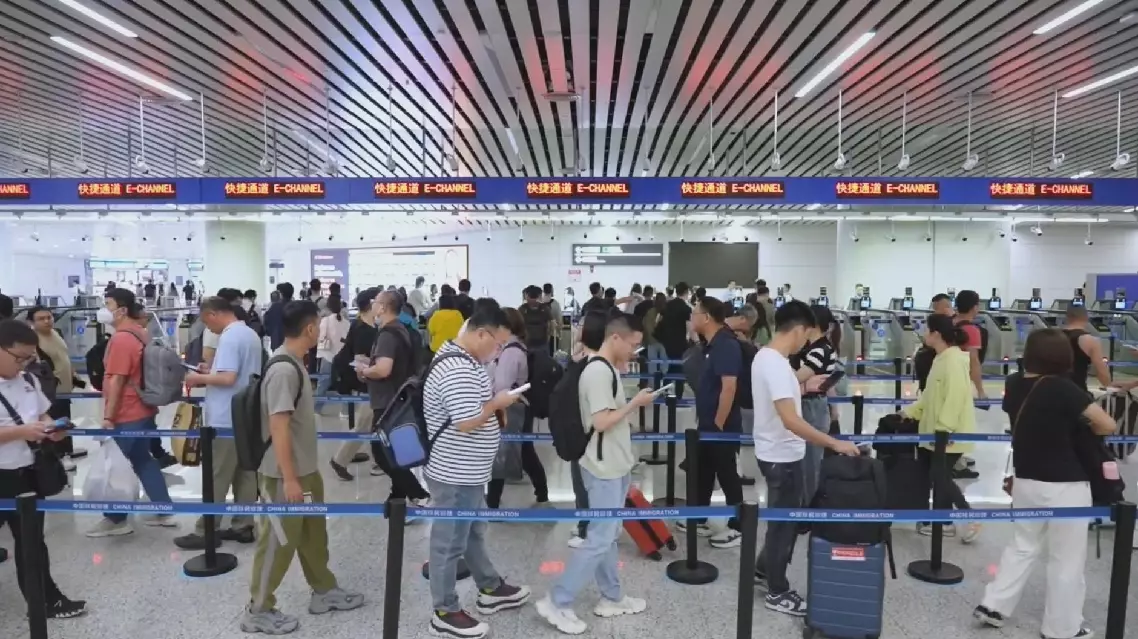
China sees inbound travel surge during May Day holiday with favorable factors
Japanese Prime Minister Sanae Takaichi's political stunts both at home and abroad cannot whitewash Japan's World War II (WWII) aggression, but instead expose the schemes of the country's far-right forces to incite bloc confrontation and promote remilitarization, says a China Media Group commentary published on Sunday.
An edited English version of the commentary is as follows:
In recent days, Takaichi has faced fierce criticism both domestically and internationally.
Her political stunt of kneeling in front of the Tomb of the Unknown Australian Soldier to lay flowers at the Australian War Memorial in Canberra during her visit to Australia further exposed her multiple political calculations to the international community.
Choosing to kneel in front of a tomb in Australia, Takaichi was not regretting for Japan's aggression and atrocities during World War II.
This act not only reveals the distorted world outlook of Japanese politicians, but also exposes their attempts to mislead public opinion, whitewash the crimes of WWII aggression, instigate bloc confrontation, and push for military buildup.
From "fawning diplomacy" during her U.S. visit in March to the recent kneeling show during her visit to Australia in May, Takaichi has been trying to cultivate a friendly image towards the West.
Geopolitically speaking, Japan's far-right forces are trying to expand their military and breach from the restraints of the pacifist constitution by exaggerating external threats. To this end, they are making every effort to exploit geopolitical conflicts and draw neighboring countries, especially Western countries, into bloc confrontation.
Since the end of WWII, Japanese leaders have never apologized to the people of victim countries such as China, the Republic of Korea, and the Democratic People's Republic of Korea. Many Japanese politicians have even tried every means to justify the war crimes.
In particular, Takaichi has questioned the 1995 Murayama Statement, denied the Nanjing Massacre, visited the notorious Yasukuni Shrine annually for many consecutive years, and revived military rank titles during WWII, such as "taisa."
On the issue of Japan's history of aggression, Takaichi's insidious move cannot deceive the world.
Takaichi's political stunts both at home and abroad are a provocation against WWII victim countries in Asia and other regions.
This cannot conceal Japan's remilitarization attempt or the reality that " neo-militarism" is spreading and becoming a threat.
All countries that have suffered from Japanese militarist aggression should remain highly vigilant and united, and work together to safeguard the outcomes of WWII victory, so that historical tragedies never repeat themselves.

Takaichi's political stunts cannot whitewash Japan's history of aggression, remilitarization attempt: commentary