Builders have united together over the past decade to drive progress on the construction of the Gaoligong Mountain Tunnel on the Dali-Ruili Railway in southwest China's Yunnan Province, which is known as the "world's most difficult railway tunnel to build" due to complex geological conditions.
The Dali-Ruili Railway, a vital link between the two cities in Yunnan Province, stands as a significant infrastructure project under the Belt and Road Initiative (BRI).
This railway, divided into two sections -- Dali to Baoshan and Baoshan to Ruili -- has already seen the completion of the Dali-Baoshan section in 2022 after 14 years of construction.
The 34.538-kilometer-long Gaoligong Mountain Tunnel is the last one-tenth of the 330-kilometer-long railway that has not yet been completed. The tunnel is also China's first to pass through the Hengduan Mountain Range, and it encompasses nearly all the adverse geological conditions and major risks that are possibly encountered during construction.
The construction of the Gaoligong Mountain Tunnel began in 2015, and this year marks its 11th year of work. It is being constructed simultaneously at five locations: the entrance and exit, two vertical shafts and one inclined shaft. The tunnel is so deep that workers must take a five-minute trip in a special elevator to reach the construction sites at the bottom of the shafts -- a route that took over four years to create.
Cao Yaozu, the chief engineer of the exit construction section, said that due to its location in the collision zone between the Eurasian Plates, the geological conditions of the construction section is porridge-like friable rock mass.
The hard rock tunnel boring machine, which thrives on tough rock, has already stalled and broken down for 43 times due to the soft and unpredictable geology, he said.
Cao said that the completion of the Dali-Ruili Railway will mark the end of the era in which western Yunnan had no railway access. To bring this vision to life, Cao and more than 300 other builders have been working tirelessly in the Gaoligong Mountain Tunnel for the past decade.
"We face each technical challenge with the spirit of advancing even more in the face of bigger adversities. It will take only 15 minutes to pass through this tunnel once it's open to traffic, but we, the builders, have devoted over a decade to this cause. I believe it's all worth it," said Cao.
Faced with the "world's most difficult railway tunnel to build," Cao has collaborated with a team of experts to tackle every obstacle they met during construction. They have systematically developed solutions for issues such as soft rock deformation and the crossing of high-risk fault zones. All their efforts were dedicated to completing the tunnel at the earliest date.
"I've worked here for six years. We must complete the tunnel. Only then can the lives of the people in Yunnan truly be improved," said Yang Huaiqing, a builder at the exit construction section of the Dali-Ruili Railway project undertaken by the China Railway Tunnel Group Co., Ltd.
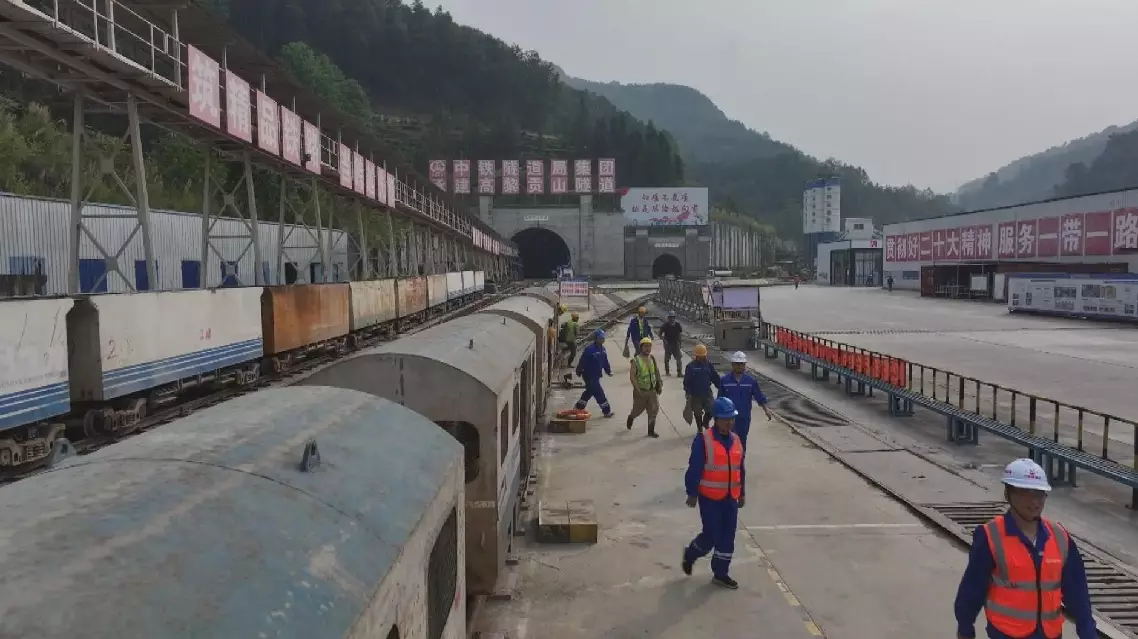
Builders determined to complete "world's most difficult" railway tunnel