China has seen an air sports boom during the May Day holiday, which runs from May 1 to 5, with a surging number of flight camps offering diverse kinds of aerial experiences to air sports fans across the country.
During the five-day holiday, the skies above southwest China's Chongqing Municipality buzzed with planes, parachutes and other kinds of aircraft.
The local government has launched a "low-altitude aviation consumption week" activity, issuing 30 million yuan (about 4.1 million U.S. dollars) worth of vouchers for locals and tourists to improve their experience.
"During the May Day holiday, we have offered 30,000 braised roast ducks to visitors for free and created seven kinds of consumption scenarios such as fixed-wing low-altitude sightseeing tours, simulator experiences, and aerial weddings, thus facilitating low-altitude consumption to be a new hotspot for tourism during the holiday," said Cao Gangjing, director of the Culture and Tourism Development Commission of Liangping District in Chongqing.
To support the sector's growth, Chongqing has streamlined low-altitude airspace project approvals, shortening the time needed to go through all procedures from one month to just one day.
Additionally, a one-billion-yuan industrial fund has been established, with over 50 leading enterprises in collaboration to build flight camps and develop general aviation businesses.
Beyond the air sports boom is a broader trend that sports consumption has become a key engine driving the growth of domestic consumption and national economy.
In the first quarter of the year, online sales of outdoor sports gear surged 50.9 percent year on year, with those of sports pants and jackets skyrocketing by 270 percent and 290 percent, respectively, year on year.
The sales of windbreakers priced above 1,000 yuan are also growing rapidly.
"The growing interest in sports has spawned a diversified demand for specialized gear, supporting services, and smart devices. Sports consumption has become a new way of fashionable lifestyle and health consumption. It's also driving the growth of dining and cultural tourism consumption, injecting strong impetus into the continuous heating up of the consumer market," said Chen Pingfang, an expert with the CCID Consulting's Consumer Goods Industry Research Institute.
China's sports industry now employs over seven million people, with new professions in event management, fitness coaching, and sports rehabilitation gaining traction. Traditional fields like sports products manufacturing, event services, and venue operations are converging at an accelerated speed with new materials, smart equipment, and digital media, forming a complete ecosystem from research and development to production, services and consumption.

China sees air sports boom during May Day holiday
The extended ceasefire between Lebanon and Israel is a welcome respite for many families and businesses, yet for many, the cost of war is still felt every day.
Months after trying to recover from the 2024 war between Israel and Hezbollah, renewed violence has again displaced families, driven up prices and shaken confidence in an already fragile economy.
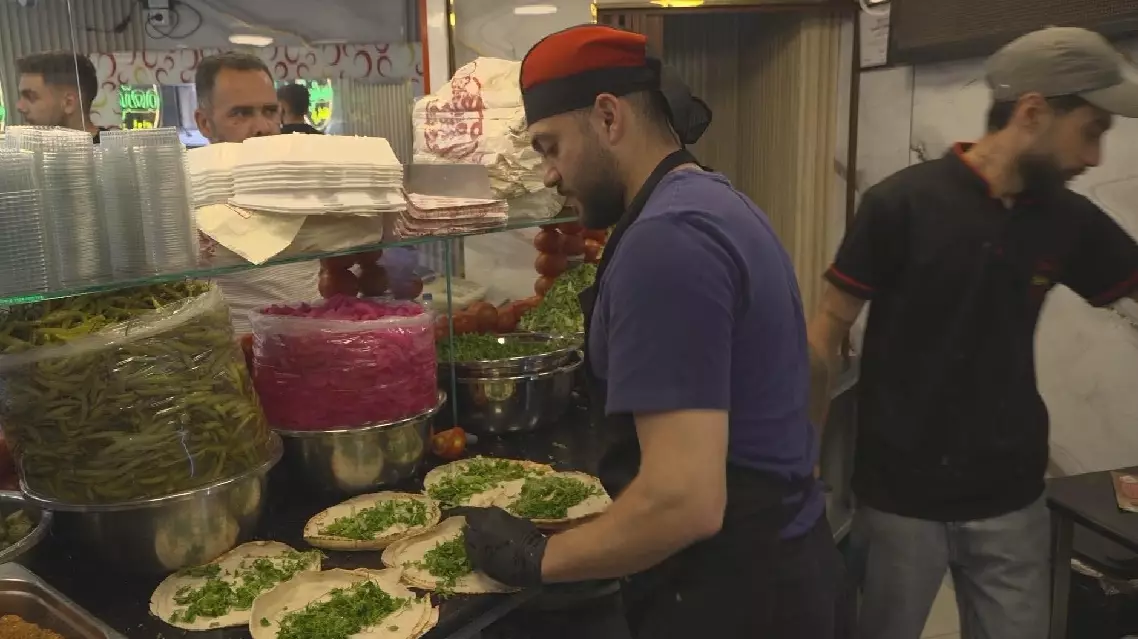
In Beirut's Hamra district, displaced shop owner Mohammad Maatouk is fighting to keep his business running. Even amid the ceasefire, his falafel business has been pushed into survival mode.
"Before the war, things were cheaper than they are now. The situation has become much harder. Everything has gone up: oil, gas, vegetables, pickles, plastic," he said.
For Maatouk, the challenges of being displaced from his home in Dahieh, south of Beirut, are compounded as he strives to keep working in a city where everything costs more.
Deliveries are harder, roads feel less safe, and ingredients are more expensive, but raising prices too much risks losing customers who are also struggling.
"We are still trying to sympathize with people, to feel their pain, because we are a part of the people," said Mohammad.
Hamra, in the heart of Beirut, has become one of the places absorbing people displaced by the renewed fighting — from Dahieh, the south, the Bekaa and other affected areas. That has brought more movement to cafes, shops and streets, but it also means more pressure on rent, food, electricity and basic services in a city that was already stretched.
"When those refugees come, the economic sector boomed, you have the cafe booms and the supermarket worked more. I don't want to say that we have had more influx of cash, but usually there has been more liquidity in the market and there has been more liquidity in the souks and in the supermarkets. Now, unfortunately, these people are not looking for jobs. They're not working," said Maan Barazy, an economic expert.
What appears to be a surge in business activity in Lebanon is not necessarily economic recovery. Much of it reflects survival spending by people displaced once again, even as the country attempts to rebound from the last war.
Renewed fighting, even amid the fragile ceasefire, is now damaging tourism, trade, agriculture and infrastructure -- the very sectors Lebanon needs to rebuild confidence.
Lebanon's Health Ministry said Saturday that the cumulative toll from Israeli attacks between March 2 and April 25 had reached 2,496 killed and 7,725 wounded.
A ceasefire between Israel and Lebanon took effect at midnight between April 16 and 17, following weeks of intensified cross-border fighting linked to the U.S.-Israeli war with Iran.
U.S. President Donald Trump said Thursday that the current 10-day ceasefire would be extended by three weeks.
Pain persists as Lebanon's displaced families struggle to survive