China clinched the 2025 Sudirman Cup title after beating South Korea 3-1 in the final in Xiamen, a coastal city in east China's Fujian Province, on Sunday.
China has won the biennial badminton mixed team world championship 14 times since Indonesia was crowned in the first edition in 1989. South Korea triumphed four times.
In the mixed doubles, the first duel of the best-of-five final, China's Feng Yanzhe and Huang Dongping beat Seo Seung-jae and Chae Yu-jung 21-16 in the first game, but the South Korean pair recovered in the second with a 21-17 win. However, Feng and Huang took the deciding one 21-15.
In the following women's singles, China's Wang Zhiyi lost to World No. 1 An Se-young 17-21, 16-21. China's Shi Yuqi had a comfortable win over Jeon Hyeok-jin 21-5, 21-5 in the men's singles, giving China a 2-1 lead over South Korea.
Shi said he's satisfied with his performance in final after helping China retain the title in front of domestic fans.
"I prepared well and maintained my good form during recent matches and also in this one. I just laid down my burden. So, I think I lived up to the expectations of the fans and myself and aced it," he said. Olympic women's doubles silver medalists Tan Ning and Liu Shengshu sealed the victory for China after defeating world No. 3 Baek Ha-na and Lee So-hee 21-14, 21-17. The rest of the Chinese players and their coaches waste no time rushing onto the court to celebrate a fourth straight title at the mixed team event, before lifting the trophy for a record-extending 14th time overall.

China wins 14th Sudirman Cup title after beating S Korea
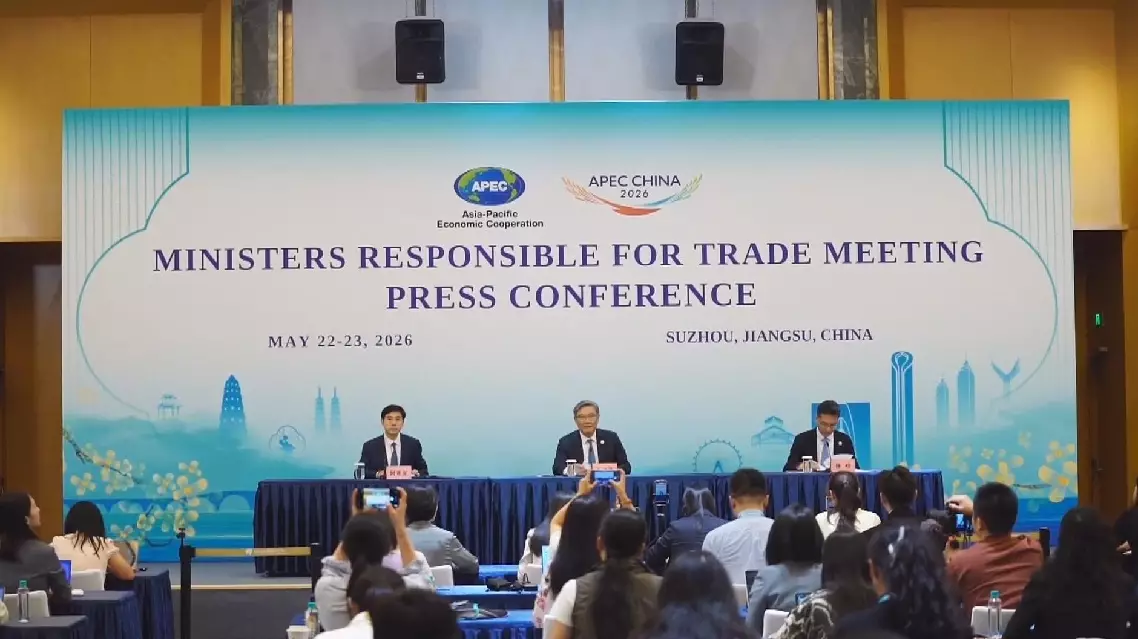
The 32nd Asia-Pacific Economic Cooperation (APEC) Ministers Responsible for Trade Meeting concluded in east China's Suzhou on Saturday, yielding fruitful results and laying significant groundwork for the APEC Economic Leaders' Meeting in November.
The trade ministers' meeting focused on "building an open and predictable regional and multilateral economic and trade order" and "fostering new engines of innovative and dynamic trade and investment cooperation."
Chinese Commerce Minister Wang Wentao briefed the media on the meeting's outcomes at a press conference.
Wang said the meeting issued a joint statement titled the Suzhou Statement, and approved the latest edition of the APEC Roadmap for Innovative, Competitive and Resilient Services.
All parties agreed to advance policy innovation and reform in services trade, build an open and predictable investment environment, improve regional trade facilitation and supply chain resilience, strengthen standards coordination, and enhance intellectual property protection, Wang told the media.
He also said that substantial progress was made on a framework document for regional digital trade cooperation and the ministers emphasized promoting inclusive AI development, strengthening AI-related trade, and bridging the digital divide to ensure shared benefits from digital transformation.
The minister noted that the outcomes of the meeting demonstrated strong cooperation willingness, highlighted an innovation-oriented approach, and reflected inclusiveness and shared benefits. "The fact that Asia-Pacific economies can come together, uphold the original aspiration of promoting trade and investment liberalization and facilitation while supporting economic growth and prosperity, and engage in in-depth discussions on the important issue of 'where multilateral and regional economic and trade cooperation is headed,' fully demonstrates that open regionalism and true multilateralism enjoy broad support, and that mutual success and shared development serve the fundamental interests of all economies," Wang said.
2026 APEC trade ministers' meeting concludes with fruitful results