IRVINE, Calif. & AMSTERDAM--(BUSINESS WIRE)--May 6, 2025--
Agendia®, Inc., today announced that new data from its ongoing FLEX Study will be presented at the upcoming ESMO BreastCancer 2025 congress taking place May 14-17 in both Munich, Germany and virtually.
This press release features multimedia. View the full release here: https://www.businesswire.com/news/home/20250505212759/en/
The FLEX Study ( NCT03053193 ) is a prospective real-world evidence, observational breast cancer study designed to correlate whole transcriptome gene expression in early-stage breast cancer with clinical outcomes, and to evaluate how genomic insights can inform treatment decisions in early-stage breast cancer. In this analysis, researchers examined the impact of BluePrint, Agendia’s 80-gene molecular subtyping assay, on pathological complete response (pCR) rates and chemotherapy (CT) decision-making in patients with hormone receptor-positive (HR+), HER2-negative tumors classified as High Risk by MammaPrint. BluePrint further stratified these tumors into Basal or Luminal B subtypes, offering a more nuanced view of tumor biology and potential treatment response.
The poster presentation, titled “ The Impact of the 80-gene signature on pCR and chemotherapy treatment decisions in Early-Stage Breast Cancer: A FLEX Analysis [70P],” (A.M. Brufsky, et al.), highlights findings from the analysis of two cohorts from the FLEX Study: one consisting of patients who underwent genomic analysis on pre-operative core needle biopsy, and received neoadjuvant chemotherapy with available pCR data and another cohort with documented physician chemotherapy recommendations. The analysis found that patients with MammaPrint High Risk, HR+ HER2- Basal-type tumors were more likely to achieve a pCR following neoadjuvant chemotherapy compared to those with Luminal B tumors. The analysis also showed that these Basal-type tumors were more frequently recommended for chemotherapy overall, more often treated with neoadjuvant chemotherapy specifically, and received more intensive regimens compared to Luminal B tumors. These results suggest that BluePrint provides actionable molecular insights that physicians are using to inform real-world treatment decisions, even among patients already eligible for chemotherapy based on MammaPrint High Risk status.
“These results reinforce the value of BluePrint in helping physicians personalize treatment plans for early-stage breast cancer,” said Adam Brufsky, MD, PhD, Professor and Associate Chief of Hematology and Oncology at UPMC Hillman Cancer Center. “By identifying Basal-type tumors that are more likely to respond to chemotherapy, BluePrint can guide decisions about treatment intensity and timing that align with each patient’s individual tumor biology.”
Poster Presentation Details:
About Agendia
Agendia is a leading provider of innovative solutions in the field of precision oncology. With a focus on early-stage breast cancer, Agendia offers reliable biological insights that inform personalized treatment decisions for patients and their care teams. Their advanced genomic assays, MammaPrint ® + BluePrint ®, enable clinicians to quickly identify the most effective treatment plan, minimizing the risk of both under- and over-treatment.
Agendia was founded in 2003 and is headquartered in Amsterdam with its state-of-the-art laboratory facility located in Irvine, CA. Led by world-renowned scientists and oncologists, Agendia is committed to advancing genomic insights through ongoing research. This includes the notable FLEX Study – the world’s largest whole transcriptome Real-World Evidence-based Breast Cancer database which aims to revolutionize precision in breast cancer management. With cutting-edge technology, research and innovation, Agendia strives to shape the future of precision oncology and make a significant impact in the fight against breast cancer.
About BluePrint
BluePrint® is a gene expression profiling test that reveals the driving forces behind a tumor’s growth at the earliest stage possible in a woman’s breast cancer care journey to help optimize and personalize treatment planning. As the only molecular subtyping test available in the U.S., BluePrint® goes where pathology cannot, offers critical insights that providers may otherwise have not known to act on, and gives women the best chance to return to a life not defined by cancer. BluePrint® measures the activity of 80 key genes that are involved in a tumor’s growth to classify a tumor as Luminal-type, HER2-type, or Basal-type, each of which warrant distinct treatment pathways. By revealing the distinct underlying biology of a woman’s tumor, BluePrint® can catch often misclassified, yet highly aggressive, Basal tumors, so women can be prescribed the most appropriate treatment from the start.

Agendia to Present FLEX Study Data on Impact of BluePrint® at ESMO Breast Cancer 2025
WASHINGTON (AP) — Becky Pepper-Jackson finished third in the discus throw in West Virginia last year though she was in just her first year of high school. Now a 15-year-old sophomore, Pepper-Jackson is aware that her upcoming season could be her last.
West Virginia has banned transgender girls like Pepper-Jackson from competing in girls and women's sports, and is among the more than two dozen states with similar laws. Though the West Virginia law has been blocked by lower courts, the outcome could be different at the conservative-dominated Supreme Court, which has allowed multiple restrictions on transgender people to be enforced in the past year.
The justices are hearing arguments Tuesday in two cases over whether the sports bans violate the Constitution or the landmark federal law known as Title IX that prohibits sex discrimination in education. The second case comes from Idaho, where college student Lindsay Hecox challenged that state's law.
Decisions are expected by early summer.
President Donald Trump's Republican administration has targeted transgender Americans from the first day of his second term, including ousting transgender people from the military and declaring that gender is immutable and determined at birth.
Pepper-Jackson has become the face of the nationwide battle over the participation of transgender girls in athletics that has played out at both the state and federal levels as Republicans have leveraged the issue as a fight for athletic fairness for women and girls.
“I think it’s something that needs to be done,” Pepper-Jackson said in an interview with The Associated Press that was conducted over Zoom. “It’s something I’m here to do because ... this is important to me. I know it’s important to other people. So, like, I’m here for it.”
She sat alongside her mother, Heather Jackson, on a sofa in their home just outside Bridgeport, a rural West Virginia community about 40 miles southwest of Morgantown, to talk about a legal fight that began when she was a middle schooler who finished near the back of the pack in cross-country races.
Pepper-Jackson has grown into a competitive discus and shot put thrower. In addition to the bronze medal in the discus, she finished eighth among shot putters.
She attributes her success to hard work, practicing at school and in her backyard, and lifting weights. Pepper-Jackson has been taking puberty-blocking medication and has publicly identified as a girl since she was in the third grade, though the Supreme Court's decision in June upholding state bans on gender-affirming medical treatment for minors has forced her to go out of state for care.
Her very improvement as an athlete has been cited as a reason she should not be allowed to compete against girls.
“There are immutable physical and biological characteristic differences between men and women that make men bigger, stronger, and faster than women. And if we allow biological males to play sports against biological females, those differences will erode the ability and the places for women in these sports which we have fought so hard for over the last 50 years,” West Virginia's attorney general, JB McCuskey, said in an AP interview. McCuskey said he is not aware of any other transgender athlete in the state who has competed or is trying to compete in girls or women’s sports.
Despite the small numbers of transgender athletes, the issue has taken on outsize importance. The NCAA and the U.S. Olympic and Paralympic Committees banned transgender women from women's sports after Trump signed an executive order aimed at barring their participation.
The public generally is supportive of the limits. An Associated Press-NORC Center for Public Affairs Research poll conducted in October 2025 found that about 6 in 10 U.S. adults “strongly” or “somewhat” favored requiring transgender children and teenagers to only compete on sports teams that match the sex they were assigned at birth, not the gender they identify with, while about 2 in 10 were “strongly” or “somewhat” opposed and about one-quarter did not have an opinion.
About 2.1 million adults, or 0.8%, and 724,000 people age 13 to 17, or 3.3%, identify as transgender in the U.S., according to the Williams Institute at the UCLA School of Law.
Those allied with the administration on the issue paint it in broader terms than just sports, pointing to state laws, Trump administration policies and court rulings against transgender people.
"I think there are cultural, political, legal headwinds all supporting this notion that it’s just a lie that a man can be a woman," said John Bursch, a lawyer with the conservative Christian law firm Alliance Defending Freedom that has led the legal campaign against transgender people. “And if we want a society that respects women and girls, then we need to come to terms with that truth. And the sooner that we do that, the better it will be for women everywhere, whether that be in high school sports teams, high school locker rooms and showers, abused women’s shelters, women’s prisons.”
But Heather Jackson offered different terms to describe the effort to keep her daughter off West Virginia's playing fields.
“Hatred. It’s nothing but hatred,” she said. "This community is the community du jour. We have a long history of isolating marginalized parts of the community.”
Pepper-Jackson has seen some of the uglier side of the debate on display, including when a competitor wore a T-shirt at the championship meet that said, “Men Don't Belong in Women's Sports.”
“I wish these people would educate themselves. Just so they would know that I’m just there to have a good time. That’s it. But it just, it hurts sometimes, like, it gets to me sometimes, but I try to brush it off,” she said.
One schoolmate, identified as A.C. in court papers, said Pepper-Jackson has herself used graphic language in sexually bullying her teammates.
Asked whether she said any of what is alleged, Pepper-Jackson said, “I did not. And the school ruled that there was no evidence to prove that it was true.”
The legal fight will turn on whether the Constitution's equal protection clause or the Title IX anti-discrimination law protects transgender people.
The court ruled in 2020 that workplace discrimination against transgender people is sex discrimination, but refused to extend the logic of that decision to the case over health care for transgender minors.
The court has been deluged by dueling legal briefs from Republican- and Democratic-led states, members of Congress, athletes, doctors, scientists and scholars.
The outcome also could influence separate legal efforts seeking to bar transgender athletes in states that have continued to allow them to compete.
If Pepper-Jackson is forced to stop competing, she said she will still be able to lift weights and continue playing trumpet in the school concert and jazz bands.
“It will hurt a lot, and I know it will, but that’s what I’ll have to do,” she said.
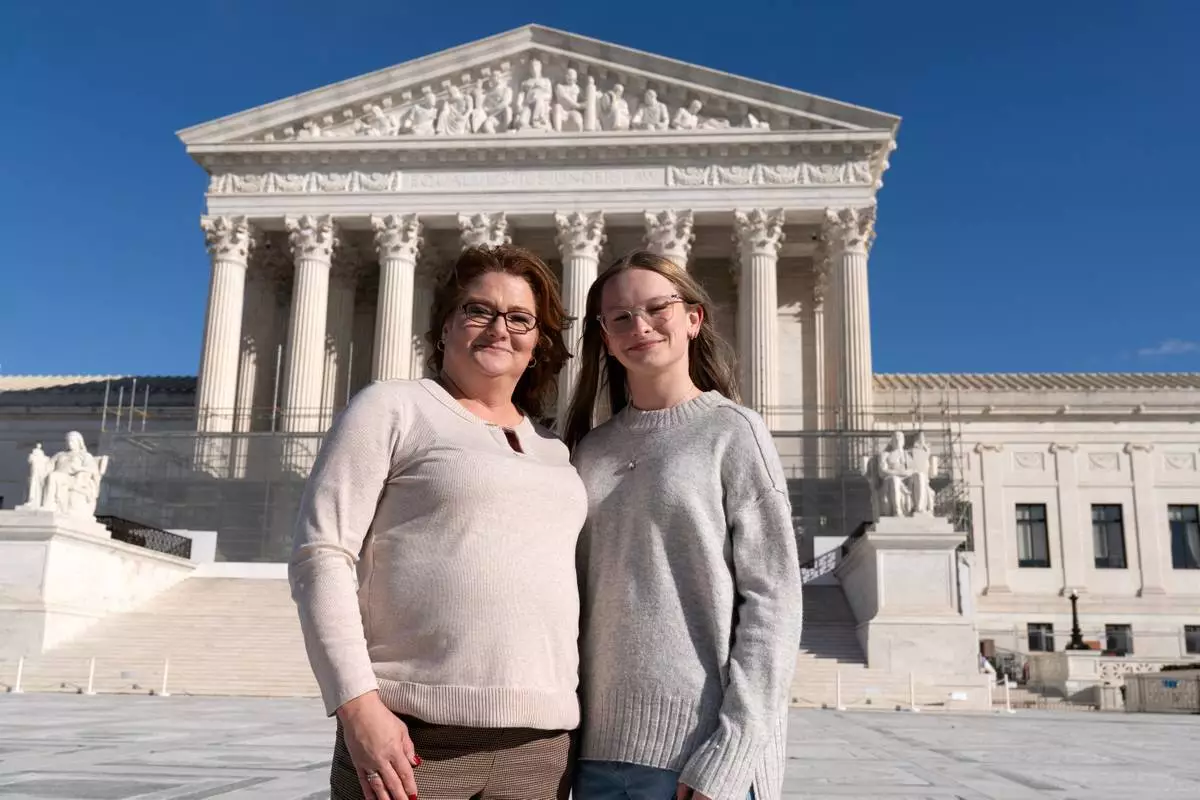
Heather Jackson, left, and Becky Pepper-Jackson pose for a photograph outside of the U.S. Supreme Court in Washington, Sunday, Jan. 11, 2026. (AP Photo/Jose Luis Magana)
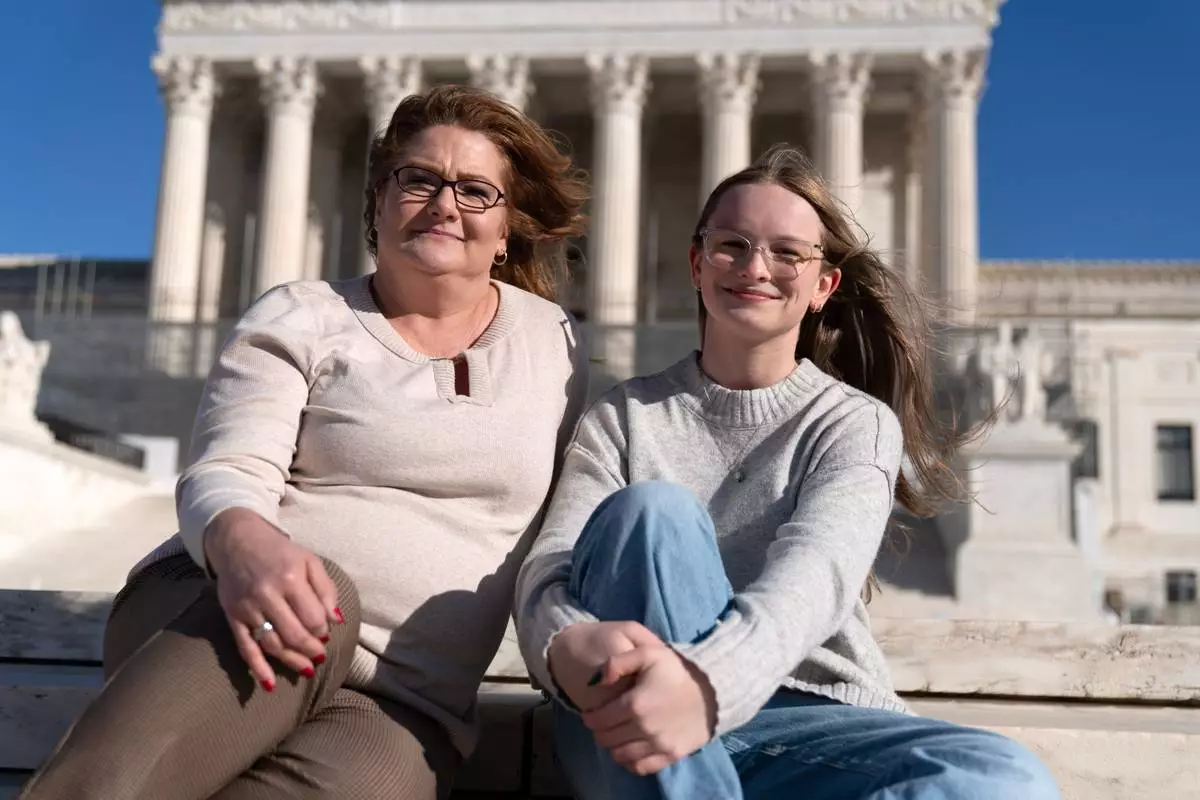
Heather Jackson, left, and Becky Pepper-Jackson pose for a photograph outside of the U.S. Supreme Court in Washington, Sunday, Jan. 11, 2026. (AP Photo/Jose Luis Magana)

Becky Pepper-Jackson poses for a photograph outside of the U.S. Supreme Court in Washington, Sunday, Jan. 11, 2026. (AP Photo/Jose Luis Magana)
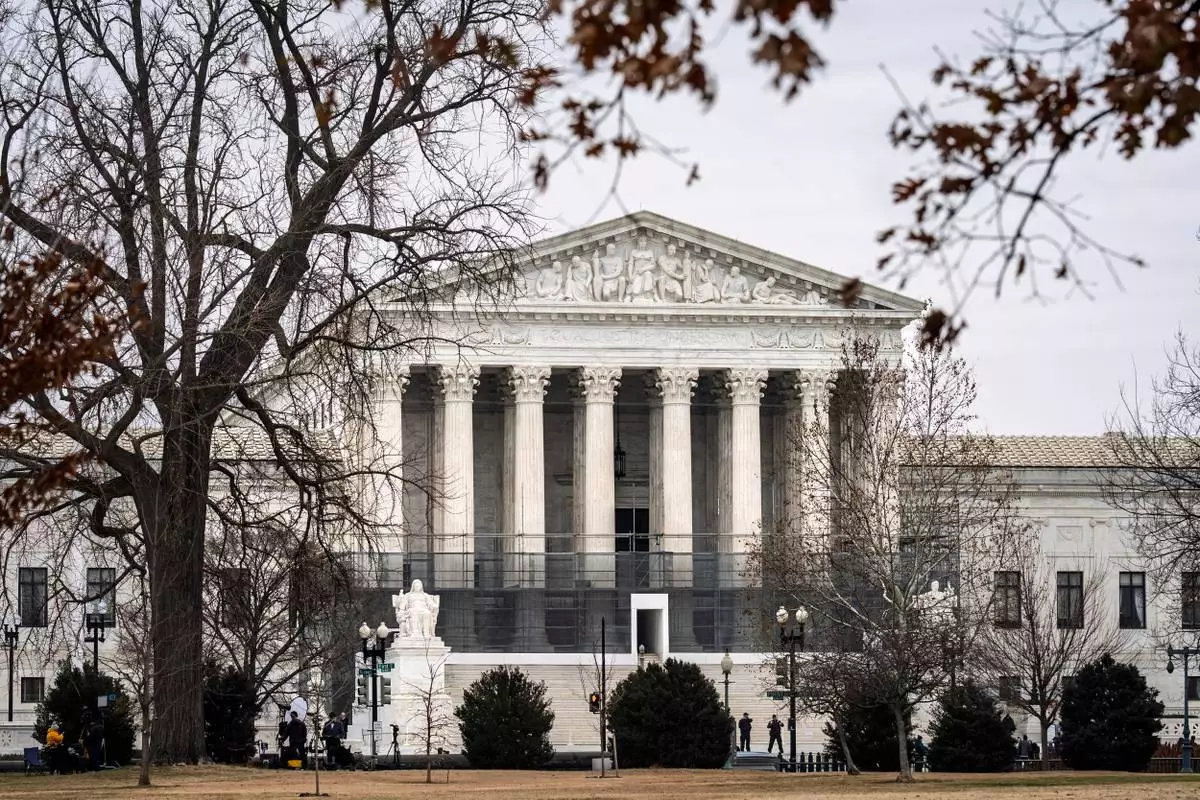
The Supreme Court stands is Washington, Friday, Jan. 9, 2026. (AP Photo/J. Scott Applewhite)
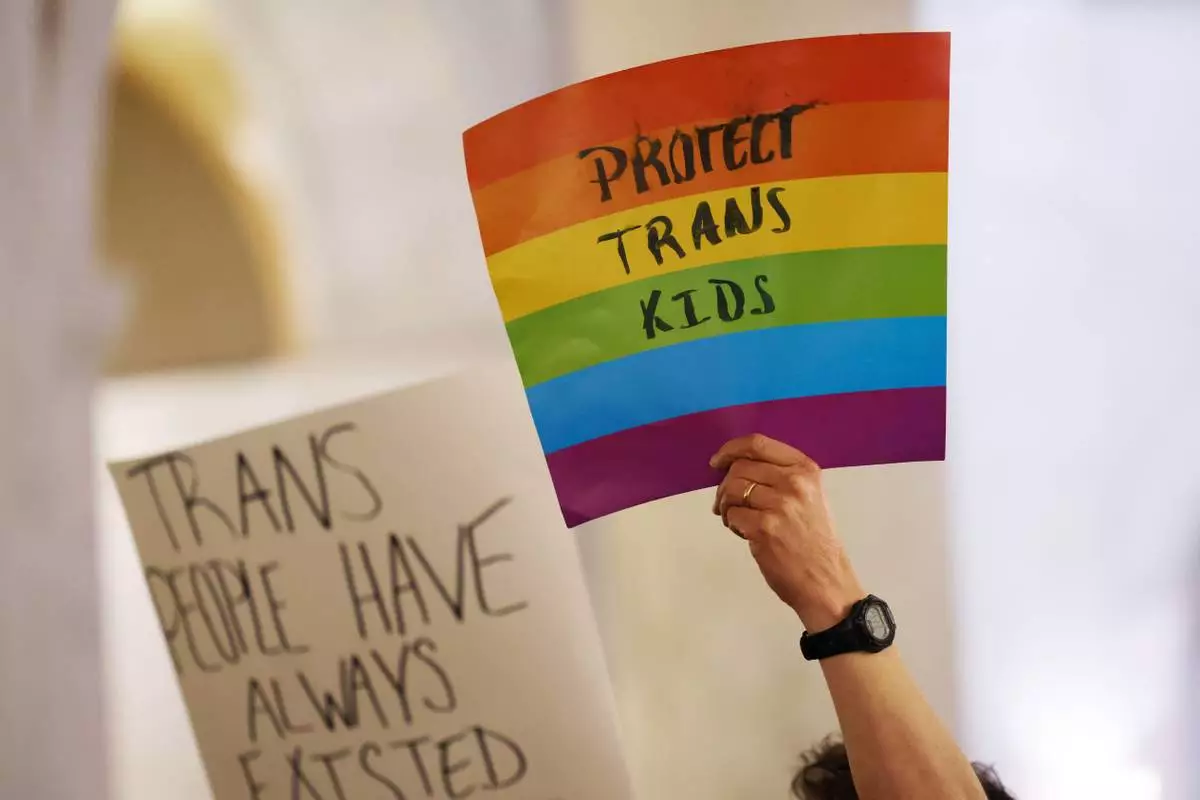
FILE - Protestors hold signs during a rally at the state capitol in Charleston, W.Va., on March 9, 2023. (AP Photo/Chris Jackson, file)