Skip to Content Facebook Feature Image

AP WAS THERE: Journalists chronicled the Nazi surrenders and end of World War II in Europe

News

AP WAS THERE: Journalists chronicled the Nazi surrenders and end of World War II in Europe
News

News

AP WAS THERE: Journalists chronicled the Nazi surrenders and end of World War II in Europe

2025-05-07 17:57 Last Updated At:19:20

REIMS, France (AP) — When Allied forces brought World War II in Europe and the Holocaust to an end 80 years ago this week, AP reporters and photographers were there, chronicling the Nazis’ historic defeat.

Here are excerpts of AP news reports that momentous week:

More Images
FILE - A vast crowd assembled in front of Buckingham Palace, London, on V-E Day, May 8, 1945, cheers the Royal Family as they come out on the balcony, centre, minutes after the official announcement of Germany's unconditional surrender. From left are: Princess Elizabeth; Queen Elizabeth; King George VI; and Princess Margaret. (AP Photo/Leslie Priest, File)
FILE - A vast crowd assembled in front of Buckingham Palace, London, on V-E Day, May 8, 1945, cheers the Royal Family as they come out on the balcony, centre, minutes after the official announcement of Germany's unconditional surrender. From left are: Princess Elizabeth; Queen Elizabeth; King George VI; and Princess Margaret. (AP Photo/Leslie Priest, File)

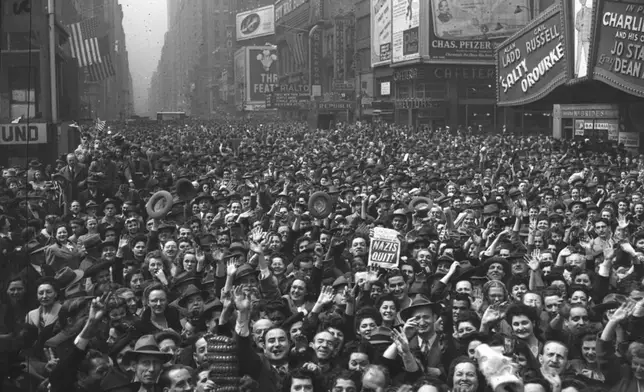
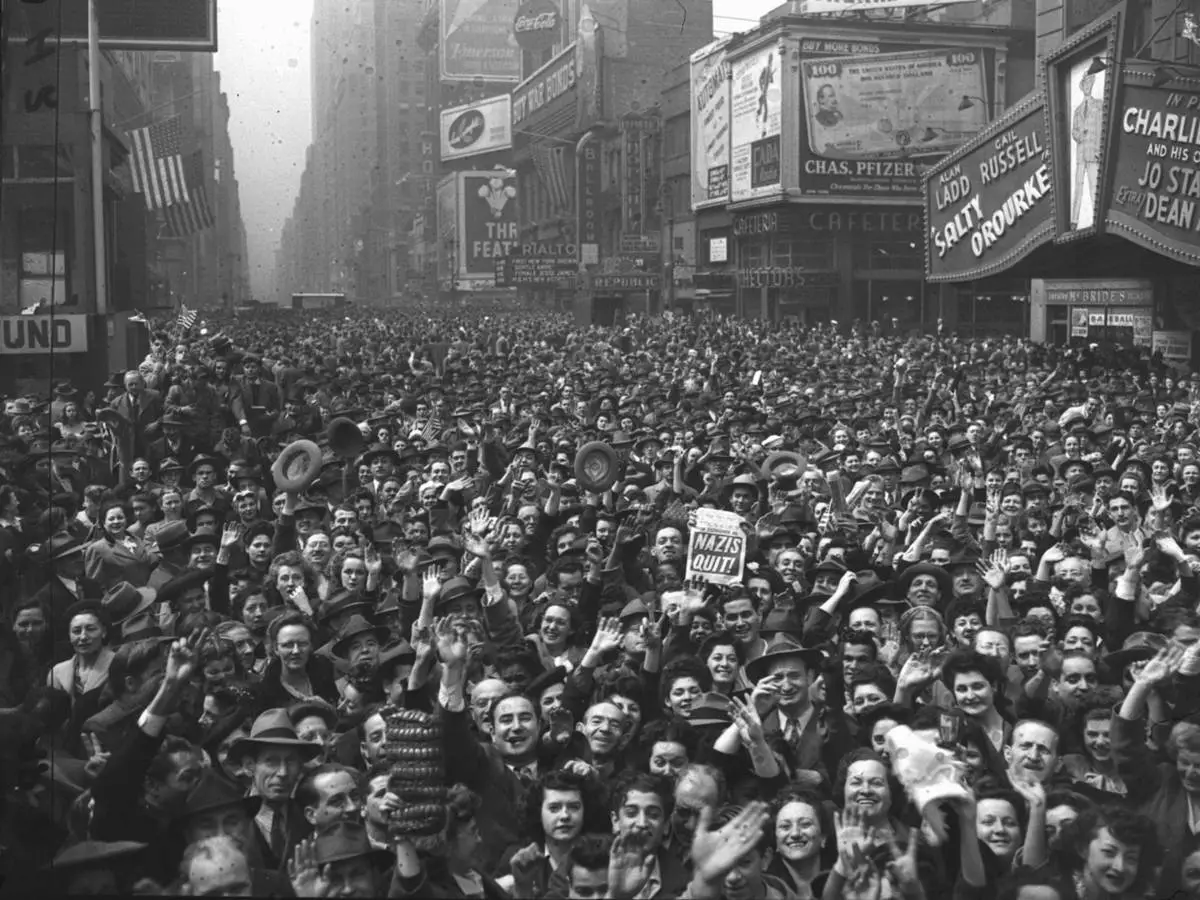
FILE - This general view of Times Square, New York at 11 a.m. on May 7, 1945, shows New Yorkers jamming the streets to cheer the news of the unconditional surrender of Germany. (AP Photo/Harry Harris, File)
FILE - This general view of Times Square, New York at 11 a.m. on May 7, 1945, shows New Yorkers jamming the streets to cheer the news of the unconditional surrender of Germany. (AP Photo/Harry Harris, File)

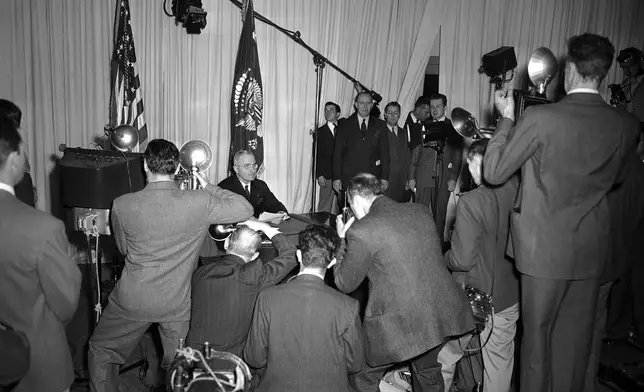
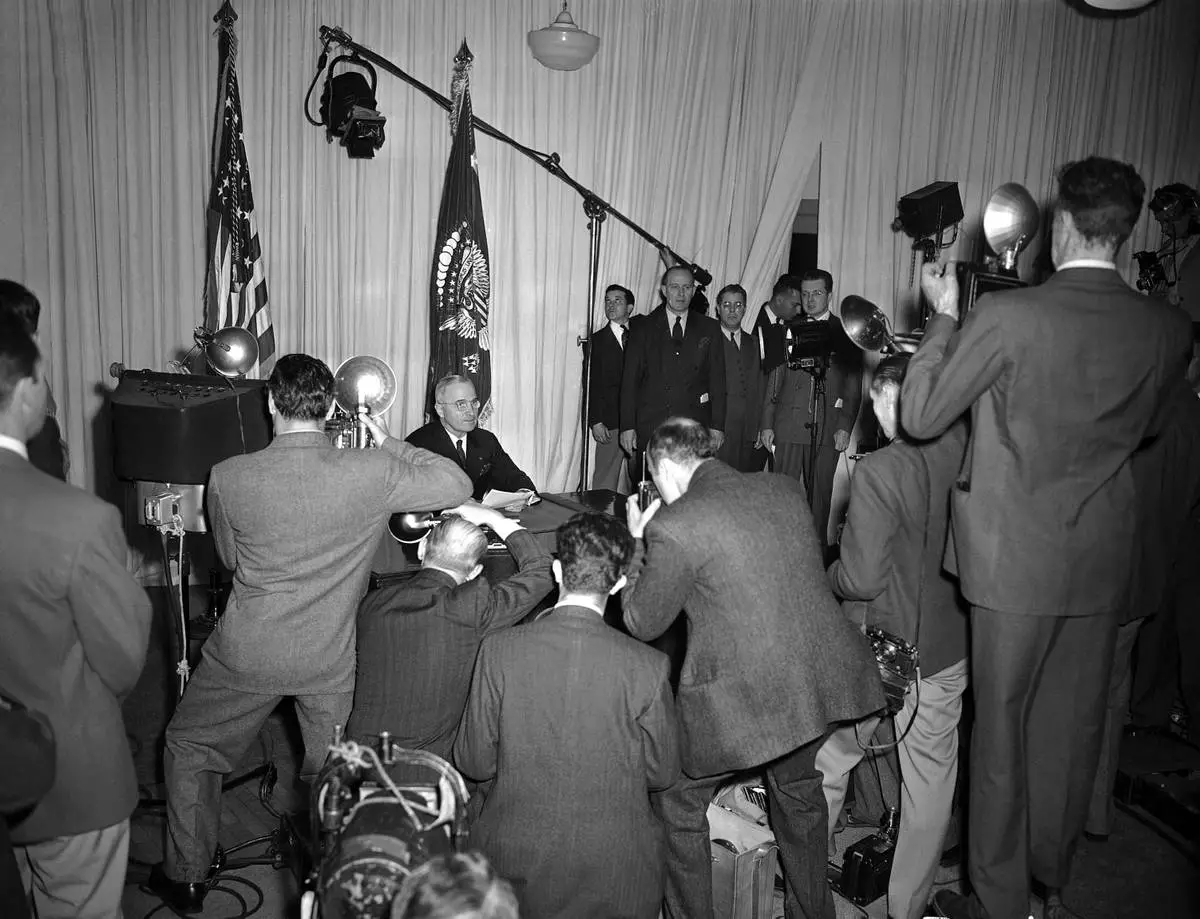
FILE - President Harry S. Truman sits at the close of his radio announcement from the White House in Washington, May 8, 1945 as cameramen record the historic occasion of the announcement of complete victory over the Germans. (AP Photo/Herbert K. White, File)
FILE - President Harry S. Truman sits at the close of his radio announcement from the White House in Washington, May 8, 1945 as cameramen record the historic occasion of the announcement of complete victory over the Germans. (AP Photo/Herbert K. White, File)

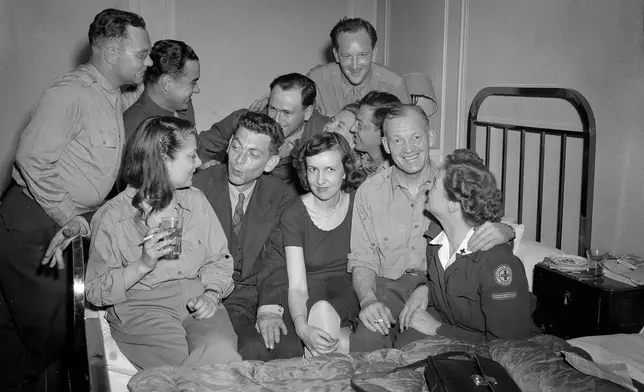
FILE - Some of the AP Paris staff join Paris Bureau Chief Ed Kennedy, seated center left, for a farewell get-together in the early hours of May 18, 1945, just before he embarked for the United States at the request of AP General Manager Kent Cooper. (AP Photo/Pete Carroll, File)

FILE - Some of the AP Paris staff join Paris Bureau Chief Ed Kennedy, seated center left, for a farewell get-together in the early hours of May 18, 1945, just before he embarked for the United States at the request of AP General Manager Kent Cooper. (AP Photo/Pete Carroll, File)

EDITORS' NOTE: On May 7, 1945, AP's Edward Kennedy witnessed the German surrender in a French schoolhouse, and was the first to announce it to the Allied public, defying authorities who wanted to delay the news.

The news was broadcast unofficially over German radio, but U.S. President Harry Truman and British Prime Minister Winston Churchill had agreed to suppress news of the capitulation for a day, in order to allow Soviet leader Josef Stalin to stage a second surrender ceremony in Berlin.

Kennedy published anyway, angering U.S. authorities. Kennedy was called home by AP and later fired. AP issued a public apology in 2012, saying Kennedy “did everything just right,” because the embargo was for political reasons, not to protect the troops. “The world needed to know,” AP’s then-President and CEO Tom Curley said. Kennedy ”stood up to power.”

REIMS, France, May 7 (Delayed)

FLASH: ALLIES OFFICIALLY ANNOUNCED GERMANS SURRENDERED UNCONDITIONALLY

Through an iron-faced Prussian general, speaking after he had finished signing the unconditional surrender of the Nazis, Germany today pleaded for mercy for the German people. On the wall behind his back was a huge chart tabulating Allied casualties.

He was Col-Gen. (Alfred) Jodl, chief of staff of the German Army.

He was standing in a room of a red school house in Reims, where Gen. Eisenhower had his advanced headquarters. On a big wooden table in front of him lay four identical documents to which he had just affixed his signature — one each for the United States, Britain, France and Russia. ...

Seventeen correspondents were present at the signing and heard Jodl’s plea. After he had signed the four instruments of surrender, and after the military representatives of the four Powers had signed them, Jodl asked for permission to speak. He was told that he might.

He held himself stiffly erect. His voice was low and soft. He said: “With this signature, the German people and armed forces are, for better or worse, delivered in the victors’ hands. In this war which has lasted more than five years, both have achieved and suffered more than perhaps any other people in the world. I express the hope that the victor will treat generously with them.’’

His face was expressionless. So were the faces of the American, British, Russian and French generals who represented the Allies. All had seen the German murder camps and all knew the furious cruelty of German occupying forces.

Jodl finished speaking and sat down. A moment passed in dead silence.

Then the German representatives were taken down the hall to meet Gen. Eisenhower. ....

Again, there was a moment of heavy silence.

Then Eisenhower spoke. He was brief and terse as always. His voice was cold and stern. His steel blue eyes were hard. In a few clipped sentences, he made it plain that Germany was a defeated nation and that henceforth all orders to the German people would come from the Allies. He said they would be obeyed.

Then the Germans filed out. It was over.

Nazi Germany has ceased to exist.

The war had ended.

The great bells of St. Peter’s Basilica rang out over Rome soon after the Associated Press report that peace had come to Europe, while several Allied capitals proclaimed V-E holidays for today, and Tokyo announced continuation of “The Sacred War.”

Many of the world’s cities went wild at the news, and even neutral capitals were bedecked and filled with celebrating crowds. Masses of people gathered in front of loudspeakers and newspaper offices, which were frantically answering inquiries and rolling out extras.

Only in the unnatural calm of the European fronts was the news reported to have been taken soberly, by soldiers who had seen the fighting taper off in one sector after another for the past two weeks.

War-scarred London burst into jubilant celebration of the end of the war in Europe today, its millions of citizens unable to wait for the government’s official V-E Day proclamation tomorrow.

Millions surged into the streets, from Buckingham Palace to the sedate East End.

The Picadilly Circus, Whitehall and Westminster areas filled with a laughing, shouting throng. Some old-timers said the scene eclipsed those of the 1918 armistice.

Pubs were jammed, Champagne was brought up from deep cellars and long-hoarded whisky and gin came out from hiding.

The great bells of Big Ben tolled the hours of the historic day.

In Washington, crowds gathered in Lafayette Square across Pennsylvania Avenue from the White House in anticipation of an announcement by President Truman to proclaim Allied V-E Day.

A dispatch from the United States 9th Army front said withdrawal of American troops toward a previously established line of demarcation between them and the Russians had begun, with the first-move evacuation of the Yanks from their bridgehead of the banks of the Elbe River. The Elbe became the temporary line between the Allied armies.

BERLIN, May 10, 1945:

By HAROLD KING, former Moscow bureau chief

This town is a city of the dead. As a metropolis, it has simply ceased to exist. Every house within miles of the center seems to have had its own bomb. …

The scene beggars description. I have seen Stalingrad; I have lived through the entire London blitz. I have seen a dozen badly damaged Russian towns, but the scene of utter destruction, desolation and death which meets the eye in Berlin as far as the eye can rove in all directions is something that almost baffles description.

Dozens of well-known thoroughfares, including the entire Unter den Linden from one end to the other, are wrecked beyond repair. The town is literally unrecognizable. The Alexander Platz, in the east end, where the Gestapo headquarters were, is a weird desert of rubble and gaping, smoke blackened walls. From the Brandenberg Gate, everything within a radius of two to five miles is destroyed. There does not appear to be one house in hundred which is even useful as a shelter. ...

The only people who look like human beings in the streets of what was Berlin are the Russian soldiers. There are two million inhabitants in this town, the Russian authorities told me, but they are mostly in the remoter suburbs. In the center part of the town, you only see a few ghostlike figures of women and children — few men — queuing up to pump water.

If Stalingrad, London, Guernica, Rotterdam, Coventry wanted avenging, they have had it, and no mistake about it.

The Red flag, or rather several red flags, fly on top of the Reichstag which is burned hollow. The Tiergarten opposite the Reichstag looks like a forest after a big fire. There was heavy street fighting here. ...

The population and the Red Army soldiers are attempting to clear some of the main streets.

The Russian command has already erected at all main squares and crossings huge sketch maps without which it would be impossible to find one’s way about.

Except for an occasional Russian army car or horses drawing Russian army carts, there is a complete silence over the city, and the air filled with rubble dust.

One sign of life, however, are the interminable columns of displaced persons of all European nationalities who seem to be marching through Berlin in various directions, carried forward by a homing instinct more than any clear idea where they are going. These columns of freed slaves are sometimes a mile long.

Follow AP’s coverage marking the 80th anniversary of the end of World War II at https://apnews.com/WorldWarII

FILE - A vast crowd assembled in front of Buckingham Palace, London, on V-E Day, May 8, 1945, cheers the Royal Family as they come out on the balcony, centre, minutes after the official announcement of Germany's unconditional surrender. From left are: Princess Elizabeth; Queen Elizabeth; King George VI; and Princess Margaret. (AP Photo/Leslie Priest, File)
FILE - A vast crowd assembled in front of Buckingham Palace, London, on V-E Day, May 8, 1945, cheers the Royal Family as they come out on the balcony, centre, minutes after the official announcement of Germany's unconditional surrender. From left are: Princess Elizabeth; Queen Elizabeth; King George VI; and Princess Margaret. (AP Photo/Leslie Priest, File)

FILE - This general view of Times Square, New York at 11 a.m. on May 7, 1945, shows New Yorkers jamming the streets to cheer the news of the unconditional surrender of Germany. (AP Photo/Harry Harris, File)
FILE - This general view of Times Square, New York at 11 a.m. on May 7, 1945, shows New Yorkers jamming the streets to cheer the news of the unconditional surrender of Germany. (AP Photo/Harry Harris, File)

FILE - President Harry S. Truman sits at the close of his radio announcement from the White House in Washington, May 8, 1945 as cameramen record the historic occasion of the announcement of complete victory over the Germans. (AP Photo/Herbert K. White, File)

FILE - President Harry S. Truman sits at the close of his radio announcement from the White House in Washington, May 8, 1945 as cameramen record the historic occasion of the announcement of complete victory over the Germans. (AP Photo/Herbert K. White, File)

FILE - Some of the AP Paris staff join Paris Bureau Chief Ed Kennedy, seated center left, for a farewell get-together in the early hours of May 18, 1945, just before he embarked for the United States at the request of AP General Manager Kent Cooper. (AP Photo/Pete Carroll, File)

FILE - Some of the AP Paris staff join Paris Bureau Chief Ed Kennedy, seated center left, for a farewell get-together in the early hours of May 18, 1945, just before he embarked for the United States at the request of AP General Manager Kent Cooper. (AP Photo/Pete Carroll, File)

WASHINGTON (AP) — Becky Pepper-Jackson finished third in the discus throw in West Virginia last year though she was in just her first year of high school. Now a 15-year-old sophomore, Pepper-Jackson is aware that her upcoming season could be her last.

West Virginia has banned transgender girls like Pepper-Jackson from competing in girls and women's sports, and is among the more than two dozen states with similar laws. Though the West Virginia law has been blocked by lower courts, the outcome could be different at the conservative-dominated Supreme Court, which has allowed multiple restrictions on transgender people to be enforced in the past year.

The justices are hearing arguments Tuesday in two cases over whether the sports bans violate the Constitution or the landmark federal law known as Title IX that prohibits sex discrimination in education. The second case comes from Idaho, where college student Lindsay Hecox challenged that state's law.

Decisions are expected by early summer.

President Donald Trump's Republican administration has targeted transgender Americans from the first day of his second term, including ousting transgender people from the military and declaring that gender is immutable and determined at birth.

Pepper-Jackson has become the face of the nationwide battle over the participation of transgender girls in athletics that has played out at both the state and federal levels as Republicans have leveraged the issue as a fight for athletic fairness for women and girls.

“I think it’s something that needs to be done,” Pepper-Jackson said in an interview with The Associated Press that was conducted over Zoom. “It’s something I’m here to do because ... this is important to me. I know it’s important to other people. So, like, I’m here for it.”

She sat alongside her mother, Heather Jackson, on a sofa in their home just outside Bridgeport, a rural West Virginia community about 40 miles southwest of Morgantown, to talk about a legal fight that began when she was a middle schooler who finished near the back of the pack in cross-country races.

Pepper-Jackson has grown into a competitive discus and shot put thrower. In addition to the bronze medal in the discus, she finished eighth among shot putters.

She attributes her success to hard work, practicing at school and in her backyard, and lifting weights. Pepper-Jackson has been taking puberty-blocking medication and has publicly identified as a girl since she was in the third grade, though the Supreme Court's decision in June upholding state bans on gender-affirming medical treatment for minors has forced her to go out of state for care.

Her very improvement as an athlete has been cited as a reason she should not be allowed to compete against girls.

“There are immutable physical and biological characteristic differences between men and women that make men bigger, stronger, and faster than women. And if we allow biological males to play sports against biological females, those differences will erode the ability and the places for women in these sports which we have fought so hard for over the last 50 years,” West Virginia's attorney general, JB McCuskey, said in an AP interview. McCuskey said he is not aware of any other transgender athlete in the state who has competed or is trying to compete in girls or women’s sports.

Despite the small numbers of transgender athletes, the issue has taken on outsize importance. The NCAA and the U.S. Olympic and Paralympic Committees banned transgender women from women's sports after Trump signed an executive order aimed at barring their participation.

The public generally is supportive of the limits. An Associated Press-NORC Center for Public Affairs Research poll conducted in October 2025 found that about 6 in 10 U.S. adults “strongly” or “somewhat” favored requiring transgender children and teenagers to only compete on sports teams that match the sex they were assigned at birth, not the gender they identify with, while about 2 in 10 were “strongly” or “somewhat” opposed and about one-quarter did not have an opinion.

About 2.1 million adults, or 0.8%, and 724,000 people age 13 to 17, or 3.3%, identify as transgender in the U.S., according to the Williams Institute at the UCLA School of Law.

Those allied with the administration on the issue paint it in broader terms than just sports, pointing to state laws, Trump administration policies and court rulings against transgender people.

"I think there are cultural, political, legal headwinds all supporting this notion that it’s just a lie that a man can be a woman," said John Bursch, a lawyer with the conservative Christian law firm Alliance Defending Freedom that has led the legal campaign against transgender people. “And if we want a society that respects women and girls, then we need to come to terms with that truth. And the sooner that we do that, the better it will be for women everywhere, whether that be in high school sports teams, high school locker rooms and showers, abused women’s shelters, women’s prisons.”

But Heather Jackson offered different terms to describe the effort to keep her daughter off West Virginia's playing fields.

“Hatred. It’s nothing but hatred,” she said. "This community is the community du jour. We have a long history of isolating marginalized parts of the community.”

Pepper-Jackson has seen some of the uglier side of the debate on display, including when a competitor wore a T-shirt at the championship meet that said, “Men Don't Belong in Women's Sports.”

“I wish these people would educate themselves. Just so they would know that I’m just there to have a good time. That’s it. But it just, it hurts sometimes, like, it gets to me sometimes, but I try to brush it off,” she said.

One schoolmate, identified as A.C. in court papers, said Pepper-Jackson has herself used graphic language in sexually bullying her teammates.

Asked whether she said any of what is alleged, Pepper-Jackson said, “I did not. And the school ruled that there was no evidence to prove that it was true.”

The legal fight will turn on whether the Constitution's equal protection clause or the Title IX anti-discrimination law protects transgender people.

The court ruled in 2020 that workplace discrimination against transgender people is sex discrimination, but refused to extend the logic of that decision to the case over health care for transgender minors.

The court has been deluged by dueling legal briefs from Republican- and Democratic-led states, members of Congress, athletes, doctors, scientists and scholars.

The outcome also could influence separate legal efforts seeking to bar transgender athletes in states that have continued to allow them to compete.

If Pepper-Jackson is forced to stop competing, she said she will still be able to lift weights and continue playing trumpet in the school concert and jazz bands.

“It will hurt a lot, and I know it will, but that’s what I’ll have to do,” she said.

Heather Jackson, left, and Becky Pepper-Jackson pose for a photograph outside of the U.S. Supreme Court in Washington, Sunday, Jan. 11, 2026. (AP Photo/Jose Luis Magana)

Heather Jackson, left, and Becky Pepper-Jackson pose for a photograph outside of the U.S. Supreme Court in Washington, Sunday, Jan. 11, 2026. (AP Photo/Jose Luis Magana)

Heather Jackson, left, and Becky Pepper-Jackson pose for a photograph outside of the U.S. Supreme Court in Washington, Sunday, Jan. 11, 2026. (AP Photo/Jose Luis Magana)

Heather Jackson, left, and Becky Pepper-Jackson pose for a photograph outside of the U.S. Supreme Court in Washington, Sunday, Jan. 11, 2026. (AP Photo/Jose Luis Magana)

Becky Pepper-Jackson poses for a photograph outside of the U.S. Supreme Court in Washington, Sunday, Jan. 11, 2026. (AP Photo/Jose Luis Magana)

Becky Pepper-Jackson poses for a photograph outside of the U.S. Supreme Court in Washington, Sunday, Jan. 11, 2026. (AP Photo/Jose Luis Magana)

The Supreme Court stands is Washington, Friday, Jan. 9, 2026. (AP Photo/J. Scott Applewhite)

The Supreme Court stands is Washington, Friday, Jan. 9, 2026. (AP Photo/J. Scott Applewhite)

FILE - Protestors hold signs during a rally at the state capitol in Charleston, W.Va., on March 9, 2023. (AP Photo/Chris Jackson, file)

FILE - Protestors hold signs during a rally at the state capitol in Charleston, W.Va., on March 9, 2023. (AP Photo/Chris Jackson, file)

Recommended Articles