Both Goldman Sachs and the U.S. Federal Reserve (Fed) have warned that the sweeping tariffs imposed by the U.S. President Donald Trump's administration are likely to trigger a substantial inflation spike and impact consumer purchasing power.
A latest research report from U.S.-based multinational investment bank and financial services company Goldman Sachs predicted that, affected by hefty tariffs and weakening U.S. dollar, the core consumer price index (CPI), excluding the more volatile food and energy items, will rise in the coming months and reach 3.8 percent in December.
It also estimated that by December, the prices of second-hand cars will soar by 8.3 percent and those of household appliances will increase by 7.8 percent.
Meanwhile, Fed Chairman Jerome Powell said on Wednesday that the new policies of the Trump administration are still evolving and their impact on the economy remains "highly uncertain".
If the announced significant tariff hikes are implemented continuously, they may lead to rising inflation, a slower economic growth and a soaring unemployment rate, he further noted.
Goldman Sachs, US Federal Reserve warn of substantial inflation hike from sweeping tariffs
Goldman Sachs, US Federal Reserve warn of substantial inflation hike from sweeping tariffs
Goldman Sachs, US Federal Reserve warn of substantial inflation hike from sweeping tariffs
The United States cannot legitimize an operation that attacked Venezuela and captured its president, a Chinese scholar said Sunday.
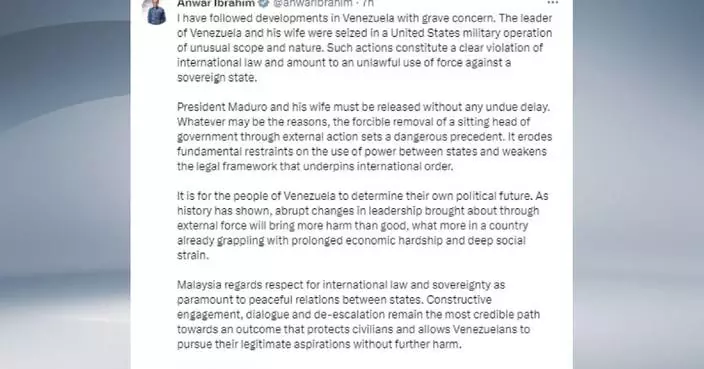
On Saturday, the United States launched a large-scale strike on Venezuela, during which Venezuelan President Nicolas Maduro and his wife were 'captured and flown out of Venezuela' according to a post by U.S. President Donald Trump on his Truth Social account.
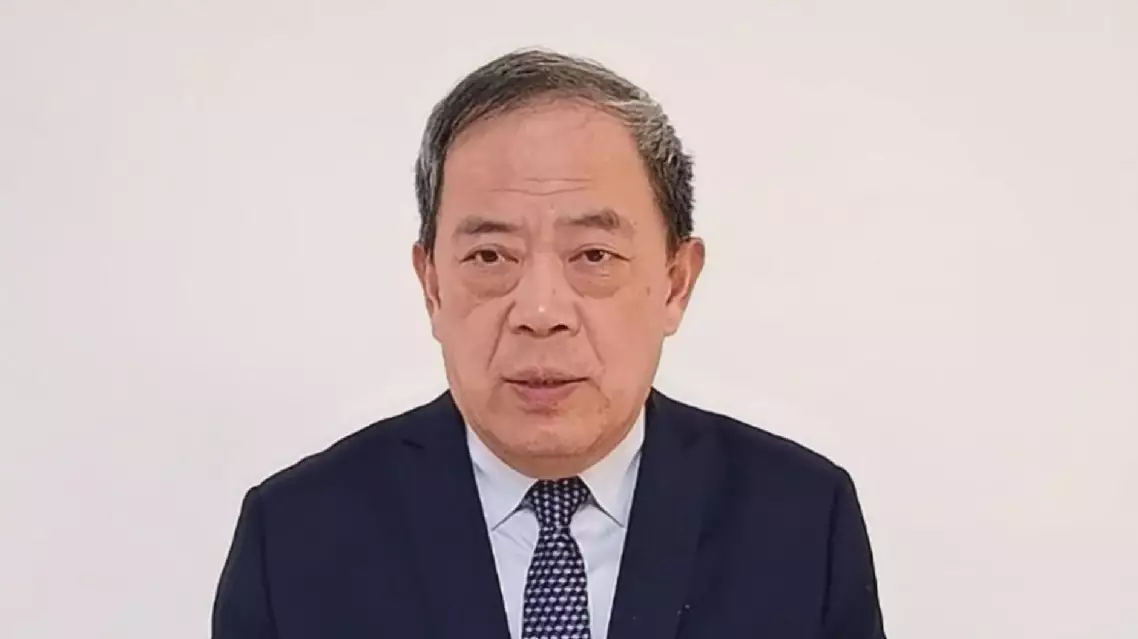
Teng Jianqun, director of the Center for Diplomatic Studies at Hunan Normal University, said in an interview with China Global Television Network (CGTN) that the aim of this operation is to take full control of Venezuela’s natural resources.
"I don't think the United States can legitimize this operation to take custody of the president of Venezuela. And also I don't think the United States can legitimize its any action in taking the oil reserves of that country. This is actually a very dangerous game played by the Trump administration. And of course, the United States would like to take full control of that country and to take full control of the natural resources, especially the large reserve of oil in Venezuela," said Teng.
Teng said Venezuela is not an isolated case but a common practice by the United States. The United States launched an invasion of Panama on Dec. 20, 1989, which continued until January 1990, with the stated objective of capturing Panamanian strongman Manuel Noriega on charges of drug trafficking and organized crime.
"We still remember the so-called sentence of the former president of Panama in the late 1980s. And this time, the president of Venezuela will be under some judicial condition (judicial proceedings) for the so-called drug trafficking and some other crimes. So I think this is not a single case for the Venezuela country, but also this is actually a practice by the United States -- to use force, to use so-called justice under law against any leaders in Latin America and the Caribbean waters," he said.
US cannot legitimize operation against Venezuela: Chinese scholar