Two Chinese naval vessels made a notable appearance at the three-day International Maritime Defense Exhibition (IMDEX) Asia 2025 which concluded at the Changi Exhibition Center in Singapore on Thursday.
The Chinese People's Liberation Army (PLA) Navy’s guided-missile frigate Xuchang (Hull 536) and the minesweeper hunter Chishui (Hull 729) joined an array of warships from around the world at the defense event, one of Asia’s most influential defense events.
The Xuchang warship, a domestically developed Type 054A missile frigate which displaces more than 4,000 tonnes at full load, is capable of both surface strike and air defense missions.
Commissioned in 2017, it has taken part in numerous key training drills and escort operations at sea.
The Chishui ship, a Type 082II minehunter, is engineered for minehunting and remote minesweeping missions. It plays a vital role in ensuring the safety of maritime routes and major ports.
During the exhibition, the Xuchang vessel hosted multiple public events, welcoming over 1,000 visitors including overseas Chinese and international guests.
The sailors designed detailed onboard tours and provided guided explanations.
"I was really amazed as it was my first time here, and the ship was much bigger than I had expected. There were so many weapons on board that I’d never seen before. I really hope I will get another chance to visit again," said one overseas Chinese visitor.
IMDEX Asia 2025 attracted participation of over 100 companies from various countries and regions, showcasing the latest achievements in maritime technologies including artificial intelligence and ship power systems.
China has participated in several consecutive editions of this event.
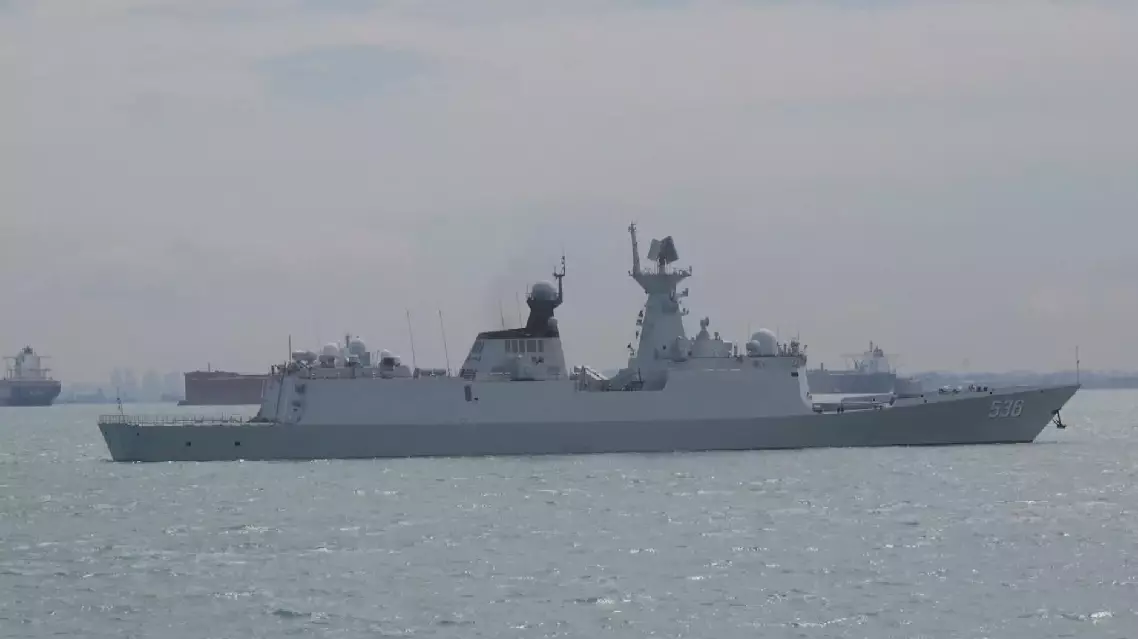
Chinese naval ships impress visitors at IMDEX Asia 2025

The three astronauts of China's recently-returned Shenzhou-20 mission on Friday shared the experiences of their dramatic 204-day space mission, including detailing the emergency procedures which were implemented to bring them safely home after their return capsule was struck by space debris.
The trio -- Chen Dong, Chen Zhongrui, and Wang Jie -- met with the press in Beijing on Friday afternoon, marking their first public appearance since returning to Earth in November.
When detailing the emergency response mechanisms which were enacted prior to their scheduled return, the astronauts explained that upon discovering a triangular crack on the spacecraft's viewport window, they immediately took photos for documentation and transmitted them to the ground team, who swiftly activated an emergency plan to get the trio home safely.
Experienced mission commander Chen Dong explained how the crew had complete faith in their colleagues on the ground to find a solution to these unforeseen circumstances which led to their return being delayed.
"First, we must trust the ground team, who would anticipate everything and develop the safest return plan for us. Second, we must believe in ourselves; as well-trained astronauts, we have the ability to manage various unexpected failures. I believe that with the collaboration of astronauts and researchers on the ground, our space home will surely go farther, more steadily, and for a longer time," he said.
Following their extended stay in space as a result of the debris incident, the Shenzhou-20 crew spent a total 204 days in orbit, setting a new record for the longest duration by a single group of Chinese astronauts.
During their mission, they completed multiple payload operations, conducted extensive scientific experiments, and carried out four extravehicular activities.
"Our crew worked together with the ground team in unity and coordination, completing four extravehicular activities, several payload entry and exit tasks, and a large number of scientific experiments. It was a fulfilling yet challenging mission. The path to exploring the heavens is long and arduous, but I firmly believe that China's space missions will succeed," said Chen Zhongrui, a former air force pilot who was making his first spaceflight during the mission.
"From the ground to space, from learning to application, I have deeply felt the solid progress of Chinese space endeavors and the quiet dedication of countless personnel behind the scenes. In the future, I will accomplish each mission with full commitment, living up to the trust of the motherland and the people," said fellow astronaut Wang Jie, who was also making his debut spaceflight.
After returning to Earth on Nov 14, the trio successfully completed their isolation recovery and rehabilitation and will now resume normal training following health assessments.
The crew's return, originally scheduled for Nov 5, was postponed due to safety concerns, with the astronauts later using the return capsule belonging to their successor crew of the Shenzhou-21 mission to get back to Earth. China later launched the unmanned Shenzhou-22 spacecraft which will serve the future return of the crew now aboard the Tiangong Space Station.
Shenzhou-20 astronauts share experiences after safely returning from debris incident