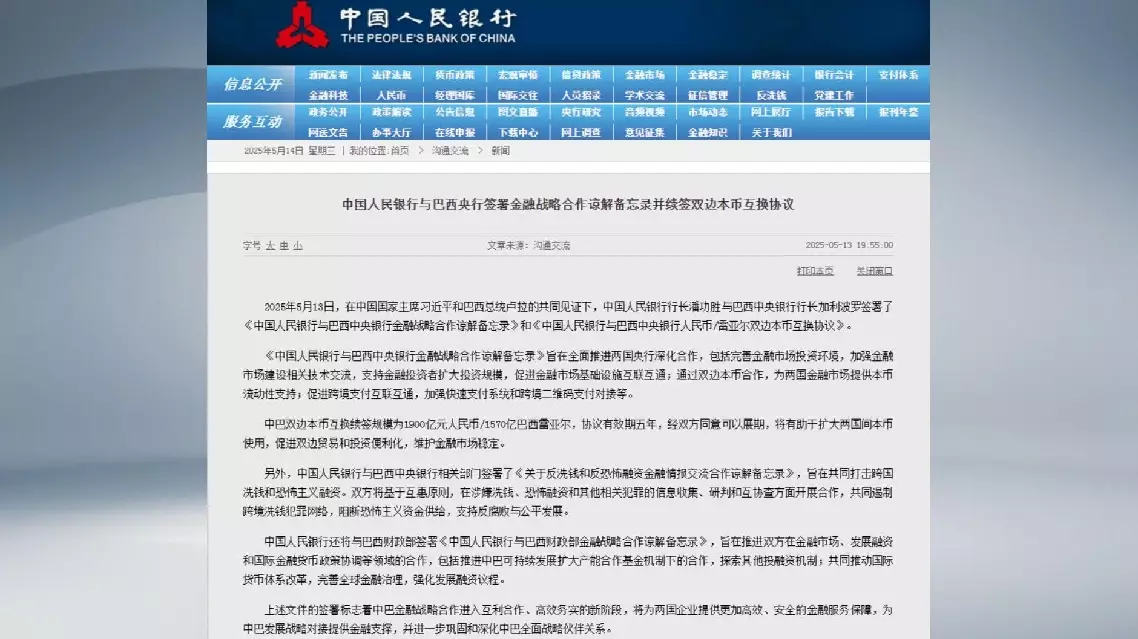
The central banks of China and Brazil on Tuesday renewed a bilateral currency swap agreement with a total value of 190 billion yuan (about 26.39 billion U.S. dollars), or 157 billion reais.
The agreement is valid for a period of five years and can be renewed upon mutual consent, according to the agreement released by the People's Bank of China (PBOC), China's central bank.
The move will help expand the use of currencies of the two countries, facilitate bilateral trade and investment, and help stabilize the financial markets.
The bilateral currency swap is a financing arrangement in which a country's central bank exchanges its own currency for another country's currency to obtain liquidity in the counterparty's currency. At maturity, the parties exchange back the principal amounts. It is generally used to maintain financial market stability.
By the end of the first quarter of 2025, PBOC had signed bilateral currency swap agreements with the central banks or monetary authorities of 42 countries and regions.
Currently, 32 such agreements remain in effect, covering major economies in key regions across six continents. The total scale of these swap agreements amounts to 4.3 trillion yuan (about 596.70 billion U.S. dollars).
China, Brazil renew currency swap agreement
With the May Day holiday coinciding with spring breaks in various regions, China's railway tourism market is heating up earlier than usual, as passenger-friendly measures are rolled out to boost cultural and tourism consumption.
"My family booked this trip for me. I'm just happy to travel with my husband," said a passenger.
In time for the May Day holiday, a new batch of branded tourist trains will be launched to cater to diverse passenger needs. China State Railway Group Co., Ltd. (China Railway) is also rolling out discount policies on tourist special trains as part of broader efforts to revitalize cultural tourism spending.
Meanwhile, accommodation along tourist train routes has begun offering coupon-based discounts.
According to data, the number of tourist trains operating nationwide in the first quarter increased by 440 compared to the same period last year. Moving forward, the integration of railway and tourism will continue to deepen.
"We plan to operate over 2,500 tourist trains this year and develop 50 premium railway tourist routes, so as to continuously energize the railway tourism market and foster new growth drivers in railway-backed consumer services," said Zhang Tao, deputy marketing director of the Passenger Transport Center of China Railway.

China rolls out passenger-friendly railway services ahead of May Day travel rush