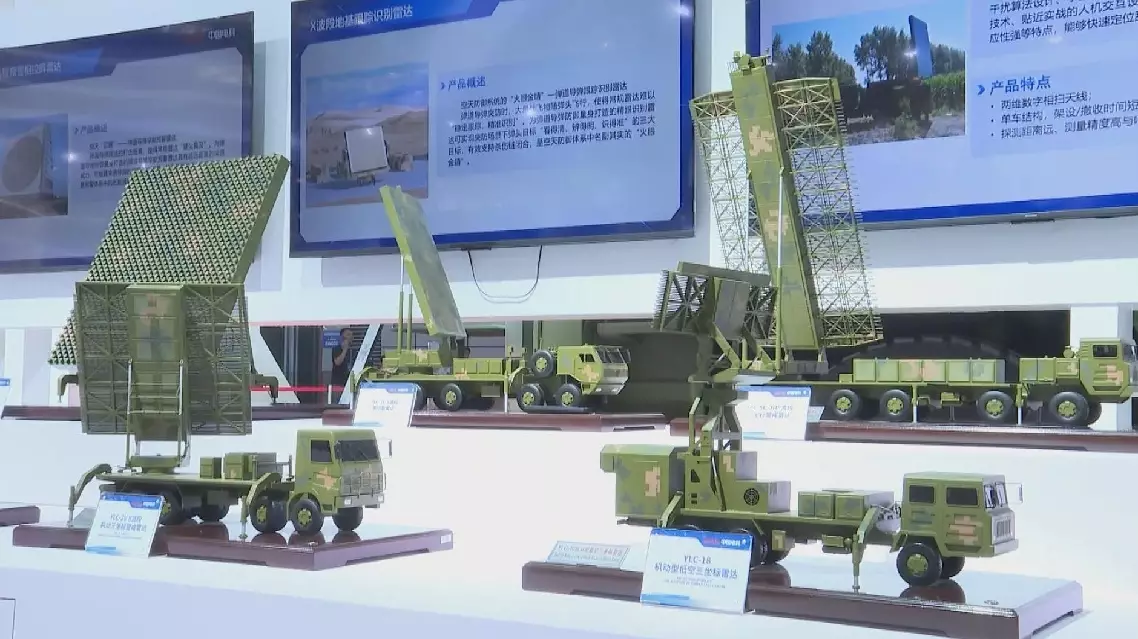
The 11th World Radar Expo opened on Saturday in Hefei City of east China's Anhui Province, showcasing some leading radar equipment and technologies from China.
At the exhibition area of the China Electronics Technology Group Corporation (CETC), a variety of radar equipment is displayed, featuring functions such as high mobility, multifunctionality, air defense and anti-missile capabilities.
"We have set up four main indoor exhibition areas of cutting-edge equipment, intelligent systems, new-domain forces, and electronic foundations, as well as a sub-exhibition area dedicated to the low-altitude economy. Together, these showcase over 400 advanced pieces of equipment and products in the electronic information sector," said Li Ji, an exhibitor and head of the Technology Department from the CETC.
In addition to military equipment, a large number of civilian equipment are also on display, offering high-precision data services for disaster warning, smart cities, and low-altitude economy.
"This is an all-in-one device for comprehensive meteorological detection, which integrates various elements such as a weather radar, a laser for wind measurement, and a millimeter-wave sensor for cloud assessment. The radar uses electromagnetic waves to measure various indicators like the speeds and directions of wind above it in real time, and it has been widely deployed across the country," said Jin Cangsong, director of the 23rd Research Institute under the Second Academy of China Aerospace Science and Industry Corporation.
The expo, held biennially since 2001, has evolved into the largest and most influential comprehensive international exhibition in the global radar field.
This year's exhibition, with an area of over 50,000 square meters, has drawn participation from more than 600 companies worldwide. The World Radar Expo will continue until Monday.
World Radar Expo in China's Hefei showcases cutting-edge technologies
As the diplomatic engagement between the United States and Iran continues despite a faltering ceasefire, a former commander of Iran's Islamic Revolutionary Guard Corps (IRGC) has said that Iran is prepared to use military power to break the U.S. maritime blockade should the negotiations collapse or run on too long.
Mohsen Rezaee, who also currently serves as a member of the Iranian Expediency Discernment Council, struck a confident tone about Iran's current trajectory in an exclusive interview with China Global Television Network (CGTN) in Tehran on Wednesday.
He said the country has withstood over two decades of crippling sanctions and continued to move forward.
"We have been under sanctions for more than 20 years. The number of sanctions likely exceeds 2,000, targeting individuals, enterprises, corporations, ships, insurance companies, and even foreign countries that interacted with us. However, we have managed to find solutions to neutralize these sanctions, and we will continue to do so moving forward," he said.
He said Iran aims to ease the sanctions burden through talks with the U.S., although at the same time, he said, Iran is ready to shift to a military response if the path to a peaceful resolution closes.
"Furthermore, we will compel the U.S. to lift these sanctions. We will force the U.S. to end the maritime blockade -- either through negotiations or, should they resist, through direct action and we will attack U.S. warships. Therefore, despite all the pressures, the future of our economy is bright and promising, while the future of the US economy is bleak," he said.
While any new war against Iran would be a dead end, the best way out for the U.S. is to continue talks, according to the senior official.
"We have prepared ourselves so that if the maritime blockade continues beyond a certain timeframe, we will launch an attack and break the blockade. The Americans have no choice but to negotiate. Continuing this war is a journey into a very dark tunnel for the United States. The more America chooses to fight, the deeper it enters a tunnel with no end. Yet for us, the path is perfectly clear. America is moving toward us in the dark, while we are monitoring their every move," he said.
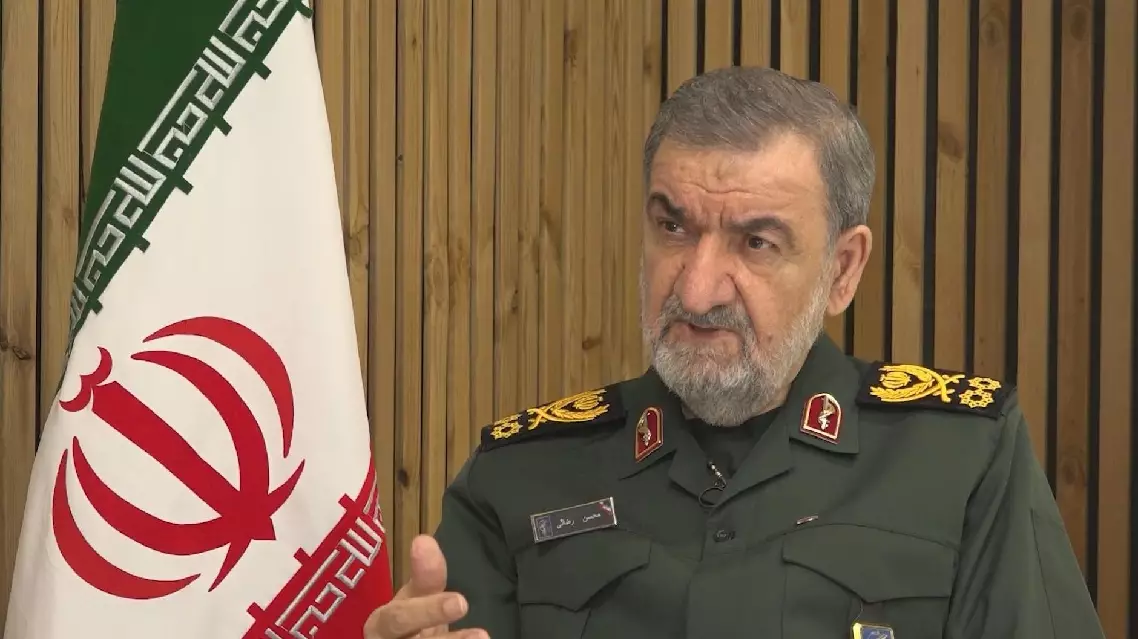
Former IRGC chief says Iran ready to break U.S. naval blockade by force if talks fail