Skip to Content Facebook Feature Image

Interactive tech transforms visitor experience at Chinese museums

China

China

China

Interactive tech transforms visitor experience at Chinese museums

2025-05-18 13:51 Last Updated At:14:07

Various Chinese museums have adopted innovative technologies and rolled out interactive programs to engage visitors ahead of the International Museum Day which falls on Sunday, blending cutting-edge digital tools with traditional cultural experiences.

In northwest China's Ningxia Hui Autonomous Region, the Xixia Imperial Tombs Museum has introduced augmented reality (AR) experiences and a crime-solving role-play game set in historical scenarios.

Located in the area of the royal mausoleums of the emperors in the Western Xia Dynasty (1038-1227), the museum features many unearthed funerary objects and the remaining cultural relics such as inscriptions, stone statues and building components.

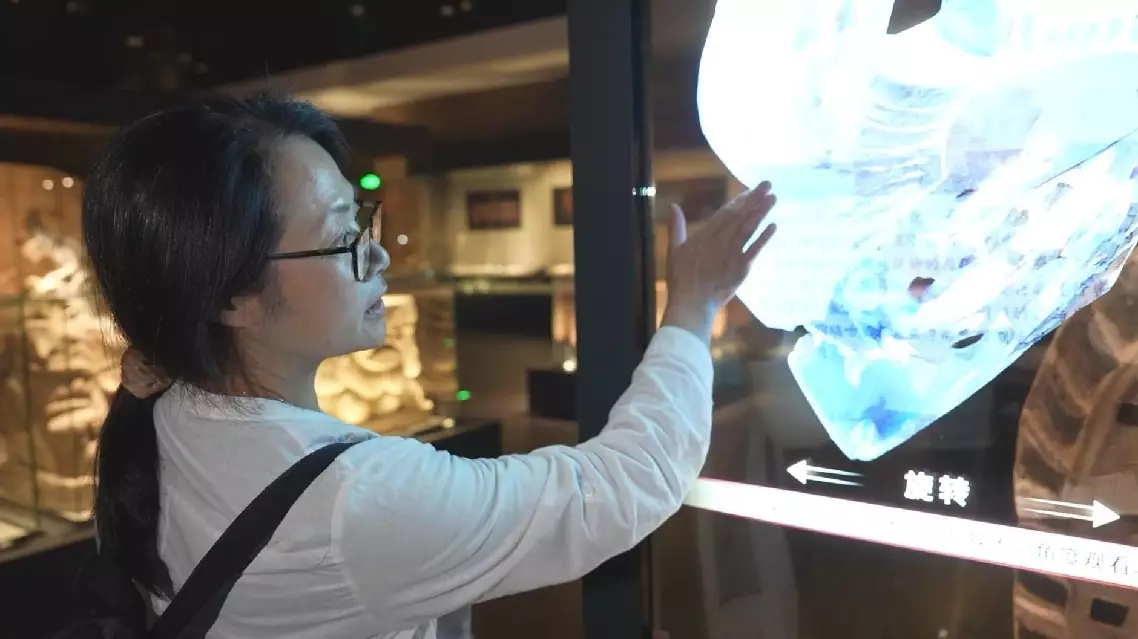
And now with a newly-installed transparent touchscreen, visitors get to explore the details of cultural relics in 720-degree examination powered by AR, while image recognition technology delivers instant exhibit details via WeChat mini-programs.

At the Bada Shanren Memorial Museum in Nanchang, capital city of east China's Jiangxi Province, visitors are trying their hands at traditional Chinese rubbing techniques - carefully pressing ink onto rice paper over stone carvings to recreate the distinctive brushstrokes of 17th-century painter Zhu Da.

The museum's concurrent painting workshops have proven particularly popular with younger visitors.

"I feel so accomplished after creating this, and it really shows the charm of Chinese ink painting," said Li Wanqi, a primary school student.

In China's southern province of Hainan, China (Hainan) Museum of the South China Sea sees an influx of visitors this week to its "Deep Blue Treasures" exhibition.

The special event features real-time updates from the ongoing excavation of two 16th-century merchant shipwrecks discovered in 2022 at a depth of 1,500 meters. For the first time, the museum has opened a visible cultural relics conservation lab where visitors can observe archaeologists restoring porcelain recovered from the sites.
Interactive tech transforms visitor experience at Chinese museums
Interactive tech transforms visitor experience at Chinese museums

Former International Olympic Committee (IOC) president Thomas Bach has hailed China's efforts to develop its winter sports industry and encourage mass participation in ice and snow activities as an enduring legacy of the 2022 Beijing Winter Olympics, an event he said has lifted winter sports to a whole new level globally.

Bach, who served as IOC president from 2013 to 2025, was speaking in an interview with the China Global Television Network (CGTN) in the German city of Munich ahead of the 2026 Milano Cortina Winter Olympics, which open on Friday.

As he looks ahead to the Games in Italy, Bach highlighted the huge success of the Beijing Winter Olympics four years ago, both as an international showcase for winter sports but also in leaving a remarkable legacy in China, where over 300 million people -- nearly a quarter of the entire population -- now engage in ice and snow sports.

"Beijing 2022 brought winter sports globally to a new level. You have now more than 350 million Chinese being familiar with winter sports. This is a new world for winter sport globally. So, in many respects, Beijing was setting an example there for new development, for a new world of winter sports. I always said there was a winter sport before Beijing 2022 and there was one -- a much better, a much bigger -- winter sport after Beijing [2022]. And we all could experience this in a very good atmosphere," he said.

Bach, who was unanimously elected as the Honorary President for Life of the IOC in March last year, also hailed how China now has a booming ice and snow economy, with Chinese people being truly passionate about winter sports.

"If you look at the number of winter sport destinations, of ice rinks, of ski lifts, which have been established, that's just amazing. It's just amazing in how the Chinese people have embraced these winter sports and these Olympics. The Chinese people are great Olympic fans -- we are very, very grateful for this -- but that they were not only Olympic fans, that they became winter sports fans. That's really something, something amazing," he said.

As for the upcoming Olympics, Bach said he is looking forward to seeing members of the Chinese team competing alongside the top athletes from around the world, and believes they can replicate their medal success at their home Games four years ago.

"[Coming] back to Beijing [2022], maybe for a moment. A major factor for making Olympic Games, be it Summer or Winter, successful, is always a successful home team, because this is creating the excitement in the country and it's creating a lot of the Olympic atmosphere. I think we can expect the same from our Chinese friends, that they will do well again in Italy. But they should be ready. Italy is the next host country, and they also will do very well. So, when I said, with Beijing we have a new level of winter sports, it means also we have a much tougher competition," said Bach.

The upcoming edition of Winter Olympics will take place from Feb 6 to 22 in the global metropolis of Milan and the Alpine mountain town of Cortina d'Ampezzo, Italy, featuring about 2,900 athletes from around the world, with a total of 116 gold medals up for grabs.

Bach hails China for lifting development of global winter sports to new level

Bach hails China for lifting development of global winter sports to new level

Recommended Articles